Marketing a robotics company online means engineering procurement-intent visibility across organic search, technical content, paid channels, account-based outreach, and AI search so engineers, integrators, and purchasing managers find and shortlist the brand throughout a long industrial buying cycle.
This guide covers the foundational definition of online marketing for a robotics firm, the strategic case for investing now, website and SEO foundations, content programs that drive demand, paid search and social channels, account-based and email outreach, backlink and PR strategy, AI search visibility, in-person and community programs, performance measurement, common mistakes, and the path to executing the work with specialist support.
We open with what makes robotics marketing different from generic B2B marketing. Decision-makers include design engineers, automation integrators, and procurement directors who research extensively before contacting a vendor.
The strategic case follows. Industrial robot installations have grown sharply, organic search dominates B2B research, and digital touchpoints now outnumber human ones in modern buying cycles.
Website and SEO foundations come next. Strong site architecture, procurement-intent keyword research, technical SEO, topical authority across robot categories, and rich-result schema all shape whether a robotics company appears in early-funnel research.
Content marketing channels expand the editorial layer. Long-form guides, application case studies, technical whitepapers, video walkthroughs, and demonstration content each move different buying-committee members closer to an RFQ.
Paid search, programmatic, LinkedIn, email, and account-based marketing add demand-generation reach. Each channel needs robotics-specific structure, landing-page patterns, and segmentation rules to convert efficiently.
Backlink building and digital PR with robotics trade publications, plus AI search optimization for LLM citation, complete the off-page program.
Trade shows, webinars, online communities, and LinkedIn thought leadership convert in-person presence into sustained online pipeline.
Measurement, common mistakes, and the implementation path round out the guide. We show how to tie marketing to pipeline, why generic targeting fails, and how Manufacturing SEO Agency executes the work end-to-end.
What Does It Mean to Market a Robotics Company Online?
Marketing a robotics company online means engineering visibility across search, technical content, paid media, and account-based outreach so engineers, integrators, and procurement teams find the brand during multi-month evaluation. The next sub-sections cover how it differs from generic B2B marketing, who the buyers are, and what behaviors shape channel choice.
How Does Online Marketing for Robotics Differ From Generic B2B Marketing?
Online marketing for robotics differs from generic B2B marketing because robotics buyers evaluate capital equipment against payload, reach, repeatability, controller compatibility, and safety standards before requesting a quote. Generic campaigns target one role with short windows; robotics targets a multi-person committee researching for months.
That friction means content must teach and de-risk, not just brand.
Who Are the Decision-Makers a Robotics Company Must Reach Online?
The decision-makers a robotics company must reach online include design engineers specifying the cell, automation integrators sourcing components, plant managers evaluating throughput, procurement directors negotiating terms, and EHS leads validating safety. Each role searches different terms, reads different formats, and trusts different sources. Engineers consume datasheets and CAD files; procurement reads vendor stability and lead-time content; integrators evaluate API documentation and interoperability. Marketing must publish content tuned to each role's intent so the brand earns shortlist consideration before a sales conversation begins. This audience map sets up the channel choices that follow.
What Buying Behaviors Shape Robotics Marketing Channels?
The buying behaviors that shape robotics marketing channels are extensive self-directed research, multi-stakeholder consensus, and long evaluation cycles dominated by technical due diligence.
Engineers and procurement teams complete most research before reaching out, then use vendor calls to confirm specifications and pricing. The implication is straightforward: search, technical content, and AI-search visibility carry the early-funnel load, while sales takes over only at the end. This research-first behavior frames every channel decision in the rest of the guide.
Why Does a Robotics Company Need a Strong Online Marketing Strategy?
A robotics company needs a strong online marketing strategy because industrial buyers research extensively online before making contact, market growth is concentrated, and weak visibility cedes early-stage shortlist position to competitors. The next sub-sections cover digital-first buyer research, pipeline risks of weak visibility, and how marketing compresses the sales cycle.
How Has Buyer Research Shifted to Digital-First in Industrial Robotics?
Buyer research in industrial robotics has shifted to digital-first as engineers and procurement leaders use search engines, vendor sites, and trade publications before any rep call.
Robotics buyers fit this pattern. They benchmark payload, reach, repeatability, and total cost of ownership across vendor sites and AI summaries before submitting an RFQ. The companies that publish detailed, structured technical content earn the consideration; those that do not get filtered out before the sales team learns of the opportunity.
What Pipeline Risks Arise From Weak Online Visibility?
The pipeline risks that arise from weak online visibility include shrinking inbound RFQ volume, longer time-to-shortlist, and dependency on outbound prospecting. When a competitor ranks for "6-axis robot for palletizing" or "collaborative robot ISO 10218 compliance," they receive the engineer's first click and the procurement team's first comparison. Weak visibility forces sales teams to chase deals already framed by competitor content.
That demand exists, but only the visible vendors capture it.
How Does Online Marketing Compress the Robotics Sales Cycle?
Online marketing compresses the robotics sales cycle by pre-answering common evaluation questions, surfacing case studies that match buyer applications, and pre-qualifying intent before the sales call. When a prospect arrives already familiar with the product line, integration documentation, and certification status, the sales conversation moves directly to specification and pricing. There are several proven mechanisms: detailed application case studies, downloadable spec sheets, video demonstrations, and CAD libraries reduce back-and-forth by days or weeks per opportunity.
How Should a Robotics Company Build Its Website for Marketing Performance?
A robotics company should build its website for marketing performance by structuring product taxonomy around buyer search intent, optimizing on-page elements for RFQ conversion, presenting specifications in machine-readable formats, and meeting mobile-first speed benchmarks. The next sub-sections detail each layer.
What Site Architecture Best Supports Robotics Product Discovery?
The site architecture that best supports robotics product discovery is a category-led taxonomy with parent product hubs, child model pages, application landing pages, and certification reference pages cross-linked through breadcrumbs and contextual internal links. Parent hubs aggregate authority for category terms such as "collaborative robots" or "SCARA robots." Child model pages own model-number queries and link upward to the hub. Application pages target use-case queries such as "palletizing robot" and link laterally to the relevant product models. This architecture lets engineers move from category research to model evaluation without leaving the site.
Which On-Page Elements Convert Engineers and Procurement Visits to RFQs?
The on-page elements that convert engineers and procurement visits to RFQs include payload-and-reach specs above the fold, downloadable datasheets and CAD files, an embedded RFQ form with model preselection, certification badges, and short application case-study links. Engineers want technical confirmation in three seconds; procurement wants stability signals. There are several conversion-critical elements: spec tables, lead-time disclosure, integrator partner lists, warranty terms, and a contact path that does not require email gating. Together these elements remove friction at the exact moment a buyer decides whether to request a quote.
How Should Robotics Companies Present Specifications, CAD Files, and Datasheets?
Robotics companies should present specifications, CAD files, and datasheets as structured, downloadable, and machine-readable assets accessible from the model page without registration walls for top-of-funnel visitors. Spec sheets belong in HTML tables with PDF mirrors. CAD files should ship in STEP, IGES, and native vendor formats so design engineers can drop them into existing assemblies. Datasheets must include payload, reach, repeatability, controller compatibility, IP rating, and safety-rated stop categories.
Which Site Speed and Mobile Benchmarks Matter for Robotics Buyers?
The site speed and mobile benchmarks that matter for robotics buyers are Google's Core Web Vitals targets and mobile-first parity requirements.
These thresholds matter because Google uses the mobile version of a site's content, crawled with the smartphone agent, for indexing and ranking. Robotics CAD downloads, video demos, and spec PDFs make hitting these thresholds harder, but lazy-loading, image optimization, and CDN delivery solve most of it. Strong site performance feeds directly into the SEO foundations covered next.
How Do You Run SEO for a Robotics Company?
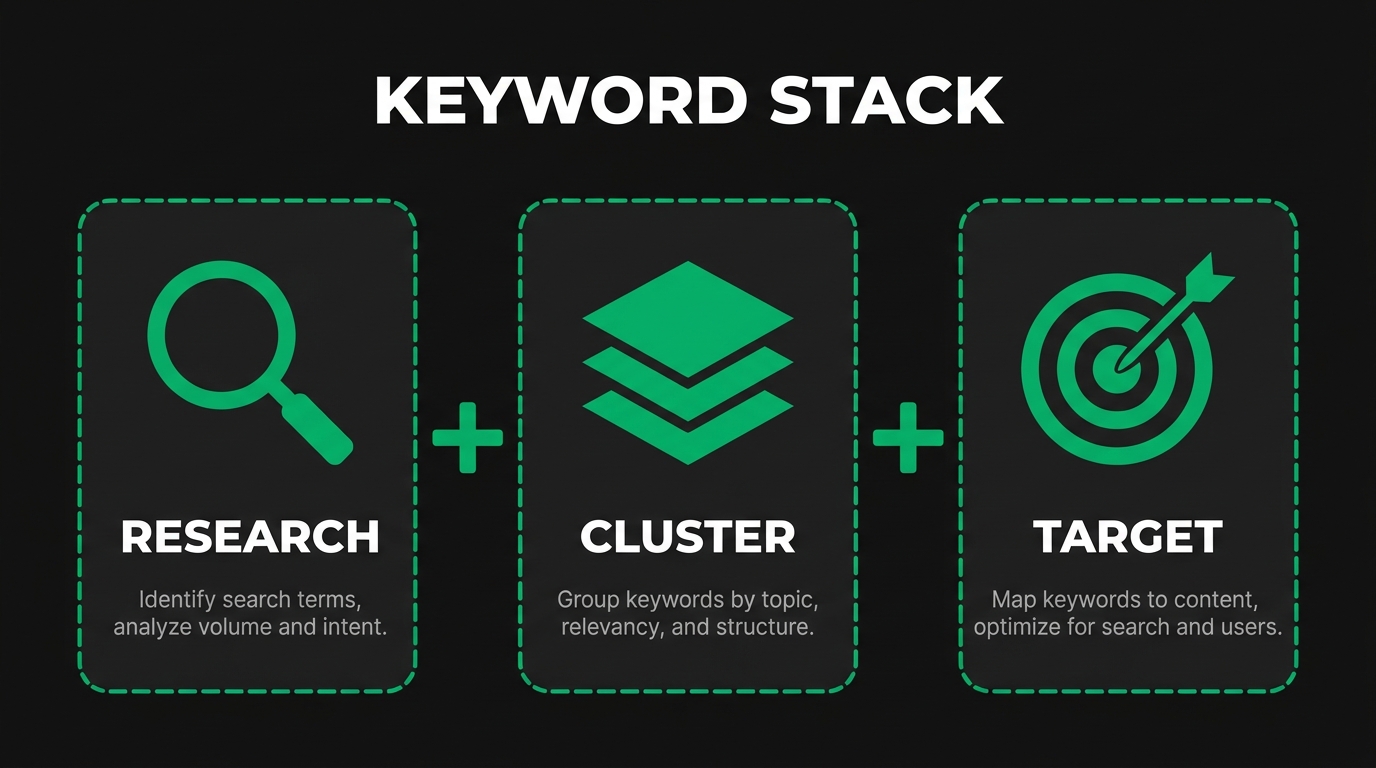
You run SEO for a robotics company by mapping procurement-intent keywords to the buyer journey, fixing technical foundations, building topical authority across robot categories, and deploying schema that earns rich results. Practical execution patterns are documented in industrial seo strategies used by manufacturing-only programs. The next sub-sections cover each layer.
How Do You Conduct Procurement-Intent Keyword Research for Robotics?
Procurement-intent keyword research for robotics is the practice of mapping queries to the procurement funnel using process names, payload classes, application verbs, and certification combinations rather than generic head terms. There are several intent layers: discovery (e.g., "robotic palletizing systems"), evaluation ("FANUC vs Yaskawa for spot welding"), specification ("6-axis robot 50kg payload IP67"), and supplier-vetting ("ISO 9001 robotics manufacturer"). The deeper companion guide how to implement seo for robotics details the full keyword architecture.
That distribution favors specification-grade phrases over vanity terms.
Which Technical SEO Foundations Do Robotics Sites Require?
The technical SEO foundations robotics sites require include a clean crawl path, canonical hygiene across model-variant URLs, XML sitemaps segmented by content type, hreflang tags for international product lines, and structured data for products and FAQs. Robotics catalogs often duplicate model pages for color, controller, or region; without proper canonicalization, that duplication splits ranking authority. Crawl budget matters when product trees grow into the thousands of pages. There are several diagnostic priorities: log-file analysis, Index Coverage reports in Search Console, and Core Web Vitals monitoring. These foundations let editorial and product content rank to its potential.
How Do You Build Topical Authority Across Robot Categories and Applications?
You build topical authority across robot categories and applications by publishing complete coverage of every category, application, integration, and certification a buyer searches for. The cluster includes category hubs (collaborative, SCARA, six-axis, AGV, AMR), application pages (palletizing, welding, machine tending, pick-and-place), integration content (PLC, vision, end-of-arm tooling), and certification references.
Comprehensive standards coverage signals expertise to both engineers and Google.
Which Schema Types Help Robotics Pages Win Rich Results?
The schema types that help robotics pages win rich results include Product, ProductModel, Offer, FAQPage, Organization, and BreadcrumbList.
For model pages, ProductModel paired with manufacturer, mpn, and gtin properties helps search engines associate spec sheets with the brand. FAQPage schema captures application questions; Organization schema with sameAs Wikipedia, LinkedIn, and Wikidata anchors entity recognition. Strong schema is the gateway to richer SERP placement, which leads into the content channels that fill the funnel.
What Content Marketing Channels Drive Robotics Company Demand?
The content marketing channels that drive robotics company demand are long-form technical guides, application case studies, whitepapers, and demonstration video, as detailed in the content marketing guide for manufacturers. Each format reaches a different buying-committee role, covered in the sub-sections.
Which Long-Form Content Formats Educate Robotics Buyers Best?
The long-form content formats that educate robotics buyers best are pillar guides, comparison articles, integration tutorials, and total-cost-of-ownership analyses. Engineers want depth; procurement wants ROI math; integrators want compatibility.
For robotics that means a well-written guide on cycle-time optimization can pull a buyer into a brand they had never heard of, then convert them across the rest of the funnel.
How Do You Use Application Case Studies to Generate Robotics Demand?
You use application case studies to generate robotics demand by documenting real customer deployments with payload data, cycle-time results, ROI calculations, and engineer testimonials. Each case study targets a specific application keyword such as "automated palletizing case study" and links to the matching product page. The case study should include the customer's industry, the problem statement, the robot model deployed, the integration partner, the measurable outcome, and a downloadable summary. Cross-link case studies into product pages and application landing pages so buyers find proof at the moment of evaluation. This pattern compounds as the case-study library grows.
Why Do Whitepapers and Technical Guides Drive Robotics RFQs?
Whitepapers and technical guides drive robotics RFQs because they let engineers complete deep technical evaluation without contacting sales, then convert when the buyer needs a quote. Strong whitepapers cover topics like end-of-arm tooling selection, robot-cell layout, cycle-time math, and safety-system design. Each asset earns backlinks from trade publications and university curricula, builds organic visibility, and pre-qualifies leads.
How Should Video and Demonstration Content Fit a Robotics Marketing Plan?
Video and demonstration content should fit a robotics marketing plan as the primary proof asset for product capability, integration speed, and customer outcomes.
For robotics there are several proven formats: 60-second product demos, three-minute application walkthroughs, full integration timelapses, and customer interviews. Embed videos on product and case-study pages, host on YouTube for SEO reach, and use clips in LinkedIn ads. Video moves prospects toward demand-generation channels covered next.
How Do You Use Paid Search and Programmatic for Robotics Lead Generation?
You use paid search and programmatic for robotics lead generation by structuring campaigns around procurement-intent terms, allocating budget across search, display, and LinkedIn, and converting traffic on application-specific landing pages. The next sub-sections cover campaign structure, budget allocation, landing patterns, and cost measurement.
Which Paid Search Campaign Structures Work for Robotics Keywords?
The paid search campaign structures that work for robotics keywords are tightly themed ad groups built around process plus payload plus application combinations such as "6-axis welding robot," with separate campaigns for category, model, application, and competitor terms.
Single-keyword ad groups (SKAGs) keep quality scores high on niche industrial terms. Negative keyword lists exclude consumer robotics, hobby kits, and toy queries that bleed budget. Use exact-match for high-intent terms and phrase-match for discovery. Bid higher on application keywords where buyer intent is specific, lower on broad category terms where research intent dominates.
How Should You Allocate Budget Between Search, Display, and LinkedIn?
You should allocate budget between search, display, and LinkedIn by weighting heaviest toward search for in-market intent capture, LinkedIn for account-based targeting, and display for retargeting and reach. A common starting split is roughly 50% search, 35% LinkedIn, and 15% display. Search captures buyers actively researching; LinkedIn reaches engineers and procurement by job title at companies that match the ICP; display retargets site visitors who left without converting. Adjust based on funnel data: higher-funnel campaigns benefit from LinkedIn weight, late-funnel benefits from search-budget concentration.
What Landing Page Patterns Convert Robotics Paid Traffic?
The landing page patterns that convert robotics paid traffic are application-specific pages with a single offer, payload-and-spec confirmation above the fold, an embedded ROI calculator or downloadable specification sheet, and a short RFQ form. Avoid sending paid traffic to the homepage. Each ad should match-message a dedicated landing page that mirrors the search query language. Include trust signals such as customer logos, certification badges, and recent case-study links. Test long versus short forms, gated versus ungated assets, and CTA copy variants on a quarterly cadence to compound conversion gains.
How Do You Measure Cost Per RFQ in Robotics Paid Campaigns?
You measure cost per RFQ in robotics paid campaigns by tracking every form submission and phone call back to the originating campaign, ad group, and keyword through CRM-integrated conversion tracking. The standard formula is total paid spend divided by total qualified RFQs in the same period.
Tag form submissions with source parameters, sync them into HubSpot or Salesforce, and report cost per RFQ alongside cost per closed deal monthly. This measurement framework feeds the email and ABM channels covered next.
How Should a Robotics Company Approach Email and Account-Based Marketing?
A robotics company should approach email and account-based marketing by segmenting target accounts, sequencing role-specific email tracks, integrating marketing automation with the CRM, and personalizing messaging by application. The next sub-sections detail each layer.
How Do You Segment Robotics Buyers for Account-Based Outreach?
You segment robotics buyers for account-based outreach by combining firmographic data, technographic signals, and behavioral intent into named-account tiers. Tier-1 accounts match ideal customer profile criteria such as facility count, automation budget, and target SIC codes. Tier-2 accounts share profile characteristics but lack confirmed intent. Tier-3 covers expansion and adjacent industries. Within each account, build contact lists across the buying committee: design engineering, automation, manufacturing operations, procurement, and EHS. Pair the segmentation with intent data to prioritize the accounts already researching robotics this quarter.
Which Email Sequences Move Robotics Leads Toward an RFQ?
The email sequences that move robotics leads toward an RFQ are role-tailored nurture tracks that deliver application case studies, technical comparisons, ROI calculators, and finally a personalized RFQ invitation.
A typical sequence runs five to seven touches across three to four weeks. Engineering tracks emphasize datasheets and integration content; procurement tracks emphasize lead times, warranty terms, and TCO analyses. Trigger handoff to sales when a contact opens three messages or downloads a spec sheet.
How Should You Combine Marketing Automation With CRM for Robotics Pipelines?
You should combine marketing automation with the CRM for robotics pipelines by syncing every form fill, page view, email open, and asset download into the contact record so sales sees a complete activity timeline. The standard stack pairs HubSpot, Marketo, or Pardot with Salesforce, Dynamics, or HubSpot CRM. Automation handles lead scoring, nurture cadence, and SLA-driven sales handoff; the CRM owns deal stage, RFQ value, and pipeline reporting. Integrate the calendar booking tool, the chat widget, and the inbound RFQ form into the same contact object so attribution stays clean across long industrial sales cycles.
What Personalization Patterns Improve Robotics ABM Response Rates?
The personalization patterns that improve robotics ABM response rates are application-specific case studies sent to matching SIC code accounts, named-account landing pages with the prospect's logo, role-customized video introductions, and direct-mail tied to digital sequencing.
There are several proven personalization layers: industry, application, plant size, current automation maturity, and recent news triggers such as facility expansion or executive hires. Pair these signals with email and LinkedIn ads to set up the backlink and PR work covered next.
How Do You Build Backlinks and Press Coverage for a Robotics Brand?
You build backlinks and press coverage for a robotics brand by earning editorial placements in trade publications, contributing to industry associations, sponsoring standards content, and running digital PR around product launches. The next sub-sections cover each tactic.
Which Trade Publications Drive the Most Authority for Robotics Companies?
The trade publications that drive the most authority for robotics companies include Robotics 24/7, The Robot Report, Automation World, Control Engineering, Manufacturing Engineering, IEEE Spectrum, ASSEMBLY Magazine, and Modern Materials Handling. Each publication serves a slightly different reader: integrators, design engineers, plant managers, or research engineers. Coverage in these outlets earns both referral traffic and high-authority backlinks that compound organic ranking. There are several proven outreach paths: HARO-style queries, contributed bylines, product-launch press releases distributed via PR Newswire, and analyst briefings around new model introductions. Aim for two to four placements per quarter.
How Do You Earn Editorial Coverage From Robotics and Automation Media?
You earn editorial coverage from robotics and automation media by pitching newsworthy product launches, original research, customer case studies with measurable outcomes, and expert commentary on industry trends. Editors prioritize stories with concrete data, named customers, and clear technical substance over generic announcements. Build relationships with three to five priority editors per outlet, supply embargo-friendly assets, and respond to media queries within an hour. A consistent flow of placement-quality content makes the brand a default source when reporters cover robotics topics.
How Do Industry Associations and Standards Bodies Strengthen a Robotics Brand?
Industry associations and standards bodies strengthen a robotics brand by anchoring the company within trusted reference networks, supplying high-authority backlinks, and creating speaking and committee opportunities. Active membership in A3 (Association for Advancing Automation), RIA, IFR, NEMA, and standards committees such as ANSI R15.06 and ISO TC 299 places the brand in front of engineers and integrators.
How Should You Run Digital PR for Robotics Product Launches?
You should run digital PR for robotics product launches by coordinating embargoed briefings, simultaneous press release distribution, customer-quote inclusion, and tier-2 amplification across LinkedIn, YouTube, and trade publication newsletters. Each launch needs a single landing page with the press kit, high-resolution images, video b-roll, spec sheet, and executive bios. Follow up with one-on-one analyst briefings for IDC, ABI, Interact Analysis, and Gartner. The launch playbook compounds: every product release adds backlinks, video views, and analyst coverage that feeds the AI-search visibility work covered next.
How Do You Optimize Robotics Marketing for AI Search and LLM Citations?
You optimize robotics marketing for AI search and LLM citations by strengthening entity signals, structuring content for extractive answers, deploying schema for AI discoverability, and tracking brand mentions across AI tools. The next sub-sections detail each layer.
What Entity Signals Help LLMs Cite a Robotics Company?
The entity signals that help LLMs cite a robotics company are consistent name, address, and product nomenclature across the web; Wikipedia or Wikidata presence; sameAs links between LinkedIn, Crunchbase, and the brand site; coverage in trusted publications; and Organization schema with verified properties.
LLMs follow similar grounding patterns. The stronger the entity graph, the more likely the brand surfaces in ChatGPT, Perplexity, Gemini, and Google AI Overview answers.
How Should You Structure Robotics Content for AI-Generated Answers?
You should structure robotics content for AI-generated answers by leading every section with a direct answer in subject-predicate-object form, supporting it with concrete data, and using descriptive headings that match buyer questions. AI summary engines extract well-formed factual claims; vague marketing prose gets skipped.
Multiple-source citation favors brands with broad topical coverage and clean factual writing. Use lists for processes, tables for comparisons, and short answer blocks at the top of each H2.
Which Schema and Structured Data Improve AI Discoverability?
The schema and structured data that improve AI discoverability are Organization, Product, ProductModel, FAQPage, HowTo, BreadcrumbList, and Article paired with sameAs entity references.
For robotics, ProductModel paired with manufacturer, mpn, gtin, and offers gives AI engines a clean factual surface to cite. FAQPage on application pages exposes the question-answer pairs LLMs prefer to extract.
How Do You Track Robotics Brand Mentions Across AI Search Tools?
You track robotics brand mentions across AI search tools by running scheduled query sets through ChatGPT, Perplexity, Gemini, and Google AI Overview, capturing the response, the cited sources, and the sentiment. Use brand-monitoring platforms that index AI responses or build a lightweight cron job that logs answers weekly.
As AI-search share grows, citation share becomes the key visibility KPI. Pair this measurement with the in-person and community programs covered next.
How Do You Use Trade Shows, Webinars, and Community Marketing for Robotics?
You use trade shows, webinars, and community marketing for robotics by treating in-person presence as a content engine that feeds online pipeline. The next sub-sections cover trade-show conversion, webinar planning, online communities, and LinkedIn thought leadership.
How Do You Convert Trade Show Presence Into Online Pipeline?
You convert trade show presence into online pipeline by capturing booth visitor contact data with badge scanners, sequencing follow-up email and ABM campaigns within 24 to 48 hours, and producing post-event content from booth demonstrations.
Tag every scanned lead with show, booth interaction, and product interest in the CRM, then route into a show-specific nurture track. Live booth demos become product-page video; customer conversations become testimonial assets; competitor intelligence informs paid search bid strategy.
How Should Robotics Companies Plan Webinars for Engineers and Buyers?
Robotics companies should plan webinars for engineers and buyers by building monthly technical sessions on application topics, pairing the live event with downloadable assets, and recording on-demand replays for ongoing lead capture. There are several proven formats: application deep-dives, integration tutorials, customer panels, and standards-update briefings.
Promote each webinar through email, LinkedIn, partner co-marketing, and paid retargeting to fill the registration funnel.
Which Online Communities Influence Robotics Procurement?
The online communities that influence robotics procurement include the Robotics subreddit, ControlsTech and PLCTalk forums, the IEEE Robotics & Automation Society community, LinkedIn groups for automation engineers, Discord servers for ROS developers, and trade-association member portals at A3 and ARM Institute. Active brand presence in these communities means engineering staff answering technical questions under real names, not gated marketing content drops. Authentic participation builds expert reputation that paid promotion cannot. Track community activity as a top-of-funnel demand signal.
How Do You Use LinkedIn Thought Leadership in Robotics Marketing?
You use LinkedIn thought leadership in robotics marketing by publishing executive and engineering perspectives on trends, application breakthroughs, and standards developments, then amplifying through employee networks and paid sponsored content. Post original commentary, original data, and customer stories rather than press-release rewrites.
Pair organic posts with LinkedIn document ads and event ads to reach the procurement and engineering decision-makers who matter most. This community work feeds the measurement framework covered next.
How Do You Measure Marketing Performance for a Robotics Company?
You measure marketing performance for a robotics company by defining pipeline-tied KPIs, setting up multi-touch attribution, reporting at an OEM-aligned cadence, and benchmarking against named competitors, as framed in manufacturing seo for market share. The sub-sections cover each layer.
Which KPIs Tie Robotics Marketing to Pipeline and Revenue?
The KPIs that tie robotics marketing to pipeline and revenue are inbound RFQ volume, RFQ-to-quote conversion rate, quote-to-close conversion rate, average deal size, marketing-sourced pipeline value, marketing-influenced pipeline value, and customer acquisition cost. There are several second-tier KPIs that matter: organic visibility for top-priority procurement-intent terms, branded-search volume growth, AI-citation share, and tier-1 backlink count. Each KPI should map to a specific channel investment so marketing leaders can defend or adjust budget per channel monthly.
How Do You Set Up Attribution Across Long Robotics Sales Cycles?
You set up attribution across long robotics sales cycles by deploying multi-touch tracking that follows a contact from the first anonymous web visit through every email, ad, content download, sales call, and quote, all stitched together in the CRM.
With deal cycles often running six to twelve months, single-touch attribution loses signal. Use position-based or weighted multi-touch models, integrate with offline events, and validate quarterly against closed revenue.
What Reporting Cadence Works for Robotics OEM Marketing Teams?
The reporting cadence that works for robotics OEM marketing teams is weekly operational metrics, monthly pipeline reviews, quarterly board-level reporting, and annual strategy resets. Weekly views cover paid spend, lead volume, and SEO ranking changes. Monthly reviews tie inbound RFQs to revenue and identify channel reallocation needs. Quarterly reports show pipeline-influenced revenue, share-of-voice trends, and competitive shifts. Annual resets adjust topical authority priorities, channel mix, and budget. Aligning the cadence to the company's manufacturing planning cycle keeps marketing accountable to revenue, not just activity.
How Do You Benchmark Performance Against Robotics Competitors?
You benchmark performance against robotics competitors by tracking organic share-of-voice across priority keyword sets, monitoring competitor backlink acquisition, mapping their content publishing cadence, and comparing branded-search trend lines. There are several proven benchmark dimensions: keyword overlap, content gap analysis, top-page traffic estimates, paid-ad share, and review counts on G2 or Capterra equivalents. Use Ahrefs, Semrush, or Similarweb for the data layer.
Quarterly competitive reviews surface where the brand is winning or losing, which sets up the common-mistake patterns covered next.
What Common Online Marketing Mistakes Do Robotics Companies Make?
The common online marketing mistakes robotics companies make are generic brand messaging, underinvesting in technical content, misaligning marketing with procurement behavior, and ignoring compliance and export-control rules. The next sub-sections cover each mistake.
Why Does Generic Brand Messaging Fail Robotics Buyers?
Generic brand messaging fails robotics buyers because engineers and procurement teams need exact specifications, not abstract value claims. A homepage that talks about "transformative automation solutions" without naming payload classes, controller types, applications, or industries forces visitors to leave and find a vendor whose site speaks technical reality. Buyers searching for "30kg payload SCARA pharmaceutical packaging" want to see those exact attributes confirmed within seconds. Vertical-specific pages for adjacent markets such as automotive and robotics manufacturing seo outperform generic capability pages because they match the way procurement teams actually scope vendors. Generic copy ranks for nothing, converts nothing, and signals low domain expertise.
How Does Underinvesting in Technical Content Hurt Robotics Pipeline?
Underinvesting in technical content hurts robotics pipeline by ceding category authority to competitors who publish complete category, application, and integration coverage.
Thin content libraries leave the brand absent from the long-tail searches that dominate procurement research. The result is fewer organic RFQs, weaker AI citations, and rising paid-search dependency. Investing in deep technical content compounds for years; underinvesting compounds in the wrong direction.
Why Do Robotics Sites Misalign Marketing With Procurement Behavior?
Robotics sites misalign marketing with procurement behavior when content targets generic head terms, gates every datasheet, lacks RFQ paths on application pages, and treats every visitor as a marketing-qualified lead. Procurement reads pricing pages, lead-time disclosures, and warranty terms before scheduling a call. Engineers read CAD files and integration docs before pinging vendors. When the site forces a form before sharing technical detail, both buyers leave for a competitor with open documentation. Align the content map to the procurement journey, not the marketing funnel.
What Compliance and Export-Control Mistakes Threaten Robotics Marketing?
The compliance and export-control mistakes that threaten robotics marketing include publishing dual-use technical specifications without ECCN review, posting export-controlled CAD files publicly, and running paid ads in restricted geographies.
Coordinate with legal before publishing technical content, gate export-controlled assets, and exclude restricted countries from paid campaigns. Avoiding these mistakes sets up the partner-led execution path covered next.
How Should You Approach Robotics Marketing With Manufacturing SEO Agency?
You should approach robotics marketing with manufacturing seo agency as a procurement-intent program that combines technical content, topical authority, technical SEO, and PR-grade link building under one industrial-only specialist. The next sub-sections cover how Manufacturing SEO Agency helps and what the article covered.
Can Manufacturing SEO Agency Help With Robotics Topical Authority and Procurement-Intent Marketing?
Manufacturing SEO Agency can help with robotics topical authority and procurement-intent marketing through manufacturing-only services that map keyword clusters to the procurement journey, build topical coverage across robot categories and certifications, and deliver editorial-grade content through dedicated manufacturing content marketing services. Manufacturing SEO Agency ranks industrial brands for the exact process names, payload classes, and certification language procurement teams type into Google. Services span audits, keyword architecture, topical authority buildout, PR-grade link building, AI search visibility, technical SEO, and revenue-tied reporting.
What Are the Key Takeaways About Marketing a Robotics Company Online We Covered?
The key takeaways about marketing a robotics company online are direct. Online marketing for robotics is a procurement-intent discipline that serves engineers, integrators, and procurement leaders across long buying cycles dominated by self-directed digital research. Strong programs combine a category-led website, procurement-intent SEO, technical content, paid search and LinkedIn, email and ABM, trade-publication backlinks, AI-search visibility, and disciplined trade-show conversion. Measurement ties every channel to inbound RFQs and closed revenue. Avoiding generic messaging, content underinvestment, procurement-misaligned funnels, and export-control oversights protects the program. Pair the playbook with specialist execution to compound results over the multi-quarter window industrial buyers actually require.