SEO for robotics is the practice of optimizing a robotics manufacturer's website, content, and technical infrastructure so engineers, procurement managers, and integrators discover its products through organic search. We treat it as procurement-intent search engineering, not generic content marketing.
This guide covers the foundational definitions of robotics SEO, the strategic case for investing in it, keyword research and technical foundations, topical authority and product-page optimization, backlink building and AI search visibility, performance measurement, common mistakes, and the path to executing the strategy with specialist support.
We start by defining how robotics SEO differs from generic B2B SEO and why procurement intent shapes every decision. Buyer behavior in industrial robotics rewards exact-match process names, payload specifications, and certification language.
The strategic case for robotics SEO follows. Industrial robot installations have grown rapidly worldwide, organic search dominates B2B research, and ranking position drives RFQ volume.
Keyword research and technical SEO foundations come next. We map procurement-funnel keyword categories, long-tail application searches, URL structure, schema markup, site speed for heavy CAD downloads, and crawlability fixes that protect indexation.
Topical authority and on-page optimization round out the editorial layer. We cover topical clusters across robot categories, specification documentation, application content, certifications, RFQ-converting page elements, internal linking, and product description writing.
Off-page strategy spans backlinks from robotics trade media, industry associations, and digital PR, plus AI search optimization for LLM citations and entity grounding.
Measurement, common mistakes, and the implementation path complete the guide. We show how SEO performance ties to pipeline, why generic targeting fails, and how Manufacturing SEO Agency executes the work end-to-end.
What Is SEO for Robotics Manufacturers?
SEO for robotics manufacturers is the discipline of optimizing a robotics company's website, content, and technical infrastructure so engineers, integrators, and procurement teams find its products through organic search. The next sections cover how robotics SEO differs from generic B2B SEO, why procurement intent shapes the strategy, and what search behaviors define robotics buyers.
How Does Robotics SEO Differ From Generic B2B SEO?
Robotics SEO differs from generic B2B SEO by anchoring every page to procurement-grade entities such as payload, reach, repeatability, end-effector type, and certification class. Generic B2B SEO targets broad industry terms; robotics SEO targets exact-match process and specification queries that engineers use to qualify suppliers. To understand the broader manufacturing context, see our overview of what is industrial seo, which explains how industrial-only SEO frameworks apply across manufacturing verticals. The economic stakes are large because the global industrial manufacturing industry sits at a US$16 trillion historic inflection point, with AI and other advanced technologies accelerating growth opportunities, according to PwC. Robotics SEO must therefore feed both classical SERPs and emerging AI search interfaces.
Why Does Procurement Intent Drive Robotics SEO Strategy?
Procurement intent drives robotics SEO strategy because the buyers controlling spend are engineers, plant managers, and supply chain directors who type process names, payload classes, and ISO standards into Google to qualify suppliers. Their queries reflect a defined RFQ funnel, not curiosity. B2B buyers go through an average of 27 touchpoints before a purchase decision, according to Gartner, so each touchpoint must reinforce technical fit. Procurement-intent SEO ranks brands for the queries that precede an RFQ, not vanity terms that attract analysts. The expert principle is simple: rank for the keywords that gate purchase orders, not the ones that drive newsletter sign-ups.
What Search Behaviors Define Robotics Buyers and Engineers?
Search behaviors of robotics buyers and engineers fall into four patterns: specification queries, application queries, certification queries, and comparison queries. Specification searches name payload, reach, axes, and protection class. Application searches pair the robot category with an industry verb such as palletizing, welding, or pick-and-place. Certification searches name ISO 10218, ANSI/RIA R15.06, or industry-specific compliance gates. Comparison searches stack two named platforms or vendors. Forrester reports that the number of self-directed buying interactions in B2B is greater than the number of human interactions, at 15 versus 12 respectively, which means robotics websites must answer these query types autonomously before sales engages. This sets up the case for SEO investment.
Why Is SEO Critical for Robotics Companies in Industrial Markets?
SEO is critical for robotics companies in industrial markets because organic search captures procurement-stage demand, ranking position determines RFQ volume, and high-intent organic traffic converts at higher rates than paid alternatives. The next sections examine search demand growth, the buying decisions that begin in organic search, and the influence of SEO on RFQs and pipeline value.
How Has Robotics Industry Search Demand Grown?
Robotics industry search demand has grown in step with industrial robot deployments and workforce expansion. The Bureau of Labor Statistics reports that there are 14,600 robotics technicians employed in the United States, working in virtually every manufacturing industry. Each technician, integrator, and engineer represents a recurring searcher for robot models, replacement parts, certification updates, and application guidance. Search demand also expands with installed base, because operators continually research integration, programming, and safety topics. The expert read: search volume is a lagging indicator of installed base, so robotics SEO investment compounds as the fleet grows.
What Buying Decisions Begin With Organic Search in Robotics?
Buying decisions that begin with organic search in robotics include vendor shortlisting, specification verification, certification confirmation, integrator selection, and replacement-part sourcing. Each decision starts with a specific query and ends on a vendor page that either earns the click or loses the lead. The number-one organic search result in Google has an average click-through rate of 27.6%, while a featured snippet that takes the place of the number-one position has an average CTR of 42.9%, according to Backlinko. Robotics brands that hold position one for procurement queries capture roughly four times the click volume of brands at position five. The expert opinion: every position you cede on a procurement query is RFQ revenue handed to a competitor.
How Does SEO Influence RFQs and Pipeline Value for Robotics OEMs?
SEO influences RFQs and pipeline value for robotics OEMs by routing high-intent procurement traffic to RFQ-ready landing pages, which compresses sales cycles and lifts close rates. The top 3 organic search results receive more than two-thirds (68.7%) of all clicks on the Google Search page, and the number-one organic result is 10x more likely to receive a click compared to a page in the number-ten spot, according to Search Engine Journal. For a robotics OEM, that means the difference between page-one and page-two rankings can be a 10x swing in monthly RFQ volume. SEO is therefore not a marketing line item; it is a pipeline-generation channel. This sets up the keyword research discipline next.
How Should Robotics Manufacturers Conduct Keyword Research?
Robotics manufacturers should conduct keyword research by mapping every robot category, application, certification, and procurement-stage query into structured clusters, then validating volume and intent with industry-grade tools. The next sections cover the core keyword categories, funnel mapping, the right tools, and long-tail discovery for industrial robotics.
What Are the Core Keyword Categories for Robotics SEO?
The core keyword categories for robotics SEO are robot category terms, payload and reach specifications, application terms, end-effector terms, certification terms, and integrator and service terms. Each category corresponds to a different procurement question and warrants its own page cluster. For a deeper foundational primer on how manufacturing keyword categories are defined, see our guide to industrial keywords? ultimate guide, which sets the framework for procurement-intent term selection across manufacturing verticals. Robotics manufacturers who skip category mapping end up with overlapping pages cannibalizing each other for the same query. The expert position: clean category architecture is non-negotiable before any content is written.
How Do You Map Keywords to the Robotics Procurement Funnel?
You map keywords to the robotics procurement funnel by tagging every term with one of three intent stages: research, evaluation, or RFQ. Research-stage queries name a problem ("automated palletizing solutions"). Evaluation-stage queries compare named platforms or specifications. RFQ-stage queries combine model number, payload, and a buying verb such as "buy" or "quote." For practical templates and step-by-step instructions, see how to find competitor keywords, which shows the methodology for reverse-engineering the keyword footprint of competing robotics suppliers and mapping it to your own funnel. Mapping discipline determines which content earns RFQs versus which earns only impressions.
Which Tools Help Identify Robotics-Specific Search Demand?
The tools that help identify robotics-specific search demand fall into three categories: keyword databases, competitor research platforms, and SERP analysis suites. Keyword databases surface volume, difficulty, and click data. Competitor platforms reveal which robotics queries rivals already rank for. SERP suites show featured snippet, video, and PAA opportunities. For a vendor-by-vendor comparison aligned to industrial use cases, see our breakdown of the best seo tools for b2b manufacturing and the head-to-head comparison of semrush vs ahrefs for industrial seo. Pair these tools with our industrial keyword research services when internal teams lack bandwidth to operate them at procurement depth.
How Do You Find Long-Tail Keywords for Industrial Robotics Applications?
You find long-tail keywords for industrial robotics applications by combining application verbs, payload classes, end-effector types, environmental constraints, and safety standards into specific queries. Approximately 15% of daily Google searches are new and have never been searched before, according to Ahrefs, which means the long tail constantly refreshes with novel combinations engineers type when sourcing parts. ISO 10218-1:2025 establishes guidelines for the safety requirements specific to industrial robots, addressing them as partly completed machinery, while ISO 10218-2:2025 specifies requirements for the safety of industrial robot applications and robot cells, and queries naming these standards almost always carry RFQ intent. Long-tail discovery sets up the technical SEO foundations next.
What Technical SEO Foundations Do Robotics Websites Need?
Technical SEO foundations that robotics websites need include a crawl-friendly URL structure, Product and ProductModel schema markup, fast-loading spec and CAD pages, and clean crawlability and indexation. The next sections address URL architecture, schema, site speed for heavy assets, and common crawl issues that block robotics catalog pages from ranking.
How Should You Structure URLs for Robotics Product Categories?
You should structure URLs for robotics product categories by nesting robot type, payload class, and application beneath a stable category root, producing paths such as /robots/articulated/6-axis/welding or /robots/cobots/10kg/assembly. Static, lowercase, hyphenated URLs let Google map category hierarchy without relying on JavaScript. Each URL should resolve one canonical page, with pagination and filters gated by canonical tags to prevent duplicate indexation. Robotics manufacturers that expose faceted URLs without controls typically index thousands of near-duplicate permutations. The expert view: a flat, noun-based URL tree beats a clever one. Treat the URL as a procurement filename engineers can scan and share.
What Schema Markup Should Robotics Manufacturers Implement?
Robotics manufacturers should implement Product, ProductModel, Offer, Organization, and BreadcrumbList schema across catalog pages, with FAQPage and HowTo schema added on application and integration content. For manufacturers, schema.org recommends a ProductModel type to mark up product datasheet or vendor specification pages, and using identifiers like gtin13, gtin14, gtin8, mpn, and the manufacturer property to enrich offers found elsewhere, according to Schema.org. Populate mpn with the robot's exact model number, manufacturer with the Organization entity, and additionalProperty entries for payload, reach, axes, repeatability, and protection class. Clean ProductModel markup is what turns a spec sheet into a machine-readable procurement asset.
How Do You Optimize Site Speed for Heavy Robotics Spec Sheets and CAD Downloads?
You optimize site speed for heavy robotics spec sheets and CAD downloads by serving spec PDFs and STEP files from a CDN, lazy-loading renderings and embedded videos, compressing hero images with WebP or AVIF, and gating multi-gigabyte CAD packages behind a lightweight landing page rather than embedding them inline. Based on a 0.1-second mobile site speed improvement, retail conversions increased by 8.4% and average order value increased by 9.2%, according to Deloitte Ireland. Industrial B2B sites see similar effects on RFQ submissions. The expert position: every second shaved from a spec page is RFQ revenue retained.
Which Crawlability and Indexation Issues Hurt Robotics Sites Most?
The crawlability and indexation issues that hurt robotics sites most are JavaScript-rendered product catalogs that Googlebot cannot parse, infinite filter combinations that bloat the index, orphaned spec pages with no internal links, and robots.txt rules that accidentally block CAD or datasheet folders. Each issue starves key catalog URLs of crawl budget. Robotics sites also suffer when old model pages 404 after being discontinued instead of redirecting to the replacement SKU. Audit crawl logs monthly, track indexation coverage in Search Console, and fix orphan pages first. Clean crawlability is the foundation topical authority builds on.
How Do You Build Topical Authority for a Robotics Brand?
You build topical authority for a robotics brand by publishing complete clusters covering every robot category, specification, application, and safety standard your buyers search for, then interlinking them as a single knowledge graph. The next sections cover cluster architecture, specification documentation, application content, and certifications.
What Topical Clusters Cover Industrial Robot Categories Comprehensively?
The topical clusters that cover industrial robot categories comprehensively are articulated robots, SCARA robots, Cartesian and gantry robots, delta robots, collaborative robots (cobots), and mobile manipulators. Each cluster needs a category pillar page, a model-level child page for every SKU, and application satellite pages pairing the category with verbs such as welding, palletizing, machine tending, and inspection. A complete cluster also includes integration, programming, and service content that procurement teams expect to find before an RFQ. Partial coverage signals weak authority to Google. The expert view: publish the full category tree or cede the cluster to the competitor that does.
How Do You Document Robot Specifications, Payload, and Reach for SEO?
You document robot specifications, payload, and reach for SEO by publishing a structured spec table on every model page listing payload in kilograms, reach in millimeters, repeatability, degrees of freedom, protection class, weight, controller model, and power requirements. By 2030, the collaborative robot market value is forecast to reach $5.8 billion with annual shipments of 150,000 units, according to BusinessWire, so cobot specification pages will absorb a growing share of procurement queries. Mirror spec fields in ProductModel schema so machines and engineers read the same data. The expert position: the spec table IS the ranking asset; prose should interpret it, not replace it.
How Do You Cover Application-Specific Content for Robotics Buyers?
You cover application-specific content for robotics buyers by building a dedicated page for each robot-plus-task combination, such as arc welding with a 6-axis articulated robot, bin picking with a vision-guided cobot, or palletizing with a 4-axis SCARA. Each page should describe the process, payload range, cycle time, safety requirements, and integration notes, then link to the relevant model and industry pages. Application pages rank on exact-match procurement queries and capture RFQ-stage intent better than category pages. The expert read: application breadth determines topical authority more than polished model pages alone.
How Do You Address Robotics Certifications and Safety Standards in Content?
You address robotics certifications and safety standards in content by creating dedicated explainer pages for ISO 10218-1 and 10218-2, ISO/TS 15066 collaborative requirements, ANSI/RIA R15.06, IEC 61508 functional safety, and CE machinery directives, then linking each standard from every relevant product and application page. NIST's Measurement Science for Robotics and Autonomous Systems program develops and deploys measurement science that advances manufacturing robotic system performance, collaboration, agility, autonomy, safety, and ease of implementation, according to the National Institute of Standards and Technology. Reference NIST and A3 as authoritative sources. Certification content converts compliance buyers who filter vendors on standards. Topical depth here sets up product-page optimization next.
How Do You Optimize Robotics Product and Application Pages?
You optimize robotics product and application pages by pairing procurement-first on-page elements with detailed product copy, evidence-based case studies, and deliberate internal linking. The next sections cover conversion elements, product description structure, case studies as ranking assets, and internal linking patterns that lift robotics page authority.
What On-Page Elements Convert Procurement Visits to RFQs?
The on-page elements that convert procurement visits to RFQs are a spec table above the fold, a clear payload-and-reach headline, a downloadable datasheet, a CAD request link, an embedded RFQ form, application photos or short video, and certification badges. Each element answers one procurement question without a sales call. Place the RFQ form in a sticky sidebar on desktop and a persistent button on mobile so engineers never scroll to act. The expert read: treat the product page as an RFQ landing page with a spec table, not a brochure with marketing copy.
How Do You Write Product Descriptions for Industrial Robots?
You write product descriptions for industrial robots by leading with payload, reach, repeatability, axes, and typical applications in the first sentence, then expanding on controller compatibility, end-effector options, safety features, and integration notes. The total number of industrial robots in operational use worldwide reached 4,664,000 units in 2024, an increase of 9% compared to the previous year, according to The Robot Report, so robotics pages compete in a dense, specification-literate market where vague copy is filtered out. Write for an engineer scanning for fit, not a generalist reading for inspiration. For OEM catalogs specifically, align copy with the framework in what is oem seo.
How Do You Use Case Studies to Rank Application Pages?
You use case studies to rank application pages by publishing one case study per industry-plus-robot combination, with structured data naming the customer industry, robot model, cycle time, throughput gain, and ROI period. Case studies double as evidence for application queries and as earned media assets. Link every case study to the matching application and model pages, and from the matching industry page. OEM-specific case study architecture mirrors the approach outlined in how to implement oem seo. The expert position: one verifiable case study outranks ten feature paragraphs.
What Internal Linking Patterns Strengthen Robotics Page Authority?
The internal linking patterns that strengthen robotics page authority are hub-and-spoke clusters where category pillars link down to model and application children and back up, cross-links between related models (same payload class or same application), and breadcrumb links that reinforce hierarchy on every page. Content organized into clusters can drive about 30% more organic traffic and hold its rankings 2.5 times longer than standalone articles, according to SearchPilot, based on case study research on internal linking. Anchor text should use the exact query, not brand names. Clean internal linking sets up external authority through backlinks next.
How Do You Build Backlinks for Robotics Manufacturing Websites?
You build backlinks for robotics manufacturing websites by earning editorial coverage in industrial trade press, participating in standards and association work, and running digital PR around product launches and deployment milestones. NIST is leading development of standard test procedures to support the innovation of mobile manipulators for agile manufacturing through ASTM Committee F45 on Robotics, Automation, and Autonomous Systems, which means association and standards activity is a natural link source. The next sections cover trade publications, editorial outreach, association participation, and digital PR.
Which Trade Publications Drive the Most Authority for Robotics Brands?
The trade publications that drive the most authority for robotics brands include The Robot Report, Automation World, Robotics 24/7, Control Engineering, Assembly Magazine, Automate.org, Manufacturing Automation, and IEEE Spectrum. Each title indexes well on procurement queries and passes domain authority that moves SERP position. A3 (Association for Advancing Automation) is North America's largest automation trade association, representing more than 1,400 organizations involved in robotics, artificial intelligence, machine vision and imaging, motion control and motors, and related automation technologies, according to Automate.org. Pitch stories backed by deployment data and named customers. The expert read: one Robot Report feature outperforms a hundred generic guest posts.
How Do You Earn Editorial Coverage From Robotics Industry Media?
You earn editorial coverage from robotics industry media by publishing original deployment data, benchmark studies, and named-customer case studies, then pitching editors short, evidence-led angles tied to upcoming trade shows such as Automate, Pack Expo, and IMTS. Match each pitch to the publication's beat: throughput and ROI to Assembly Magazine, safety and standards to Control Engineering, market and funding to The Robot Report. Follow up with high-resolution images, a spec sheet, and a technical contact. The expert position: data is the pitch; the press release is just the envelope.
What Role Do Industry Associations and Standards Bodies Play?
Industry associations and standards bodies play a dual role for robotics backlinks by publishing member directories that carry authoritative nofollow and dofollow citations and by hosting working-group pages where participating companies gain contextual links. Joining A3, RIA, IEEE RAS, ASTM Committee F45, ISO TC 299, and the ARM Institute creates durable link paths and entity associations Google trusts. Participating is also how brands end up quoted in standards explainers the industry cites. The expert view: association work compounds over years and cannot be bought through paid outreach.
How Do You Use Digital PR for Robotics Product Launches?
You use digital PR for robotics product launches by pairing the launch with a data angle editors will publish, such as cycle-time benchmarks versus incumbent platforms, safety test results under ISO 10218, or deployment ROI from a named integrator. Distribute the release through a wire service, pitch top-tier robotics editors directly, and syndicate a deeper story to a beat publication. Pair each campaign with a link audit using the method in how to use moz link explorer for industrial. This sets up AI search optimization next.
How Do You Optimize Robotics Content for AI Search and LLM Citations?
You optimize robotics content for AI search and LLM citations by publishing entity-dense pages, structuring answers in direct question-and-answer form, layering structured data, and tracking which AI engines cite the brand. The next sections cover entity signals, answer structure, schema for AI, and AI mention tracking.
What Entity Signals Help LLMs Cite a Robotics Brand?
The entity signals that help LLMs cite a robotics brand are a consistent Organization schema, Wikipedia and Wikidata entries, Wikipedia-compatible sameAs links, authored expert bios with credentials, and repeated co-occurrence of the brand with robot-category entities across the open web. A site's overall link authority strongly correlates with higher rankings, with pages having lots of backlinks ranking above pages without as many backlinks, based on analysis of 11.8 million Google search results, according to Search Engine Journal. LLMs weight similar signals when choosing citations. The expert view: build the entity record before chasing citations.
How Should You Structure Content for AI-Generated Answers?
You should structure content for AI-generated answers by placing a direct, self-contained definition in the first sentence after each H2 and H3, expressing facts as subject-predicate-object triples, and supporting each claim with a named source. AI engines extract answer passages in roughly 40 to 80 words, so the opening lines must stand alone without reliance on later context. Use lists for processes, tables for comparisons, and prose for causal claims. The expert position: write for a retrieval engine first; humans still benefit from the structure.
Which Schema and Structured Data Improve AI Discoverability?
The schema and structured data that improve AI discoverability for robotics pages are Product, ProductModel, Organization, FAQPage, HowTo, BreadcrumbList, and Article, plus Dataset schema on benchmark or deployment data. Pages that show as rich results in search have an 82% higher click-through rate than non-rich result pages, as measured by Nestlé, according to Google Search Central. LLMs parse the same JSON-LD that powers rich results. Mark up every spec, FAQ, and process block, then validate with the Rich Results Test before publishing. Structured data is the most predictable AI-discoverability lever available.
How Do You Track Brand Mentions in AI Search Results?
You track brand mentions in AI search results by running a fixed set of procurement prompts across ChatGPT, Gemini, Perplexity, and Claude weekly, logging whether the brand is cited, linked, or mentioned, and mapping changes against content and link activity. Track citation source URL, citation text, prompt, model, and date. Treat the output as an AI-SERP log equivalent to a rank-tracking report. Weekly cadence reveals which pages AI engines surface and which entity gaps need closing. This sets up performance measurement next.
How Do You Measure SEO Performance for Robotics Companies?
You measure SEO performance for robotics companies by tracking pipeline-tied KPIs, wiring CRM data to organic sessions, adopting a reporting cadence that matches sales cycles, and benchmarking against named robotics competitors. The next sections cover KPIs, CRM integration, reporting cadence, and competitive benchmarking.
Which KPIs Tie Robotics SEO to Pipeline and Revenue?
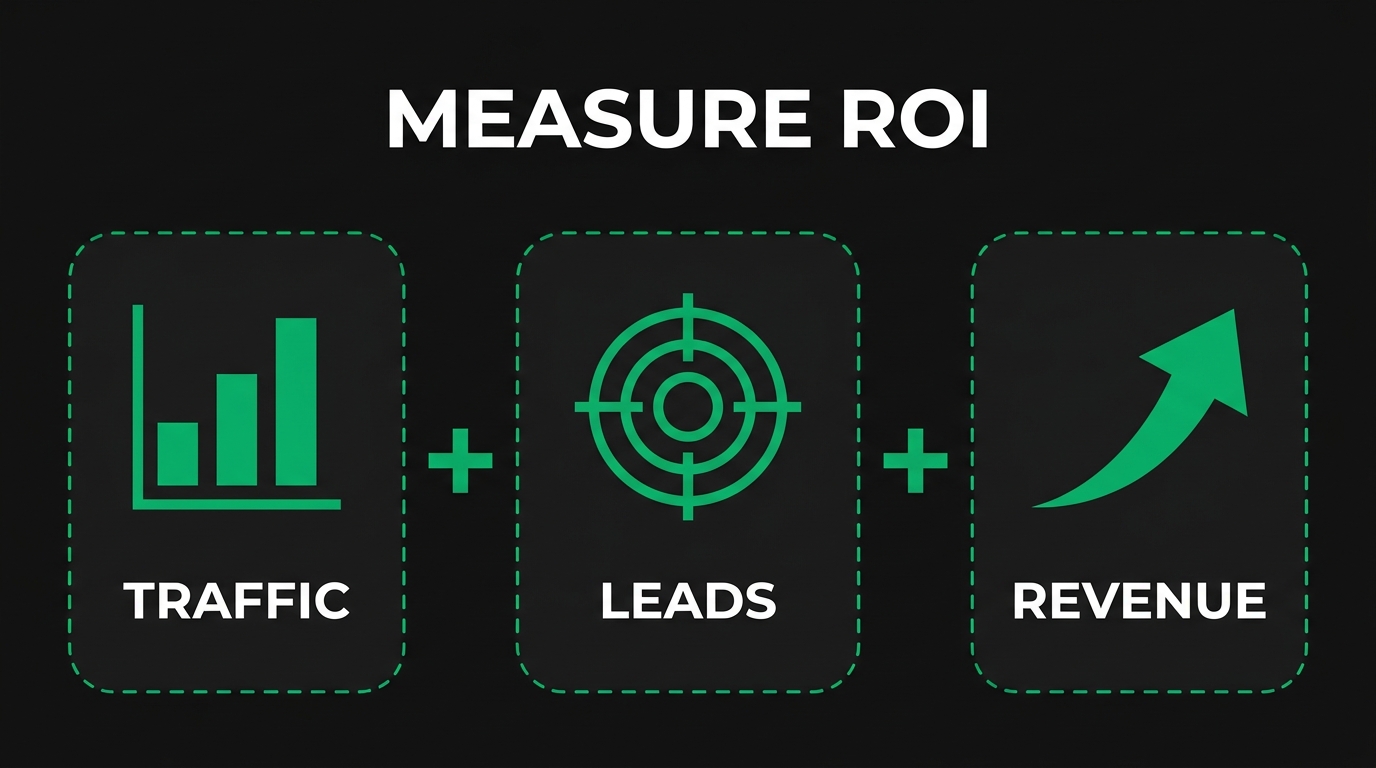
The KPIs that tie robotics SEO to pipeline and revenue are organic RFQ submissions, RFQ-to-quote conversion rate, quote-to-purchase-order conversion rate, organic pipeline value in dollars, won revenue attributed to organic, cost per organic RFQ, and ranked-keyword share for procurement queries. Vanity KPIs such as sessions and bounce rate should support the pipeline view, not replace it. Weight reporting toward dollars and RFQs because that is what the CFO signs off on. The expert position: if a KPI does not ladder to revenue or RFQ count, demote it to a diagnostic row in the report.
How Do You Set Up CRM Integration for SEO Reporting?
You set up CRM integration for SEO reporting by passing UTM parameters and the landing-page URL into the CRM on every form submission, capturing first-touch and last-touch organic sources, and syncing opportunity stage, deal value, and close date back to the analytics platform. Configure a source-of-truth dashboard that joins organic sessions to opportunities by contact ID. Then segment reporting by robot category, application, and industry so SEO investment maps to the highest-ROI clusters. Without CRM integration, robotics SEO reporting stops at the form submission and misses the revenue story.
What Reporting Cadence Works for Robotics OEMs?
The reporting cadence that works for robotics OEMs is a weekly operational update, a monthly performance review, and a quarterly pipeline and strategy review. Weekly reports cover crawl health, rankings, new publishes, and technical tickets. Monthly reports cover organic sessions, RFQs, conversion rates, and content performance. Quarterly reviews tie organic to sourced pipeline and closed revenue, and reset the content and link roadmap. Robotics sales cycles often span six to twelve months, so quarterly reviews line up with procurement reality. The expert read: daily dashboards feed ops; quarterly reviews drive budget.
How Do You Benchmark Against Robotics Competitors?
You benchmark against robotics competitors by building a fixed tracking list of 10 to 20 named competitors, pulling their ranked keyword count, estimated organic traffic, referring domains, and top pages monthly, and comparing against your own footprint on the same metrics. Segment by robot category and application to spot cluster-level gaps. Record which competitors win featured snippets and AI citations on priority queries so content and link work can target the delta. Competitive benchmarking transforms SEO from an internal report into a procurement scoreboard. This sets up the common-mistakes review next.
What Common SEO Mistakes Do Robotics Manufacturers Make?
The common SEO mistakes robotics manufacturers make are chasing generic keywords, shipping flat or JavaScript-heavy site architectures, underinvesting in content depth, and ignoring export-control and compliance requirements that affect which queries they can even target. The next sections examine each in turn.
Why Does Generic Keyword Targeting Fail Robotics Brands?
Generic keyword targeting fails robotics brands because terms such as "industrial robots" or "automation solutions" attract analyst traffic, consultant research, and student queries that rarely convert to RFQs. Procurement buyers search with model numbers, payload classes, and application verbs. Ranking for the generic term delivers impressions without pipeline. Robotics brands also overspend on these head terms, competing with trade publications that will always outrank a manufacturer on definitional queries. The expert position: cede the head term to editorial sites and own the procurement long tail where RFQs actually live.
How Does Poor Site Architecture Hurt Robotics Product Discovery?
Poor site architecture hurts robotics product discovery by burying model pages beneath five or more clicks, hiding catalogs behind JavaScript that Googlebot cannot render, and producing thousands of faceted-filter URLs that dilute crawl budget. Google discovers fewer model pages, indexes weaker variants as canonical, and ranks competitor catalogs with cleaner trees. Symptoms include orphaned spec pages, near-zero impressions on deep model URLs, and Search Console coverage errors. The expert read: if a human needs more than three clicks to reach a specific model from the homepage, neither Google nor a procurement engineer will finish the journey.
Why Do Robotics Sites Underinvest in Content Depth?
Robotics sites underinvest in content depth because product teams prioritize the next hardware release over topical-authority content, and because engineering-led organizations see blog content as marketing fluff. The result is a spec sheet without the supporting application, integration, and certification context procurement buyers require. Thin content ranks below trade publications and consultant sites that publish the explainers the manufacturer should own. The expert view: the company that builds the robot should also publish the definitive procurement guide for it, because otherwise a third party defines the category for buyers.
What Compliance and Export Control Issues Affect Robotics SEO?
The compliance and export control issues that affect robotics SEO include ITAR-restricted defense robotics content, EAR-regulated dual-use technologies, CE marking obligations in the European Union, and region-specific safety certification gates. The Commerce Department's Bureau of Industry and Security revised the Export Administration Regulations' controls on advanced computing integrated circuits and added a new control on artificial intelligence model weights for certain advanced closed-weight dual-use AI models, according to the Federal Register. Pages covering restricted specifications may need geo-gating or login walls. Compliance-aware SEO avoids regulatory risk while still capturing unrestricted procurement demand. This sets up the bridge to a specialist partner next.
How Should You Approach Robotics SEO With Manufacturing SEO Agency?
You should approach robotics SEO with Manufacturing SEO Agency by engaging a manufacturing-only partner that builds procurement-intent keyword architecture, topical authority across every robot category, and revenue-tied reporting. The next sections cover how Manufacturing SEO Agency supports robotics keyword architecture and topical authority, and recap the key takeaways from this guide.
Can Manufacturing SEO Agency Help With Robotics Keyword Architecture and Topical Authority?
Manufacturing SEO Agency helps robotics brands with keyword architecture and topical authority by mapping every robot category, payload class, application, and certification into procurement-stage clusters, then publishing or remediating the pages needed to cover each cluster end to end. Manufacturing SEO Agency operates as manufacturing-only manufacturing seo experts and focuses every engagement on the queries engineers and buyers use during RFQ sourcing, not generic automation terms. Manufacturing SEO Agency ties rankings to RFQs, pipeline, and closed revenue through CRM-integrated reporting. Manufacturing SEO Agency also handles technical SEO remediation, schema deployment, PR-grade editorial link building, and AI search visibility engineering across the cluster.
What Are the Key Takeaways About Implementing SEO for Robotics We Covered?
The key takeaways about implementing SEO for robotics are direct and actionable:
- Anchor every page to procurement-grade entities: payload, reach, axes, end-effector, and certification class.
- Map keywords to research, evaluation, and RFQ stages of the procurement funnel.
- Build technical foundations first: clean URLs, ProductModel schema, fast spec pages, and clean indexation.
- Cover every robot category, application, and safety standard as a complete topical cluster.
- Optimize product pages as RFQ landing pages with spec tables, CAD access, and embedded forms.
- Earn backlinks through trade publications, association work, and data-led digital PR.
- Structure content for AI engines with direct answers, SPO triples, and rich structured data.
- Measure performance on RFQs, pipeline, and closed revenue, not sessions.
- Avoid generic keywords, flat JavaScript catalogs, thin content, and compliance blind spots.