OEM SEO is the practice of optimizing an original equipment manufacturer's digital presence so engineers and purchasing managers can find, evaluate, and submit RFQs through organic search. It combines procurement-intent keyword architecture, process and material topical authority, technical SEO, editorial link building, and AI search visibility.
This guide covers what OEM SEO means, why it matters right now, the core components of an effective strategy, how to build topical authority around processes and materials, on-page and technical requirements, backlinks and digital PR, AI search visibility, measurement, common mistakes, and how to approach the work with a specialized manufacturing partner.
We begin by defining OEM SEO, comparing it with standard B2B SEO, mapping procurement-intent queries to engineer and purchasing-manager personas, and explaining how buyer research has moved almost entirely into organic search, AI assistants, and self-directed digital channels.
We then walk through keyword architecture, topical authority for processes and materials, the role of certifications such as AS9100, ISO 13485, and IATF 16949, and the technical foundations every OEM site needs. We extend the same logic into on-page elements, schema markup, Core Web Vitals, and mobile performance.
Next we look at backlinks, editorial mentions in trade media, link tactics to avoid, and the signals that help OEMs earn citations inside AI-generated answers.
Finally we cover KPIs that tie ranking to pipeline and revenue, reporting cadence for stakeholders, common mistakes that sink OEM programs, and how a manufacturing-only SEO partner changes the outcome.
What Does OEM SEO Mean for Original Equipment Manufacturers?
OEM SEO is the practice of optimizing an original equipment manufacturer's website and content so procurement-intent searches return its capability, process, and material pages. The sub-sections cover how it differs from standard B2B SEO, the queries to target, and the buyer personas driving search behavior.
How Is OEM SEO Different from Standard B2B SEO?
OEM SEO is different from standard B2B SEO because the queries are built from process names, material grades, certifications, and tolerances rather than generic buyer-persona keywords. An OEM target list reads like a bill of materials: "AS9100 aluminum die casting," "ISO 13485 injection molding," "IATF 16949 stamping supplier." Standard B2B SEO usually optimizes for solution categories and pain points; OEM SEO optimizes for specification. The content proof point shifts from thought leadership to capability pages, process sheets, and material libraries. Internal linking clusters entities such as alloys, finishes, and tolerances into topical graphs that Google can resolve against its Knowledge Graph, giving strong context for what is additive manufacturing and adjacent process queries.
What Procurement-Intent Queries Should an OEM Target?
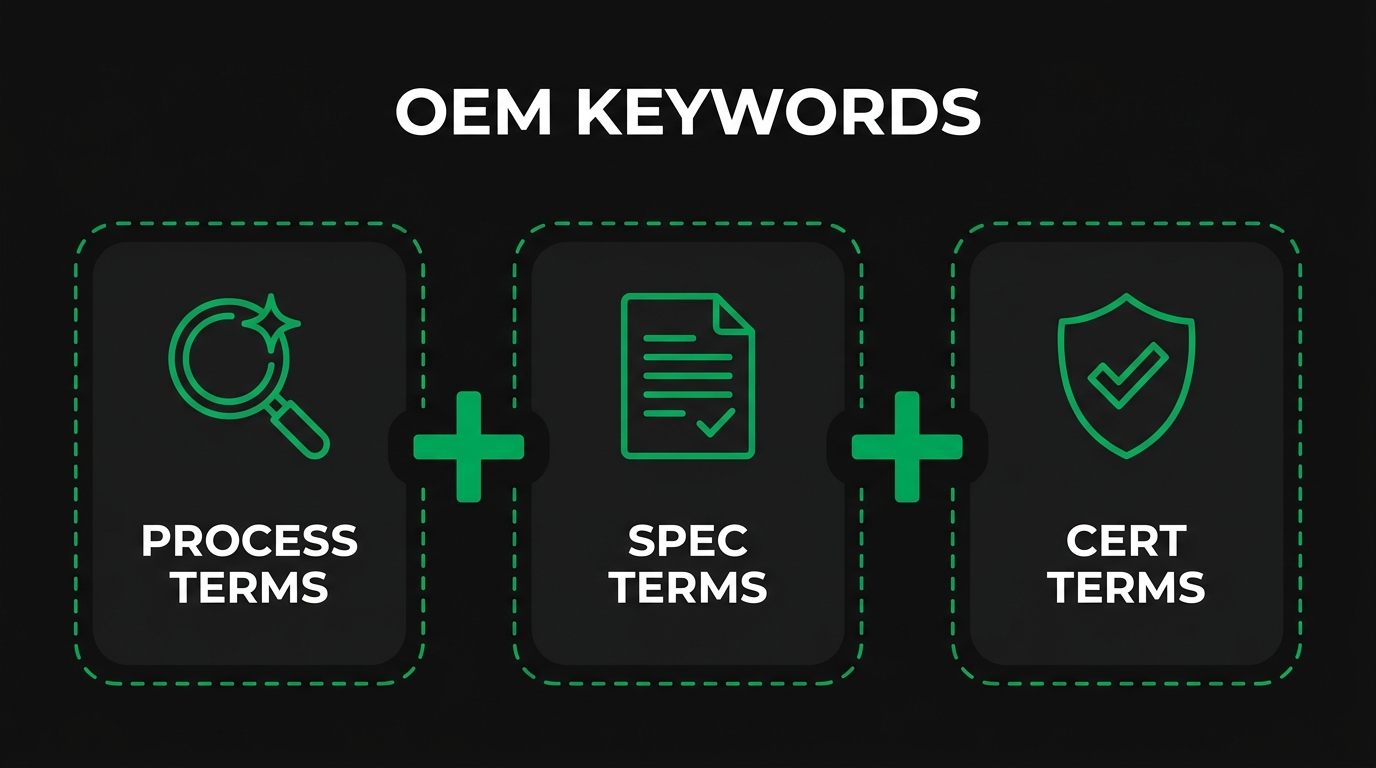
The procurement-intent queries an OEM should target are capability-plus-specification phrases that procurement and engineering teams actually type. Typical patterns include process plus material ("CNC 7075 aluminum machining"), process plus certification ("NADCAP heat treat supplier"), and application plus tolerance ("medical implant micro-machining ISO 13485"). These queries have lower volume than category keywords but convert at RFQ-level rates because the searcher has a print, a spec, or an AVL in hand. A deeper comparison of scope differences between OEM and horizontal B2B search is covered in oem seo vs b2b manufacturing seo.
Which Buyer Personas Drive OEM Search Behavior?
The buyer personas that drive OEM search behavior are design engineers, manufacturing engineers, sourcing specialists, and commodity managers, each searching at a different depth. Engineers search for feasibility ("can X process hold ±0.0005 in stainless?"), while buyers search for qualified sources ("IATF 16949 stamping vendor Michigan"). Personas research in parallel and arrive at the quote form with a specification already written.
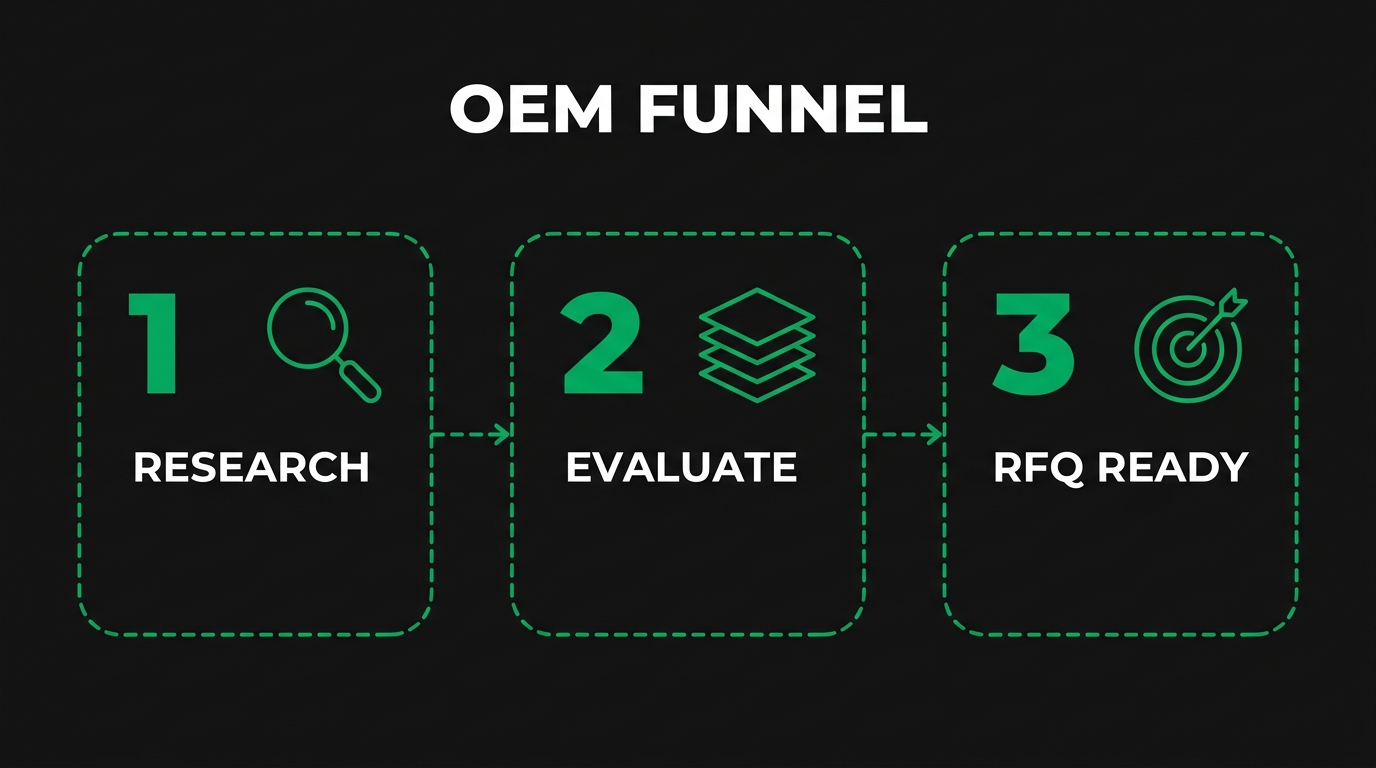
Persona mapping turns the research path into the content map that feeds the SEO program.
Why Is SEO Critical for OEM Manufacturers Today?
SEO is critical for OEM manufacturers today because procurement research has moved into organic search and AI assistants, and directories alone no longer close the loop. The sub-sections explain the buyer-research shift, the revenue impact of organic visibility, and why trade directories fall short.
How Has B2B Buyer Research Shifted to Search and AI?
B2B buyer research has shifted to search and AI through longer, deeper, self-directed journeys that pass through search engines and generative models before any sales conversation. Buyers run parallel searches across Google, specification databases, and AI chat interfaces, which means OEMs that are thin in organic search fall off the consideration set. Search is the first stop, and AI citations mirror what ranks, so implementing an oem seo strategy has become a direct revenue driver.
What Revenue Impact Can Organic Visibility Deliver for OEMs?
Organic visibility delivers revenue impact for OEMs through three compounding effects: expanded top-of-funnel RFQ volume, higher win rates on specification-matched queries, and reduced reliance on paid directories.
For an OEM with a narrow capability set, a ranking capability page that receives 300 qualified visits monthly and converts 2% can generate more pipeline than a six-figure trade show.
Why Are Trade Directories No Longer Enough to Win RFQs?
Trade directories are no longer enough to win RFQs because buyers research well beyond a single listing, and directory visibility is capped by subscription tier rather than specification match. Buyers triangulate by searching Google for the capability, reading the OEM's own pages, checking AI overviews, then opening directory profiles. Directories stay useful as citation signals, but they do not rank for long-tail procurement queries.
Winning the RFQ now requires owning the organic result that matches the spec.
What Are the Core Components of an Effective OEM SEO Strategy?
The core components of an effective OEM SEO strategy are procurement-intent keyword architecture, topical authority across process and material pages, certification signals that mirror buyer qualification checklists, and technical SEO foundations that make the site crawlable, fast, and structured. The sub-sections below detail each pillar in order.
How Should OEMs Structure Procurement-Intent Keyword Architecture?
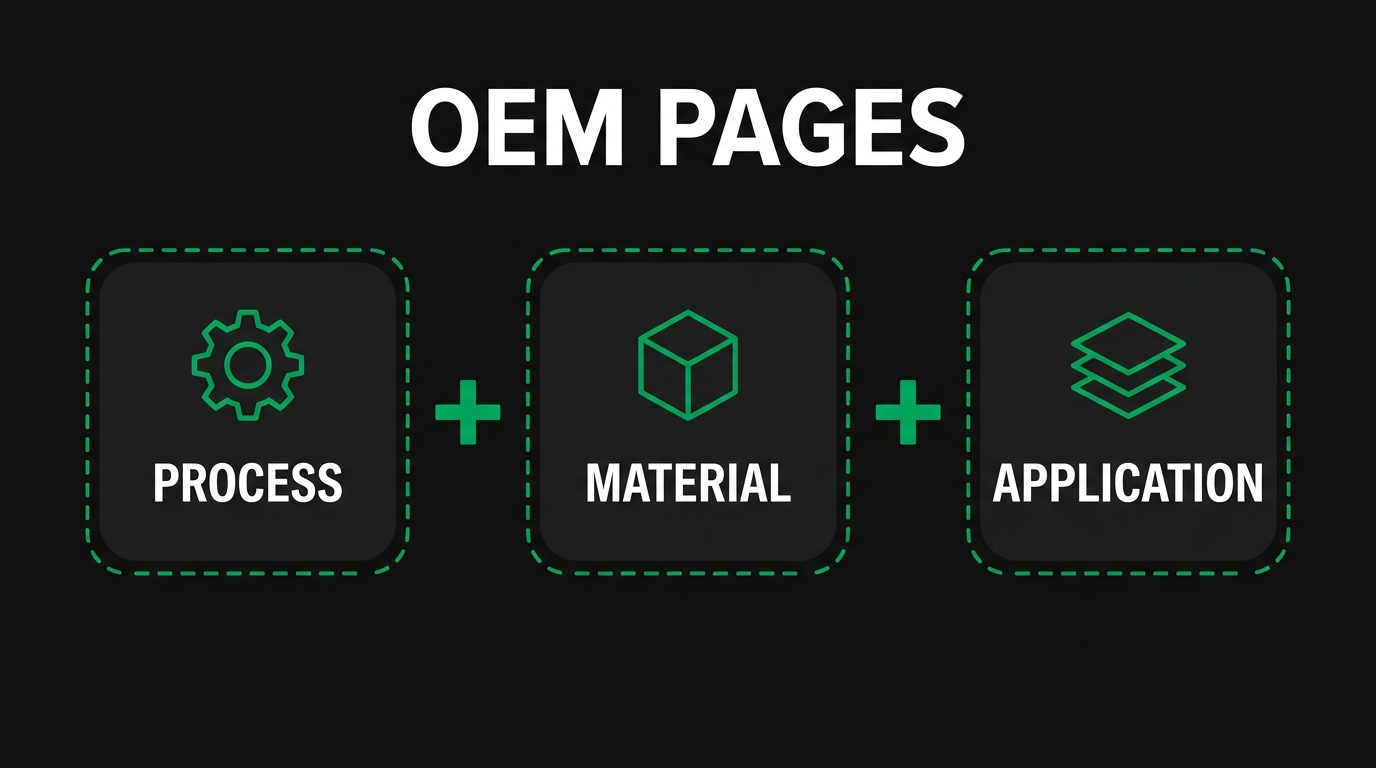
OEMs should structure procurement-intent keyword architecture as a three-axis matrix of process, material, and application, mapped to dedicated URLs that mirror how engineers specify jobs. The process axis includes machining, molding, stamping, forging, additive, and finishing. The material axis includes alloys, polymers, composites, and elastomers by grade. The application axis includes medical, aerospace, automotive, and defense contexts. Each intersection yields a specific URL such as "/cnc-machining/inconel-718/aerospace," and each URL targets one concrete query. Horizontal framing that compares this architecture with other manufacturing SEO patterns is covered in what is industrial seo. Architecture that fails here forces a single page to compete for dozens of queries it cannot rank for.
What Role Does Topical Authority Play for OEM Process and Material Pages?
Topical authority plays the role of connecting every OEM process and material page into a coherent entity graph that Google can resolve against its Knowledge Graph. Semantic clustering of alloys, finishes, tolerances, and certifications signals subject-matter depth; isolated pages signal thinness. Topical authority also survives algorithm updates because the signals are earned through coverage, not purchased.
How Do Certifications Like AS9100, ISO 13485, and IATF 16949 Influence Search Visibility?
Certifications like AS9100, ISO 13485, and IATF 16949 influence search visibility by supplying the qualification keywords procurement teams use to filter suppliers, reinforcing E-E-A-T trust on capability pages, and anchoring schema properties that connect the entity to recognized standards. AS9100 is the IAQG quality standard for aviation, space, and defense; IATF 16949 is the automotive quality standard applied across the supply chain; ISO 13485 covers medical device quality systems.
Listing certification names and scopes on capability pages creates direct matches for buyer filters.
Which Technical SEO Foundations Must an OEM Manufacturer Address First?
An OEM manufacturer must address crawlability, indexability, structured data, Core Web Vitals, and mobile rendering as the first technical SEO foundations. Sites with deep capability trees need a clean XML sitemap, canonical tags, and internal links that let Googlebot reach every specification page within three clicks. Structured data using Organization, Product, and BreadcrumbList schema makes capability entities machine-readable. Core Web Vitals thresholds are non-negotiable since the mobile user experience is the basis of indexing. Site search, faceted navigation, and PDF spec sheets all need deliberate handling to avoid duplicate content and thin pages. A practical pre-launch checklist for these foundations is outlined in oem seo strategy checklist. Technical fixes unlock every other investment, which leads into the content architecture next.
How Do You Build Topical Authority Around OEM Processes and Materials?
Topical authority around OEM processes and materials is built by publishing a complete set of process pages, a complete set of material specification pages, a set of application and industry pages, and a deliberate internal link graph that connects every entity. Disciplined vertical manufacturing seo content across these four layers is what separates a capability site from a topical authority. The sub-sections below walk through each layer.
What Process Pages Should Every OEM Publish?
Every OEM should publish one dedicated page per in-house process, covering CNC turning, CNC milling, EDM, injection molding, stamping, welding, heat treating, surface finishing, assembly, and any additive manufacturing methods offered. Each page answers five spec questions: equipment, size range, tolerance, materials supported, and certifications applied. Each page links out to material spec pages and industry application pages that share the process. Process pages anchor the capability hub and capture queries of the form "[process] [material]" and "[process] supplier." Complete process coverage signals that the manufacturer can handle the spec without handoff. Evidence that content completeness drives demand is covered in basic seo strategies for manufacturers.
How Should Material Specification Pages Be Organized?
Material specification pages should be organized by material family, then by grade, with each grade on its own URL. A top-level "Materials" hub links to family pages: aluminum, stainless, tool steel, titanium, copper alloys, plastics, elastomers, and composites. Each family page links to grade pages such as 6061, 7075, 17-4 PH, Inconel 718, PEEK, and PA6/6. Every grade page lists mechanical properties, typical processes applied in-house, finish options, and typical applications, with links back to process and industry pages. Material pages attract engineers mid-spec, who often search by grade first and process second.
What Application and Industry Pages Strengthen Topical Coverage?
Application and industry pages strengthen topical coverage by connecting processes and materials to real end markets such as aerospace, medical, automotive, defense, energy, and semiconductor. Each industry page summarizes relevant certifications, typical materials, typical processes, tolerance expectations, and representative applications without naming customers under NDA. Industry pages capture mid-funnel queries such as "aerospace component manufacturer" and "medical device contract manufacturer" while reinforcing certification entities. Published case studies behind these pages act as proof; examples of successful b2b seo shows what that proof layer can look like. Application pages also give sales teams a natural URL to share during RFQ discussions, which shortens the qualification step.
How Do Internal Linking Patterns Reinforce Topical Authority?
Internal linking patterns reinforce topical authority by routing equity from the homepage through capability hubs into every process, material, application, and certification page, and by cross-linking peers where the entity relationship is real. Anchor text should carry the grade or process name, not "click here" or "learn more." Breadcrumbs make the hierarchy explicit to both users and crawlers. Related-page modules at the bottom of each URL should surface the three or four semantically nearest pages. Linking patterns also feed AI retrieval, since LLMs follow hyperlinks to verify claims and collect citations. A disciplined link graph is the difference between a large site and an authoritative one.
How Should OEMs Approach On-Page and Technical SEO?
OEMs should approach on-page and technical SEO by matching every capability URL to one specific procurement query, implementing manufacturing-appropriate schema, meeting Google's Core Web Vitals thresholds, and ensuring mobile renders the same structured data as desktop. The sub-sections cover each layer in turn.
What On-Page Elements Matter Most for OEM Product and Capability Pages?
The on-page elements that matter most for OEM product and capability pages are a spec-matched H1, a first-paragraph answer that names the process or material, a specification table, a capability list, an RFQ call-to-action above the fold, and a clear certifications strip. Every image should carry descriptive alt text referencing the part family or process. FAQ blocks should target the engineer and buyer questions that appear in Google's People Also Ask box.
The combination answers the query directly and earns the rich result.
How Should Schema Markup Be Implemented for Manufacturing Sites?
Schema markup should be implemented on manufacturing sites as JSON-LD blocks that describe the organization, its certifications, its capabilities, and its individual products or service offerings. Core types include Organization, LocalBusiness or Corporation, Product, Service, BreadcrumbList, FAQPage, and VideoObject where relevant. Certifications map cleanly to the "hasCredential" property and the issuer as a named Organization. Each capability or process page should carry its own Product or Service schema with clear "serviceType" and "areaServed" fields. Schema must match visible page content exactly, since mismatches trigger manual actions.
Which Page Speed and Core Web Vitals Benchmarks Should OEMs Target?
OEMs should target Google's published Core Web Vitals thresholds: Largest Contentful Paint at 2.5 seconds or less, Interaction to Next Paint at 200 milliseconds or less, and Cumulative Layout Shift at 0.1 or less.
Heavy spec tables, engineering drawings, and PDF embeds are common LCP offenders that need lazy loading and compression.
How Does Mobile Performance Affect Engineer and Buyer Behavior?
Mobile performance affects engineer and buyer behavior because engineers search on shop-floor phones, buyers check specifications between meetings, and Google's mobile-first indexing uses the mobile version of the page for ranking. A slow mobile render costs both a ranking signal and an RFQ, since a buyer who cannot pull up a spec sheet at a customer site defers the conversation. Manufacturers that ship the same schema, same content, and same critical images on mobile as on desktop keep their rankings intact. Ignoring mobile rendering erases the gains from every other technical investment, which is why it closes this technical block before we look at off-site signals.
How Do Backlinks and Digital PR Influence OEM Search Rankings?
Backlinks and digital PR influence OEM search rankings by concentrating authority on capability pages, supplying E-E-A-T trust signals, and carrying the citations LLMs use to verify claims. The sub-sections cover publication targets, editorial outreach, and tactics to avoid.
What Types of Publications Provide the Strongest Manufacturing Backlinks?
The publications that provide the strongest manufacturing backlinks are peer-reviewed journals, standards bodies, industry associations, government agencies, and trade editorial sites with real reporting staffs. Top targets include IEEE, ASME, SAE International, ASM International, NAM, SME, AMT, Manufacturing.gov, NIST, and trade outlets such as Manufacturing Engineering, Modern Machine Shop, and Design News.
One strong trade-press feature outperforms dozens of directory placements because the anchor text and context are real, not boilerplate.
How Can OEMs Earn Editorial Mentions in Trade Media?
OEMs can earn editorial mentions in trade media by publishing original research on capability data, offering expert commentary on regulatory changes, announcing facility expansions and certification milestones, and sharing named case studies the customer has approved. Editors respond to proprietary data, photos from the plant floor, and named engineers available for quotes. A quarterly release cadence with one data-led story, one expansion announcement, and one technical article gives the PR pipeline enough volume to win placements.
Which Link-Building Tactics Should OEMs Avoid?
OEMs should avoid private blog networks, paid guest post farms, exact-match anchor text schemes, irrelevant directory submissions, and any tactic that requires paying for a dofollow link without disclosure. These tactics violate Google's spam policies and invite manual actions that take months to reverse. The same tactics also generate zero lift with LLM retrieval, since AI models discount low-authority domains. A clean backlink profile that grows 10 to 15 editorial links a quarter outperforms a profile with 200 paid links, because quality scales while spam decays. Clean link acquisition feeds the AI visibility layer covered next.
How Is AI Search Changing OEM Visibility?
AI search is changing OEM visibility by inserting LLM-generated answers ahead of traditional rankings, rewarding content that is citable and entity-rich, and penalizing content that lacks clear attribution. The sub-sections cover LLM citation signals, content optimization for AI answers, and entity-building tactics that earn AI mentions.
What Are LLM Citation Signals and Why Do They Matter?
LLM citation signals are the features that cause a large language model to reference a specific URL as the source of a claim, and they matter because citation placement in AI overviews now sits above the organic result. Citations reward clear subject-predicate-object statements, structured data, named authorship, and attribution to primary sources. Pages that list their facts in a one-fact-per-sentence style make it easier for the retriever to pull a clean passage.
Citation visibility compounds on itself, since being cited by one model raises the probability of being picked up by others.
How Can OEMs Optimize Content for AI-Generated Answers?
OEMs can optimize content for AI-generated answers by writing clear definitional first sentences, grouping related specifications into tables, adding FAQ schema for buyer and engineer questions, and keeping every factual claim tied to a primary source. Short paragraphs, explicit entity names, and consistent naming of materials, processes, and certifications help retrievers extract a passage without ambiguity. Pages must match on-page text with the schema, since LLM crawlers drop mismatched content.
Designing content for citation, not just ranking, is the new baseline.
What Entity-Building Tactics Help OEMs Appear in AI Responses?
Entity-building tactics that help OEMs appear in AI responses include claiming and completing a Wikidata entry, publishing Organization schema that links to authoritative profiles, registering on IAQG and NIST databases where appropriate, maintaining consistent NAP across every listing, and earning mentions in publications already inside LLM training sets. Named engineers with author bios give the entity a human dimension that retrievers can resolve. Cross-linking between the OEM site and trusted adjacent entities such as materials suppliers and certifying bodies strengthens the entity graph.
That earned citation is the bridge to the measurement section that follows.
How Do You Measure and Report on OEM SEO Performance?
OEM SEO performance is measured by tying organic activity to pipeline and revenue, mapping query rankings to RFQ generation, and reporting on a cadence that matches the buying cycle of manufacturing stakeholders. The sub-sections below define the KPIs, the ranking-to-RFQ mapping, and the cadence.
Which KPIs Tie SEO Activity to Pipeline and Revenue?
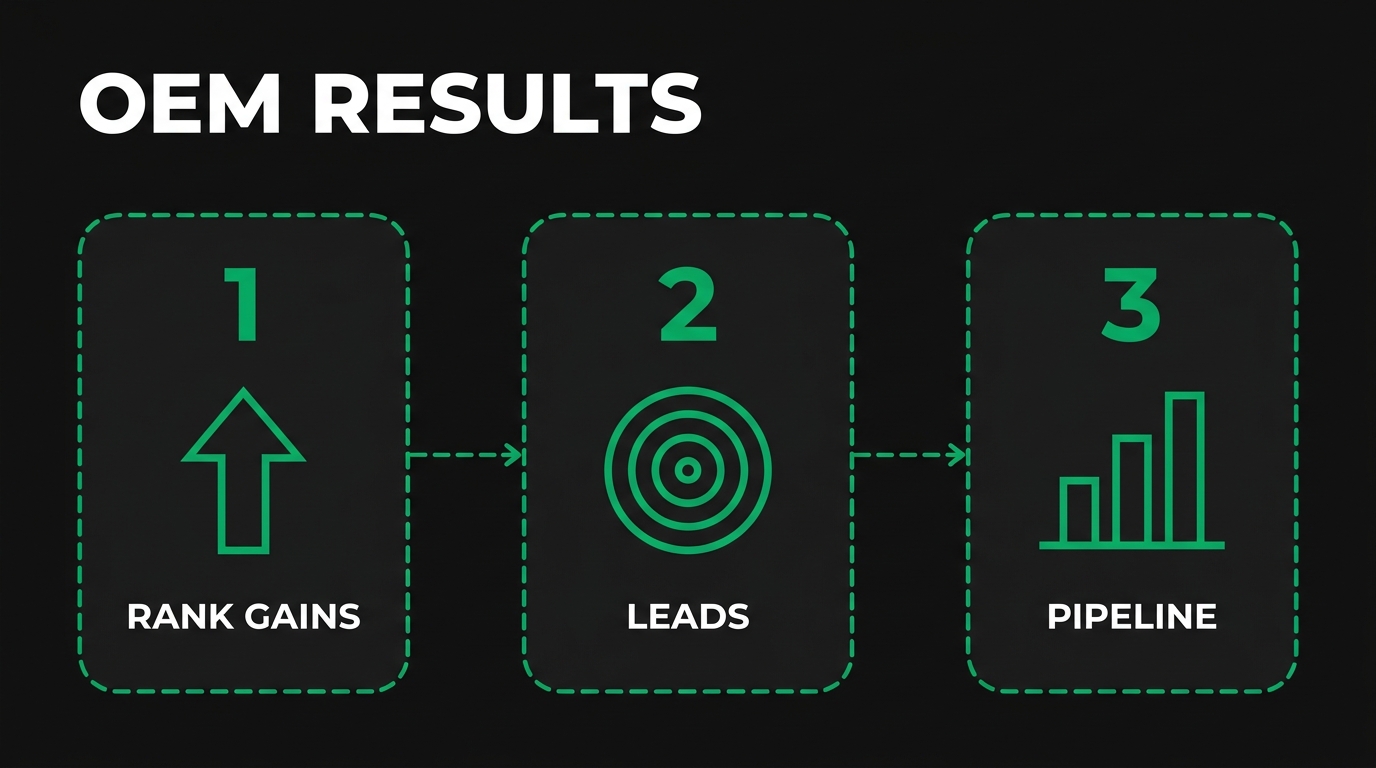
The KPIs that tie SEO activity to pipeline and revenue are qualified organic sessions on capability pages, RFQ submissions attributed to organic search, pipeline dollar value of those RFQs, closed-won revenue by originating query, and cost-per-RFQ compared with paid channels. Rank-tracking alone is a vanity metric in isolation. Engineering-hour attribution, CRM integration, and UTM discipline on every internal CTA make attribution durable. A good reporting stack pipes Google Search Console, GA4, and the CRM into a single dashboard tagged by capability cluster.
How Should Rankings Be Mapped to RFQ Generation?
Rankings should be mapped to RFQ generation by linking each target query to a capability URL, tagging every RFQ submission with the entry page and referrer query in the CRM, and tracking the lag between ranking change and RFQ volume. Procurement-intent queries typically produce a four-to-eight-week lag between reaching the top three and a sustained RFQ lift. Reports should break the funnel into impressions, clicks, RFQs, and won revenue per cluster so each investment is provable.
What Reporting Cadence Works Best for Manufacturing Stakeholders?
A monthly executive summary plus a quarterly deep review works best for manufacturing stakeholders, because sales cycles run in quarters and capability investments pay back over months, not weeks. The monthly report covers sessions, RFQs, pipeline, and won revenue by cluster, plus top movers. The quarterly review adds query-level analysis, competitive delta, certification-page performance, and the roadmap update. Engineering and operations leaders should see the same dashboard as marketing so spec-page changes, facility updates, and certification renewals feed the content calendar. Consistent cadence builds the trust that leads into the mistakes OEMs most often make, reviewed next.
What Common Mistakes Do OEMs Make with SEO?
Common mistakes OEMs make with SEO are chasing generic keywords, publishing thin capability pages, and outsourcing the work to generalist agencies that never learn the vocabulary. The sub-sections explain each failure mode.
Why Does Targeting Generic Keywords Fail for OEMs?
Targeting generic keywords fails for OEMs because the top results for broad terms such as "manufacturing" or "metal parts" belong to marketplaces, directories, and publishers that outrank any single supplier, and because the resulting traffic is unqualified. A ranking on "CNC machining" sounds good until the search intent splits across hobbyists, students, and sourcing agents with no spec in hand. Long-tail procurement-intent queries convert at many multiples of the rate of generic keywords, because the searcher already has a specification.
How Do Thin Capability Pages Hurt Procurement Visibility?
Thin capability pages hurt procurement visibility because they fail both the ranking algorithm and the buyer qualification check in one shot. A one-paragraph page with a stock photo cannot compete against a competitor with a specification table, a certifications strip, a tolerance chart, and three linked case studies. Google's E-E-A-T evaluation penalizes thin content, and AI retrievers skip it for lack of usable passages. Thin pages also fail the buyer check, since an engineer who cannot find the spec in 30 seconds moves to the next supplier. The minimum bar is 600 to 1,200 words per capability page with specifications, materials, tolerances, certifications, applications, and internal links to related coverage.
What Risks Come from Outsourcing to Generalist SEO Agencies?
Outsourcing to generalist SEO agencies carries three risks: content that confuses grades with alloys, keyword targets built from volume rather than procurement intent, and link campaigns aimed at consumer publishers instead of trade and standards bodies. Generalists rarely distinguish between AS9100, ISO 13485, and IATF 16949, and their writers often invent tolerances or misuse certification names in ways that destroy engineering credibility. The cost shows up as rankings on the wrong queries, RFQs that never reach spec, and brand damage with buyers who notice the errors. A manufacturing-only partner avoids these failure modes by hiring writers and strategists fluent in the domain, which leads into how to evaluate that partnership.
How Should You Approach OEM SEO with a Specialized Manufacturing Partner?
You should approach OEM SEO with a specialized manufacturing partner that maps the capability matrix, owns the technical implementation, and reports on RFQ pipeline rather than vanity rankings. The sub-sections below cover how a manufacturing-only agency changes outcomes and summarize the key takeaways of this guide.
Can a Manufacturing-Only SEO Agency Help Original Equipment Manufacturers Win More RFQs?
Yes, a manufacturing-only SEO agency can help original equipment manufacturers win more RFQs by building procurement-intent keyword architecture, publishing specification-deep capability pages, and tying every dashboard metric to the CRM. Manufacturing SEO Agency is a US-based industrial-only SEO firm that ranks B2B manufacturers for queries built from process names, material grades, and certifications, serving CNC, injection molding, aerospace, medical, oem seo, and contract manufacturers. Manufacturing SEO Agency delivers audits, keyword architecture, topical authority buildout, editorial link building, AI search visibility engineering, technical SEO, and revenue-tied reporting.
A comparative view of vendor options is available in top seo agencies for oem.
What Are the Key Takeaways About OEM SEO We Covered?
The key takeaways about OEM SEO we covered are that procurement-intent queries drive RFQs, topical authority across process and material pages is the highest-leverage content investment, certifications and technical foundations are non-negotiable, editorial backlinks and AI citations carry trust signals, and measurement must tie rankings to RFQs and revenue. Buyer research has shifted to search and AI, and directories and generic agencies cannot replicate the vocabulary or the architecture. A specialized partner such as Manufacturing SEO Agency converts these principles into pipeline. The winning OEM program stays disciplined on specification, measurement, and the entity graph.