The ultimate OEM SEO strategy checklist is a sequential blueprint that helps original equipment manufacturers rank for the process names, material grades, and certifications that procurement managers and design engineers actually search. We built this guide to map every step from technical audit through measurement, so OEM marketing teams can replace generic SEO playbooks with one tuned to industrial buying behavior.
This guide covers OEM intent and audience definition, foundational technical audit work, procurement-intent keyword architecture, topical authority planning, on-page and content optimization, backlink and digital PR tactics, AI search visibility, and measurement frameworks tied to pipeline.
OEM intent and audience definition explains why design engineers, purchasing managers, and supply chain directors search differently than retail or distributor buyers, and how their queries cluster around process, material, and certification combinations rather than brand terms.
Foundational audit and architecture work covers the technical SEO checklist for an OEM site: crawl health, indexation, mobile-first compliance, Core Web Vitals thresholds, and the information architecture that lets engineers reach a capability page within two clicks.
Keyword architecture and topical authority show how to cluster long-tail RFQ queries by process, material, and certification, then build pillar and cluster pages that close topical gaps against top-ranking OEM competitors and update as new capabilities come online.
On-page optimization and content creation translate that architecture into capability pages, technical articles, and trust signals, including schema, title tags, tolerance tables, and certification proof that engineers and buyers expect to see before submitting an RFQ.
Backlink, AI search, and measurement layers cover editorial link acquisition from trade publications, entity and schema signals that influence LLM citations, and the reporting cadence that ties organic rankings to RFQ pipeline and closed revenue rather than vanity keyword positions.
What Is OEM SEO and Why Does It Differ From Generic B2B SEO?
OEM SEO is the practice of ranking original equipment manufacturer websites for the process, material, and certification queries that buyers type when sourcing production suppliers. It diverges from generic B2B SEO because the audience, intent, and conversion event all change.
How Does OEM Search Intent Differ From Distributor or Retail Intent?
OEM search intent differs from distributor or retail intent because the searcher needs a manufactured part to spec, not a stocked SKU at a price. A design engineer types "AS9100 5-axis CNC titanium aerospace bracket supplier" expecting a capability page with tolerances and certifications. A retail buyer types "buy CNC machined bracket" expecting a cart. According to Forrester, marketers lack visibility into at least 50% of the buying journey because buyers research online before reaching out. For deeper context on intent fundamentals, see what is oem seo.
Which Procurement Roles Are Searching for OEM Suppliers Online?
The procurement roles searching for OEM suppliers online are design engineers, purchasing managers, supply chain directors, and plant operators. Pew Research Center reports that nearly three out of four professionals and managers or executives use the internet at work, either constantly or several times a day, which means industrial decision makers are reachable through organic search at every stage of the sourcing process. Each role searches with a different vocabulary: engineers query specifications, buyers query lead times, and supply chain leads query certifications.
What Buyer Journey Stages Should an OEM SEO Strategy Cover?
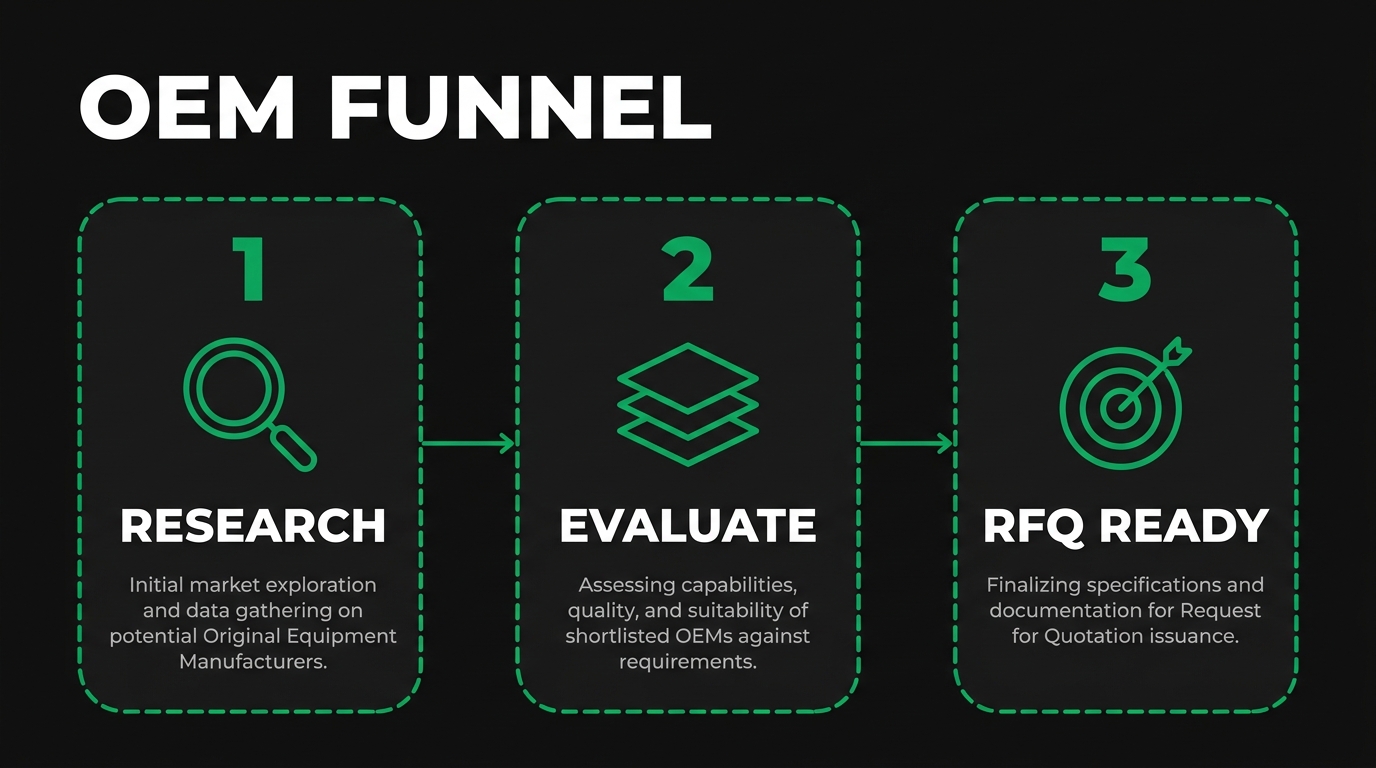
The buyer journey stages an OEM SEO strategy should cover are awareness, evaluation, RFQ, and post-quote validation. Content Marketing Institute research shows manufacturing marketers report only 20% feel their content strategy is "very effective," with 47% citing strategies "not tied to the customer journey" as the primary reason. An OEM checklist therefore maps every keyword cluster to a specific stage so engineers find a process explainer at awareness, a capability comparison at evaluation, and an RFQ-ready spec page at decision.
Why Do Process, Material, and Certification Keywords Outperform Brand Terms?
Process, material, and certification keywords outperform brand terms because procurement buyers search by capability before they know who supplies it. Queries like "ITAR registered injection molding nylon 6/6" carry RFQ intent that brand-name keywords never reach. Targeting these long-tail combinations also separates qualified OEM SEO programs from generic playbooks, as covered in oem seo vs b2b manufacturing seo and oem seo. The expert read: brand terms protect existing revenue, but process and material terms build new pipeline.
What Are the Foundational Audit Steps in an OEM SEO Checklist?
The foundational audit steps in an OEM SEO checklist are a technical SEO audit, a crawl error review, a keyword-to-intent mapping pass, and an architecture assessment. Each step diagnoses a specific failure mode that blocks RFQ-ready pages from ranking.
How Do You Conduct a Technical SEO Audit for an OEM Website?
You conduct a technical SEO audit for an OEM website by verifying mobile-first indexing parity, Core Web Vitals thresholds, HTTPS coverage, XML sitemap integrity, and robots.txt directives. Google Search Central states that Largest Contentful Paint should stay under 2.5 seconds, Interaction to Next Paint under 200 milliseconds, and Cumulative Layout Shift under 0.1, with at least 75 percent of page views meeting the "good" threshold. Capability pages hosting tolerance tables and PDFs break these thresholds most often. Start the audit with a full Screaming Frog crawl, log file review, and GSC coverage export before moving to on-page issues. Pair this baseline with competitor analysis for industrial seo to see how top-ranking OEM sites solve the same constraints.
Which Crawl Errors Most Damage OEM Indexation and Visibility?
The crawl errors that most damage OEM indexation and visibility are soft 404s on discontinued product pages, orphaned capability URLs, blocked JavaScript rendering resources, and 5xx responses on dynamic spec filters. Soft 404s waste crawl budget on pages that used to rank for RFQ queries. Orphaned pages lose internal PageRank because no capability or blog page links inward. Blocked render resources prevent Googlebot from seeing tolerance tables and schema. Fix these first, then resubmit the sitemap.
How Do You Map Existing Keyword Rankings to Procurement Intent?
You map existing keyword rankings to procurement intent by exporting every ranking URL from GSC, tagging each query with a buying-stage label (awareness, evaluation, RFQ), and flagging pages ranking for wrong-intent queries. A capability page ranking on page two for a generic process query belongs in evaluation. The same URL ranking for a material-plus-certification modifier belongs in RFQ. Separate the two, then rewrite titles, H1s, and body copy to match the dominant intent. This reassignment recovers pipeline from pages already indexed.
What Should an OEM Site Architecture Look Like for Maximum Crawlability?
An OEM site architecture for maximum crawlability should follow a three-tier hierarchy: a process pillar (CNC machining, injection molding), a material or industry cluster (aerospace titanium, medical PEEK), and a capability or certification leaf (AS9100 5-axis titanium bracket). Every leaf must reach the homepage within three clicks through breadcrumb and contextual links. Internal linking should pass authority downward from pillar to leaf and upward from RFQ landing pages to pillars. The expert read: crawl depth predicts indexation speed far more than raw page count, so compress the tree. This foundation sets up the keyword architecture work that follows.
How Should OEMs Build a Procurement-Intent Keyword Architecture?
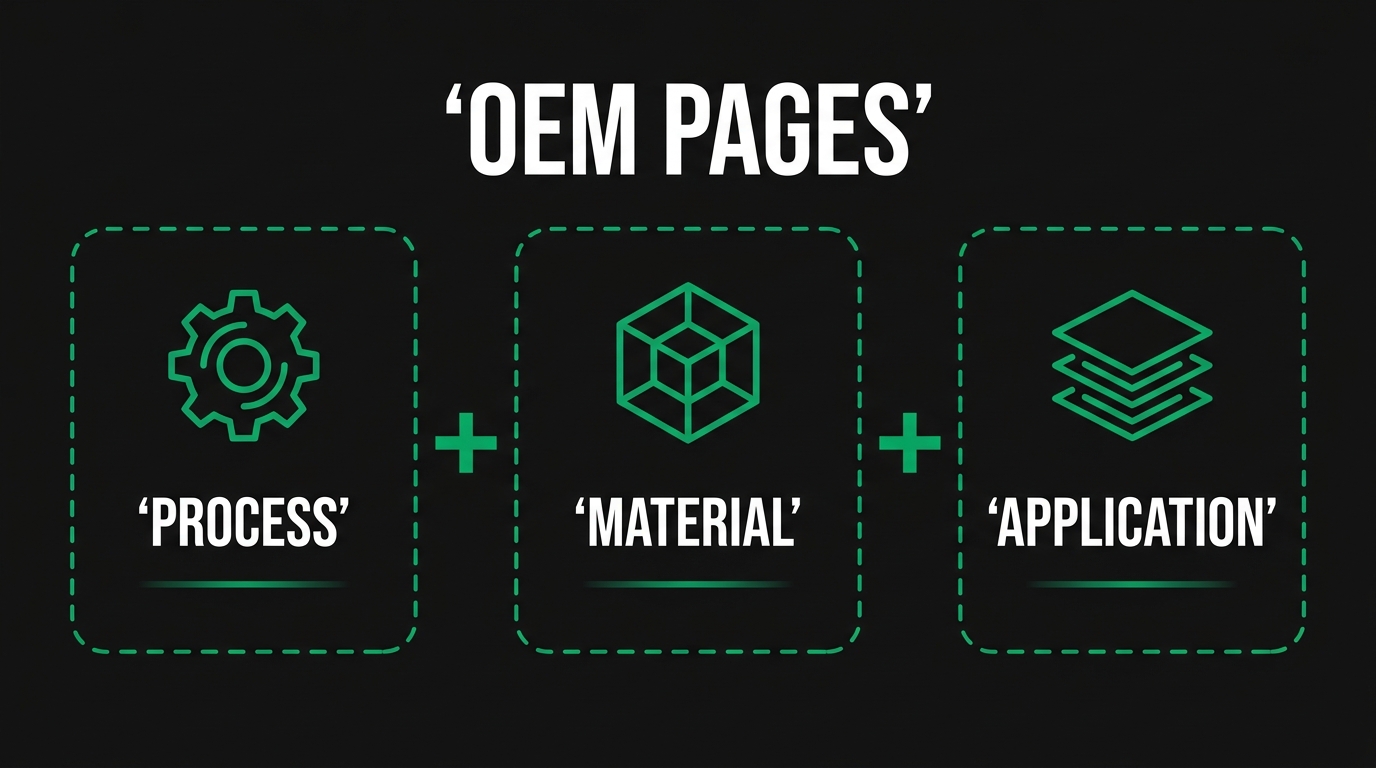
OEMs should build a procurement-intent keyword architecture by clustering queries around process, material, and certification, isolating long-tail RFQ modifiers, prioritizing by volume and buying stage, and scaling the map with keyword tools. Each step compounds the next.
How Do You Cluster Keywords by Process, Material, and Certification?
You cluster keywords by process, material, and certification by building a three-axis matrix where each row is a process (CNC milling, die casting), each column is a material (6061 aluminum, Inconel 718), and each cell anchors a certification layer (AS9100, ISO 13485). Every cell becomes a candidate cluster head. Combine a row-column-cell trio to generate RFQ phrases such as "AS9100 5-axis machined Inconel 718 bracket." Tag each cluster with its pillar parent so internal links stay consistent with the architecture work from the audit.
Which Long-Tail Modifiers Capture High-Value RFQ Intent?
The long-tail modifiers that capture high-value RFQ intent are tolerance values, material grades, certification codes, industry applications, and lot-size qualifiers. Examples include "+/-0.0005 tolerance," "6061-T6 aluminum," "ITAR registered," "medical device housing," and "low-volume prototype." Demand Gen Report found that 80% of B2B buyers initiate first contact once they're 70% through their buying journey, meaning the single RFQ query they type has already absorbed all the upstream research. Pages that answer the exact modifier combination win that contact.
How Do You Prioritize Keywords by Search Volume and Buying Stage?
You prioritize keywords by search volume and buying stage by scoring each cluster on a two-axis grid: monthly search volume on one axis, buying stage on the other (awareness, evaluation, RFQ). High-volume awareness queries feed pillar content. Low-volume RFQ queries justify dedicated capability pages because a single closed-won deal pays back thousands of hours of writing. The expert call: never optimize an RFQ page for a high-volume awareness keyword, because the intent mismatch will tank conversion even if rankings look good. See implementing an oem seo strategy for the prioritization worksheet.
What Tools Help OEMs Map Procurement Keywords at Scale?
The tools that help OEMs map procurement keywords at scale are Ahrefs, Semrush, Google Search Console, Keyword Planner, and competitor SERP scrapers. Ahrefs and Semrush surface the long-tail process-plus-material combinations that manufacturer-focused SERPs hide. GSC anchors the map to queries you already earn impressions for. A custom SERP scraper pulls competitor H1s for gap discovery. Combine outputs into one spreadsheet where each row has a cluster name, pillar parent, volume, difficulty, and stage. This master sheet drives the topical authority map next.
What Does an OEM Topical Authority Map Include?
An OEM topical authority map includes pillar-and-cluster content relationships, a complete process-material-application matrix, documented topical gaps against top-ranking competitors, and a refresh cadence tied to new manufacturing capabilities. Each element protects rankings as the OEM's capability list grows.
How Do Pillar and Cluster Pages Support OEM Topical Coverage?
Pillar and cluster pages support OEM topical coverage by giving search engines a hub-and-spoke graph that signals subject-matter depth. A pillar page covers a broad process like injection molding. Cluster pages cover narrow slices: medical-grade PEEK overmolding, ITAR-compliant nylon 6/6 insert molding, food-safe TPE enclosures. Each cluster links up to the pillar and sideways to sibling clusters. This graph mirrors the way engineers actually narrow a search from process to material to certification. For a deeper walkthrough, see how to implement oem seo.
Which Process, Material, and Application Topics Must Every OEM Cover?
The process, material, and application topics every OEM must cover are the top three processes on the shop floor, the five most-requested material grades, and the regulated industries served. Aerospace OEMs must cover titanium grade 5 machining, AS9100 compliance, and fatigue-critical part geometry. Medical OEMs must cover 316L stainless, ISO 13485 compliance, and cleanroom assembly. Automotive OEMs must cover IATF 16949, high-volume aluminum die casting, and PPAP documentation. Additive-focused OEMs should review what is additive manufacturing before expanding the map. Every topic on the list gets a dedicated cluster page.
How Do You Identify Topical Gaps Against Top-Ranking OEM Competitors?
You identify topical gaps against top-ranking OEM competitors by crawling their sitemap, extracting H1s and URL slugs, and subtracting your own published topics. The remainder is the gap list. Sort the gap list by competitor count: topics three or more competitors cover are table stakes, and topics only one competitor covers may be differentiation opportunities. Publish the table-stakes topics first to close the qualification gate, then pick one differentiation topic per quarter for deep, original coverage.
How Often Should an OEM Topical Map Be Updated for New Capabilities?
An OEM topical map should be updated quarterly for new capabilities and monthly for ranking drift. Quarterly adds new equipment, materials, and certifications earned since the last revision. Monthly pulls GSC data to catch cannibalization, lost rankings, or new query opportunities. Any time the shop floor commissions new tooling or earns a new certification, trigger an out-of-cycle update the same week. The expert view: stale topical maps are the single largest cause of OEM ranking decay after an initial launch spike.
How Do You Optimize OEM Product, Capability, and Service Pages?
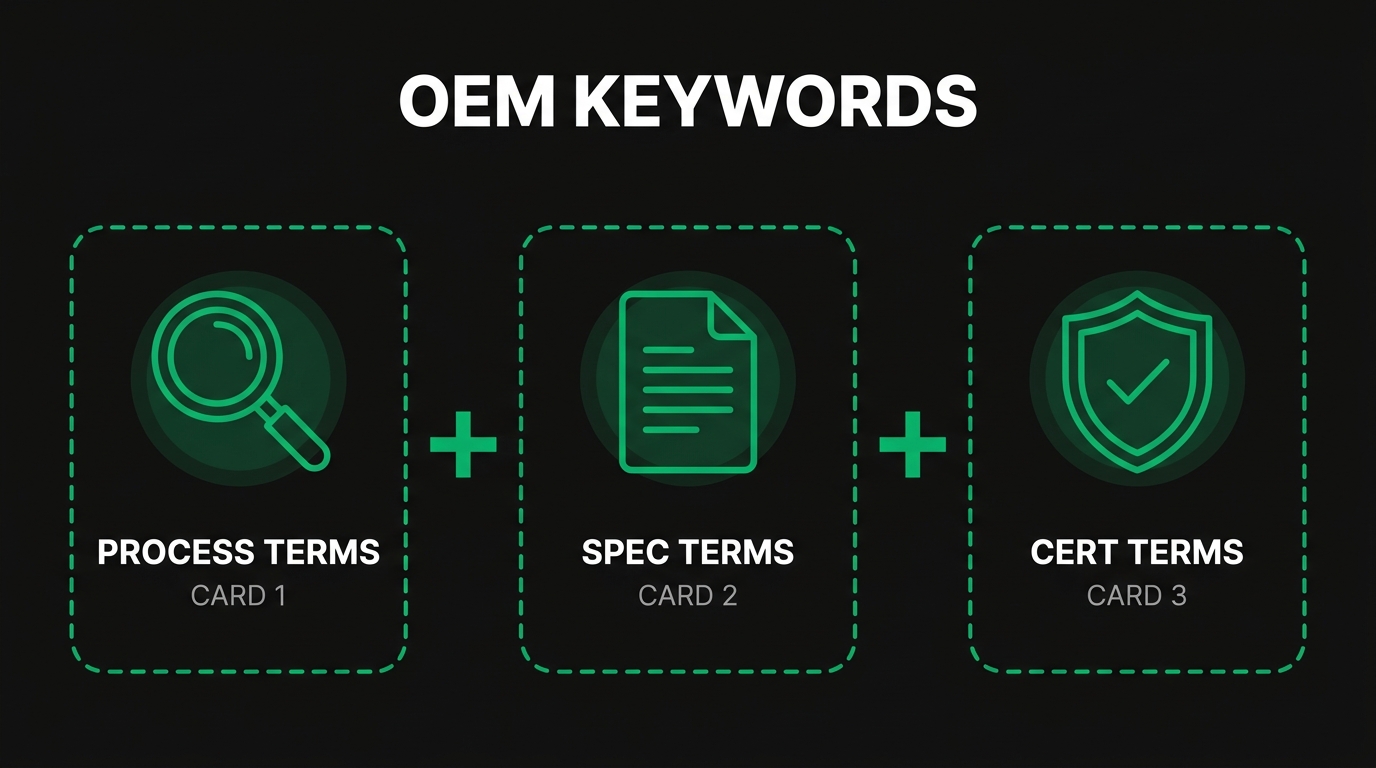
You optimize OEM product, capability, and service pages by tuning on-page elements for specification queries, structuring layouts for engineers and procurement, deploying the right schema types, and writing title tags and meta descriptions engineered for RFQ clicks.
What On-Page Elements Drive OEM Page Rankings for Specification Queries?
The on-page elements that drive OEM page rankings for specification queries are the H1, an above-the-fold tolerance table, material grade lists, certification badges with alt text, internal links to related capabilities, and a visible RFQ call to action. Thomasnet's industrial buyer study found that 73% of industrial buyers pay close attention to the company's website when evaluating potential suppliers, which means every visible element doubles as both a ranking and a trust signal. Pages that hide tolerances behind PDFs lose on both axes.
How Should Capability Pages Be Structured for Engineers and Procurement?
Capability pages for engineers and procurement should be structured as a top-to-bottom sequence: direct answer headline, process overview, materials table, tolerance table, certification list, quality process, typical industries and parts, and RFQ form. Engineers scan for tolerances and materials in the first screen. Procurement scans for certifications and lead time. Keep each section tight and label every table and list so CTRL-F succeeds. An expert page earns the RFQ when the engineer finds the tolerance they need without opening a PDF.
Which Schema Types Boost OEM Search Visibility?
The schema types that boost OEM search visibility are Organization, Product, ProductModel, Service, BreadcrumbList, and FAQPage. Schema.org defines ProductModel as "a datasheet or vendor specification of a product. Use this type when you are describing a product datasheet rather than an actual product, for example if you are the manufacturer of the product and want to mark up your product specification pages." Deploy ProductModel on capability pages, Service on process pages, and Organization on the homepage with sameAs links to LinkedIn, Thomasnet, and industry association pages. Use JSON-LD exclusively.
How Do You Write Title Tags and Meta Descriptions That Win RFQ Clicks?
You write title tags and meta descriptions that win RFQ clicks by front-loading the process, material, and certification in the title and promising a quote path in the description. Google Search Central states there's no limit on how long a meta description can be, but the snippet is truncated in Google Search results as needed, typically to fit the device width. Keep titles to 60 characters and descriptions to roughly 155 for consistent rendering. Lead with the exact RFQ modifier, then close with "Get a quote in 48 hours." This pattern sets up the content framework the next section expands.
How Should OEMs Approach Content Creation for Engineers and Buyers?
OEMs should approach content creation for engineers and buyers by matching format to intent, calibrating depth to the query, loading every page with trust signals, and making process tolerances and certifications the hero evidence.
What Content Types Convert Engineers Into RFQ Submissions?
The content types that convert engineers into RFQ submissions are capability case studies, tolerance-rich technical articles, downloadable design guides, video shop tours, and engineer-authored application notes. HubSpot's State of Marketing report shows 97% of marketers have a content strategy, with 61% indicating it significantly or moderately improved results and ROI, and top content types being case studies/customer success stories (41%), videos (39%), blogs (37%), and podcasts (31%). For OEM context specifically, see content strategy for oem vs fabrication. Case studies convert best because they prove the exact process, material, and certification the next engineer needs.
How Long Should an OEM Technical Content Asset Be to Rank Well?
An OEM technical content asset should be long enough to answer every buyer question on the topic and no longer. Capability pages commonly need 800 to 1,500 words plus tables. Process explainers and pillar pages run 2,000 to 3,500 words. Application notes are tighter, 600 to 1,200 words, because engineers scan for specific failure modes. Word count is not a ranking factor, but the depth required to cover tolerances, materials, certifications, and use cases usually lands in these ranges. Cut any sentence that does not add evidence.
Which Trust Signals Must Appear on Every OEM Content Page?
The trust signals that must appear on every OEM content page are author credentials, certification logos, client logos, facility photos, explicit tolerance claims, and supplier association memberships. Google Search Central Blog notes that "of these aspects, trust is most important. Pages that lack trust have low E-E-A-T regardless of how experienced, expert, or authoritative they may appear," with Google adding a second "E" for Experience in December 2022. For OEM sites, experience means photos of the actual shop, named engineers, and measured outcomes. A page with no photos and no author reads as unverified.
How Do You Showcase Process Tolerances and Quality Certifications in Content?
You showcase process tolerances and quality certifications in content by embedding a tolerance table in the first viewport, placing certification logos below the hero, and dedicating a section to the accreditation audit scope. The Performance Review Institute states "the Nadcap program offers 26 critical process accreditations, including historic special processes such as Nondestructive Testing, Heat Treating, Chemical processes," and "Nadcap process accreditation requires the company's quality system itself to be certified to AS9100 (or equivalent) before Nadcap auditing can be conducted." Spelling out the audit hierarchy beats a logo pile. This evidence pattern sets up the link-earning work in the next section.
What Backlink and Digital PR Tactics Work for OEM Manufacturers?
The backlink and digital PR tactics that work for OEM manufacturers are trade-publication placements, editorial links from engineering media, outreach angles built on original data or proprietary process depth, and link quality tracking aligned to referring-domain relevance.
Which Trade Publications Pass the Most Authority to OEM Sites?
The trade publications that pass the most authority to OEM sites are industry-specific titles with active editorial teams, strong referring-domain counts, and reader bases of engineers and buyers. Examples include Modern Machine Shop, Design News, Plastics Technology, Medical Design & Outsourcing, Assembly, and Aerospace Manufacturing and Design. Industry association sites such as SME, AMT, and NTMA also carry weight because they signal topical authority to Google alongside raw DR. Prioritize titles whose editorial calendar covers your process and material cadence.
How Do You Earn Editorial Links From Engineering and Industrial Media?
You earn editorial links from engineering and industrial media by pitching data-driven stories, commentary on regulatory change, new certifications earned, and proprietary process breakthroughs. Reporters need numbers, named engineers, and a specific angle. Send the pitch with a draft headline, three bullet-point findings, an interview quote, and a photo link. Follow with the editor's preferred CMS format. See b2b link building strategy for the full editorial pitch template used for industrial SEO campaigns.
What Outreach Angles Work Best for OEM Link Acquisition?
The outreach angles that work best for OEM link acquisition are original survey data, anonymized customer case evidence, regulatory commentary, equipment investment announcements, and new-certification press. Avoid generic "we exist" pitches. A specific angle such as "Our AS9100 audit surfaced three tolerance failures most aerospace suppliers miss" earns coverage because it teaches the reader's audience something concrete. The expert view: angles that educate the editor's readers always outperform angles that promote the OEM.
How Do You Measure Backlink Quality for OEM SEO?
You measure backlink quality for OEM SEO by scoring each referring domain on topical relevance, referring-page context, anchor-text diversity, and referring-domain authority. A DR 50 trade publication in your exact vertical outperforms a DR 80 generic news site. Track referring-domain growth monthly, not raw backlink count, because one publication can place dozens of links that all carry one signal. Filter out directories, scraped press releases, and irrelevant guest posts. The highest-value OEM link is an in-text citation from a reporter your engineer emailed.
How Should OEMs Optimize for AI Search and LLM Citations?
OEMs should optimize for AI search and LLM citations by treating entity signals as first-class SEO assets, deploying schema that LLMs can parse, publishing the formats answer engines prefer, and tracking brand mentions across AI interfaces.
Why Are LLM Citations Becoming Critical for OEM Procurement Discovery?
LLM citations are becoming critical for OEM procurement discovery because buyers increasingly ask ChatGPT, Perplexity, and Gemini for supplier shortlists before opening Google. Pew Research Center reports that 38% of employed 18- to 29-year-olds say they've used ChatGPT at work, dropping to 30% of those 30 to 49 and 18% of those 50 and older. Procurement teams skew older but are catching up, and the younger cohort now sits in specifying engineer roles. Getting cited by an LLM is a qualification event on par with ranking page one.
How Do Entity Signals and Schema Influence AI Search Visibility?
Entity signals and schema influence AI search visibility because LLMs ground their answers in structured, cross-referenced data far more than in raw page text. Publish Organization schema with sameAs links to LinkedIn, Thomasnet, and trade-association profiles. Publish ProductModel schema on capability pages with precise material, tolerance, and certification properties. Keep a consistent NAP across every directory. The expert view: the OEM with the cleanest entity graph, not the one with the most pages, wins AI citations.
Which Content Formats Are Most Often Cited by Large Language Models?
The content formats most often cited by large language models are direct-answer Q&A, numbered step-by-step guides, comparison tables, glossaries, and data-heavy industry reports. LLMs quote short, self-contained paragraphs that answer the exact user question. Structure every capability page with a direct-answer opener, a tolerance table, a materials list, and a Q&A section at the bottom. Include numbers with units and sources so the model can resolve the claim. Avoid walls of marketing prose that force the LLM to summarize rather than quote.
How Do You Track OEM Brand Mentions Across AI Answer Engines?
You track OEM brand mentions across AI answer engines by running structured prompts through ChatGPT, Perplexity, Gemini, and Claude on a weekly schedule and logging every citation, mention, and competitor reference. Tools such as Profound, Peec AI, and Ahrefs Brand Radar automate the scraping. Score each prompt response on three signals: brand presence, competitor presence, and citation accuracy. Feed gaps back into the entity graph and content roadmap. This loop closes the AI visibility layer before we measure results.
How Do You Measure OEM SEO Success Beyond Keyword Rankings?
You measure OEM SEO success beyond keyword rankings by tying KPIs to pipeline and revenue, attributing RFQs and quotes to organic search, reporting on a cadence that matches stakeholder decisions, and benchmarking against direct competitors.
Which KPIs Tie OEM SEO Performance to Pipeline and Revenue?
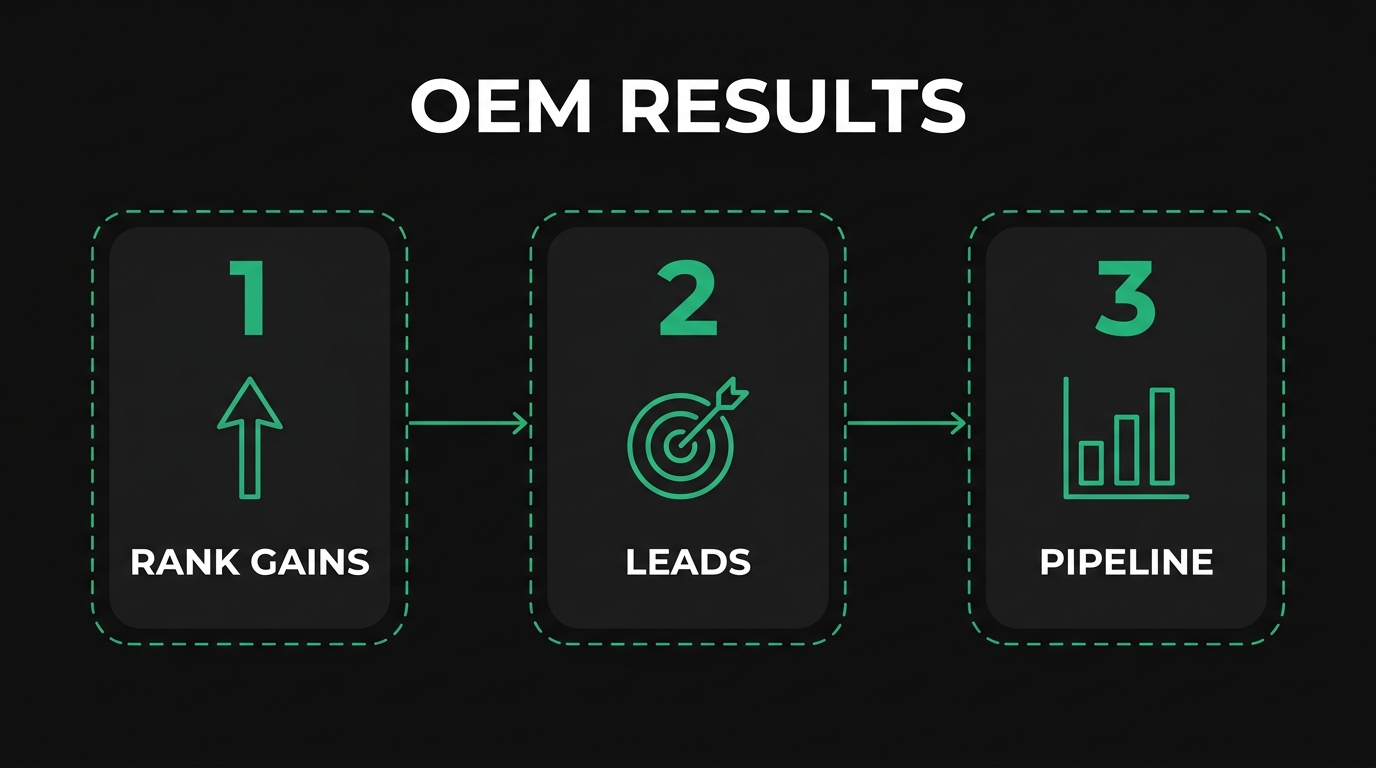
The KPIs that tie OEM SEO performance to pipeline and revenue are organic RFQ count, organic quote dollar volume, closed-won revenue sourced from organic, average deal size by landing page, and first-touch to closed-won cycle time. Forrester reports that more buyers than ever are conducting their research online before they visit any provider's own website, meaning that marketers lack visibility into at least 50% of the buying journey. Multi-touch attribution captures that hidden window and assigns credit where the first organic visit earned it. Vanity metrics such as total keywords or impressions stay in the appendix.
How Do You Attribute RFQs and Quotes to Organic Search?
You attribute RFQs and quotes to organic search by implementing GA4 ecommerce events on the RFQ form, passing the form payload into the CRM with the landing page URL, and tagging every opportunity with first-touch, last-touch, and multi-touch values. Set up a data layer that captures landing page, query, device, and UTM on submit. Mirror the same fields in the CRM lead record. A monthly reconciliation ties closed-won revenue back to the capability page that earned the click. Without this plumbing, organic always looks smaller than paid.
What Reporting Cadence Works Best for OEM Stakeholders?
The reporting cadence that works best for OEM stakeholders is a monthly deep-dive deck for marketing leadership, a weekly one-page scorecard for the sales team, and a quarterly executive review for finance and operations. Monthly covers rankings, RFQs, and content velocity. Weekly covers quote pipeline and hot keywords. Quarterly ties SEO spend to closed-won revenue and forecasts the next quarter's investment. The expert cadence call: more frequent reporting never produces better outcomes; it produces meeting fatigue.
How Do You Benchmark OEM SEO Against Direct Competitors?
You benchmark OEM SEO against direct competitors by tracking shared keyword overlap, share of voice on RFQ queries, referring-domain velocity, and content publishing frequency. Use Ahrefs or Semrush to export the competitor's top pages, subtract your own, and size the gap by traffic value. Track share of voice monthly on a fixed list of 50 RFQ phrases. A rising competitor share of voice is an earlier leading indicator than a dropping ranking. This benchmarking data drives the engagement plan the next section opens.
How Should You Approach OEM SEO Strategy With a Manufacturing-Focused SEO Agency?
You should approach OEM SEO strategy with a manufacturing-focused SEO agency by bringing your capability inventory, existing keyword data, and RFQ pipeline goals to a partner that speaks the procurement vocabulary. Generalist agencies optimize for vanity rankings; manufacturing specialists optimize for quote volume.
Can Manufacturing SEO Agency Help Implement This OEM SEO Checklist?
Manufacturing SEO Agency can help implement this OEM SEO checklist because Manufacturing SEO Agency is a manufacturing-focused seo agency built exclusively for industrial operators. Manufacturing SEO Agency provides manufacturing audits, procurement-intent keyword architecture, topical authority buildout, editorial link building, AI search visibility engineering, technical SEO, and revenue-tied reporting. Manufacturing SEO Agency serves OEMs, contract manufacturers, and regulated-industry operators whose buyers are engineers, purchasing managers, and supply chain directors. Every engagement ties deliverables to RFQ pipeline value, not vanity keyword movement. Manufacturing SEO Agency builds each OEM program on the same checklist documented above.
What Are the Key Takeaways About the OEM SEO Strategy Checklist We Covered?
The key takeaways about the OEM SEO strategy checklist we covered are these:
- OEM SEO wins by targeting process, material, and certification queries that procurement buyers actually type, not brand names.
- Foundational audits fix technical SEO, crawl errors, intent mismatches, and architecture before any new content ships.
- Procurement-intent keyword architecture clusters queries by process, material, and certification, then prioritizes by volume and buying stage.
- Topical authority maps and pillar-plus-cluster content close coverage gaps against top-ranking OEM competitors and refresh quarterly.
- Capability pages must surface tolerance tables, certification badges, and ProductModel schema above the fold to win RFQ clicks.
- Editorial links from trade publications and AI search citations compound rankings as the entity graph matures.
- Success measurement ties organic RFQs and quote pipeline to closed-won revenue, not keyword counts.