Industrial SEO competitor analysis is the systematic process of identifying the manufacturers, distributors, and industrial suppliers ranking for your procurement-intent keywords, then reverse-engineering their topical coverage, technical SEO, backlink profiles, and conversion systems to outrank them for RFQ-driving queries. Unlike generic competitor research, it maps competition at the intersection of process, material, and certification searches used by engineers and procurement managers.
This guide covers foundational definitions, the strategic reasons manufacturers must audit rivals, how to identify real industrial search competitors, a 7-step analysis workflow, the tools and data sources behind the work, a full checklist of on-page and off-page signals, and tactical plays for outranking competitors after the audit.
We begin by defining industrial SEO competitor analysis inside the manufacturing sector and explaining why procurement-driven search behavior, certification keywords, and process-material specificity make this discipline different from standard B2B competitor research.
We then explain why manufacturers must conduct competitor SEO analysis before building any growth strategy, including how this work surfaces hidden RFQ opportunities, exposes the risks of ignoring search intelligence, and lifts procurement funnel conversion rates.
Next, we identify who your real competitors actually are, separating SERP rivals from sales pipeline rivals and mapping competition across process, material, and certification niches that engineers query.
We then walk through the 7-step workflow, the tools and data sources that power it, the complete on-page and off-page comparison checklist, and the post-audit tactics for winning and defending rankings against aggressive industrial competitors.
What Defines Industrial SEO Competitor Analysis in the Manufacturing Sector?
Industrial SEO competitor analysis is defined as reverse-engineering rival manufacturers, distributors, and trade platforms ranking for procurement-intent queries tied to process, material, and certification keywords. This section covers how it differs from generic B2B research, which procurement behaviors make it unique, and why spec keywords rule competition.
How Does Industrial SEO Competitor Analysis Differ From Generic B2B Competitor Research?
Industrial SEO competitor analysis differs from generic B2B competitor research because it targets the process-material-certification keyword triad that procurement engineers query, not broad category terms. Generic B2B research measures brand share of voice across wide topics. Industrial analysis pinpoints long-tail queries such as "5-axis CNC titanium aerospace" or "ISO 13485 injection molder." Companies that confuse the two disciplines lose to specialists who audit at spec-level granularity. Start with what is industrial seo to anchor the vocabulary.
Which Procurement-Driven Search Behaviors Make Industrial Competitor Analysis Unique?
Procurement-driven search behaviors make industrial competitor analysis unique by pushing buyers through self-directed, spec-heavy, multi-session research before any sales contact. Engineers search tolerances, certifications, lead times, and sample capacity before contacting a supplier. A deeper competitive seo analysis manufacturing industry breakdown shows how these behaviors cluster into recognizable query patterns.
Why Do Process, Material, and Certification Keywords Define Manufacturing Search Competition?
Process, material, and certification keywords define manufacturing search competition because procurement teams only shortlist suppliers whose pages match the exact spec triad inside the RFQ. SERPs reward manufacturers who explicitly name every accreditation, material grade, and process variant on dedicated pages.
This spec-level specificity is what separates ranking industrial sites from generic B2B pages and sets up the strategic urgency discussed next.
Why Should Manufacturers Conduct Competitor SEO Analysis Before Building a Strategy?
Manufacturers should conduct competitor SEO analysis before building a strategy because competitors have already taught Google which manufacturing entities, specifications, and trust signals earn procurement-intent rankings. Skipping this audit means guessing. This section covers hidden RFQ opportunities, the risks of ignoring intelligence, and funnel conversion lift.
How Does Competitor Analysis Reveal Hidden RFQ Opportunities for Industrial Suppliers?
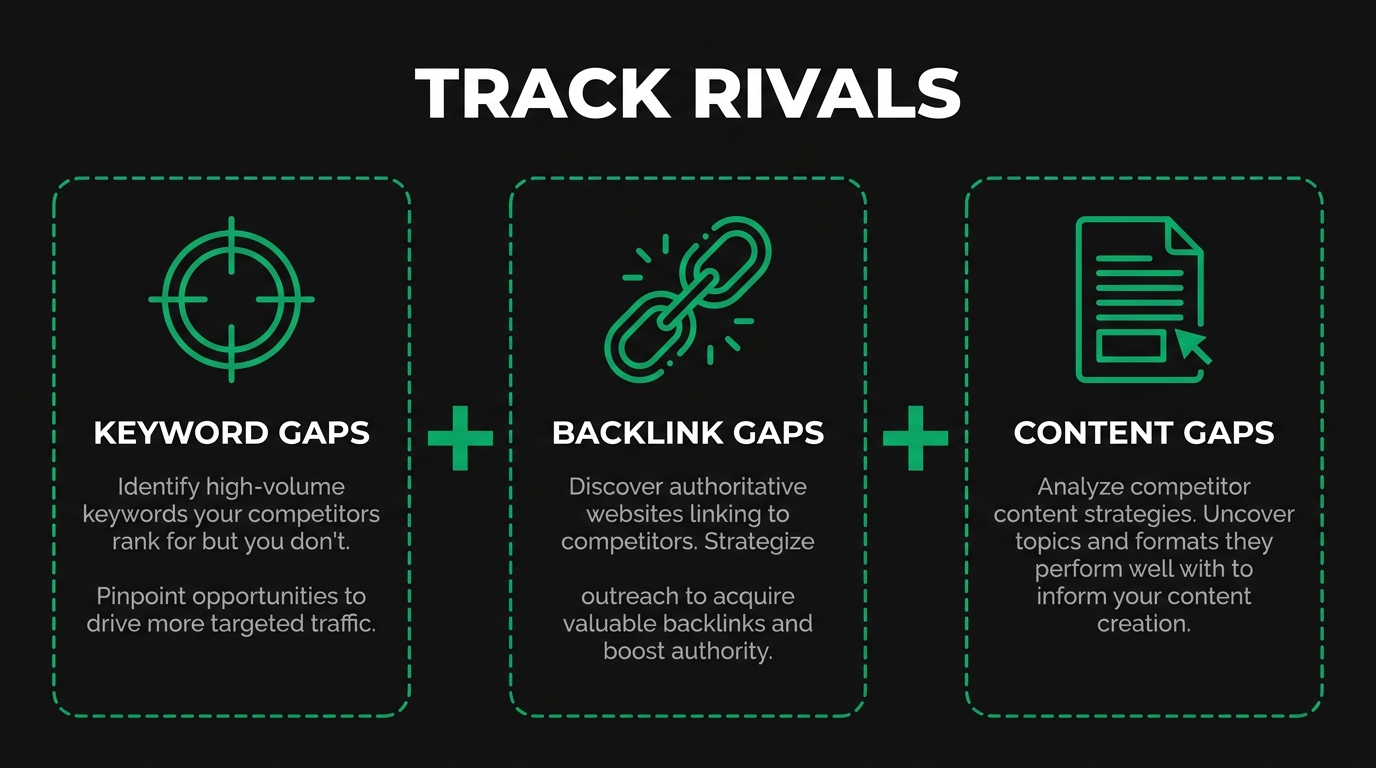
Competitor analysis reveals hidden RFQ opportunities for industrial suppliers by exposing high-intent queries where rivals rank but you have no matching page. Gap analysis finds process, material, or certification permutations competitors monetize and you ignore. Hidden RFQs cluster around niche certification queries, uncommon material grades, and local process combinations. Pair this audit with seo for industrial lead generation to connect ranking lift to revenue.
What Risks Do Manufacturers Face Without Ongoing Competitor SEO Intelligence?
Manufacturers face risks without ongoing competitor SEO intelligence such as silent ranking losses, category misunderstanding, and strategic drift. Risks include ceding topical authority to newer rivals, missing AI Overview citation patterns, overlooking trade-publication backlink acquisition, and pursuing commoditized keywords.
How Does Competitor Benchmarking Improve Procurement Funnel Conversion Rates?
Competitor benchmarking improves procurement funnel conversion rates by revealing on-page trust signals, content depth, and interactive tools that already convert industrial buyers. By studying the top five ranking competitors per cluster, you inventory which certification badges, datasheets, video walk-throughs, capability matrices, and RFQ forms drive lift.
The fastest conversion gains come from replicating competitor RFQ form fields rather than redesigning the page. Benchmarking sets the stage for identifying who your real rivals actually are.
Who Are Your Real Competitors in Industrial Search Results?
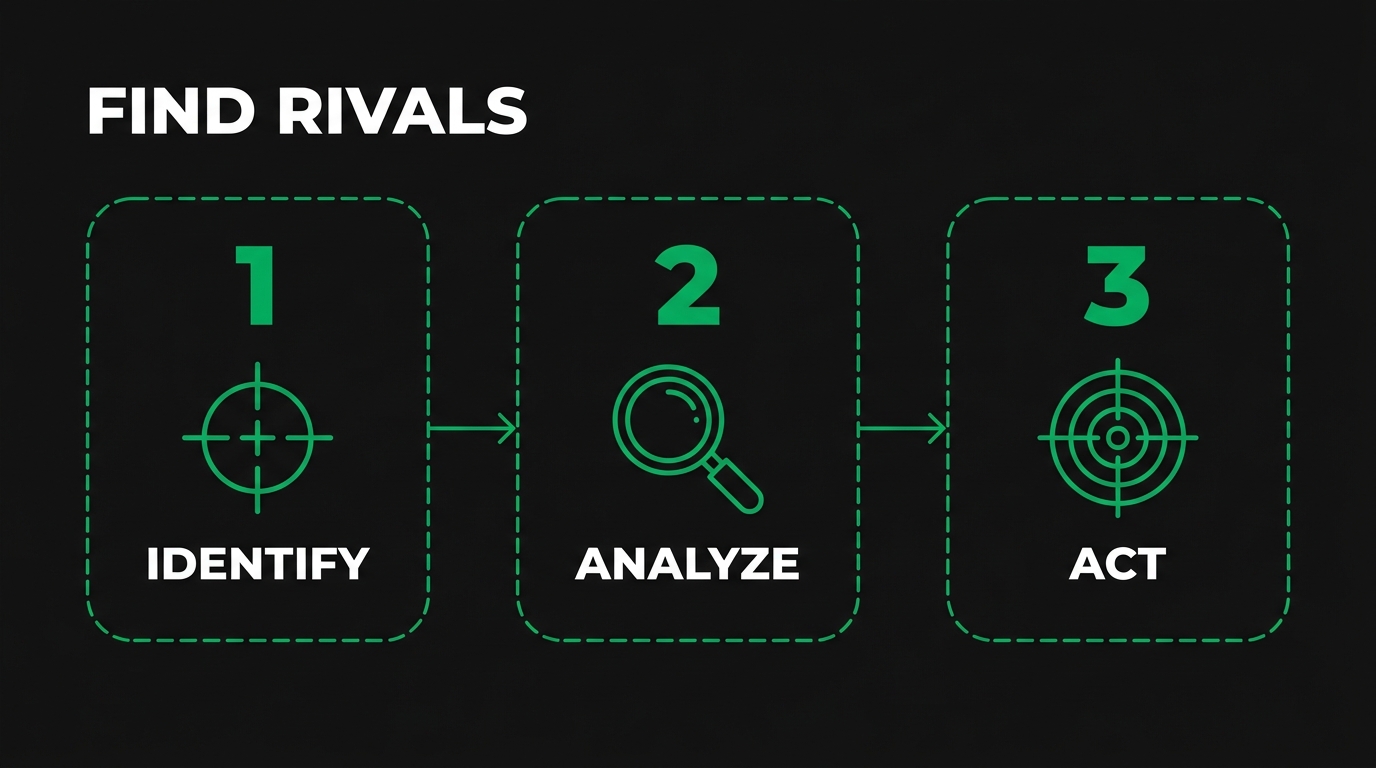
Your real competitors in industrial search results are the manufacturers, distributors, trade platforms, and AI-cited sources occupying your target SERPs, not the rivals your sales team names. These subsections cover direct versus adjacent rivals, SERP versus pipeline competitors, and competitor mapping across process, material, and certification niches.
How Do You Identify Direct Versus Adjacent Manufacturing SEO Competitors?
Direct versus adjacent manufacturing SEO competitors are identified by comparing process, material, and certification overlap across the top ranking domains for your keyword clusters. Direct competitors offer the same process-material-certification triad you offer. Adjacent competitors share two of the three and bid for related clicks. Examples of adjacent rivals include sheet-metal shops ranking for fabrication queries while you run weldments, distributors outranking fabricators on material-grade pages, and trade platforms such as Thomasnet aggregating suppliers.
Identification requires SERP scraping, deduplication by root domain, and scoring each domain on keyword overlap. Top five domains recurring across 30 percent or more of cluster keywords define the direct-competitor set.
Why Are SERP Competitors Different From Your Sales Pipeline Competitors?
SERP competitors are different from your sales pipeline competitors because Google ranks based on topical authority, backlinks, and user signals, while your sales team names rivals based on deal-room losses. The two lists rarely overlap completely. Distributors, trade directories, and content-heavy agencies routinely outrank fabricators on fabricator-intent keywords.
That link dynamic explains why aggregators and publishers capture rankings even when they never quote an RFQ. Treating SERP rivals and pipeline rivals as one list is a common, costly error.
How Do You Map Competitors Across Process, Material, and Certification Niches?
Competitors are mapped across process, material, and certification niches by building a matrix where rows list your capabilities and columns list the top ranking domains for each capability. Each cell records keyword count, average position, and estimated traffic for that domain-capability pair.
Mapping includes: (1) listing every process you offer, (2) listing every material family, (3) listing every certification you hold, (4) extracting ranking domains from tools such as Ahrefs or Semrush, and (5) color-coding overlap density. This mapping feeds the 7-step workflow we cover next.
What Are the 7 Steps of an Industrial SEO Competitor Analysis Workflow?
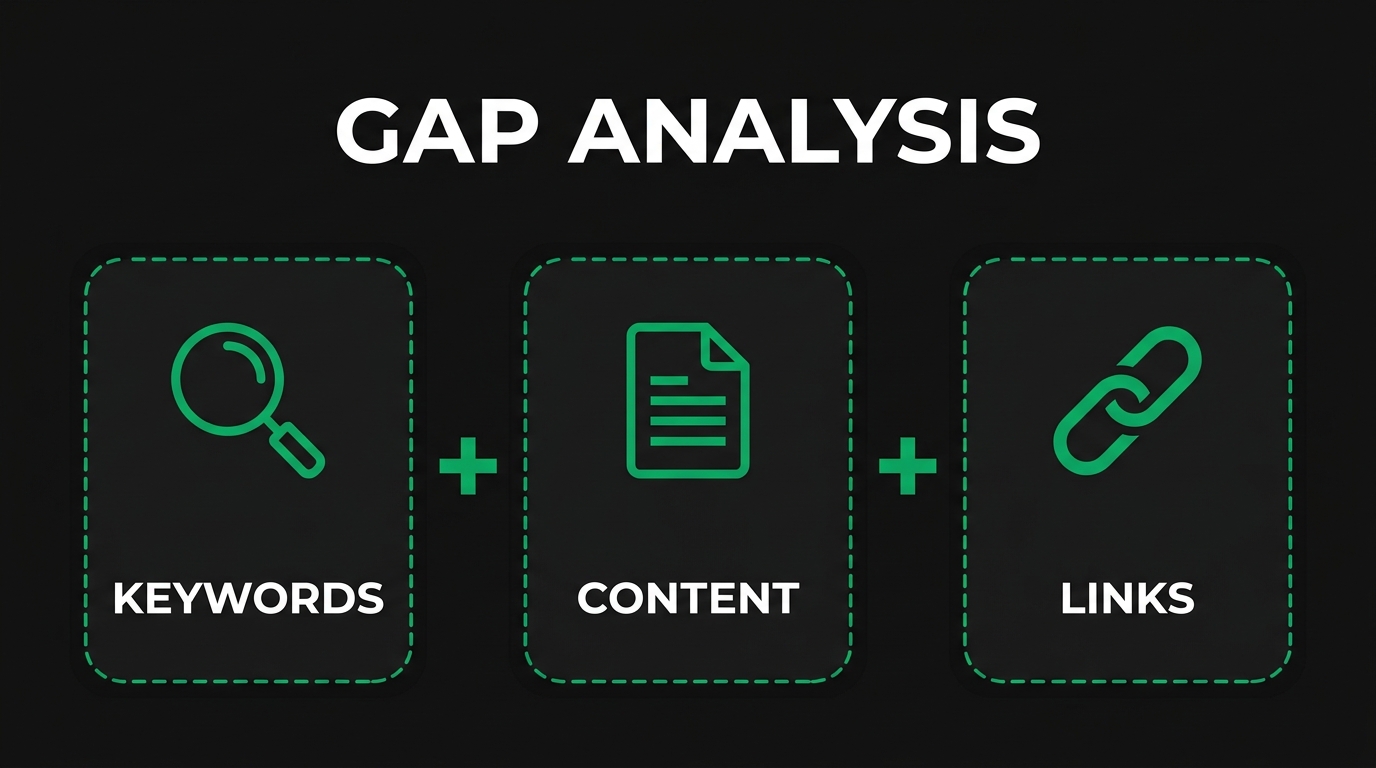
The 7 steps of an industrial SEO competitor analysis workflow are: define the keyword universe, identify SERP competitors, audit backlinks, map topical coverage, benchmark technical SEO, analyze content depth, and prioritize actions. These align with mainstream industrial seo strategies and create a quarterly cadence.
Step 1: How Do You Define the Procurement Keyword Universe Worth Analyzing?
The procurement keyword universe worth analyzing is defined by enumerating every process, material, certification, application, and geographic modifier your buyers search across the RFQ funnel. Seed the universe with capabilities lifted from your quoting system and ERP material codes, then expand using keyword tools and LLM query logs.
Capture research-stage, evaluation-stage, and RFQ-stage queries separately. The universe should also cover synonym variants, obsolete spec names still queried by veteran engineers, and LLM-friendly natural-language phrasings.
Step 2: How Do You Identify the Top SERP Competitors for Each Keyword Cluster?
The top SERP competitors for each keyword cluster are identified by running the cluster seed terms through a rank tracker, extracting the top ten organic URLs, and aggregating domains by frequency. Run queries in incognito windows tied to your target buyer location to neutralize personalization.
Steps include logging SERP features such as AI Overview and People Also Ask, recording position variability, and flagging domains that appear in more than 20 percent of cluster queries. The output is a ranked competitor shortlist of 8 to 12 domains.
Step 3: How Do You Audit Competitor Domain Authority and Backlink Profiles?
Competitor domain authority and backlink profiles are audited by exporting each rival's referring domains, anchor-text distribution, top-linked pages, and link velocity from a backlink intelligence platform.
Compare each competitor's monthly acquisition rate to that benchmark to spot who is actively link-building versus coasting. Audit outputs should include referring-domain count, authority distribution, link velocity trend, top anchor clusters, and the specific pages attracting the most links.
Step 4: How Do You Map Competitor Topical Coverage Across Processes and Materials?
Competitor topical coverage across processes and materials is mapped by crawling each rival's site, classifying every URL by process, material, certification, and application, and plotting gaps against your own coverage. Use a technical crawler to extract H1 and canonical URL patterns, then run the titles through an LLM classifier to tag each page by capability.
The map surfaces process permutations competitors cover but you do not, material grades they document on dedicated pages, and certification hubs that aggregate capability landing pages.
Step 5: How Do You Benchmark Competitor Technical SEO and Schema Implementation?
Competitor technical SEO and schema implementation are benchmarked by crawling each domain for Core Web Vitals, mobile rendering, internal link structure, and structured data coverage. Run the same crawl against your own site as an industrial seo audit to produce an apples-to-apples diff.
Schema benchmarking includes Organization, Product, FAQPage, HowTo, BreadcrumbList, and LocalBusiness markup on capability pages. Web Data Commons reports structured data adoption now exceeds 51 percent of examined pages, making schema a parity expectation.
Step 6: How Do You Analyze Competitor Content Depth and Procurement-Intent Alignment?
Competitor content depth and procurement-intent alignment are analyzed by scoring each top-ranking URL against a rubric covering word count, heading architecture, spec-table presence, certification call-outs, RFQ CTA placement, and expert-authored byline signals.
Depth analysis flags pages missing material tables, capabilities without tolerance data, blogs without engineer bylines, and hub pages with thin internal linking. Comparing your pages against the competitor rubric yields a concrete upgrade list per URL.
Step 7: How Do You Translate Competitor Findings Into a Prioritized Action Plan?
Competitor findings are translated into a prioritized action plan by scoring each gap on RFQ impact, implementation effort, and time-to-rank, then sequencing work into 30-day, 60-day, and 90-day cohorts. Plan elements include content tickets per missing capability page, technical remediation per Core Web Vitals failure, link acquisition targets per quarter, and schema deployment sprints.
A companion resource for partners is how to choose an industrial seo agency. The plan then requires the right tooling.
Which Tools and Data Sources Power Industrial SEO Competitor Analysis?
The tools and data sources that power industrial SEO competitor analysis include keyword research platforms, backlink intelligence suites, technical crawlers, trade databases, and patent search tools. Each category answers a different question, so a complete audit needs one tool from each layer.
Which Keyword Research Platforms Surface Procurement-Intent Search Volume?
Keyword research platforms that surface procurement-intent search volume include enterprise suites built on large clickstream panels and industry-specific databases for spec-driven terms. The two dominant generalist options are Ahrefs and Semrush, both offering SERP-level rank tracking, keyword difficulty scoring, and competitor gap analysis. A deep breakdown of the trade-offs sits in our semrush vs ahrefs for industrial seo guide.
Supplementary sources include Google Search Console for zero-click query discovery, Google Keyword Planner for long-tail volume, and AnswerThePublic for question-modality queries.
How Do Backlink Intelligence Tools Reveal Competitor Authority Patterns?
Backlink intelligence tools reveal competitor authority patterns by exposing each domain's referring-domain count, anchor-text distribution, link velocity, and top linked pages.
Tools include Ahrefs Site Explorer, Semrush Backlink Analytics, Majestic Trust Flow metrics, and Moz Link Explorer. Each surfaces new referring domains by week, lost backlinks flagging at-risk rankings, topic clusters attracting links, and the trade publications that historically link to competitors. Patterns worth replicating include long-form technical guides, industry benchmark studies, and data-rich calculators that earn unprompted citations.
What Role Do Technical Crawlers Play in Auditing Competitor Site Health?
Technical crawlers play the role of stress-testing competitor site health by rendering every URL, flagging Core Web Vitals issues, indexability problems, and schema gaps.
Crawlers worth standardizing on include Screaming Frog for depth, Sitebulb for visualization, DeepCrawl for enterprise sites, and JetOctopus for log-file analysis. Run crawls against both your own site and each top-five competitor, then diff the reports. The gaps frequently expose JavaScript rendering failures, duplicate canonical chains, and missing hreflang that quietly suppress rankings.
How Do Industry Trade Databases Enrich Competitor Intelligence?
Industry trade databases enrich competitor intelligence by layering supplier directories, certification registries, patent filings, and trade-flow data on top of SERP signals.
Trade databases worth consulting include Thomasnet for supplier capability listings, the IAQG OASIS database for aerospace certifications, the IATF public certification search, the USPTO Patent Public Search tool, and NIST Manufacturing Extension Partnership resources. Layering these with SERP data turns a flat ranking report into an intelligence product that informs the on-page checklist next.
What Should Be on Your Industrial SEO Competitor Analysis Checklist?
Your industrial SEO competitor analysis checklist should include on-page elements, off-page signals, procurement-intent conversion elements, and a reporting cadence. These four layers convert a one-off audit into an ongoing intelligence feed that guides quarterly sprint planning.
Which On-Page Elements Must You Compare Across Manufacturing Competitors?
On-page elements you must compare across manufacturing competitors include page title and H1 spec density, heading architecture depth, capability tables with tolerance data, material-grade schema markup, certification badges, engineer byline signals, RFQ CTA placement, internal linking between process and material pages, and image alt text on spec photos.
Score each element on a 0-to-3 scale per competitor URL. The composite score predicts which competitor pages are vulnerable to well-structured challenger content.
Which Off-Page Signals Should You Track to Measure Competitive Authority?
Off-page signals you should track to measure competitive authority include referring-domain count, referring-domain quality distribution, monthly net link gain, trade-publication citation frequency, brand mention volume, AI Overview citation inclusion, LLM answer inclusion, unlinked brand mentions on forums and supplier directories, and review-site presence on platforms such as Thomasnet.
Off-page monitoring also catches reputation shifts early, since negative coverage impacts SERP click behavior before rankings move.
Which Procurement-Intent Conversion Elements Need Side-by-Side Comparison?
Procurement-intent conversion elements needing side-by-side comparison include RFQ form field count, file-upload acceptance, quote-turnaround promises, sample-request buttons, capability-matrix downloads, calculator tools, testimonial formats, case-study depth, lead-time transparency, and chat availability. The OEM buyer journey has its own conversion grammar, so pair this checklist with an oem seo strategy checklist.
Side-by-side grids expose friction deltas that shift RFQ submit rates by whole percentage points.
Which Reporting Cadence Sustains Competitor SEO Intelligence Over Time?
The reporting cadence that sustains competitor SEO intelligence over time is a three-tier rhythm: weekly rank-delta alerts, monthly topical-coverage diffs, and quarterly strategic reviews. Weekly alerts flag sudden position drops and new competitor entrants. Monthly reports compare content velocity, link velocity, and schema deployment across the competitor set. Quarterly reviews reset the keyword universe, retire solved gaps, and add newly surfaced query patterns.
Automate data collection with rank trackers and crawler APIs to keep manual analyst time focused on interpretation.
How Do You Outsmart Industrial Competitors Once the Analysis Is Complete?
You outsmart industrial competitors once the analysis is complete by shipping high-intent content fast, compounding topical authority before rivals notice, and hardening your SERP positions against counter-attacks. This playbook covers quick-win prioritization, topical-authority moat construction, and ranking defense against aggressive challengers.
How Do You Prioritize Quick-Win Keyword Gaps for Immediate RFQ Lift?
Quick-win keyword gaps for immediate RFQ lift are prioritized by intersecting three filters: competitor rankings with weak content, keywords with direct RFQ association, and pages you can ship inside two weeks. Rank each gap 1-to-5 on intent, effort, and time-to-rank. Quick wins cluster around underserved certification-plus-process queries, neglected material-grade pages, and local-plus-process combinations.
Production-ready content following the spec-page template lifts RFQ submissions inside the quarter.
How Do You Build a Topical Authority Moat Competitors Cannot Replicate Quickly?
A topical authority moat competitors cannot replicate quickly is built by publishing complete process-material-certification hubs with interconnected internal linking, engineer-authored bylines, and schema-rich entity pages.
Moat components include a process hub with one page per capability variant, a material hub with one page per grade and alloy family, a certification hub with individual accreditation pages, a glossary linking entity terms, and an application library linking capability to end-use industries. The resulting link graph produces cumulative authority that out-paces piecemeal competitor content for 12 to 24 months.
How Do You Defend Hard-Won Rankings Against Aggressive Industrial Rivals?
Hard-won rankings are defended against aggressive industrial rivals by monitoring SERP volatility weekly, refreshing ranking pages quarterly, and building a defensive backlink reservoir. Defensive actions include adding internal links when related pages ship, updating statistics on capability pages when fresh data publishes, expanding FAQ schema with new question phrasings, and acquiring trade-publication mentions that reinforce anchors.
Ranking defense is trust preservation as much as content optimization. This sets up the strategic partnership question next.
How Should You Approach Industrial SEO Competitor Analysis With Manufacturing SEO Agency?
You should approach industrial SEO competitor analysis with Manufacturing SEO Agency by scoping a manufacturing audit, mapping the procurement keyword universe, and tying findings to RFQs and closed revenue in one engagement. Working with manufacturing seo experts who operate only in industrial categories compresses analysis-to-pipeline time.
Can Manufacturing SEO Agency's Competitive Intelligence Service Help With Industrial Competitor Analysis?
Manufacturing SEO Agency's competitive intelligence service helps with industrial competitor analysis by delivering a full technical crawl, current keyword footprint mapping, and reverse-engineering every competitor ranking above the client. Manufacturing SEO Agency serves B2B manufacturers across CNC machining, injection molding, metal fabrication, additive manufacturing, aerospace, automotive, electronics, food, pharmaceutical, and OEM contract manufacturing.
The service sits inside the Manufacturing SEO Agency methodology covering procurement-intent keyword architecture, topical authority buildout, PR-grade editorial link building, AI search visibility engineering, and revenue-tied reporting.
What Are the Key Takeaways About Industrial SEO Competitor Analysis We Covered?
The key takeaways about industrial SEO competitor analysis we covered are: industrial analysis lives at the process-material-certification intersection, procurement-driven search behavior rewards spec-dense pages, SERP rivals rarely match sales-pipeline rivals, and a 7-step workflow spanning keyword universe definition through prioritized action planning produces a repeatable audit. The tooling stack combines keyword platforms, backlink intelligence, technical crawlers, and trade databases. The checklist spans on-page, off-page, conversion, and reporting layers. Post-audit execution prioritizes quick-win gaps, topical-authority moats, and ranking defense. Manufacturing SEO Agency packages these disciplines into a single engagement so manufacturers move from competitor insight to RFQ lift without assembling a multi-vendor toolchain.