Industrial SEO for lead generation is the practice of ranking manufacturing websites for procurement-intent queries (process, material, certification, and capability terms) so that engineers and purchasing managers find the supplier, request a quote, and convert organic traffic into qualified RFQs. We treat search visibility as a pipeline channel, not a vanity metric.
This guide covers buyer behavior and search intent, keyword and content strategy, on-page and technical foundations, off-site authority, local visibility, measurement, and the pitfalls that suppress reported lead volume.
The buyer-behavior layer explains how engineers and procurement managers actually search and how the industrial buying journey maps to specification-heavy long-tail queries that convert into quote requests.
The strategy layer covers keyword architecture built around process, material, and certification clusters, plus page templates, trust signals, and CTAs that turn ranking traffic into form fills.
The technical layer covers Core Web Vitals, schema markup, mobile-first crawl health, and the topical-authority systems (pillar pages, content clusters, publishing cadence) that compound lead volume over time.
The off-site and local layer covers trade-publication backlinks, editorial outreach, Google Business Profile optimization, and NAP consistency across multi-facility operations.
The measurement and pitfalls layer covers the KPIs that tie organic rankings to RFQs and closed revenue, attribution modeling for upper-funnel content, and the common mistakes (vanity keywords, tracking errors, generic-agency strategies) that quietly suppress reported lead volume.
What Is Industrial SEO for Lead Generation and Why Does It Matter for Manufacturers?
Industrial SEO for lead generation is the discipline of ranking manufacturing websites for procurement-intent queries so engineers and purchasing managers find the supplier and submit a quote request. It matters because organic search routes the highest-intent buyers directly into the RFQ funnel without paid-acquisition tax.
How Does Industrial SEO Differ from Generic B2B Lead Generation?
Industrial SEO differs from generic B2B lead generation by targeting buyers who specify processes, materials, tolerances, and certifications, not job titles or persona traits. The audience searches for "5-axis CNC machining titanium AS9100 supplier," not "manufacturing services."
Generic B2B campaigns chase awareness; industrial SEO chases the procurement keyword cluster a real buyer types when sourcing parts. Understanding the foundational question of what is industrial seo frames every downstream lead-generation decision a manufacturer makes.
Why Is Organic Search the Highest-Intent Channel for Industrial Buyers?
Organic search is the highest-intent channel for industrial buyers because procurement teams self-direct the supplier discovery process before any sales conversation begins.
Industrial buyers translate that preference into specific spec-and-cert search queries. Each query represents a buyer already past the consideration stage and shopping suppliers, which makes organic clicks worth more than any cold-channel impression manufacturers can buy.
Which Manufacturing Sectors See the Biggest Lead Lift from SEO?
The manufacturing sectors that see the biggest lead lift from SEO are sectors with fragmented supplier markets and certification gates, such as CNC machining, injection molding, metal fabrication, additive manufacturing, aerospace, medical, automotive, and contract manufacturing.
Sectors with niche capabilities and regulated buyers benefit most because procurement teams use search to filter on certifications and process specificity. Strong SEO becomes the qualifier of first impression for how do manufacturers get leads online in these regulated, search-driven categories.
How Do Industrial Buyers Search When They Are Ready to Request a Quote?
Industrial buyers search by combining process names, material specs, certifications, tolerances, and geography into long-tail queries that signal an active sourcing project. The sub-sections below cover engineer and procurement search behavior, buying-journey mapping, and why long-tail queries convert.
What Search Behaviors Define Engineers and Procurement Managers?
The search behaviors that define engineers and procurement managers center on specification-first queries, multi-tab supplier comparisons, and document-style content downloads. Engineers query "ABS injection molding tolerance ±0.05mm" rather than "plastic parts." Procurement managers layer on certification filters such as ISO 9001, AS9100, ITAR, and IATF 16949.
Both roles open multiple tabs, scan capability pages for matched specs, and download spec sheets before any human contact. Suppliers either match the spec language verbatim or get filtered out before the buyer picks up the phone.
How Does the Industrial Buying Journey Map to Search Funnel Stages?
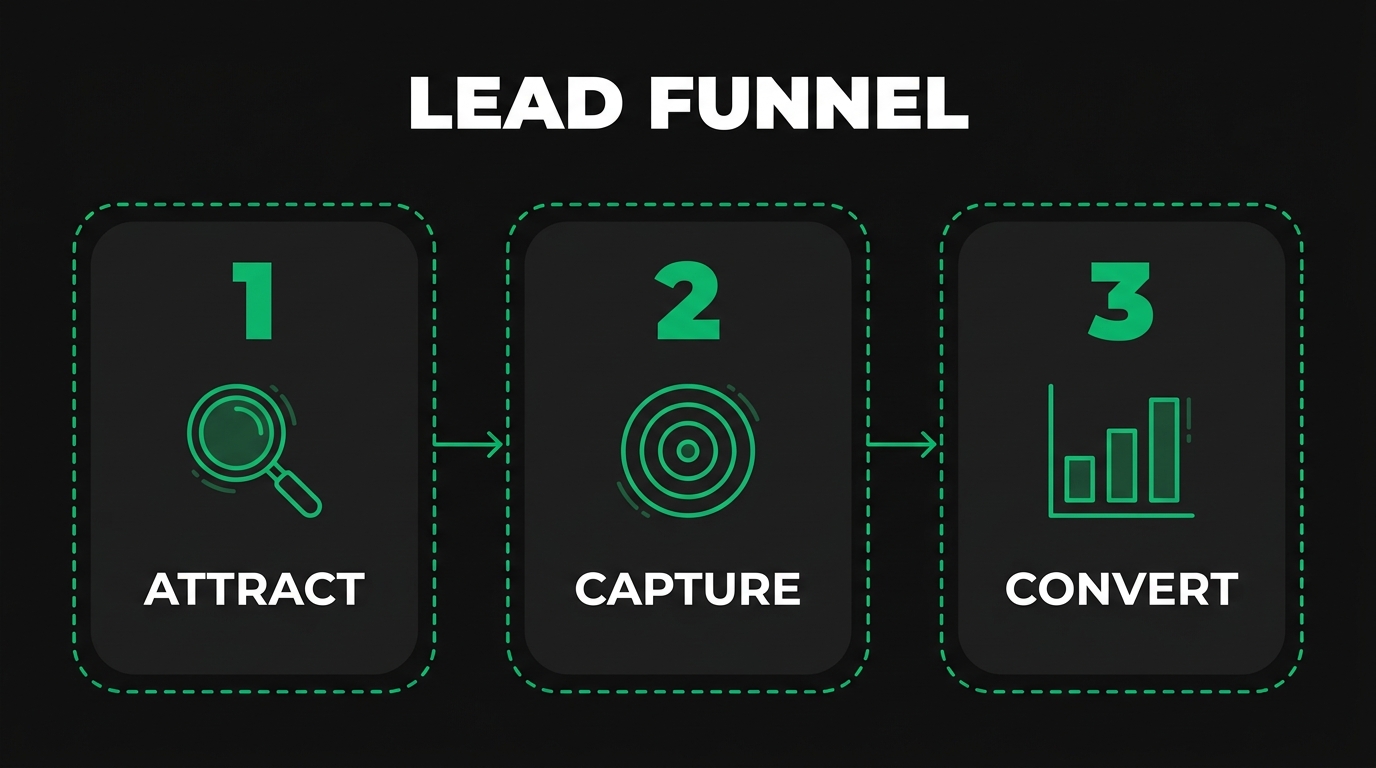
The industrial buying journey maps to search funnel stages in a clear progression: problem recognition (informational queries), supplier discovery (capability-keyword queries), evaluation (spec-and-certification queries), and RFQ submission (branded plus location queries). Each stage corresponds to a different intent signal and a different page type. Informational queries deserve guides; capability queries deserve service pages; spec queries deserve product or material-specific pages; RFQ-stage queries deserve contact pages with frictionless forms.
Mapping intent to template is what converts search visibility into pipeline. This mapping also clarifies the trade-offs around organic lead generation for manufacturers vs paid ads at every funnel stage.
Why Do Specification-Heavy and Long-Tail Queries Convert Into Leads?
Specification-heavy and long-tail queries convert into leads because they isolate buyers with active projects and specific requirements rather than browsers in research mode.
A query like "5-axis CNC machining titanium aerospace parts AS9100" reveals process, material, application, and certification gates in one string, signaling a buyer ready to evaluate suppliers and submit an RFQ. The next step is engineering keyword strategy around the same specificity.
What Keyword Strategy Generates Procurement-Ready Leads for Manufacturers?
A keyword strategy that generates procurement-ready leads for manufacturers maps every process, material, certification, and application a buyer can search to a dedicated landing page. The sub-sections cover RFQ keyword identification, keyword research tools, and cluster design around quote-ready intent.
How Do You Identify Process, Material, and Certification Keywords That Drive RFQs?
You identify process, material, and certification keywords that drive RFQs by mining customer RFQ language, sales-call transcripts, and supplier-database queries (Thomasnet, GlobalSpec, IndustryNet). Build a matrix with process on one axis (CNC machining, injection molding, sheet metal) and modifiers on the other (material grade, tolerance, certification, application).
Each cell becomes a keyword cluster targeting a defined buyer intent. The high-converting clusters are where existing customer RFQs concentrate. This procurement-grounded approach defines the broader lead generation strategies for b2b manufacturing that compound RFQ pipeline.
Which Tools Reveal Lead-Generating Search Demand for Industrial Niches?
The tools that reveal lead-generating search demand for industrial niches include Google Search Console, Ahrefs, Semrush, Google Keyword Planner, and AnswerThePublic, paired with Thomasnet and GlobalSpec category data.
Cross-reference paid-platform demand (Keyword Planner) with intent-rich question data (AnswerThePublic) and competitor topical maps (Ahrefs Content Explorer) to surface niche-specific clusters. The mix is what separates surface-level keyword lists from procurement-grade targeting.
How Do You Cluster Keywords Around Quote-Ready Buyer Intent?
You cluster keywords around quote-ready buyer intent by grouping queries that share the same destination page and the same buying-stage signal. Start with one anchor query (e.g., "aluminum CNC machining services") and bind every variant (synonyms, modifier orders, plural forms, certification tags) to that single page. Quote-ready clusters share these traits: capability noun + material modifier + certification or location qualifier. Treating each cluster as a self-contained mini-page prevents keyword cannibalization and concentrates topical authority on the page Google should rank for the RFQ-stage query. Robust industrial seo strategies operationalize this clustering pattern across an entire capability catalog.
How Should You Structure Industrial Pages to Convert Search Traffic Into Leads?
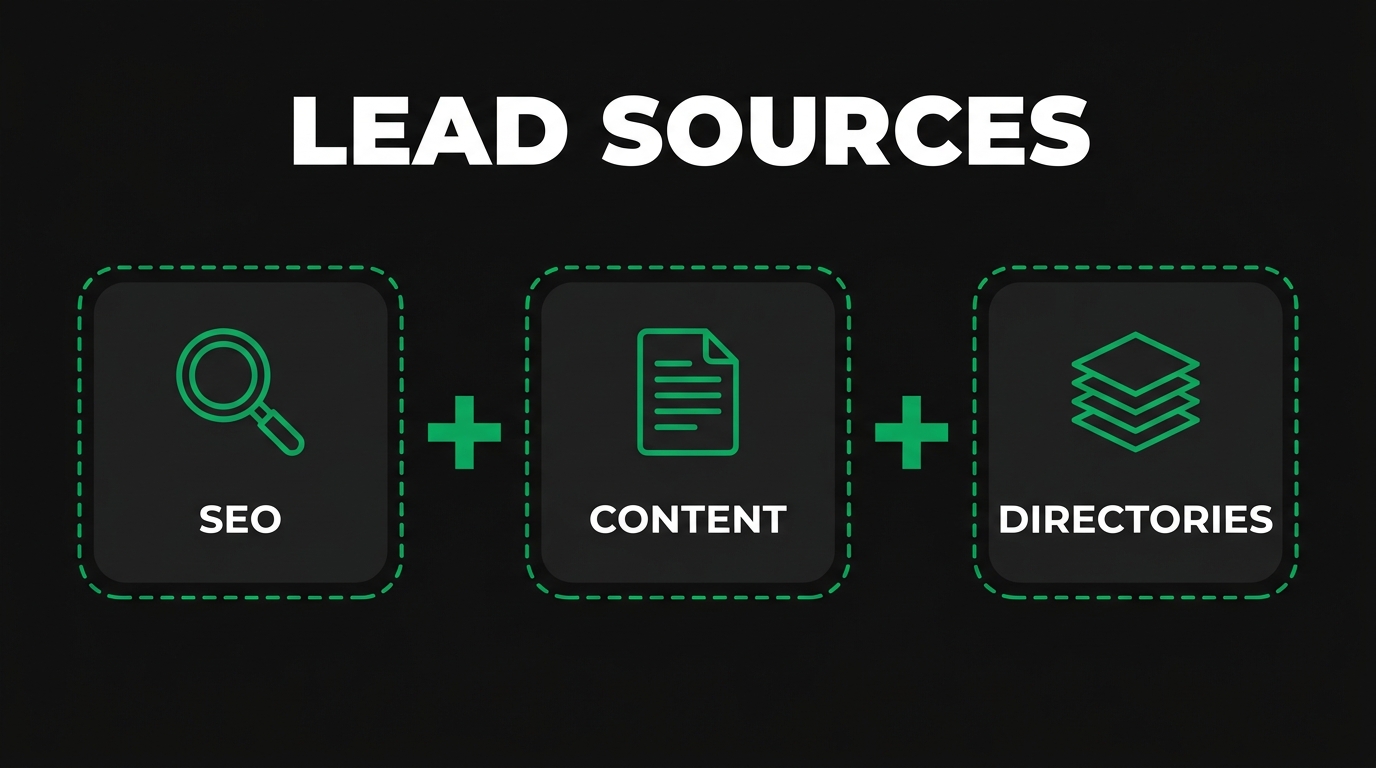
Industrial pages should be structured to mirror buyer-intent stages, with each capability and spec page delivering process detail, certifications, materials, and a frictionless RFQ path above the fold. The sub-sections cover capability templates, spec pages, trust signals, and RFQ placement.
What Page Templates Convert Best for Capability and Service Pages?
The page templates that convert best for capability and service pages follow a fixed pattern: H1 process + materials, capability matrix, certifications, equipment list, tolerances, industries served, case-study snippet, and an inline RFQ form.
The template is reusable across every capability page in a catalog. Consistency in template structure also speeds Google indexing across hundreds of capability pages.
How Do You Write Product and Spec Pages That Rank and Convert?
You write product and spec pages that rank and convert by leading with the exact spec a buyer would type, supporting it with material grade, tolerance band, certification list, lead time, and minimum order quantity, and embedding an inline quote form.
Writing structured, fact-dense spec pages earns both classical rankings and AI Overview citations.
Why Do Trust Signals, Certifications, and Case Studies Lift Conversion Rates?
Trust signals, certifications, and case studies lift conversion rates because procurement teams need certification gates and proof points before they will issue an RFQ to an unfamiliar supplier.
Display ISO 9001, AS9100, IATF 16949, and customer logos on every capability page. The same fundamentals support improving lead quality in manufacturing by filtering inbound interest to qualified buyers from the first impression.
How Should You Place RFQ Forms and CTAs on Industrial Pages?
RFQ forms and CTAs should be placed on industrial pages above the fold, repeated mid-page after the capability matrix, and persistent in the page footer.
Forms must render cleanly on mobile because procurement researchers increasingly browse from phones. Limit required fields to name, company, email, and quote details to reduce abandonment. The conversion architecture sets up the technical foundation that protects every form submission.
What Technical SEO Foundations Support Sustainable Lead Generation?
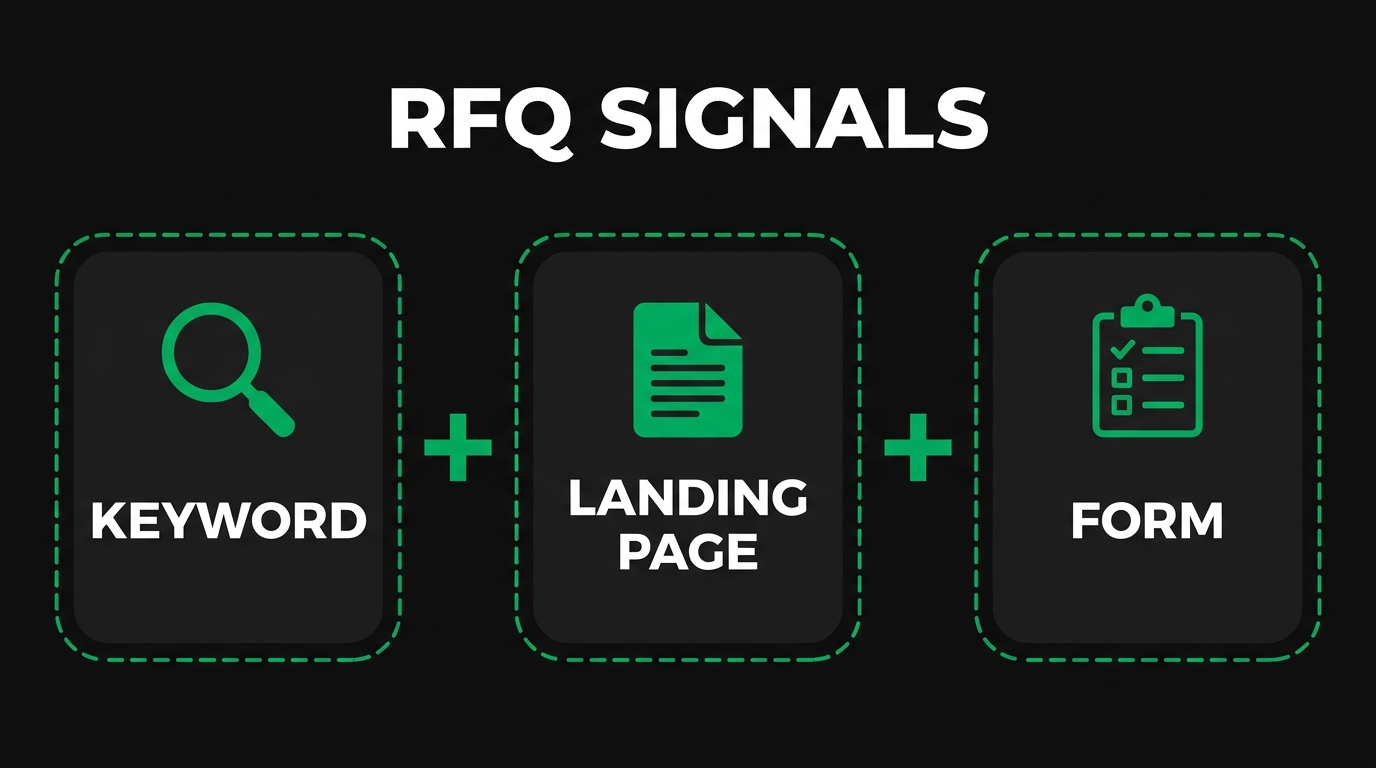
The technical SEO foundations that support sustainable lead generation are speed, schema markup, mobile readiness, and crawl health. These layers determine whether a manufacturer's catalog actually surfaces in search and renders fast enough to keep procurement researchers from bouncing.
How Do Site Speed and Core Web Vitals Affect Industrial Lead Conversion?
Site speed and Core Web Vitals affect industrial lead conversion by directly influencing bounce rate and form-completion rate on capability and spec pages.
Procurement researchers running multi-supplier comparison sessions abandon the slowest catalogs first, so speed shifts pipeline share to the fastest competitor.
What Schema Markup Helps Manufacturing Pages Earn Rich Results?
The schema markup that helps manufacturing pages earn rich results includes Service, Product, Organization, FAQPage, BreadcrumbList, and LocalBusiness types from Schema.org.
Combine speed-tuned templates with structured-data markup so capability pages become eligible for rich results, knowledge-panel inclusion, and AI Overview citation, all of which pull procurement traffic above the standard ten-blue-link experience.
Why Is Mobile and Crawl Health Critical for Procurement Search?
Mobile and crawl health are critical for procurement search because Google indexes from the smartphone agent first, and a slow or blocked crawl prevents capability pages from appearing for spec queries at all.
Manufacturers with hundreds of capability and material pages must keep robots.txt clean, sitemaps accurate, and internal links shallow so the full catalog ranks. Technical hygiene becomes the gating factor for content and authority work that follows.
How Do Content and Topical Authority Multiply Industrial Lead Volume?
Content and topical authority multiply industrial lead volume by giving every process, material, certification, and application its own page so the catalog ranks across the full procurement query universe. Complete topical coverage outranks scattered blog posts because Google rewards depth, not breadth.
What Content Formats Generate the Most Manufacturing Leads?
The content formats that generate the most manufacturing leads are capability pages, material guides, technical white papers, case studies, calculators, and FAQ pages targeting specific spec questions. Procurement researchers download spec sheets and case studies as proof artifacts during evaluation. Calculators (load, tolerance, material strength) capture engineering-stage traffic and double as RFQ entry points. Long-form how-to guides on regulated processes (heat-treatment cycles, anodizing specs, AS9100 audits) earn editorial backlinks.
Each format earns leads at a different funnel stage, so a complete content strategy produces leads at the top, middle, and bottom of the procurement journey.
How Do Pillar Pages and Topic Clusters Capture Full-Funnel Demand?
Pillar pages and topic clusters capture full-funnel demand by pairing a comprehensive parent page (the pillar) with supporting cluster pages targeting every related sub-query, all interlinked.
The pillar page targets the head term ("CNC machining"); cluster pages target the long-tail variants ("aluminum CNC machining," "5-axis CNC machining," "ITAR CNC machining"). Disciplined comparison against basic seo strategies for manufacturers shows where pillar/cluster builds outperform scattered tactical posts.
How Often Should Manufacturing Sites Publish Lead-Driving Content?
Manufacturing sites should publish lead-driving content on a cadence dictated by topical-coverage gaps, not arbitrary calendar schedules.
A new capability, a new material, a new certification, or a new application all warrant immediate content. Refresh existing capability pages quarterly with updated equipment, tolerances, and case-study data. Cadence matters less than coverage: complete topical maps capture more demand than a steady drip of unfocused blog posts. Authority signals from outside the site amplify everything published on it.
How Do Backlinks and Trade-Publication Outreach Accelerate Industrial Lead Growth?
Backlinks and trade-publication outreach accelerate industrial lead growth by transferring topical authority and referral traffic from sites procurement teams already trust. Editorial mentions in trade publications also surface in branded search and AI-generated answers, compounding visibility beyond direct referral.
Which Trade Publications and Directories Drive Referral Leads?
The trade publications and directories that drive referral leads are sector-specific outlets including IndustryWeek, Modern Machine Shop, Plastics Technology, Aerospace Manufacturing, Assembly Magazine, MoldMaking Technology, Medical Design & Outsourcing, Thomasnet, GlobalSpec, MFG.com, IQS Directory, and supplier registries maintained by industry associations. Each outlet captures a defined buyer audience and forwards qualified procurement traffic.
Editorial features on these properties carry citation weight in classical search and increasingly in AI Overview answers, while directory listings deliver direct RFQ traffic from buyers already in active sourcing mode.
How Do You Earn Editorial Links from Industry Associations?
You earn editorial links from industry associations by publishing original technical research, contributing case studies, sponsoring standards-body events, and joining association-led working groups that publish member content.
Industry associations (NAM, SME, AMT, ASME, MAPP, PMA, IPC) publish member spotlights, certification announcements, and technical contributions that earn natural editorial links. The relationship is reciprocal: associations need expert content; manufacturers need authority links.
What Outreach Tactics Build Tier-1 Industrial Backlinks?
Outreach tactics that build tier-1 industrial backlinks include data-driven studies (original survey results, benchmarking reports, capacity-utilization analyses), expert commentary placements, broken-link reclamation on trade-pub archives, and journalist queries through HARO and Featured. Pitch trade-pub editors with specific story angles tied to current industry events (tariff changes, certification updates, capacity shifts). Tools like how to use moz link explorer for industrial audits expose link gaps and competitor referring-domain patterns that direct outreach toward the highest-authority targets. The combined approach builds referring domains faster than ad-hoc guest posting. Multi-facility manufacturers must also pair national authority with local visibility.
How Does Local and National Visibility Combine for Multi-Facility Manufacturers?
Local and national visibility combine for multi-facility manufacturers when each plant location runs its own optimized Google Business Profile while corporate domain authority accumulates from national topical content. Local pack visibility captures geo-modified RFQs; national topical authority captures spec-based queries.
How Do You Optimize Google Business Profiles for Industrial Locations?
You optimize Google Business Profiles for industrial locations by claiming each facility separately, using accurate categories (Manufacturer, Tool & Die Shop, Custom Manufacturer, Plastic Injection Molding Service), populating capability descriptions, uploading equipment photos, and posting plant-specific updates.
Plant-level profiles capture localized RFQs from buyers searching with city or state modifiers, and the structured business data feeds Google's local ranking systems for the geo-targeted procurement queries that compress sales cycles.
Why Does NAP Consistency Matter Across Plant Locations?
NAP consistency matters across plant locations because Google deduplicates business entities by matching name, address, and phone number across the web, and any mismatch fragments authority across multiple unverified entities. Each plant's NAP must appear identically on the website, Google Business Profile, Thomasnet listing, GlobalSpec listing, association directories, and trade-publication features.
Inconsistent NAPs split prominence signals between duplicate entities, suppressing local pack rankings for facility-specific RFQ queries. Standardize the format (suite numbers, abbreviations, phone format) and audit citations quarterly to catch drift from acquisitions, rebrands, or vendor data updates.
How Should You Balance National Topical Authority with Local Lead Capture?
National topical authority and local lead capture should be balanced by hosting all capability content on the corporate domain while creating dedicated plant-location pages that target geo-modified queries.
Corporate pillar pages target spec queries; location pages target "[capability] in [city]" queries. Internal links flow authority from corporate pillar pages to location pages, while location pages link out to plant-specific capability subsets. Measurement systems then close the loop on every channel.
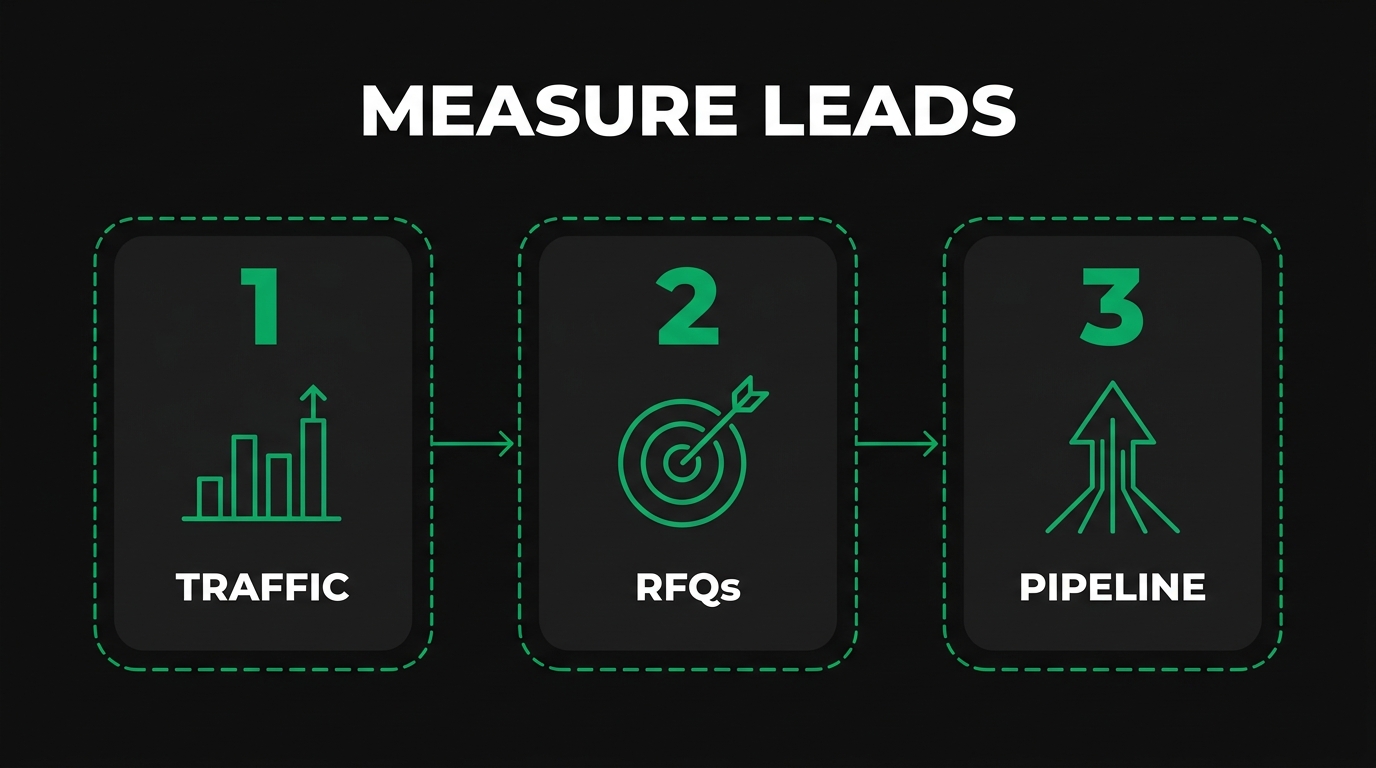
How Should You Measure SEO Lead Quality and Tie Rankings to Revenue?
SEO lead quality should be measured by tying every organic-source RFQ to its landing page, query, and downstream pipeline outcome (qualified opportunity, quote sent, closed revenue). Rank-only reporting hides which keywords actually generate revenue and which generate vanity traffic.
Which KPIs Connect Organic Search to RFQs and Closed Revenue?
The KPIs that connect organic search to RFQs and closed revenue are organic sessions to capability pages, RFQ form-fill rate by landing page, average quote value per organic lead, quote-to-close conversion rate, and revenue attributed to organic-source opportunities in the CRM. Track these alongside ranking position for procurement-intent keyword clusters.
The connection between rankings and revenue is what justifies sustained SEO investment in a CFO conversation, transforming SEO from a marketing-line cost into a measurable pipeline channel with documented ROI.
How Do You Attribute Pipeline Value to Specific SEO Activities?
You attribute pipeline value to specific SEO activities by integrating Google Analytics 4 lead events with CRM opportunity records using a shared identifier (form-fill ID, email, or company domain).
Layer first-touch and multi-touch models to credit upper-funnel content (technical guides) and bottom-funnel content (capability pages). The attribution model exposes which keyword clusters, content pieces, and link campaigns drive revenue versus traffic alone.
What Reporting Cadence Keeps SEO Tied to Lead Generation Goals?
The reporting cadence that keeps SEO tied to lead generation goals combines weekly tactical reports (rankings, traffic, form fills), monthly strategic reports (lead quality, pipeline contribution, content performance), and quarterly business reviews (revenue attribution, ROI, roadmap). Weekly cadence catches technical regressions; monthly cadence reveals conversion trends; quarterly cadence ties results to revenue and re-prioritizes the roadmap. Manufacturing buyers expect manufacturing seo reporting and analytics that ties every report directly to RFQs and closed-won revenue, not vanity rank charts. Disciplined measurement also exposes the recurring mistakes that suppress reported lead volume.
What Common Mistakes Prevent Manufacturers from Generating Leads with SEO?
The common mistakes that prevent manufacturers from generating leads with SEO are agency-fit mismatches, vanity-keyword targeting, and broken conversion tracking. Each mistake quietly suppresses reported lead volume and obscures the real ROI of organic search investment.
Why Do Generic Marketing Agencies Fail to Generate Industrial Leads?
Generic marketing agencies fail to generate industrial leads because they target persona-based keywords and consumer-style content rather than process, material, and certification queries that procurement buyers actually type. Generic agencies optimize for "manufacturing companies" or "best CNC shop"; procurement teams search for "AS9100 5-axis CNC machining titanium aerospace parts." The vocabulary gap kills relevance, and Google ranks the supplier that speaks the spec language.
Agencies without manufacturing-process fluency miss certification gates, tolerance language, and material-grade modifiers that filter qualified buyers, so the resulting traffic converts at low single-digit RFQ rates while specialized programs convert significantly higher.
How Does Targeting Vanity Keywords Waste Manufacturing Budgets?
Targeting vanity keywords wastes manufacturing budgets because head-term traffic ("manufacturing services," "industrial supplier") attracts research-stage browsers, students, and journalists, not active procurement teams ready to submit RFQs.
Vanity rankings inflate traffic dashboards while RFQ pipeline stays flat. The budget that funds head-term content competition could instead fund hundreds of specification-targeted capability pages that each rank for low-volume but high-intent procurement queries. The compound effect of dozens of high-intent pages outperforms a single high-volume vanity ranking on every metric tied to revenue.
What Conversion and Tracking Errors Suppress Reported Lead Volume?
Conversion and tracking errors that suppress reported lead volume include unfired form events, broken thank-you-page redirects, missing UTM parameters on inbound campaigns, untagged phone-call conversions, and mismatched CRM lead-source mapping. Audit Google Tag Manager containers, GA4 conversion events, and CRM source-field rules quarterly. A misfiring form event hides organic-source RFQs and starves the SEO program of attribution credit, prompting budget cuts based on phantom underperformance rather than real results.
Avoiding these mistakes sets the foundation for a specialized partner program that ties rankings to real revenue.
How Should You Approach Industrial SEO Lead Generation with a Specialized Manufacturing SEO Agency?
You should approach industrial SEO lead generation with a specialized manufacturing SEO agency that maps procurement-intent keywords to capability pages and ties every ranking to RFQs, pipeline value, and closed revenue. Manufacturing SEO Agency is a manufacturing-only industrial seo agency that builds programs around process, material, and certification queries.
Can Manufacturing SEO Agency Build a Lead-Generating Procurement-Intent SEO Program?
Yes, Manufacturing SEO Agency can build a lead-generating procurement-intent SEO program by combining manufacturing audits, procurement-intent keyword architecture, topical-authority buildout, PR-grade editorial link building, AI search visibility engineering, technical SEO remediation, and revenue-tied reporting. Manufacturing SEO Agency serves CNC machining, injection molding, metal fabrication, additive manufacturing, aerospace, automotive, electronics, medical, contract, and custom manufacturing clients.
Manufacturing SEO Agency ranks clients for the exact process, material, and certification combinations procurement teams type when sourcing suppliers, with reporting that ties rankings to RFQs and closed revenue rather than vanity traffic.
What Are the Key Takeaways About Industrial SEO for Lead Generation?
The key takeaways about industrial SEO for lead generation are that procurement-intent search drives the highest-value B2B leads, specification-heavy long-tail queries convert into RFQs at multiples of head-term traffic, and complete topical authority across processes, materials, and certifications outperforms scattered blog publishing. Page experience, schema markup, and mobile-first crawl health protect every ranking. Trade-publication backlinks and disciplined Google Business Profile work amplify visibility. Measurement that ties rankings to closed revenue (not impressions) is what justifies sustained investment. Manufacturers that invest in this stack with a specialist partner convert organic search into a primary, predictable lead-generation channel.