Manufacturing lead generation is the systematic process of attracting and capturing qualified procurement contacts who have a real intent to source parts, materials, or services from a U.S. manufacturer. We define a qualified lead as a buyer whose process, material, certification, and volume needs match what a supplier can produce profitably.
This guide covers what manufacturing lead generation actually is, how manufacturers get leads online today, the proven strategies that work, how to build a lead generation funnel, the SEO tactics that drive the most qualified leads, how to measure return on investment, and the common mistakes that hurt pipeline.
We start with definitions, separating manufacturing lead generation from generic B2B marketing and explaining why procurement has shifted online for engineers and purchasing managers.
We then walk through the digital channels that produce industrial leads, including organic search, paid search, content, account-based outreach, and trade publication backlinks, with concrete tactics for each.
We outline the industrial buying journey, the lead magnets that convert engineers, the scoring frameworks that separate noise from real opportunities, and the marketing-to-sales handoff that protects revenue.
We then go deep on procurement-intent SEO: keyword research, process and certification page architecture, AI search optimization, and the technical fixes that prevent slow load times from killing RFQs.
We close with the metrics that matter, the attribution methods that connect rankings to closed revenue, and the recurring mistakes that quietly drain manufacturing pipelines.
What Is Manufacturing Lead Generation?
Manufacturing lead generation is the structured process of attracting, qualifying, and capturing procurement contacts who want to source parts, materials, or finished goods from a U.S. manufacturer. The next sections cover sector differences, the shift to online procurement, and what counts as a qualified lead.
How Does Lead Generation Differ for Manufacturers Versus Other B2B Sectors?
Lead generation differs for manufacturers because buying decisions hinge on process tolerances, material grades, certifications, and capacity, not on brand affinity or impulse. Industrial buyers evaluate suppliers against engineered specifications and audit trails before requesting a quote. Per the U.S. Bureau of Labor Statistics, the manufacturing sector comprises establishments engaged in the mechanical, physical, or chemical transformation of materials, substances, or components into new products. That technical reality forces marketers to publish process pages, material data sheets, and certification proof. Generic SaaS-style funnels fail because procurement teams reject vendors that cannot demonstrate AS9100, ISO 9001, NADCAP, or IATF 16949 compliance up front.
Why Has Procurement Moved Online for Industrial Buyers?
Procurement has moved online because engineers and purchasing managers now research suppliers, compare specifications, and shortlist vendors through search engines, supplier directories, and trade media before any sales call. According to research published in Issues in Science and Technology Librarianship, in 79% of the top 500 design firms, engineers obtained information on their own without the help of a professional librarian. That self-service behavior compresses the supplier discovery window and rewards manufacturers whose technical content ranks for process-plus-material queries. Buyers now expect downloadable spec sheets, capability matrices, and tolerance charts indexed in search.
What Counts as a Qualified Manufacturing Lead?
A qualified manufacturing lead is a procurement contact whose project specifications, volume, certifications, and timeline match what the supplier can produce profitably. The qualification criteria for industrial leads are part match (process and material capability), volume fit (annual usage versus minimum order quantity), certification fit (AS9100, ISO 13485, IATF 16949), and timeline fit. A lead missing any of these dimensions is unqualified, regardless of company size. Treating every contact form submission as equally valuable wastes sales capacity and inflates cost per closed deal. Strong qualification frameworks separate engineering tire-kickers from active RFQ owners with budget and authority.
How Do Manufacturers Get Leads Online Today?
Manufacturers get leads online today through organic search rankings on procurement-intent queries, paid search on capability terms, supplier directory listings, technical content syndication, and outbound email tied to ABM lists. The next sections cover the highest-yield digital channels, how buyers search during the procurement cycle, and the role of RFQs in capture.
Which Digital Channels Drive the Most Manufacturing Leads?
The digital channels that drive the most manufacturing leads are organic search, paid search, supplier directories, trade publication content, LinkedIn outreach, and webinars, with organic search and supplier directories generating the highest qualified-lead volume for established manufacturers. According to the U.S. International Trade Administration, the ITA offered sessions on website globalization for manufacturers, social media tools to market manufacturing businesses overseas, and using live online events to market manufacturing technologies. Each channel rewards a specific buyer behavior: search captures active demand, directories surface capability matches, and webinars convert engineers in the evaluation phase. Serious manufacturers run two or three of these channels in parallel.
How Do Buyers Search for Suppliers in the Procurement Cycle?
Buyers search for suppliers in the procurement cycle by typing process-plus-material-plus-certification queries, downloading spec sheets, comparing capabilities side-by-side, and submitting RFQs to a shortlist. Typical query patterns include "5-axis CNC titanium AS9100," "Class 100 cleanroom injection molding medical," and "ITAR sheet metal fabrication." Buyers move from broad capability discovery to narrow tolerance and certification verification, then to commercial terms. Manufacturers ranking only on broad terms like "CNC machining" miss the high-intent procurement traffic that converts.
What Role Do RFQs and Quote Requests Play in Lead Capture?
RFQs and quote requests play the central role in lead capture for manufacturers because every closed deal starts as an RFQ with specifications, drawings, or part numbers attached. The RFQ is the qualifying event: it carries part data, target quantity, target price, delivery date, and required certifications. Capture mechanics matter, with structured RFQ forms outperforming generic contact forms by gathering enough data for the engineering team to quote within hours rather than days. Manufacturers that publish capability content but make RFQ submission friction-heavy lose qualified pipeline silently, which sets up why funnel design matters in the next section.
Which Proven Lead Generation Strategies Work for Manufacturers?
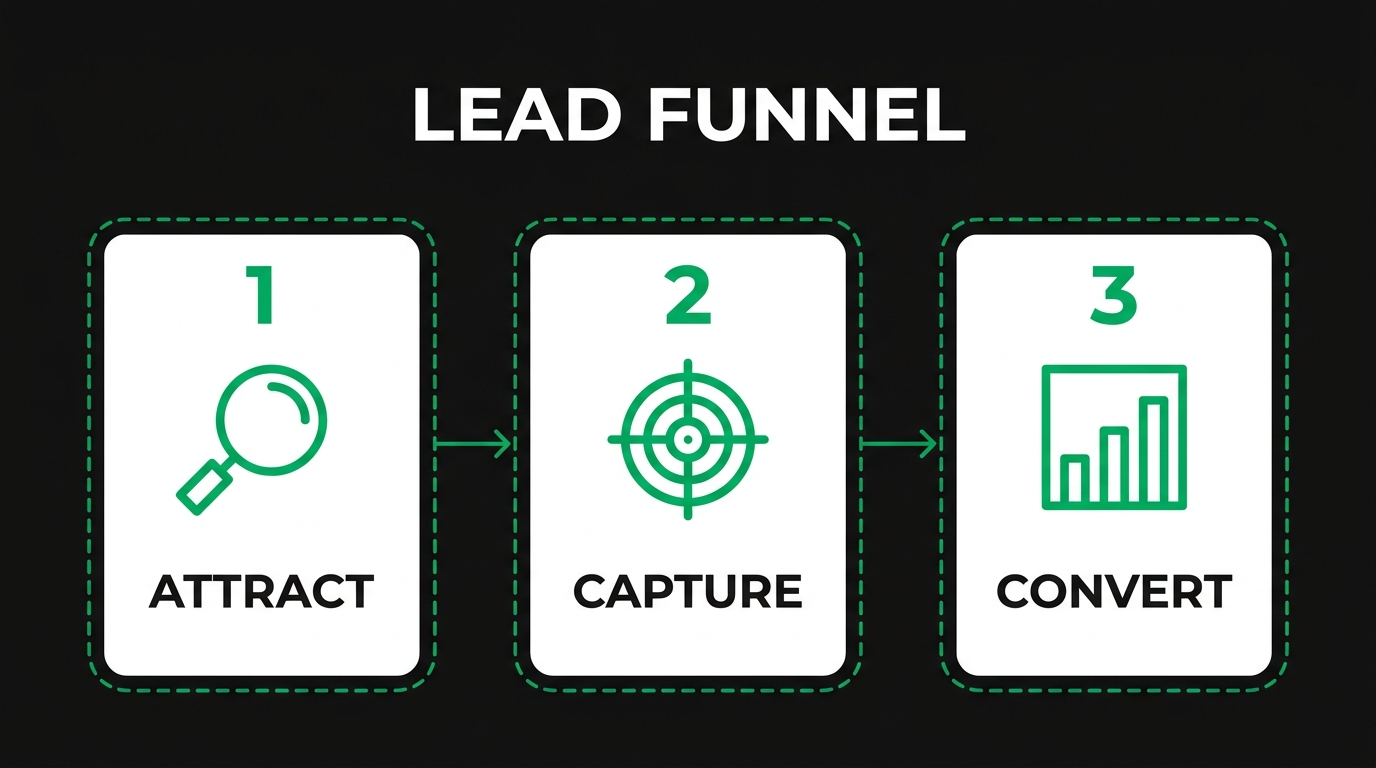
The proven lead generation strategies that work for manufacturers are technical SEO targeting procurement-intent queries, paid search on capability terms, content marketing built around process and material expertise, account-based marketing for strategic accounts, and PR-grade backlinks from trade publications. The next sections cover each in turn.
How Does SEO Generate Qualified Manufacturing Leads?
SEO generates qualified manufacturing leads by ranking process, material, and certification pages for the exact queries procurement uses, then routing that traffic to RFQ forms. Buyers search "5-axis CNC machining titanium aerospace" rather than "machine shop"; pages built around those specific clusters convert at far higher rates than generic capability pages. The U.S. Department of Energy's Advanced Materials and Manufacturing Technologies Office supports the national plan to revitalize American manufacturing, secure critical supply chains, and develop diverse innovation ecosystems leading to new manufacturing jobs and increased economic strength of the nation, signaling sustained federal investment in domestic supplier visibility. SEO compounds: each additional ranking page is a lead source that runs without paid spend.
How Do PPC and Paid Search Campaigns Convert Industrial Buyers?
PPC and paid search campaigns convert industrial buyers when ad copy carries the exact process, material, and certification language buyers typed, and when landing pages mirror that intent with capability tables and an RFQ form above the fold. Tight match types and negative keyword lists prevent budget waste on consumer or hobbyist queries. Manufacturers comparing channels often weigh organic lead generation for manufacturers vs paid ads because paid traffic stops the moment spend stops, while organic compounds; serious shops run both, with PPC covering high-intent gaps that organic has not yet earned.
How Does Content Marketing Build Trust With Engineers and Procurement Teams?
Content marketing builds trust with engineers and procurement teams when it answers technical questions with depth, cites verifiable data, and avoids promotional fluff. Useful formats include process tolerance guides, material selection matrices, design-for-manufacturability checklists, and certification crosswalks. Authority signals matter: Google's Search Quality guidelines emphasize content produced with demonstrable expertise, experience, authoritativeness, and trust. Buyers who learn from a supplier's content shortlist that supplier on the next RFQ. Manufacturers evaluating partners often vet top manufacturing marketing firms that specialize in technical content rather than retail or SaaS playbooks.
How Do Account-Based Marketing Campaigns Target Strategic Accounts?
Account-based marketing campaigns target strategic accounts by selecting a list of named procurement organizations, mapping the buying committee at each (engineer, buyer, supply chain director), and running coordinated content, ads, and outbound across those contacts. ABM works for manufacturers because deal sizes justify the per-account investment and buying committees are concentrated. Per the U.S. Bureau of Economic Analysis, GDP by Industry measures industries' performance and their contributions to GDP, which helps ABM teams prioritize the verticals with the highest spend density. ABM excels at pulling RFQs from accounts that would never have searched.
How Do Trade Publications and PR Backlinks Amplify Lead Flow?
Trade publications and PR backlinks amplify lead flow because procurement teams trust editorial coverage from outlets they already read for technical specifications and supplier news. A feature in a recognized industrial publication delivers referral traffic, authority backlinks that lift rankings on procurement queries, and direct inbound from engineers screening suppliers. Pairing PR with directory listings for manufacturing lead generation on platforms used by purchasing professionals stacks coverage across the supplier discovery surface. Editorial mentions also strengthen domain authority, which compounds across the entire procurement-intent keyword footprint, setting up funnel mechanics next.
How Should Manufacturers Build a Lead Generation Funnel?
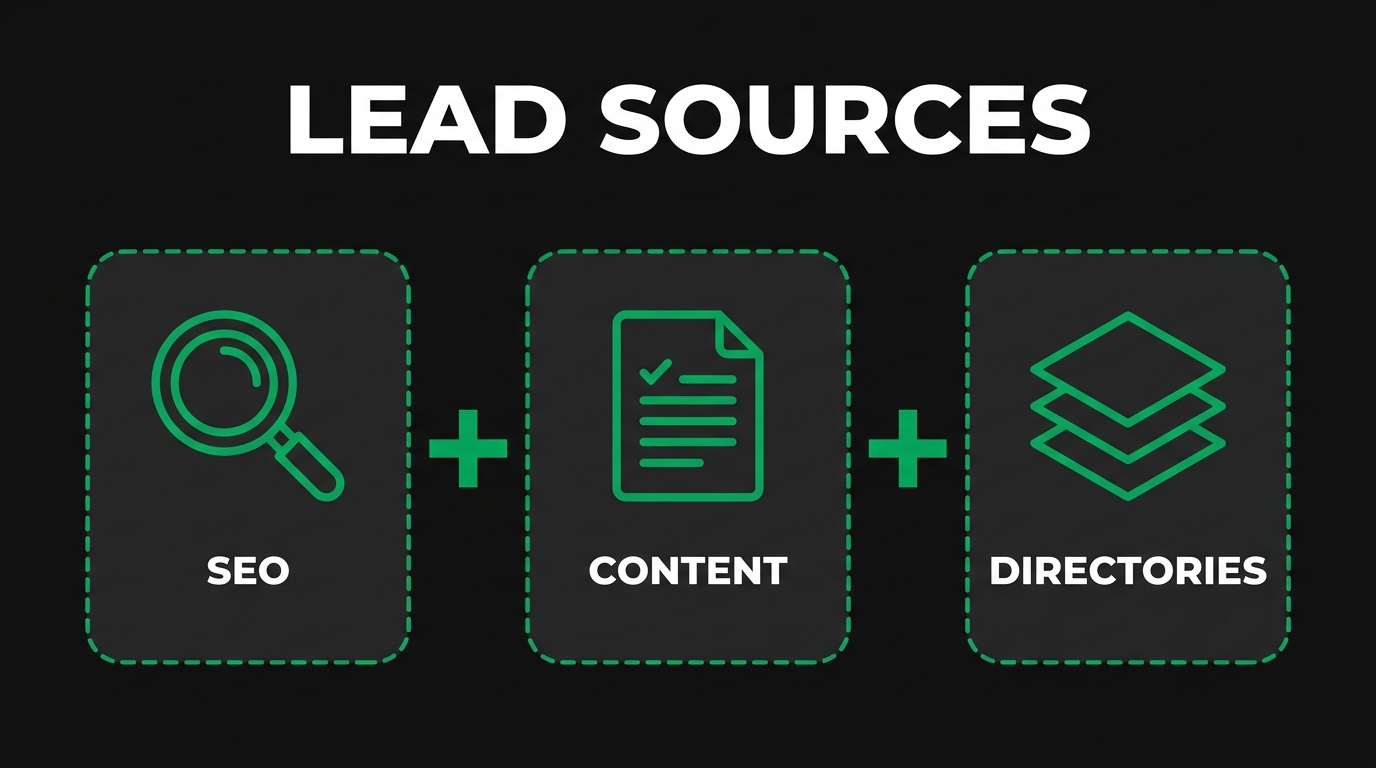
Manufacturers should build a lead generation funnel that mirrors the industrial buying journey: awareness through technical SEO and trade media, evaluation through capability content and webinars, decision through RFQ forms and engineering responsiveness. The next sections cover stages, magnets, scoring, and handoff.
What Are the Stages of the Industrial Buying Journey?
The stages of the industrial buying journey are problem identification, supplier discovery, capability evaluation, RFQ submission, vendor selection, and onboarding. Each stage has its own content and channel needs: discovery rewards process pages and directories; evaluation rewards spec sheets, certifications, and case studies; RFQ stage rewards fast quote response and clear pricing logic. Manufacturers building a funnel should map at least one piece of high-intent content to each stage. Detailed lead generation strategies for b2b manufacturing sequence content against these stages so no journey step is unsupported.
Which Lead Magnets Convert Engineers and Procurement Managers?
The lead magnets that convert engineers and procurement managers are technical assets directly useful to specification work, such as material selection guides, tolerance charts, capability matrices, design-for-manufacturability checklists, and certification crosswalks. Generic eBooks and "ultimate guides" with no engineering substance underperform. Strong magnets gate only what is genuinely valuable: a materials database might require an email; a marketing infographic should not. The goal is to capture qualified engineers, not to inflate top-of-funnel form submissions with low-intent contacts.
How Do You Score and Qualify Manufacturing Leads?
You score and qualify manufacturing leads by combining firmographic fit (industry, size, location), behavioral signals (RFQ form completion, spec sheet downloads, capability page visits), and explicit qualification fields collected at form submission (process needed, annual volume, certifications required). A practical scoring model assigns weight to each dimension and routes high-score leads directly to engineering for quote, mid-score leads to nurture, and low-score leads to long-cycle email. Per Federal Reserve community insights, reaching customers and growing sales was the most commonly reported operational challenge among small businesses, which underscores why disciplined scoring beats raw volume.
How Do You Hand Off Leads From Marketing to Sales?
You hand off leads from marketing to sales by defining a service-level agreement that specifies what qualifies a lead, who owns response time, and what data must accompany every handoff. Typical SLA elements include scoring threshold, maximum response window (often 24 hours for RFQs), required form fields, and CRM ownership rules. The handoff fails when marketing throws unqualified leads over the wall and sales ignores them, or when sales chases low-fit leads at the expense of high-fit RFQs. Disciplined handoff sets up the SEO tactics covered next.
Which SEO Tactics Generate the Most Manufacturing Leads?
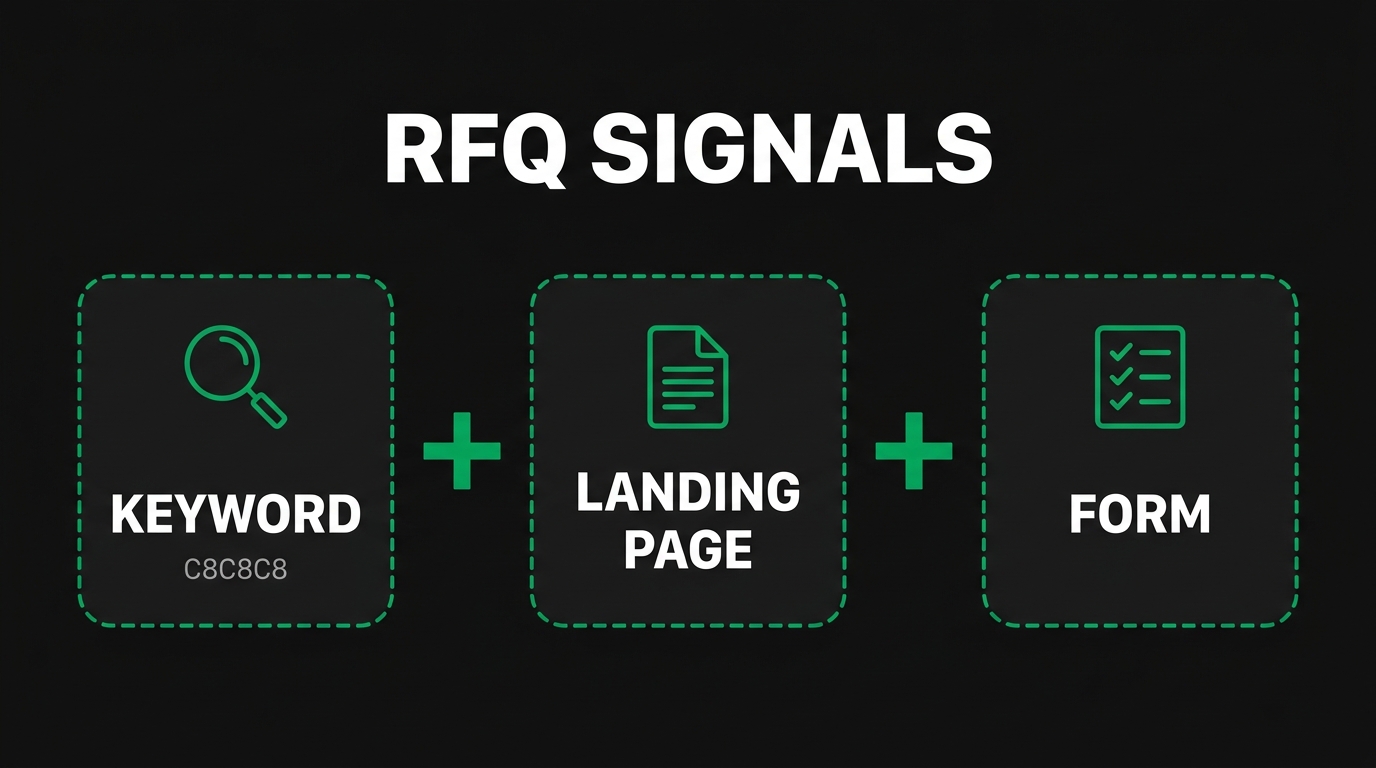
The SEO tactics that generate the most manufacturing leads are procurement-intent keyword research, process-plus-material-plus-certification page architecture, AI search optimization, and technical performance fixes that protect RFQ form completion. The next sections cover each.
How Do You Research Procurement-Intent Keywords?
You research procurement-intent keywords by clustering queries around the three variables buyers actually combine: process (CNC turning, injection molding, sheet fabrication), material (titanium, PEEK, 316L stainless), and certification (AS9100, ISO 13485, NADCAP). Strong research includes pulling supplier directory taxonomies, reviewing trade publication query patterns, and mining customer RFQ language for verbatim search phrases. The output is a keyword map organized by cluster, each tied to a specific capability page. Deeper analysis of high-value industrial terms helps teams separate commercial-intent procurement queries from low-value informational searches that rarely convert.
How Should You Structure Process, Material, and Certification Pages?
You should structure process, material, and certification pages so each page targets one tight cluster, carries proof (tolerances, certifications, equipment list, sample parts), and routes the visitor to an RFQ form. Avoid single mega-pages for every capability; Google rewards topical depth at the URL level. Core page elements: H1 naming the exact capability, specifications table, certifications block with logos and registration numbers, representative part gallery, and a quote CTA above the fold. Comprehensive industrial seo strategies lay out the process-plus-material architecture that earns rankings on buyer-specific queries.
How Do You Optimize for AI Search and LLM Citations?
You optimize for AI search and LLM citations by publishing structured, fact-dense content that large language models can parse and attribute cleanly. Practical tactics include Schema.org structured data for Organization, Service, and Product; clear entity naming across the site; and fact-tight sentences that pair claims with verifiable sources. Google Search Central notes that Core Web Vitals, along with other page experience aspects, aligns with what our core ranking systems seek to reward, which reinforces the foundation AI-surfaced citations depend on. Manufacturers whose content appears in LLM responses win share of the AI-mediated supplier discovery traffic that is rapidly overtaking classical SERPs.
Which Technical SEO Fixes Improve Lead Capture?
The technical SEO fixes that improve lead capture are Core Web Vitals compliance, mobile responsiveness, crawlable URL structure, lossless image compression, and schema markup validation. Per Google's web.dev guidance, Largest Contentful Paint (LCP) measures loading performance, and to provide a good user experience, strive to have LCP occur within the first 2.5 seconds of the page starting to load. Slow pages lose engineers mid-search, especially on 4G connections where procurement staff browse between meetings. Clean crawl health ensures every capability page gets indexed, which protects the long tail of procurement queries that drive the bulk of qualified RFQs.
How Do You Measure Manufacturing Lead Generation ROI?
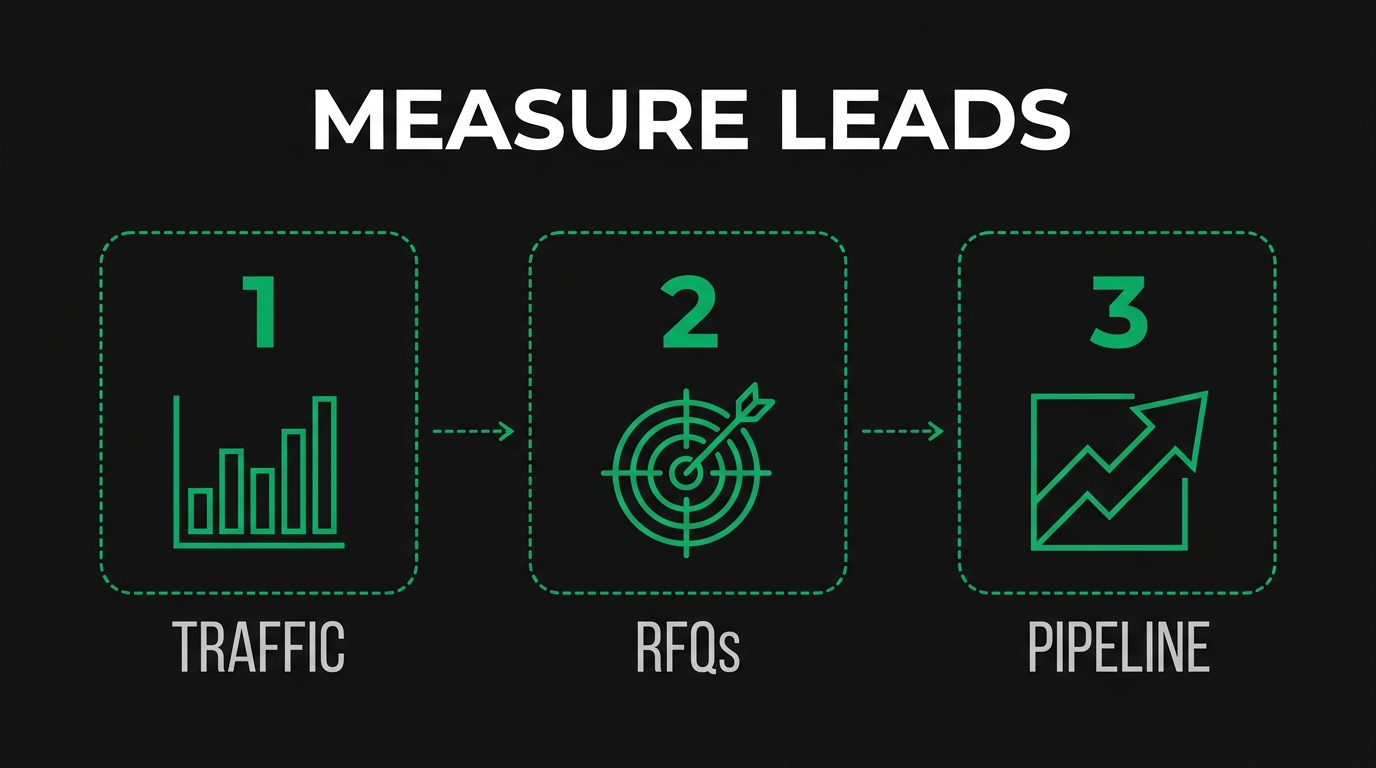
You measure manufacturing lead generation ROI by tying every channel to pipeline value and closed revenue, not vanity metrics like rankings or traffic. The next sections cover the KPIs that matter, attribution methods, cost per qualified lead, and RFQ-to-revenue tracking.
Which KPIs Matter Most for Industrial Lead Generation?
The KPIs that matter most for industrial lead generation are qualified RFQ volume, cost per qualified lead, pipeline value generated, closed-won revenue by source, and time-to-quote. Traffic and keyword rankings are leading indicators, not outcomes. Strong programs track channel-level conversion from visit to RFQ to quote to closed deal, with dollar values at each stage. Many measurement teams also study seo for industrial lead generation to benchmark how rankings map to qualified pipeline, rather than stopping at position-tracking dashboards that miss revenue.
How Do You Attribute Pipeline Revenue to Marketing Channels?
You attribute pipeline revenue to marketing channels by connecting the marketing automation platform to the CRM, timestamping every touchpoint from first page visit through closed deal, and applying a consistent attribution model (first-touch, last-touch, linear, or position-based). Manufacturers with long sales cycles benefit from position-based models that credit both the discovery touch and the closing touch. Per the U.S. Bureau of Economic Analysis, GDP by Industry is an industry-by-industry breakdown of gross domestic product, a reminder that channel-level attribution is simply revenue accounting done for marketing instead of national accounts.
How Do You Calculate Cost Per Qualified Lead?
You calculate cost per qualified lead by dividing total channel spend (ad dollars, content production, agency fees, tooling) by the count of leads that meet your qualification threshold in the same period. Include all-in costs, not just media spend, or the number misleads. Benchmark by channel: paid search often shows higher cost per qualified lead than organic but faster time-to-lead. Manufacturers publishing high-volume unqualified leads have a cheap cost per raw lead but expensive cost per qualified lead, which is the number procurement actually cares about.
How Do You Track RFQs From First Touch to Closed Revenue?
You track RFQs from first touch to closed revenue by tagging every RFQ form with the originating channel, campaign, and landing page via UTM parameters, then persisting that data through the CRM opportunity record. Every stage change (RFQ received, quoted, negotiated, closed-won, closed-lost) updates the same record, so reporting can roll up revenue by source without manual reconciliation. Integrated CRM and analytics is the backbone of credible reporting, which is where manufacturing seo reporting and analytics services help manufacturers tie organic pipeline directly to RFQ outcomes. Done right, this setup answers "which channel produced this revenue?" in one click.
What Common Mistakes Hurt Manufacturing Lead Generation?
The common mistakes that hurt manufacturing lead generation are targeting generic vanity keywords, running slow non-mobile sites, omitting certifications and specifications, and operating sales and marketing as disconnected silos. The next sections cover each.
Why Do Generic Keywords Fail in Industrial Search?
Generic keywords fail in industrial search because procurement teams type process-plus-material-plus-certification combinations, not single-word category terms. Ranking number one for "machine shop" attracts hobbyists and homeowners; ranking for "5-axis CNC titanium aerospace AS9100" attracts qualified procurement. Per the U.S. Bureau of Labor Statistics OEWS, production occupations had employment of 8.7 million with an annual mean wage of $50,090, illustrating the scale of the workforce whose technical buyers search with this specificity. Generic terms have huge volume but near-zero commercial intent, so they convert poorly even when they rank. Cluster strategy beats vanity strategy every time.
How Do Slow Sites and Poor Mobile Experience Lose RFQs?
Slow sites and poor mobile experience lose RFQs because procurement staff browse capability pages between meetings on phones, and a slow load or broken form abandons the visit. Per Google's web.dev, mobile is typically less performant than desktop since it is a more resource-constrained device operating under potentially less stable network conditions, which means manufacturers must engineer for the harder environment first. Common failures include uncompressed engineering images, render-blocking scripts, and contact forms that break on mobile keyboards. Each lost RFQ carries thousands of dollars of latent pipeline, so technical performance is a revenue lever, not an IT chore.
Why Does Skipping Certifications and Specifications Cost Leads?
Skipping certifications and specifications costs leads because procurement teams disqualify any supplier that cannot prove compliance up front. Pages that list capabilities without certification logos, registration numbers, or specification tables get filtered out before sales is ever contacted. The fix is publishing every relevant cert (AS9100, ISO 9001, ISO 13485, IATF 16949, NADCAP, ITAR), every material the shop runs, and every tolerance the equipment holds. Per Manufacturing.gov, every dollar spent in manufacturing results in an additional $2.79 added to the economy, making it the highest multiplier effect of any sector, which is why procurement screens hard for verified suppliers.
How Does Misaligned Sales and Marketing Tank Conversion?
Misaligned sales and marketing tank conversion when marketing throws every form fill to sales without scoring, when sales ignores qualified leads in favor of cold outbound, and when neither team agrees on what qualifies a lead. The result is wasted ad spend on leads sales never works and missed RFQs that should have closed. Fixing alignment requires a written lead definition, a scoring threshold both teams accept, response-time SLAs, and shared revenue targets. The Federal Reserve's Small Business Credit Survey is administered every fall across the United States as a collaboration of all 12 Federal Reserve Banks, modeling the kind of disciplined cross-functional measurement manufacturing teams should adopt internally. Alignment is the cheapest revenue lift available, which sets up the brand bridge.
How Should You Approach Manufacturing Lead Generation With Manufacturing SEO Agency?
You should approach manufacturing lead generation with Manufacturing SEO Agency by combining procurement-intent SEO, topical authority buildout, PR-grade backlinks, and revenue-tied reporting that ties rankings to RFQs and closed deals. Manufacturing SEO Agency works exclusively with industrial clients, so every tactic is built from procurement reality.
How Can Manufacturing SEO Agency's Reporting Analytics Service Help With Lead Attribution?
Manufacturing SEO Agency's Reporting Analytics service helps with lead attribution by integrating CRM data with marketing analytics so every RFQ is traceable from first organic touch through closed revenue. The service maps procurement-intent rankings to the specific pages that captured each RFQ, then ties those RFQs to pipeline value and closed deals. As the only manufacturing-focused seo agency operating exclusively in the industrial vertical, Manufacturing SEO Agency builds reporting around the metrics procurement teams and CFOs actually care about, not vanity rankings. The MEP National Network comprises the National Institute of Standards and Technology's Manufacturing Extension Partnership and over 1,440 trusted advisors at approximately 460 service locations, illustrating the scale at which industrial reporting must operate to drive measurable outcomes. Manufacturing SEO Agency delivers that level of measurable rigor for individual manufacturers.
What Are the Key Takeaways About Manufacturing Lead Generation Strategies We Covered?
The key takeaways about manufacturing lead generation strategies we covered are: qualified leads come from procurement-intent search, supplier directories, and trade publication authority, not generic SaaS-style funnels. Successful programs combine technical SEO targeting process-plus-material-plus-certification clusters with structured RFQ capture, disciplined lead scoring, and tight marketing-to-sales handoff. Measurement must extend beyond rankings to cost per qualified lead, pipeline value, and closed-won revenue by source. Common failures include generic keyword targeting, slow mobile sites, missing certification proof, and disconnected sales and marketing teams. Manufacturers that fix these fundamentals earn compounding RFQ flow, while competitors stuck on traffic vanity metrics fall behind in the procurement search rankings that actually drive revenue.