B2B manufacturing lead generation strategies are the digital and offline tactics industrial companies use to attract qualified procurement buyers, capture RFQs, and convert specification-stage interest into revenue. These strategies blend search visibility, content depth, paid acquisition, trade media, and pipeline measurement into a coordinated system aimed at engineers and supply chain teams.
This guide covers what B2B manufacturing lead generation is, how manufacturers acquire leads online today, which strategies work best, how to build an industrial lead funnel, the SEO tactics that produce the most qualified inquiries, how to measure ROI, the common mistakes that suppress conversion, and how to apply these strategies with a specialist partner.
B2B manufacturing lead generation differs from other sectors because procurement is committee-driven, queries are technically specific, and the conversion event is an RFQ rather than a checkout, which reshapes every channel and metric.
Manufacturers acquire leads online through search, paid media, trade publications, and quote forms, with procurement buyers running independent research before any sales contact.
The strategies that work best combine SEO, paid search, content marketing, digital PR through trade publications, and account-based programs aimed at named target accounts.
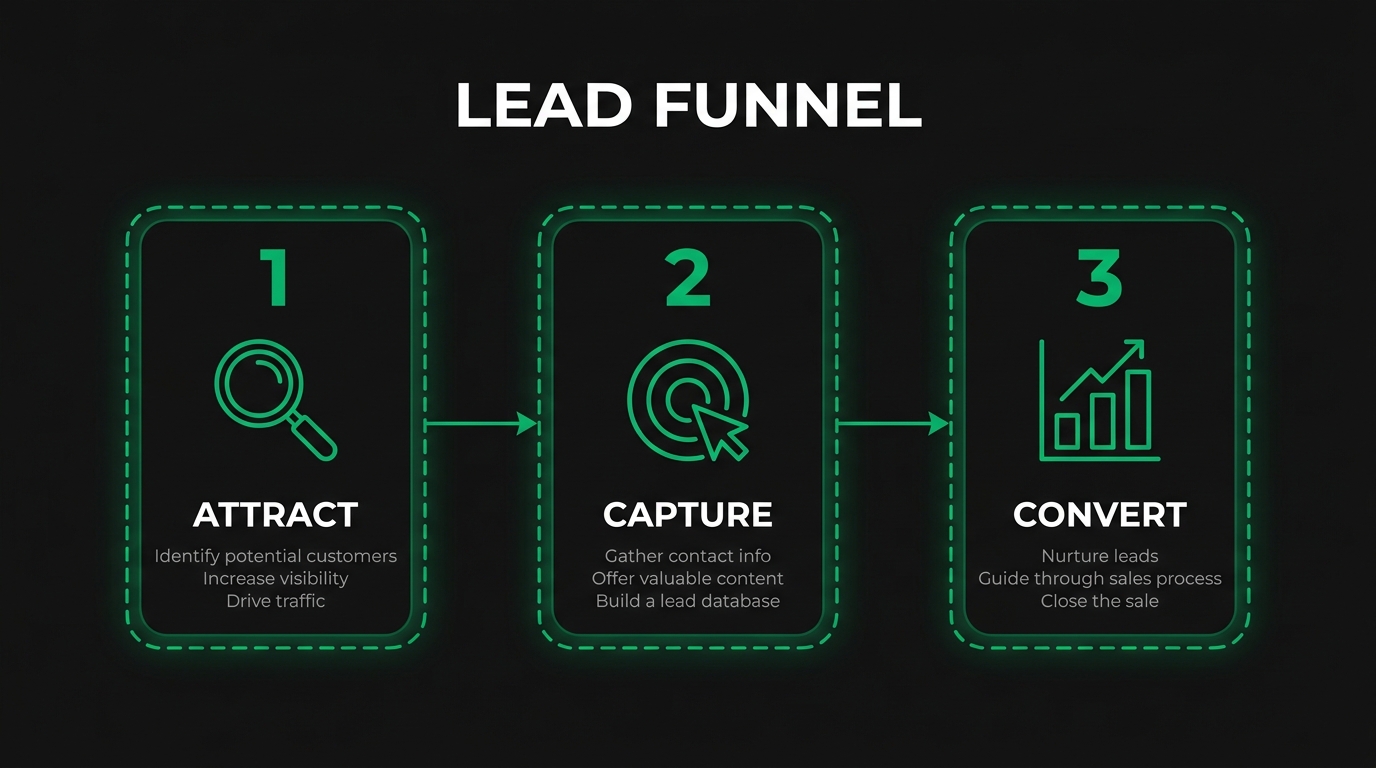
A working lead generation funnel maps the industrial buying journey, deploys lead magnets engineers will exchange contact details for, scores leads against specification fit, and hands qualified opportunities to sales without delay.
SEO tactics that generate the most leads center on procurement-intent keyword research, structured process and certification pages, AI search visibility, and technical SEO that supports indexing and conversion.
Measurement ties channel activity to pipeline revenue, cost per qualified lead, and RFQ-to-close attribution rather than vanity metrics.
Common mistakes that hurt manufacturing lead generation include generic keyword targeting, slow mobile experiences, missing certification content, and disconnected marketing and sales operations.
What Is B2B Manufacturing Lead Generation?
B2B manufacturing lead generation is the systematic process of attracting industrial buyers, capturing their contact information, and qualifying them against specification fit so sales can pursue real RFQ opportunities. The sub-sections below cover how it differs from other B2B sectors, why it shifted online, and what counts as a qualified lead.
How Does B2B Manufacturing Lead Generation Differ From Other B2B Sectors?
B2B manufacturing lead generation differs from other B2B sectors because the buyer is a multi-person procurement committee, the query is process- or material-specific, and the conversion event is a request for quote rather than a software trial or subscription. Manufacturing leads must satisfy capability, certification, and capacity gates before they reach a sales conversation, which means the supplier site has to act as a technical reference, not a marketing funnel.
Lead generation systems built for SaaS or retail rarely translate without restructuring around RFQ workflows.
Why Has Lead Generation Shifted Online for Industrial Buyers?
Lead generation has shifted online for industrial buyers because procurement teams now complete the majority of supplier evaluation through independent digital research before contacting any vendor. Buyers compare process capability, materials, tolerances, and certifications across multiple supplier sites in parallel, validating each one against an internal specification sheet.
A clear primer on how do manufacturers get leads online walks through the channel mix in detail.
What Counts as a Qualified B2B Manufacturing Lead?
A qualified B2B manufacturing lead is a contact who matches the supplier's process capability, material expertise, certification scope, and minimum order or annual volume threshold, and who has expressed clear sourcing intent through a quote request, capability inquiry, or specification-level question. Qualification criteria typically include process fit (such as 5-axis CNC, Swiss machining, or stamping), material grade compatibility, certification requirements (AS9100, ISO 13485, ITAR, IATF 16949), and geographic or lead-time constraints. Marketing-qualified leads become sales-qualified leads only after meeting these procurement-relevant gates. The bridge between definition and channel selection begins next.
How Do Manufacturers Get Leads Online Today?
Manufacturers get leads online today through organic search, paid search, trade-publication referrals, AI-assisted discovery, and direct quote-form submissions on capability pages. The sub-sections below cover the dominant channels, how procurement buyers search across the RFQ cycle, and the role quote forms play in lead capture.
Which Digital Channels Drive the Most B2B Manufacturing Leads?
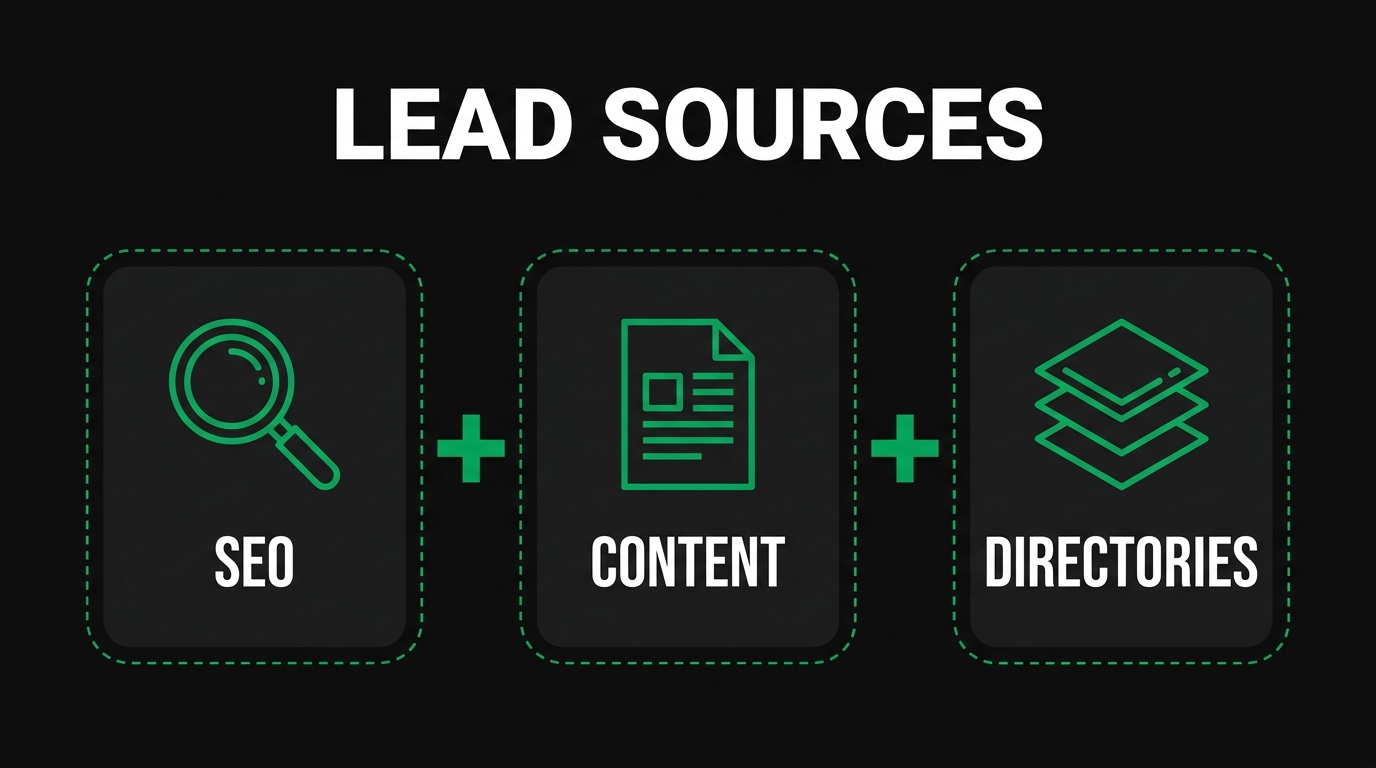
Digital channels that drive the most B2B manufacturing leads include organic search, paid search, industry directories, trade publication coverage, LinkedIn, and email nurture sequences tied to capability content. Among these, organic search consistently delivers the lowest cost per qualified lead because procurement-stage queries indicate active sourcing intent.
How Do Procurement Buyers Search for Suppliers in the RFQ Cycle?
Procurement buyers search for suppliers in the RFQ cycle by running a sequence of progressively specific queries: first researching processes, then comparing material capabilities and certifications, and finally entering RFQ-ready terms that combine process, material, certification, and geography.
Buyers cross-reference engineering datasheets, case studies, certification pages, and quote forms across several supplier sites before sending an RFQ. Suppliers that publish technically accurate, certification-tagged pages get shortlisted; those that publish generic marketing copy do not.
What Role Do Quote Forms and RFQ Submissions Play in Lead Capture?
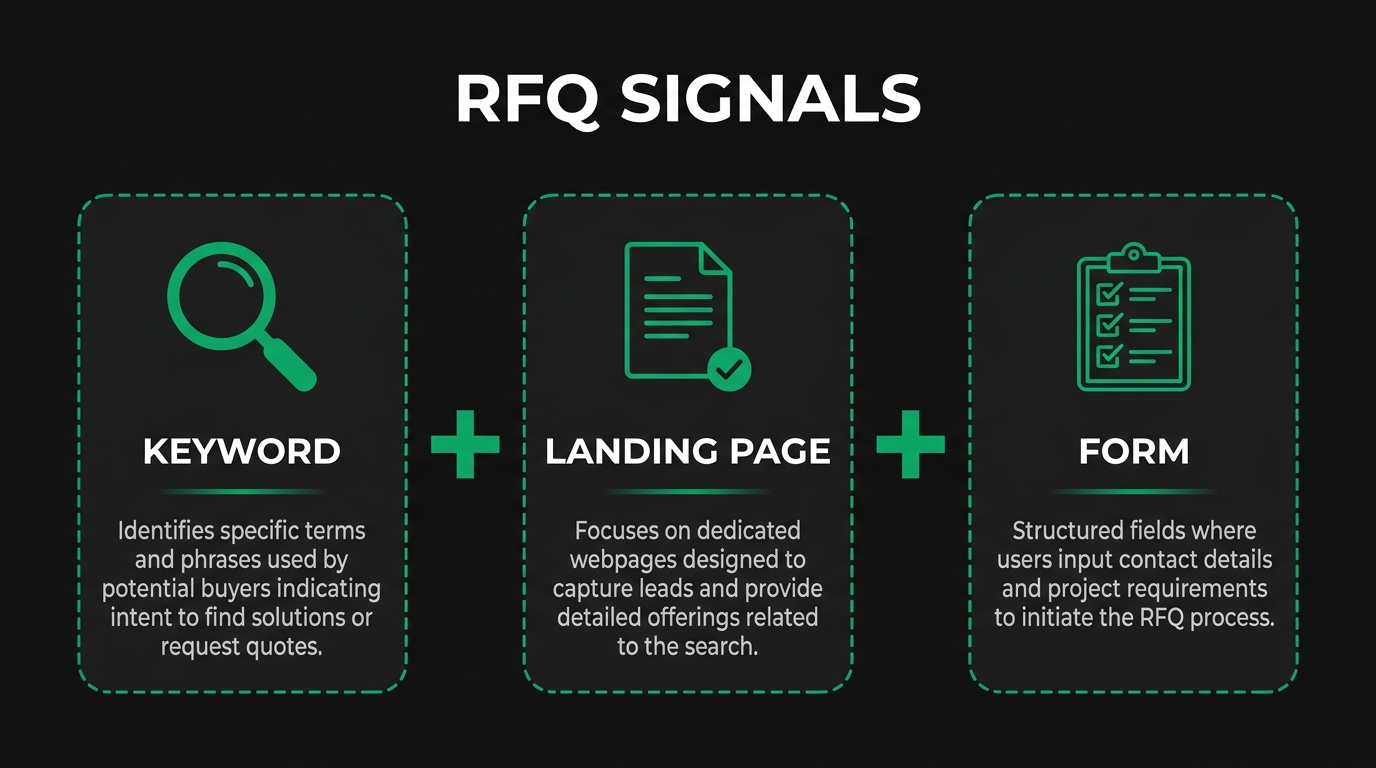
Quote forms and RFQ submissions are the primary lead-capture mechanism for B2B manufacturers because they are the moment a procurement researcher converts into a tracked sales opportunity. Effective RFQ forms are short, clearly labeled, and placed at the top of every capability page rather than buried under a contact tab. Required fields should match procurement reality: process, material, quantity, tolerance class, certification needs, and target lead time.
The next section maps which strategies actually feed these RFQ forms.
Which B2B Manufacturing Lead Generation Strategies Work Best?
The B2B manufacturing lead generation strategies that work best combine SEO, paid search, content marketing for engineers, trade-publication digital PR, and account-based marketing programs targeted at named procurement teams. The sub-sections below cover each in detail.
How Does SEO Generate Qualified B2B Manufacturing Leads?
SEO generates qualified B2B manufacturing leads by ranking capability, material, and certification pages for the exact procurement-stage queries engineers and supply chain teams type during sourcing. Pages that rank for terms like "5-axis CNC titanium AS9100 supplier" attract buyers already in evaluation mode, which is why the resulting RFQs convert at higher rates than top-of-funnel awareness traffic. A focused approach to seo for industrial lead generation covers the full intent-to-RFQ mapping in greater depth.
How Do Paid Search and PPC Campaigns Convert Industrial Buyers?
Paid search and PPC campaigns convert industrial buyers by placing capability pages directly in front of high-intent procurement queries, especially in competitive process or material segments where organic ranking takes longer to achieve. Effective campaigns isolate process keywords, layer material and certification modifiers, and route clicks to capability pages with one quote form rather than to a generic homepage. Negative-keyword discipline keeps spend off retail or DIY traffic. Procurement-intent ad copy emphasizes certifications, lead time, and quote turnaround, not adjectives. A side-by-side view of organic lead generation for manufacturers vs paid ads helps allocate budget across channels.
How Does Content Marketing Build Trust With Engineers and Procurement Teams?
Content marketing builds trust with engineers and procurement teams when it delivers technical depth, original imagery, and verifiable specifications rather than aspirational copy. Engineers want tolerance ranges, material grade comparisons, finishing options, and certification scope written in standard units. Process tutorials, case studies with measured cycle-time and yield outcomes, and material selection guides earn shares inside engineering teams and inbound links from trade publications.
How Do Trade Publications and Digital PR Amplify Manufacturing Lead Flow?
Trade publications and digital PR amplify manufacturing lead flow by placing the supplier in front of qualified industry audiences and earning high-authority backlinks that compound organic visibility. Editorial coverage in process-specific outlets, contributed bylines on technical topics, and inclusion in industry directories all drive referral traffic and search authority. Inclusion in directory listings for manufacturing lead generation creates a steady channel of vetted procurement inquiries from buyers who specifically use directories during supplier discovery. Pair earned media with original research the supplier publishes, such as benchmark data, process surveys, and capability studies, to attract editorial citations.
How Do Account-Based Marketing Programs Target Strategic Manufacturing Accounts?
Account-based marketing programs target strategic manufacturing accounts by aligning sales and marketing on a named list of high-value buyers and orchestrating coordinated outreach across email, LinkedIn, paid display, and direct outreach. ABM works best when capability content, case studies, and quote-form pages are tailored to the named account's process and certification needs.
The next section covers how to translate strategy choices into a working lead funnel.
How Should B2B Manufacturers Build a Lead Generation Funnel?
B2B manufacturers should build a lead generation funnel that mirrors the industrial buying journey, deploys the right lead magnets at each stage, scores leads against specification fit, and hands qualified opportunities to sales without delay. The sub-sections below cover each stage of the funnel.
What Are the Stages of the Industrial Buying Journey?
The stages of the industrial buying journey are problem identification, supplier research, evaluation, RFQ submission, vendor selection, and post-award validation. At problem identification, an engineer or procurement lead defines a need such as a new part, second source, or capacity expansion. Supplier research surveys the broader vendor landscape through search and directories. Evaluation narrows the list against capability, certification, and capacity. RFQ submission triggers formal quoting from the shortlist. Vendor selection compares quotes against price, lead time, and risk. Post-award validation tracks PPAP, first-article inspection, and ongoing performance.
Which Lead Magnets Convert Engineers and Procurement Managers?
Lead magnets that convert engineers and procurement managers are technically substantive resources such as material selection guides, process comparison whitepapers, certification checklists, capability matrices, sample part galleries, downloadable spec sheets, and CAD libraries. Magnets must trade real informational value for a contact: a generic "subscribe to our newsletter" call to action will not work. The strongest magnets are tools such as calculators for tolerance, finish, or cost, reference data like material datasheets aligned to ASTM grades, and templated RFQ forms engineers can pre-fill. A deeper look at improving lead quality in manufacturing explains how magnet design changes downstream conversion.
How Do You Score and Qualify B2B Manufacturing Leads?
You score and qualify B2B manufacturing leads by combining explicit firmographic data (industry, company size, geography), specification fit (process, material, certification, volume), and behavioral signals (pages visited, datasheets downloaded, RFQ form completed). Assign weighted points to each criterion and set thresholds for marketing-qualified (MQL), sales-qualified (SQL), and opportunity-stage handoffs. Any lead missing required certifications or volume thresholds gets disqualified or routed to nurture.
How Do You Hand Off Marketing Leads to Manufacturing Sales Teams?
You hand off marketing leads to manufacturing sales teams by defining a clear MQL-to-SQL definition, automating handoff through CRM integration, and committing both sides to service-level agreements on response time, follow-up cadence, and feedback. Every handoff record should include the source page, downloaded assets, RFQ details, and lead score so sales engineers can lead with relevance rather than restart discovery. Weekly pipeline reviews between marketing and sales align on which lead sources convert and which need refinement. Sales feedback flows back into lead scoring, closing the loop. The next section drills into the SEO tactics that fuel the funnel.
Which SEO Tactics Generate the Most B2B Manufacturing Leads?
The SEO tactics that generate the most B2B manufacturing leads are procurement-intent keyword research, structured process and certification pages, AI search visibility, and technical SEO that supports indexing and conversion. The sub-sections below cover each tactic with concrete guidance.
How Do You Research Procurement-Intent Keywords for Manufacturing?
You research procurement-intent keywords for manufacturing by mining process names, material grades, certifications, and applications, then layering geographic and lead-time modifiers that appear in real RFQ language. Build keyword clusters around each capability (for example, Swiss machining, Swiss machining medical, Swiss machining ISO 13485) rather than chasing single high-volume terms. Validate each cluster against Google Search Console impression data and competitor page coverage. Comparing options across the best seo tools for b2b manufacturing helps standardize a tooling stack before scaling research. Foundational guidance in basic seo strategies for factories covers how to structure the first 50 pages on a new factory site.
How Should You Structure Process, Material, and Certification Pages?
Process, material, and certification pages should be structured in hub-and-spoke clusters where each capability hub links to material-specific spokes and certification-specific spokes, and every spoke links back. Apply that to industrial pages by giving each process its own hub (with FAQs, equipment, tolerances), then linking individual material and certification variations one click below. The result is a topical map procurement buyers can navigate without bouncing.
How Do You Optimize Manufacturing Pages for AI Search and LLM Citations?
You optimize manufacturing pages for AI search and LLM citations by writing in clean SPO (subject-predicate-object) sentences, marking up entities with schema.org Service, Product, and Organization types, and surfacing key facts in extractable lists and tables. Use sameAs references to Wikipedia and Wikidata for processes, materials, and certifications so AI systems can disambiguate the entities. A broader view of manufacturing seo for market share connects AI visibility to long-term competitive position.
Which Technical SEO Fixes Improve Manufacturing Lead Capture?
Technical SEO fixes that improve manufacturing lead capture include compressing CAD imagery and videos for faster Largest Contentful Paint, fixing redirect chains, removing thin or duplicate spec pages, surfacing orphan capability pages through internal links, and validating Service and Organization schema on every URL. Audit Search Console weekly for coverage errors and prioritize fixes on capability pages tied to procurement intent. Forms must load fast on mobile, accept file uploads without errors, and submit in under three seconds. Fast, indexable, schema-rich pages capture more RFQs by removing friction the buyer never had to tolerate. The next section covers how to measure whether these tactics actually pay back.
How Do You Measure B2B Manufacturing Lead Generation ROI?
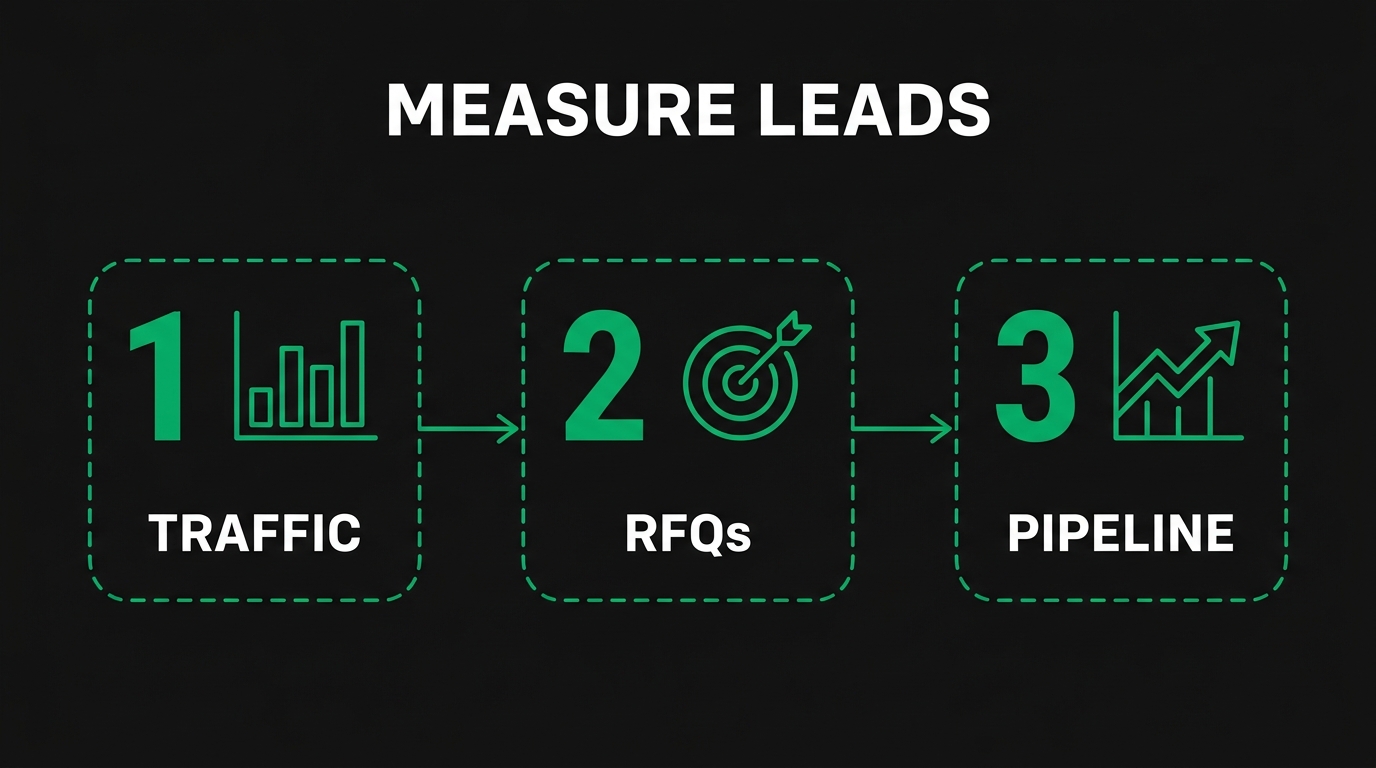
You measure B2B manufacturing lead generation ROI by tracking the right KPIs, attributing pipeline revenue to source channels, calculating cost per qualified lead, and following RFQs from first touch to closed revenue. The sub-sections below cover each measurement layer.
Which KPIs Matter Most for Industrial Lead Generation Programs?
The KPIs that matter most for industrial lead generation programs are RFQs generated, marketing-qualified lead volume, sales-qualified lead volume, opportunity creation rate, pipeline value influenced, cost per qualified lead, and closed revenue by channel. Vanity metrics like total sessions or generic form fills do not predict pipeline.
Trustworthy capability content is the leading indicator behind every lagging revenue metric.
How Do You Attribute Pipeline Revenue to Marketing Channels?
You attribute pipeline revenue to marketing channels by integrating CRM data with marketing automation and analytics, applying multi-touch attribution models that credit each touchpoint along the buying journey, and tagging every lead source on entry. Manufacturing sales cycles are long and committee-driven, so first-touch and last-touch alone distort credit. Use position-based or data-driven attribution that weights research, evaluation, and RFQ-stage touches. Specialist manufacturing seo reporting and analytics implementations connect organic rankings to RFQs, pipeline value, and closed revenue inside CRM systems rather than reporting isolated keyword positions.
How Do You Calculate Cost Per Qualified Manufacturing Lead?
You calculate cost per qualified manufacturing lead by dividing total channel spend (paid media, content production, agency fees, tooling) by the number of sales-qualified leads attributable to that channel within the same period. Track CPQL by channel (organic SEO, paid search, trade publications, ABM, directories) and by lead-to-opportunity conversion rate so the metric reflects pipeline quality, not just volume.
How Do You Track RFQs From First Touch to Closed Revenue?
You track RFQs from first touch to closed revenue by tagging every form submission with its source page and campaign, syncing lead data into the CRM, and updating opportunity stages as procurement advances through quote, sample, PPAP, and award. Closed-loop reporting then ties each award back to the originating organic keyword, paid campaign, or directory referral. Revenue-tied reporting reveals which content investments actually produce procurement awards, not just inquiries. The bridge from measurement to applying these strategies with a specialist partner begins next.
What Common Mistakes Hurt B2B Manufacturing Lead Generation?
Common mistakes that hurt B2B manufacturing lead generation include targeting generic keywords, running slow or mobile-hostile sites, omitting certifications and specifications from key pages, and operating sales and marketing as disconnected functions. The sub-sections below cover each mistake.
Why Do Generic Keywords Fail to Attract Procurement Buyers?
Generic keywords fail to attract procurement buyers because procurement queries are specification-rich and buyer intent is binary: either the page matches the spec or it does not. Ranking for "CNC machining" pulls in students, hobbyists, and unrelated traffic. Ranking for "5-axis CNC titanium AS9100 aerospace machining" attracts qualified procurement engineers ready to send an RFQ. Generic copy also signals shallow expertise to engineers, who abandon pages that lack tolerance ranges, material grades, or certification scope.
How Do Slow Sites and Poor Mobile Experience Lose RFQs?
Slow sites and poor mobile experience lose RFQs because procurement engineers abandon pages that fail to load quickly on whatever device they happen to be holding.
Industrial pages tend to carry heavy CAD imagery and machine videos that bloat load times, so compress aggressively, defer non-critical scripts, and confirm RFQ forms render and submit cleanly on mid-tier mobile devices.
Why Does Skipping Certifications and Specifications Cost B2B Leads?
Skipping certifications and specifications costs B2B leads because procurement teams disqualify any supplier whose capability pages do not visibly meet the certification, tolerance, or material requirements on the spec sheet. Aerospace buyers need AS9100. Medical device buyers need ISO 13485. Defense buyers need ITAR registration. Automotive Tier 1 work needs IATF 16949. Pages that omit these credentials get filtered out before any human review. Publish certification scope explicitly on every relevant page, list specific tolerances in standard units, and name material grades by ASTM or equivalent designation. The visibility itself shortens qualification.
How Does Misaligned Sales and Marketing Tank Manufacturing Conversion?
Misaligned sales and marketing tank manufacturing conversion when marketing chases vanity leads sales cannot use, sales ignores leads marketing generates, and neither side agrees on what qualifies. The result is leaked pipeline, wasted spend, and rising cost per closed deal. Fix the alignment with a shared MQL/SQL definition, weekly pipeline reviews, CRM-integrated lead routing, and shared revenue accountability. Marketing should be measured on pipeline contribution and closed revenue, not lead volume. Sales should commit to follow-up SLAs and feedback on lead quality. Closing this gap restores the lead-to-revenue throughput that funded the marketing investment in the first place.
How Should You Approach B2B Manufacturing Lead Generation With Manufacturing SEO Agency?
Approach B2B manufacturing lead generation with Manufacturing SEO Agency by combining procurement-intent keyword architecture, topical authority buildout, and revenue-tied reporting under one industrial-only program. Manufacturing SEO Agency is a team of manufacturing seo experts focused exclusively on B2B manufacturers, mapping every campaign to RFQs, pipeline value, and closed revenue.
How Can Manufacturing SEO Agency's Reporting Analytics Service Help With Lead Attribution?
Manufacturing SEO Agency's reporting analytics service helps with lead attribution by integrating organic ranking data, CRM opportunity records, and pipeline outcomes into a single dashboard tied to RFQs and closed revenue. The service connects keyword-level visibility to specific procurement awards, so manufacturers can see which content investments produced quoted revenue and which need refinement. Manufacturing SEO Agency builds attribution models that respect the long, committee-driven manufacturing sales cycle rather than crediting only first or last touch.
Manufacturers using this approach gain clarity on cost per qualified lead, channel ROI, and the keyword clusters that consistently feed pipeline.
What Are the Key Takeaways About B2B Manufacturing Lead Generation Strategies We Covered?
The key takeaways about B2B manufacturing lead generation strategies are that procurement buyers research suppliers digitally before any contact, qualified leads require process, material, and certification fit, and the strategies that work combine SEO, paid search, content marketing, trade-publication digital PR, and ABM. A working funnel maps content to each stage of the industrial buying journey, deploys engineer-relevant lead magnets, and scores leads against specification fit before sales handoff. SEO tactics that produce the most leads are procurement-intent keyword research, hub-and-spoke process and certification page architecture, AI search visibility, and technical fixes that reduce friction. ROI measurement ties channel activity to RFQs, pipeline value, and closed revenue rather than vanity metrics, and avoiding generic keywords, slow mobile pages, missing certifications, and sales-marketing misalignment protects the entire program.