
Competitive SEO analysis for manufacturing is the systematic study of how rival manufacturers, distributors, and trade publications win procurement-intent organic visibility, then converting that intelligence into a roadmap for outranking them on the process, material, and certification queries that drive RFQs. We use it to surface keyword gaps, link patterns, technical health differentials, and content depth advantages across an entire industrial niche.
This guide covers why the analysis matters, how to define the competitive landscape, what data to capture, how to run keyword and content audits, how to compare backlinks and technical SEO, and how to translate findings into a measurable roadmap supported by the right tools.
We open with the strategic case for treating SEO as competitive intelligence inside a procurement-driven supply chain, where buyers research extensively before any vendor contact and a single ranking can decide which supplier receives the RFQ.
We then walk through scoping the landscape, separating direct business competitors from search competitors, and accounting for distributors, marketplaces, and trade media that often outrank manufacturer sites for specification queries.
Next, we examine the data layer: keyword footprints, backlink profiles, technical SEO, schema, and topical coverage, with practical methods for keyword gap analysis across procurement funnel stages and process, material, and certification clusters.
Finally, we cover competitor backlink and digital PR analysis, technical benchmarking, the translation of findings into prioritized roadmaps tied to RFQs and pipeline, and the tools, datasets, and refresh cadences that keep manufacturing competitive intelligence actionable.
Why Does Competitive SEO Analysis Matter for Manufacturers?
Competitive SEO analysis matters for manufacturers because procurement buyers shortlist suppliers through search before any sales contact, so the firms ranking for process, material, and certification queries capture the RFQ pipeline. The sub-sections below cover industrial search behavior, the business outcomes tied to visibility, and the competitor set worth tracking.
How Does Search Behavior Differ in Industrial Procurement?
Search behavior in industrial procurement differs from consumer search in three structural ways: queries are highly technical, the buyer journey is long and committee-driven, and a single specification mismatch eliminates a supplier before any conversation. Procurement researchers chain process, material, tolerance, and certification terms ("5-axis cnc machining titanium AS9100") rather than brand keywords. Decision committees of engineers, purchasing managers, and quality leads each repeat the search with their own modifiers. The supplier whose page surfaces under every modifier wins the RFQ slot. Strong competitor analysis for industrial seo reveals which modifiers rivals already own and where you can intercept the buyer earlier.
What Business Outcomes Depend on Search Visibility for Manufacturers?
Business outcomes that depend on search visibility for manufacturers are RFQ volume, average deal size, sales cycle length, and supplier-of-record status with multi-facility OEMs. Pages that rank for procurement queries feed qualified buyers directly into the quote pipeline; pages buried below page one feed nothing.
Smaller shops feel this most acutely, which is why seo for small manufacturing companies often has higher revenue leverage per ranking than enterprise plays.
Which Competitors Should Manufacturers Actually Track?
Manufacturers should actually track three competitor classes: direct business competitors making the same parts, search competitors ranking for your target queries (often distributors, marketplaces, and trade publications), and content competitors building topical authority on adjacent processes. The three rarely overlap completely. A custom CNC shop in Ohio competes commercially with regional machinists, but its SERP rivals are usually Thomasnet category pages, an aerospace trade journal, and one national contract manufacturer. Tracking only direct business rivals leaves the largest visibility leaks invisible. Mapping all three classes sets the foundation for the landscape work in the next section.
How Should Manufacturers Define the Competitive SEO Landscape?
Manufacturers should define the competitive SEO landscape by separating direct, search, and content competitors, then layering in the distributors, marketplaces, and trade media that absorb procurement query volume. The next sub-sections walk through each lens.
Who Counts as a Direct Search Competitor Versus a Business Competitor?
A direct search competitor is any domain that ranks on page one for your priority procurement queries; a business competitor is any firm that quotes the same RFQs. The two sets overlap by perhaps 30 to 50 percent in most industrial niches.
The choice between contract manufacturing vs custom manufacturing seo often shifts which set dominates your page one results.
How Do You Build a Competitor Set Around Process, Material, and Certification Queries?
You build a competitor set around process, material, and certification queries by extracting the top ten ranking domains for each priority cluster, then deduping into a single weighted list. Start with the process verbs ("injection molding," "metal stamping," "5-axis cnc"), pair each with the materials you run ("PEEK," "Inconel 718," "316 stainless"), and append the certifications buyers screen on ("AS9100," "ISO 13485," "NADCAP," "IATF 16949"). Pull the SERP for every combination, count how often each domain appears, and rank by frequency. Domains showing up across 25 or more of your top clusters become anchor competitors; domains in only one or two are niche threats worth a separate watchlist.
What Role Do Distributors, Marketplaces, and Trade Publications Play?
Distributors, marketplaces, and trade publications play the role of intercept layers that sit between manufacturers and procurement buyers in the SERP. Industrial directories like Thomasnet rank for category-level queries; trade publications like Modern Machine Shop or Plastics Technology own informational queries; distributors like McMaster-Carr capture spec sheet searches. Treat them as part of the landscape because they consume click share even when you outrank direct rivals. The next H2 covers exactly which data points to capture across all three competitor classes.
What Data Should a Competitive SEO Analysis for Manufacturing Capture?
A competitive SEO analysis for manufacturing should capture four data layers: keyword footprints, backlink profiles, technical SEO health, and content depth with schema. The sub-sections below detail each, including the procurement-intent metrics that matter most.
Which Keyword Footprint Metrics Reveal Real Procurement Intent?
The keyword footprint metrics that reveal real procurement intent are organic keyword count, percentage of keywords containing process, material, or certification modifiers, average position for buying-stage queries, and traffic share of pages that include "RFQ," "quote," "supplier," or "capabilities." Vanity metrics like total monthly traffic obscure intent. A competitor ranking for 50,000 informational keywords may still lose to a rival ranking for 800 procurement queries with quote-page intent.
How Do Backlink Profiles and Referring Domains Signal Authority in Industrial Niches?
Backlink profiles and referring domains signal authority in industrial niches when the linking sites are trade publications, standards bodies, university engineering departments, OEM supplier directories, or association rosters rather than generic blog networks. Count unique referring domains, weight them by industry relevance, and look for editorial mentions in publications your buyers actually read. Five trade-press links typically outweigh five hundred low-quality directory citations.
What Technical SEO Signals Matter Most for Manufacturer Sites?
The technical SEO signals that matter most for manufacturer sites are crawl budget allocation across capabilities and parts pages, indexation rate of spec-sheet PDFs, mobile rendering of CAD viewers, structured data on Product and Service entities, and HTTPS coverage across legacy subdomains. Manufacturer sites tend to accumulate orphaned product pages and unindexed PDF libraries; competitive analysis catches both. Compare crawl health head to head before assuming content gaps explain ranking deltas. A focused industrial seo audit surfaces these issues faster than generic crawl scans.
How Should Content Depth, Topical Coverage, and Schema Be Audited?
Content depth, topical coverage, and schema should be audited against a process-material-certification matrix that lists every query cluster a buyer might run, then scored for whether each competitor publishes a dedicated page, supports it with schema, and includes specifications, tolerances, and case examples. Score depth on a four-tier scale: stub, overview, comprehensive, definitive. Map schema usage by entity type. The audit reveals whether rivals win because they outwrite you, out-mark up you, or both, and feeds directly into the keyword gap analysis next.
How Do You Conduct a Competitive Keyword Gap Analysis for Manufacturers?
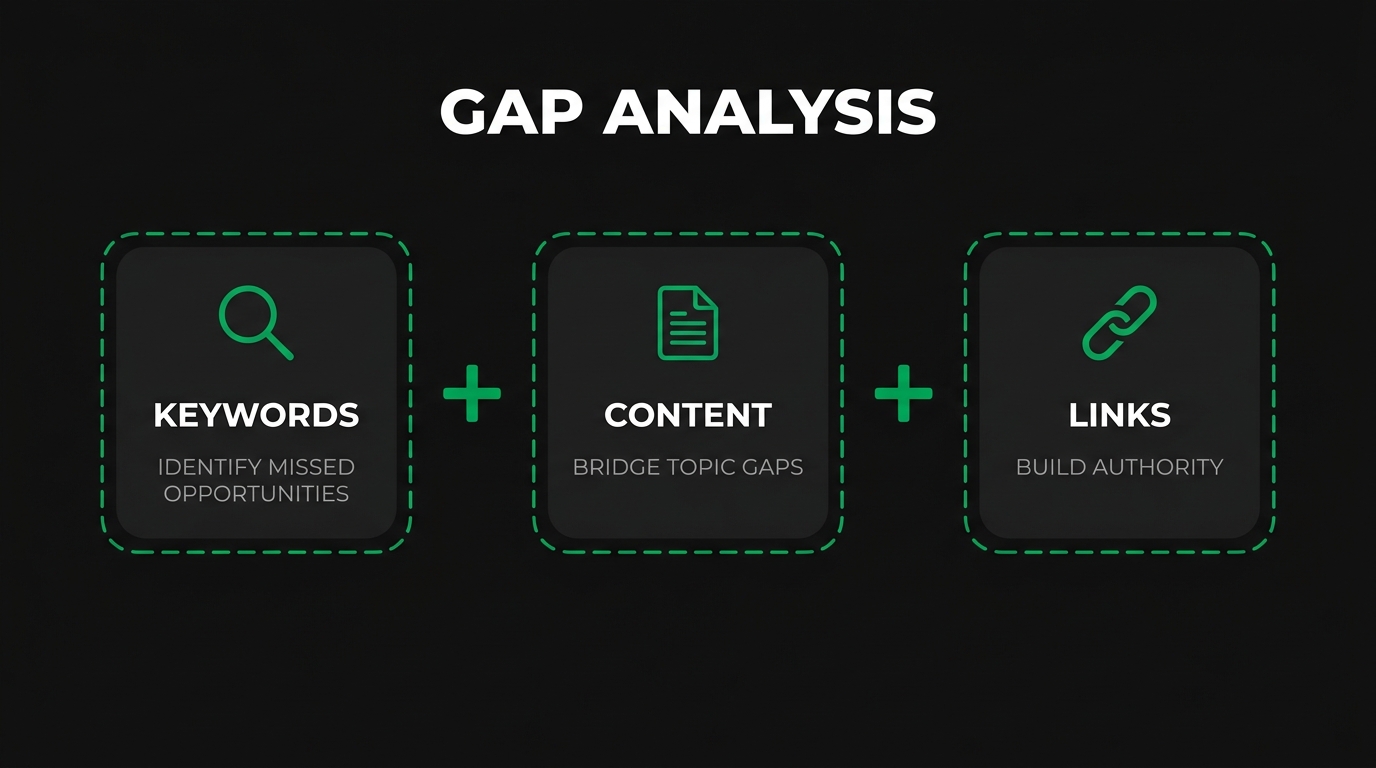
You conduct a competitive keyword gap analysis for manufacturers by mapping queries to procurement funnel stages, grouping them into process, material, and certification clusters, and then isolating the high-value terms your rivals already rank for but you do not. The sub-sections below detail each step.
How Do You Map Keywords to the Procurement Funnel Stages?
You map keywords to the procurement funnel stages by sorting every tracked query into three buckets: awareness (process definition), consideration (supplier evaluation), and decision (RFQ, quote, capabilities, and certification terms). Awareness queries like "what is 5-axis CNC machining" carry low commercial intent; decision queries like "AS9100 titanium machining supplier" carry the RFQ.
Learning how to find competitor keywords is the fastest way to populate each stage.
What Are Process, Material, and Certification Keyword Clusters?
Process, material, and certification keyword clusters are three orthogonal dimensions manufacturers combine to form the full procurement query space. Process clusters describe the manufacturing method (injection molding, stamping, wire EDM, additive); material clusters describe the workpiece substrate (PEEK, 316L stainless, Inconel 718, medical-grade silicone); certification clusters describe the standards that gate supplier selection (AS9100, ISO 13485, NADCAP, IATF 16949, ITAR).
Any ranking page that does not address at least two of the three dimensions is leaving relevance on the table.
How Do You Spot High-Value Gaps Competitors Are Already Ranking For?
You spot high-value gaps competitors are already ranking for by running a keyword-intersection report: pull the top 200 commercial keywords for each anchor competitor, overlay them against your ranked set, and filter for keywords where at least two competitors rank in positions one through ten but you rank outside the top thirty. Sort remaining gaps by search volume weighted by buyer-intent modifiers. A small subset (usually 30 to 80 terms) drives most RFQ potential. Pattern-matching competitor spec pages feeds seo strategies for manufacturing specifications, which is how most gaps close in practice.
How Do You Audit Competitor Content and Topical Authority in Manufacturing?
You audit competitor content and topical authority in manufacturing by classifying every competitor URL into pillar, cluster, or application roles, scoring whether the set covers a full topical map, and reverse-engineering SERP features like featured snippets and People Also Ask. The sub-sections below walk through each step.
How Do You Identify Pillar, Cluster, and Application Pages?
You identify pillar, cluster, and application pages by parsing each competitor site's URL structure and internal link graph, then tagging every page by role. Pillar pages cover a parent process at depth (e.g., "CNC machining services"); cluster pages cover a narrow sub-process or material pairing ("aluminum CNC machining," "5-axis titanium machining"); application pages cover end-use industries ("aerospace brackets," "medical implants"). Strong competitor sites publish one pillar per process, six to twelve clusters beneath it, and application pages that cross-link back to both. Weak competitors publish blog posts with no parent-child relationship. The classification surfaces exactly which nodes you must build to match topical depth.
What Patterns Indicate Strong Topical Authority Versus Scattered Blogging?
Patterns that indicate strong topical authority versus scattered blogging are consistent URL taxonomy, dense internal links between pillar and cluster pages, schema on every procurement-intent page, and breadth across the process-material-certification matrix. Scattered blogging shows up as isolated posts with no pillar, generic topics unrelated to buyer queries, and zero schema.
Broader seo strategies for manufacturing specifications consistently outperform blog-heavy approaches.
How Do You Reverse-Engineer Featured Snippets and PAA Coverage?
You reverse-engineer featured snippets and PAA coverage by pulling every SERP for your priority clusters, logging which domain owns the snippet, extracting the question format, and mapping the on-page structure that earned the box (H2 question + direct first-sentence answer + supporting list or table).
Feed the captured questions into your own topical map to close PAA gaps systematically. This analysis completes the content layer and sets up the backlink comparison next.
How Do You Analyze Competitor Backlinks and Digital PR in Industrial Sectors?
You analyze competitor backlinks and digital PR in industrial sectors by isolating links from trade publications and industry authorities, extracting replicable patterns from rival profiles, and reading anchor text plus tier-2 link flow to forecast ranking movement. The sub-sections below cover each lens.
Which Trade Publications and Industry Authorities Drive Real Link Equity?
Trade publications and industry authorities that drive real link equity are domain-specific editorial outlets, standards bodies, trade associations, federal data sources, and OEM supplier directories. Examples include Modern Machine Shop, Plastics Technology, Assembly Magazine, SME, NAM, and AS9100 registrars.
One editorial placement from these sources typically outperforms hundreds of directory listings in moving rank on procurement queries. Filter each competitor's referring domain list to this whitelist before drawing any conclusions about authority.
How Do You Find Replicable Backlink Patterns From Competitor Profiles?
You find replicable backlink patterns from competitor profiles by clustering each rival's referring domains into link-type buckets: editorial mentions, expert quotes in roundups, data studies, association memberships, supplier listings, and resource page inclusions. Count volume per bucket, sort by velocity, and check which buckets correlate with pages that gained positions. Replicable patterns are ones any manufacturer with comparable capabilities can earn.
Applying heavy industry seo best practices accelerates link acquisition.
What Anchor Text and Tier-2 Patterns Predict Ranking Movement?
Anchor text and tier-2 patterns that predict ranking movement are a balanced anchor mix (brand, naked URL, generic, and exact-match), exact-match anchors on two to six percent of links, and tier-2 links pointing at the money pages from secondary domains controlled by competitors or their PR firms. Over-optimized exact-match ratios usually signal link schemes and trigger algorithmic suppression. Track each competitor's anchor distribution over time; rising exact-match ratios on gaining pages tell you which anchors earned the gain.
This closes the link layer and opens the technical benchmark next.
How Do You Benchmark Technical SEO Performance Across Manufacturer Competitors?
You benchmark technical SEO performance across manufacturer competitors by auditing crawlability, indexation, and schema side by side, comparing Core Web Vitals and mobile UX, and inspecting internal linking and site architecture for spec page depth. The sub-sections below detail each.
What Crawlability, Indexation, and Schema Issues Are Most Common?
The crawlability, indexation, and schema issues most common on manufacturer sites are unlinked spec-sheet PDFs, orphaned product pages, inconsistent canonical tags across parameterized filter URLs, missing Product or Service schema, and legacy HTTPS gaps on subdomains.
Compare crawl logs and schema coverage before touching content.
How Do You Compare Core Web Vitals and Mobile UX Across Competitor Sites?
You compare Core Web Vitals and mobile UX across competitor sites by pulling CrUX field data for each domain, scoring LCP, INP, and CLS on both form factors, and noting which competitors fail the assessment.
Manufacturer sites with heavy CAD viewers or uncompressed spec images tend to fail mobile INP; competitors that lazy-load and ship server-rendered HTML almost always pass. Rank order often mirrors CrUX pass rate on mid-difficulty procurement queries.
How Should Internal Linking and Site Architecture Be Compared?
Internal linking and site architecture should be compared by mapping every competitor's link graph, measuring average clicks from home to spec page, counting internal links pointing at each money page, and checking whether pillar pages pass equity down to clusters and applications.
Manufacturers whose spec pages sit three or fewer clicks from the homepage and receive 20 or more internal links typically outrank peers whose pages sit five clicks deep. Architecture fixes then feed the roadmap covered next.
How Do You Translate Competitive SEO Findings Into a Manufacturing SEO Roadmap?
You translate competitive SEO findings into a manufacturing SEO roadmap by prioritizing quick wins against long-horizon plays, tying every action to RFQ and pipeline impact, and adapting the plan for AI search and LLM citation signals. The sub-sections below walk through each.
How Do You Prioritize Quick Wins, Gaps, and Long-Horizon Plays?
You prioritize quick wins, gaps, and long-horizon plays by scoring each action on three axes: effort, expected traffic value, and time to result. Quick wins include on-page optimization of page-two procurement pages, schema fixes, and orphan-page relinking. Gaps are the 30 to 80 high-intent terms where competitors rank and you do not, requiring new cluster pages. Long-horizon plays are pillar rebuilds, PR-grade link acquisition, and application page buildouts. Sort by value divided by effort and publish a rolling quarterly queue. Layering proven industrial seo strategies keeps execution disciplined.
How Do You Tie SEO Actions to RFQs, Pipeline, and Revenue?
You tie SEO actions to RFQs, pipeline, and revenue by instrumenting every procurement-intent landing page with form, phone, and chat event tracking, piping those events into the CRM as lead source tags, and back-attributing opportunity value to the originating keyword cluster. Pages without CRM hooks cannot demonstrate revenue impact; pages with them let you compare cost per RFQ across clusters and redirect budget toward the highest ROI.
Revenue attribution, not traffic, is what keeps SEO investment funded.
How Should the Roadmap Adapt to AI Search and LLM Citations?
The roadmap should adapt to AI search and LLM citations by publishing pages structured for direct answer extraction, building entity-rich schema with sameAs references, and tracking brand mentions across AI Overviews and chatbot responses.
Optimize for citation, not just ranking. Combining classical rank tracking with LLM citation audits is how mature programs stay ahead. The roadmap sets up the tooling and cadence in the next section.
What Tools, Data Sources, and Workflows Support Manufacturing Competitive SEO Analysis?
The tools, data sources, and workflows that support manufacturing competitive SEO analysis span crawl platforms, keyword intelligence suites, backlink indexes, analytics stacks, and federal datasets, combined on a regular refresh cadence. The sub-sections below cover each layer.
Which Tool Categories Are Essential for Industrial Competitive Intelligence?
The tool categories essential for industrial competitive intelligence are keyword intelligence suites (Ahrefs, Semrush, Keywords Explorer), crawl and log-analysis platforms (Screaming Frog, Sitebulb, Botify), backlink indexes (Ahrefs, Majestic), SERP and rank tracking tools, structured data validators (Google Rich Results Test, Schema.org validator), analytics and CRM stacks (GA4, HubSpot, Salesforce), and industry datasets like the International Trade Administration's Manufacturing Industry Tracker and FRED's Industrial Production series. Each category answers a different question; together they produce a complete competitive picture. Our take on the best seo tools for b2b manufacturing is that the category mix matters more than any single vendor.
How Do You Combine Crawl, Keyword, Backlink, and Analytics Data?
You combine crawl, keyword, backlink, and analytics data by exporting each tool's output to a shared warehouse (BigQuery, Snowflake, or a flat Google Sheet for smaller operations), keying every dataset on URL, then building a single competitor scorecard with keyword footprint, referring domain count, Core Web Vitals status, schema coverage, and traffic share columns. The unified table is where patterns emerge.
Without joining the data, each tool tells a partial story. A keyed warehouse also makes month-over-month deltas trivial.
How Often Should Manufacturers Refresh Their Competitive SEO Analysis?
Manufacturers should refresh their competitive SEO analysis on a cadence of weekly rank tracking, monthly keyword and backlink snapshots, quarterly full technical audits, and annual landscape reviews tied to strategic planning. Weekly scans catch emerging SERP volatility and new competitor pages before they mature; monthly snapshots track link acquisition velocity and content publishing pace; quarterly audits repeat the full scorecard; annual reviews decide whether to expand coverage into new processes, materials, or certifications. Pair the cadence with CRM-attributed RFQ data so every refresh ties back to pipeline. This closes the analytical loop and sets up how Manufacturing SEO Agency operationalizes the system next.
How Should You Approach Competitive SEO Analysis for Manufacturing With Manufacturing SEO Agency?
You should approach competitive SEO analysis for manufacturing with Manufacturing SEO Agency by pairing the procurement-intent framework above with a manufacturing-only partner that runs the audit, gap closure, and revenue attribution end to end. The sub-sections below summarize the engagement and the key takeaways.
Can Manufacturing SEO Agency Help With Competitive SEO Analysis and Procurement-Intent Strategy?
Yes, Manufacturing SEO Agency can help with competitive SEO analysis and procurement-intent strategy as an industrial-only, manufacturing-focused seo agency serving B2B manufacturers across CNC machining, injection molding, metal fabrication, additive manufacturing, aerospace, automotive, medical, and regulated industries. Manufacturing SEO Agency runs full technical crawls, reverse-engineers every competitor ranking above the client, maps procurement-intent keyword clusters across process, material, and certification dimensions, and ties every ranking to RFQs, pipeline value, and closed revenue through CRM-integrated reporting. Engagements start at $5,000 per month and scale with site size, competitive density, and scope. Manufacturing SEO Agency does not take retail, SaaS, or local-services clients; every strategy is built from procurement reality.
What Are the Key Takeaways About Competitive SEO Analysis for Manufacturing We Covered?
The key takeaways about competitive SEO analysis for manufacturing we covered are:
- Procurement visibility shapes RFQ volume and pipeline.
- Define the landscape across direct, search, and content competitors, plus distributors and trade media.
- Capture four data layers: keyword footprints, backlinks, technical health, and content depth with schema.
- Run gap analysis by funnel stage and by process-material-certification cluster.
- Audit content against pillar, cluster, and application roles; reverse-engineer snippets and PAA.
- Benchmark backlinks against trade publications and industry authorities.
- Compare crawl, schema, Core Web Vitals, and internal linking head to head.
- Translate findings into a prioritized roadmap tied to CRM-attributed revenue.
- Refresh weekly, monthly, quarterly, and annually, and adapt for AI search and LLM citations.