Finding competitor keywords for manufacturing SEO means reverse-engineering the exact process, material, and certification queries that drive engineers and procurement managers to rival suppliers, then mapping every profitable term into a procurement-intent keyword architecture that captures RFQ demand. We approach this as an industrial-only discipline, not a generic digital marketing exercise.
This guide covers the definitions behind competitor keyword research in a manufacturing context, the strategic case for reverse-engineering rival domains, the methods and tooling that surface procurement-grade terms, and the operational playbook for turning stolen keywords into ranking RFQ pages.
We start by defining what counts as a manufacturing SEO competitor and why procurement-intent keywords outperform generic industrial phrases. Vanity terms rarely convert, while exact process and material queries map directly to supplier shortlists.
We then explain why reverse-engineering matters: competitor keywords reveal missed RFQ demand, compress topical authority timelines, and expose pipeline risk. Ignoring a rival's footprint lets them compound rankings inside your sourcing SERPs.
From there, we cover identifying true competitor domains, applying documented frameworks such as content gap, top pages, SERP overlap, and keyword intersection, and comparing enterprise research platforms alongside free signals like Google Search Console and Google Trends.
We close with procurement-intent filtering, topical clustering by process, material, and application, editorial prioritization against RFQ value, executional rules for briefing writers and earning industrial backlinks, and tracking systems that tie keyword wins to closed revenue.
What Are Competitor Keywords in Manufacturing SEO?
Competitor keywords in manufacturing SEO are the exact process, material, certification, and application queries that rival suppliers already rank for in Google, which your procurement-driven buyers type when sourcing parts. This section defines who counts as a competitor, how procurement-intent terms differ from generic industrial phrases, and why specificity beats volume. For a deeper foundation, review our industrial keywords? ultimate guide.
What Counts as a Manufacturing SEO Competitor?
A manufacturing SEO competitor is any domain that ranks for the process, material, tolerance, or certification queries your buyers use to build supplier shortlists, regardless of whether that domain actually produces parts. Direct fabricators, contract shops, distributors, trade marketplaces, and editorial trade publications all compete for the same SERP real estate. The working definition is ranking-based, not legal-entity-based.
If a domain outranks you on "5-axis CNC machining titanium aerospace," it is stealing pipeline and qualifies as a competitor for that query.
How Are Procurement-Intent Keywords Different From Generic Industrial Terms?
Procurement-intent keywords are different from generic industrial terms because they embed a process, material, tolerance, certification, or application that only a buyer preparing an RFQ would specify, while generic terms stop at category level. "CNC machining" is generic; "Swiss-turned PEEK medical components ISO 13485" is procurement intent.
Procurement-intent queries signal active sourcing, tighter shortlists, and shorter sales cycles. Review our high-value industrial keyword framework for the full taxonomy behind intent scoring.
Why Do Process, Material, and Certification Keywords Matter More Than Vanity Phrases?
Process, material, and certification keywords matter more than vanity phrases because regulated buyers disqualify suppliers on specification mismatches before they ever click. A part quote requiring AS9100 certification will never close with a shop that ranks for "metal parts."
Certification queries also correlate to higher-margin work. The plural differentiators include process names such as 5-axis milling, waterjet, and Swiss turning; material grades such as Inconel 718, PEEK, and 6061-T6; and certifications such as NADCAP, ITAR registration, and AS9100D. Vanity phrases attract readers, not purchase orders.
Why Should Manufacturers Reverse-Engineer Competitor Keywords?
Manufacturers should reverse-engineer competitor keywords because rivals have already validated which procurement queries produce RFQs, which compresses research time and exposes missed demand. This section covers hidden RFQ demand, topical authority timelines, and pipeline risk. For strategic context on implementing at smaller shops, see our guide on seo for small manufacturing companies.
How Do Competitor Keywords Reveal RFQ Demand You Are Missing?
Competitor keywords reveal RFQ demand you are missing by exposing every ranked query on a rival's top pages that your domain does not cover, which is a direct map of unworked sourcing opportunities. The gap becomes quantifiable the moment you subtract your keyword set from theirs.
Missing keywords include specific process-material combinations, certification-bound applications, tolerance-driven searches, and regional sourcing terms. Each missing query is a buyer who never saw your name on the shortlist.
How Does Competitor Keyword Research Shorten Topical Authority Timelines?
Competitor keyword research shortens topical authority timelines by replacing blank-sheet planning with a proven topical map that a ranking competitor has already spent months validating. You inherit their SERP-tested information architecture.
Reverse-engineering cuts the coverage plan from a guess to a checklist.
What Pipeline Risk Comes From Ignoring Competitor Keyword Footprints?
The pipeline risk from ignoring competitor keyword footprints is that every unworked query compounds into permanent buyer habituation toward the incumbent ranker, which erodes future win rates even after you catch up. Rankings are not neutral ground.
Ignored competitor footprints also signal to Google that your domain lacks topical completeness, suppressing rankings on queries you do target. The risk is cumulative: lost RFQs, weaker topical signals, and a widening authority gap that takes 12 to 18 months to close once you start.
Who Are Your True Manufacturing SEO Competitors?
Your true manufacturing SEO competitors are the domains ranking on page one for your procurement-intent queries, which usually include direct rivals, distributors, marketplaces, and trade publications, not just shops with similar capabilities. This section separates rivals from information sites, classifies non-obvious competitors, and maps sets by process and vertical. A related resource is our contract manufacturing vs custom manufacturing seo comparison.
How Do You Separate Direct Manufacturing Rivals From Information Sites in the SERP?
You separate direct manufacturing rivals from information sites in the SERP by examining whether the ranking URL offers a purchasable capability, quotable specification page, or RFQ form versus educational content without a conversion path. The difference is commercial intent in the page, not just the domain.
Rivals carry capability pages, equipment lists, and certification badges. Information sites host glossaries, definitions, and buying-guide copy. Both rank, but only one converts RFQs.
Which Distributors, Marketplaces, and Trade Publications Should You Treat as Competitors?
The distributors, marketplaces, and trade publications you should treat as competitors are the ones absorbing procurement-intent clicks that would otherwise reach your capability pages, including industrial marketplaces, master distributors, and editorial trade outlets with directory listings. Their ranking power is structural.
The competitor set includes aggregators such as industrial marketplaces that publish supplier directories, specialty distributors ranking on material grades, and trade publications running sponsored capability editorial. Each one is a toll booth on the path to your RFQ form.
How Do You Map Competitor Sets by Process, Material, and Industry Vertical?
You map competitor sets by process, material, and industry vertical by pulling the top twenty ranking domains for every process-material-vertical combination your shop serves, then clustering domains that appear across three or more SERPs as your true rivals. The repeating domains are your core competitor set. Mapping rules include grouping by process families such as CNC machining, injection molding, and metal fabrication; by material class such as aluminum alloys, stainless steel, and engineering plastics; and by vertical such as aerospace, medical, and automotive.
Keep the map updated quarterly, because competitor sets shift with SERP volatility.
How Do You Identify Competitor Domains Worth Analyzing?
You identify competitor domains worth analyzing by scraping procurement-intent SERPs, running branded and unbranded searches, and validating candidate domains against a fixed set of commercial signals. This section covers the SERPs to scrape, the branded-versus-unbranded method, and validation rules that eliminate false positives before a competitor enters your tracking stack.
Which SERPs Should You Scrape to Find Recurring Competitor Domains?
The SERPs you should scrape to find recurring competitor domains are those tied to your highest-value process-material-certification queries, capacity-modifier searches, and RFQ-ready phrases such as "quote," "supplier," and "contract manufacturer."
Scrape lists include top-twenty results per query, People Also Ask panels, video carousel hosts, and local pack rankers. Aggregate domains across 50 to 200 SERPs, then rank by frequency of appearance.
How Do You Use Branded and Unbranded Searches to Surface Competitor Sets?
You use branded and unbranded searches to surface competitor sets by pairing a known rival's brand name with capability modifiers to find their content clusters, then stripping the brand to see which domains colonize the same unbranded SERP. The paired query exposes neighbors.
Branded searches reveal direct comparison pages and review sites; unbranded searches reveal category-level rivals. Run both, deduplicate, and rank by SERP overlap count.
How Do You Validate That a Domain Is Worth Adding to Your Competitor List?
You validate that a domain is worth adding to your competitor list by confirming it ranks for three or more of your priority queries, serves the same industrial audience, and publishes capability or product pages that could appear on a buyer's shortlist. Three filters, no exceptions.
Weak signals include thin content farms, off-industry SaaS sites, and publishers without a commercial product. Keep the validated list under 25 true rivals per pillar.
Which Methods and Frameworks Reveal Competitor Keywords?
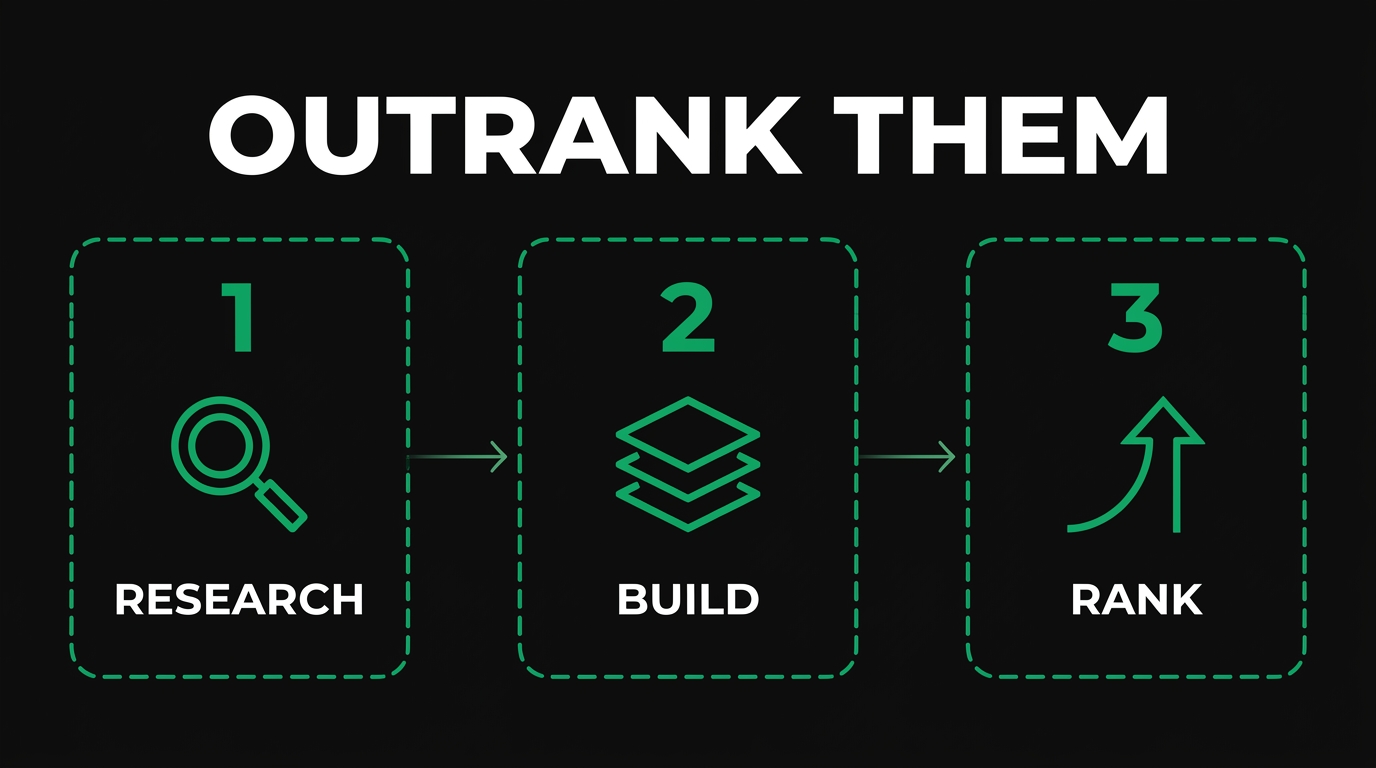
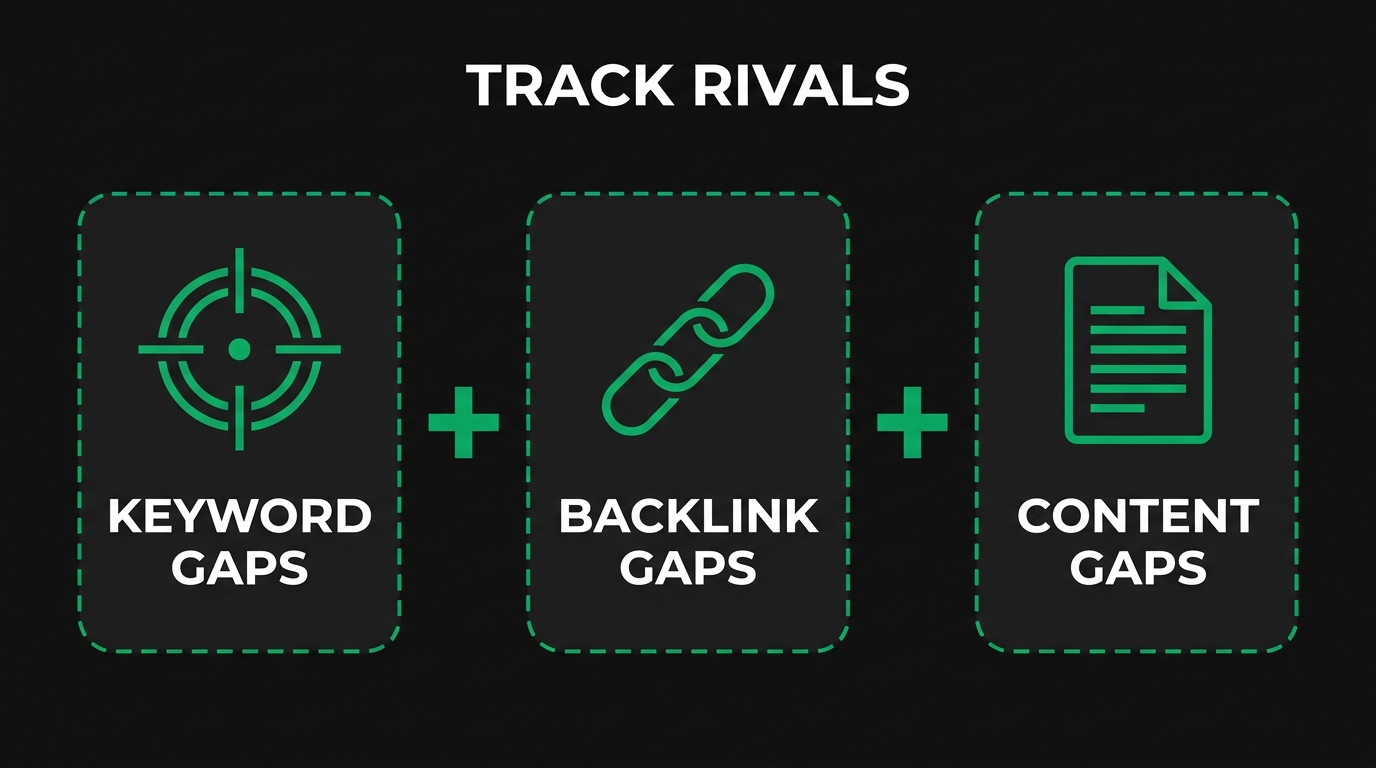
There are four documented frameworks that reveal competitor keywords in manufacturing SEO: content gap analysis, top pages analysis, SERP overlap analysis, and keyword intersection analysis. Each method surfaces a different layer of the rival's keyword footprint. This section defines how each one works and where it belongs in a procurement-focused research sequence.
How Does the Content Gap Method Surface Missing Procurement Queries?
The content gap method surfaces missing procurement queries by listing every keyword a competitor ranks for that your domain does not, then filtering the delta to procurement-intent terms only. The output is a priority backlog of missed RFQs.
Filter criteria include process specificity, material grade, certification, and buyer stage signals such as "quote," "MOQ," and "lead time." A clean gap list is smaller than the raw export but converts on a higher percentage of impressions.
How Does Top Pages Analysis Reveal a Competitor's Highest-Value RFQ Pages?
Top pages analysis reveals a competitor's highest-value RFQ pages by sorting their indexed URLs by organic traffic, then auditing the top twenty for the exact keyword set, schema, internal link density, and conversion pattern that produces pipeline. The page is the unit, not the keyword.
Replicate the winning patterns: process-specific H1, material-grade table, certification badge block, RFQ call-to-action, and entity-dense specification copy.
How Does SERP Overlap Analysis Cluster Competitors by Topical Territory?
SERP overlap analysis clusters competitors by topical territory by measuring how often two or more domains appear together across your priority keyword set, which exposes topical tribes fighting for the same buyers. Overlap percentage is the clustering signal.
High-overlap clusters reveal your true rivals for a pillar. Low-overlap clusters expose adjacent territories worth raiding.
How Does Keyword Intersection Analysis Find Shared Buyer Queries?
Keyword intersection analysis finds shared buyer queries by intersecting the ranking keyword sets of three or more rivals to isolate the terms every serious competitor ranks for, which is the defensive minimum for topical credibility. The intersection is your coverage baseline.
Shared queries usually carry the highest buyer validation, because multiple commercially motivated rivals concluded the term is worth targeting. Intersection pairs well with the content gap method, because together they show the non-negotiable core and the offensive upside.
Which Tools Help You Find Competitor Keywords for Manufacturing?
The tools that help you find competitor keywords for manufacturing include enterprise SEO platforms, Google's own free data products, paid ads intelligence, and specialist industrial data sources, each with documented limits inside niche industrial verticals. See our deeper vendor comparisons in best seo tools for b2b manufacturing and in our review of tools for global keyword research.
How Do Enterprise SEO Platforms Compare for Manufacturing Competitor Research?
Enterprise SEO platforms compare for manufacturing competitor research on four axes: industrial keyword coverage, SERP refresh frequency, content gap feature maturity, and backlink index depth on editorial trade publications. Ahrefs, Semrush, and Moz maintain large keyword indexes, but coverage of ultra-specific queries such as "micro-machining PEEK medical implantable" falls below mainstream consumer topics.
Evaluation criteria include keyword database size, SERP history, filters for commercial intent, and clean API access for custom procurement-intent scoring. Run pilot queries before committing to annual contracts.
How Do You Use Google Search Console and Google Trends as Free Competitor Signals?
You use Google Search Console and Google Trends as free competitor signals by pulling your own impression-but-no-click queries from Search Console, then cross-checking rising topic curves in Trends to spot competitor-driven demand shifts. The two tools triangulate.
Search Console exposes queries where competitors outrank you; Trends shows seasonal demand for process and material terms, such as summer spikes in food-grade packaging. Combined, they approximate a paid gap analysis at zero cost.
How Do You Combine Paid Ads Intelligence With Organic Keyword Data?
You combine paid ads intelligence with organic keyword data by pulling competitor Google Ads copy, landing-page destinations, and bid-visible keywords, then overlaying those terms on your organic gap list to find queries competitors treat as purchase-ready. Paid spend is a commercial vote.
Overlap between paid and organic keyword sets usually correlates with the highest RFQ conversion rates. Use paid data to prioritize organic writing order, not as a replacement for organic rank tracking.
What Are the Limits of Tool Data for Niche Manufacturing Queries?
The limits of tool data for niche manufacturing queries include thin keyword databases for ultra-specific process-material-certification combinations, stale volume estimates, missing local procurement variants, and the absence of RFQ intent signals. Tool data is directional, not authoritative.
The common limits include zero-volume queries that still convert, regional variants missing from national indexes, and certification terms flagged as branded noise. Validate tool-derived lists against Search Console, sales team inputs, and live SERP scrapes before committing editorial budget.
How Do You Filter Competitor Keywords for Procurement Intent?
You filter competitor keywords for procurement intent by scoring each term on process, material, and certification specificity, mapping it to a buyer-journey stage, and discarding vanity terms that do not progress an RFQ. This section covers the scoring system, the journey mapping, and the elimination rules that prevent editorial drift into high-traffic dead ends.
How Do You Score Keywords by Process, Material, and Certification Specificity?
You score keywords by process, material, and certification specificity using a three-column matrix where each keyword earns points for naming a defined process, a defined material grade, and a defined certification or tolerance. A score of three is a pure procurement query.
Scoring anchors include processes such as 5-axis milling, Swiss turning, and powder bed fusion; materials such as Inconel 625, PEEK, 7075-T6, and 316L stainless; and certifications such as AS9100D, IATF 16949, and NADCAP. Reject any keyword scoring zero in all three columns.
How Do You Map Keywords to Each Stage of the Procurement Journey?
You map keywords to each stage of the procurement journey by sorting them into initial material research, supplier evaluation, and RFQ submission buckets based on the language patterns buyers use at each phase. The pattern is lexical and intent-based.
Early-stage terms include "what is," "vs," and "materials for"; mid-stage terms include "suppliers," "certified," and "for aerospace"; late-stage terms include "quote," "MOQ," and "lead time." Map every ranked keyword to one stage before writing content.
How Do You Eliminate Vanity Terms That Will Not Convert to RFQs?
You eliminate vanity terms that will not convert to RFQs by rejecting any keyword that lacks process, material, or certification specificity, ranks primarily against consumer or DIY intent, or pulls traffic from outside your servable geography. Vanity terms inflate reports without producing quotes.
The rejection list includes single-word process terms, category-only phrases, and content-farm question queries with zero commercial modifier.
How Do You Cluster Competitor Keywords Into a Manufacturing Topical Map?
You cluster competitor keywords into a manufacturing topical map by grouping terms along process, material, and application axes, building pillar and cluster pages on each group, and resolving cannibalization risk before the content ships. This section covers the grouping logic, the pillar-cluster architecture, and the cannibalization audit.
How Do You Group Keywords by Process, Material, and Application?
You group keywords by process, material, and application by assigning each keyword three tags, then clustering terms that share at least two tags into the same content bucket. Three-tag overlap defines a cluster.
Process tags include CNC machining, casting, and extrusion; material tags include aluminum, titanium, and engineering plastics; application tags include aerospace structural, medical implantable, and automotive powertrain. Clusters become page outlines once three to seven related keywords aggregate.
How Do You Build Pillar and Cluster Pages Around Stolen Keyword Sets?
You build pillar and cluster pages around stolen keyword sets by assigning the highest-volume, broadest procurement term to the pillar page, then assigning narrower long-tail variants to supporting cluster pages that internally link up to the pillar. The pillar is the category capability page.
Pillar examples include "CNC Machining Services," supported by clusters such as "5-Axis Milling for Aerospace," "Swiss Turning for Medical," and "Micro-Machining PEEK Components." Every cluster page must link to the pillar with a descriptive anchor.
How Do You Resolve Keyword Cannibalization Risk Across Process Pages?
You resolve keyword cannibalization risk across process pages by auditing every indexed URL against every priority keyword, then consolidating any two pages that compete for the same primary term into one canonical page. One keyword, one page.
The audit output includes redirect targets, merge instructions, and updated internal link maps. Cannibalization hides most often between similar process pages such as "CNC milling" and "3-axis CNC milling." Resolve it before shipping new clusters, because split authority undermines every new page you publish next.
How Do You Prioritize Competitor Keywords for Your Editorial Roadmap?
You prioritize competitor keywords for your editorial roadmap by scoring each term on RFQ value and pipeline potential, validating difficulty against backlink profiles, and sequencing quick wins ahead of long-term pillar plays. This section defines the scoring system, the backlink validation, and the sequencing rule that protects editorial velocity. Related specification-driven planning sits in our seo strategies for manufacturing specifications guide.
How Do You Score Keywords by RFQ Value and Pipeline Potential?
You score keywords by RFQ value and pipeline potential by multiplying estimated monthly searches, historical close rate for that process-material-application combination, and average order value against a decay factor for SERP volatility. The product is a ranked pipeline estimate.
Scoring inputs include CRM close-rate history, average RFQ-to-PO conversion, and margin by part family. Output scores let editorial leads trade off a 200-search-per-month aerospace PEEK keyword against a 5,000-search-per-month consumer vanity phrase and correctly choose the former.
How Do You Use Competitor Backlink Profiles to Validate Difficulty Estimates?
You use competitor backlink profiles to validate difficulty estimates by comparing the number, quality, and relevance of industrial editorial links pointing at a ranking page against your achievable link-building output, which is the real gating factor for procurement keywords. Tool difficulty scores are not enough.
Validation inputs include referring-domain count, trade-publication anchor density, and Google-crawled link velocity. A keyword with a weak backlink incumbent is a quick win; a keyword with heavy trade-publication backing requires a pillar-grade plan.
How Do You Sequence Quick-Win Keywords Against Long-Term Pillar Plays?
You sequence quick-win keywords against long-term pillar plays by shipping the lowest-difficulty procurement queries first to build momentum, then funding pillar assets once early RFQ attribution proves the roadmap. Momentum funds the long bets.
The sequencing rule is 70/20/10: 70% quick-win long-tail pages, 20% cluster support pages, 10% pillar flagships.
How Do You Turn Stolen Competitor Keywords Into Ranking Pages?
You turn stolen competitor keywords into ranking pages by briefing writers on process-material-certification specificity, embedding schema and entity signals for Google's Knowledge Graph, and earning industrial backlinks that validate the keyword win at link-equity level. Supporting vendors for this workflow appear in our best seo competitor analysis tools manufacturing review.
How Do You Brief Writers on Process, Material, and Certification Specificity?
You brief writers on process, material, and certification specificity by supplying a structured brief that names the exact process tolerances, material grades, certifications, and application constraints the target buyer uses, plus a reference set of SERP-winning competitor pages. Specificity must be non-negotiable.
Brief components include keyword target, primary entities, required SPO triples, citation sources, competitor URLs, certification names, and acceptance criteria. Writers without domain fluency cannot invent these details, so the brief does the technical work before drafting begins.
How Do You Add Schema and Entity Signals to Outrank Competitors?
You add schema and entity signals to outrank competitors by marking up Product, Service, Organization, and FAQPage entities with Schema.org vocabulary, linking entities via sameAs properties to authoritative references, and embedding entity-dense specification copy that feeds Google's Knowledge Graph.
Entity targets include process names, material grades, certification bodies, and location entities. Done correctly, schema turns a well-written page into an entity hub Google cites in AI-generated answers.
How Do You Earn Industrial Backlinks That Validate the Keyword Win?
You earn industrial backlinks that validate the keyword win by placing editorial content in trade publications, landing capability features in engineering outlets, and supplying primary research that procurement-focused editors cite.
Tactics include expert byline articles in trade media, data-driven industry surveys, cited capability references in engineering newsletters, and speaking placements that convert to backlinks. Avoid generic guest-post networks. Google's link-quality signals discriminate heavily against off-industry, low-relevance backlinks in competitive procurement SERPs.
How Do You Track Whether Your Competitor Keyword Strategy Is Working?
You track whether your competitor keyword strategy is working by tying keyword wins to RFQs and closed revenue, monitoring competitor movements with share-of-voice, and refreshing your competitor keyword list on a quarterly cadence. This section covers the revenue attribution model, the share-of-voice methodology, and the refresh discipline that prevents ranking decay.
How Do You Tie Competitor Keyword Wins to RFQs and Closed Revenue?
You tie competitor keyword wins to RFQs and closed revenue by stamping every organic landing session with the query and URL, carrying those tags through the RFQ form into CRM, and reporting closed-revenue attribution against original keyword source. The tag must survive every handoff.
Instrumentation includes UTM taxonomy, form hidden fields, CRM custom properties, and closed-won revenue joins. Reporting outputs include revenue per keyword, revenue per cluster, and revenue per process pillar. This is the only report that justifies the next editorial budget cycle.
How Do You Monitor Competitor Movements With Share-of-Voice Tracking?
You monitor competitor movements with share-of-voice tracking by defining a fixed keyword set, tracking where every competitor ranks inside it, and reporting each domain's weighted share of total possible clicks on a weekly or monthly cadence. Share-of-voice is the ranking market-share signal.
Tracking inputs include fixed keyword baskets, weighted CTR curves, and competitor domain lists refreshed quarterly. Alerts trigger when a competitor jumps into the top three on a priority term.
How Do You Refresh Your Competitor Keyword List on a Quarterly Cadence?
You refresh your competitor keyword list on a quarterly cadence by re-scraping your priority SERPs, re-running intersection and gap analyses, and replacing stale keywords with new procurement-intent terms that emerged from industry shifts. The cadence is non-negotiable.
Refresh inputs include new competitor domains, new standards, new certifications, and new material grades. Quarterly keeps your editorial roadmap aligned with what buyers are typing today, not what they typed a year ago.
What Common Mistakes Should Manufacturers Avoid With Competitor Keyword Research?
The common mistakes manufacturers should avoid with competitor keyword research include copying competitor headlines without procurement intent, chasing high-volume generic terms rivals rank for, and misreading information sites as direct competitors. This section covers each mistake, why it happens, and the discipline that prevents it from contaminating the editorial roadmap.
Why Is Copying Competitor Headlines Without Procurement Intent a Mistake?
Copying competitor headlines without procurement intent is a mistake because headline language carries intent signals that must align with your pipeline, not your rival's, and blind copying imports their audience problem into your page. The page inherits the wrong buyer.
The failure mode shows up when a generic copied headline attracts wide traffic but zero RFQ forms. The fix is to rewrite every headline with your exact process, material, certification, and target industry terms, validated against CRM close-rate data before publication.
Why Should You Stop Chasing High-Volume Generic Terms Your Competitors Rank For?
You should stop chasing high-volume generic terms your competitors rank for because generic volume rarely maps to procurement-ready buyers, and the difficulty of competing for vanity phrases consumes budget that long-tail procurement terms convert at a far higher rate. Volume is a trap.
The mistake pattern is obvious: a "CNC machining" campaign drains backlink budget while dozens of exact process-material combinations sit unworked. Reallocate to long-tail clusters.
Why Do Manufacturers Misread Information Sites as Direct Competitors?
Manufacturers misread information sites as direct competitors because ranking alone looks like competition, but sites without a commercial conversion path are not absorbing RFQs and therefore distort the competitive set. Ranking is not revenue competition.
Information sites absorb awareness-stage clicks; commercial rivals absorb evaluation and purchase-stage clicks. Treating encyclopedias, glossaries, and academic pages as rivals pollutes gap analysis with terms your capability pages should not target at all. Filter the competitor list by commercial conversion path before running any keyword extraction.
How Should You Approach Competitor Keyword Research With Manufacturing SEO Agency?
You should approach competitor keyword research with Manufacturing SEO Agency as a structured engagement that maps every rival's procurement footprint, filters the keyword universe to RFQ-grade terms, and builds the topical coverage your buyers expect. Manufacturing SEO Agency is an industrial seo agency focused exclusively on B2B manufacturing SEO.
Can Manufacturing SEO Agency's Procurement-Intent Keyword Architecture Service Help You Steal Competitor Keywords?
Manufacturing SEO Agency's Procurement-Intent Keyword Architecture service helps you steal competitor keywords by reverse-engineering every ranking competitor, mapping keyword clusters to each stage of the procurement journey, and building architecture around process, material, and certification combinations your buyers already search. The scope covers initial material research, supplier evaluation, and RFQ submission stages. Manufacturing SEO Agency understands the difference between 3-axis and 5-axis machining, AS9100 versus ISO 13485, NADCAP, and IATF 16949, which is why the keyword maps reflect procurement reality rather than generic volume.
Engagements include full technical crawl, current keyword footprint mapping, reverse-engineering every competitor ranking above the client, and topical authority buildouts. Learn more through our industrial keyword research services page.
What Are the Key Takeaways About Finding Competitor Keywords for Manufacturing SEO?
The key takeaways about finding competitor keywords for manufacturing SEO are that procurement-intent specificity beats generic volume every time, that real competitors are the domains ranking for your RFQ queries regardless of legal-entity similarity, and that the four documented frameworks (content gap, top pages, SERP overlap, and keyword intersection) each surface a different layer of the rival footprint. The operational discipline includes quarterly competitor list refresh, revenue-tied reporting that ties rankings to closed RFQs, pillar-and-cluster architecture built around process-material-application axes, industrial backlinks from trade publications, and schema-plus-entity signals that feed Google's Knowledge Graph. Manufacturing SEO Agency applies this playbook exclusively for B2B manufacturers, because procurement keyword research is a specialist discipline, not a generalist SEO exercise.