SEO for small manufacturing companies is the practice of optimizing a manufacturer's website, content, and digital presence so engineers, procurement managers, and supply chain decision makers can find that manufacturer through Google when they search for specific processes, materials, certifications, and capabilities.
This guide covers why search visibility matters for small manufacturers, the technical and content foundations that support rankings, the keyword and topical authority work that maps to procurement intent, the link building and local search levers that compound authority, the measurement frameworks that tie organic results to revenue, and how to evaluate vendors when outsourcing the work.
We start with the buyer behavior shift that has moved supplier discovery online and the revenue outcomes a small manufacturer can expect from a focused organic strategy. From there, we walk through on-page elements, technical health, and site architecture that form the SEO base layer, then translate those fundamentals into the keyword research that surfaces process, material, and certification queries.
The middle of the guide focuses on topical authority and the content formats that earn engineering trust, followed by the link earning, local SEO, and measurement systems that scale a small manufacturer's footprint without inflating budget.
The final sections compare vendor models so a small manufacturer can choose between in-house, generalist, and industrial SEO specialists with clear criteria for fit, pricing, and red flags.
Why Does SEO Matter for Small Manufacturing Companies?
SEO matters for small manufacturing companies because procurement buyers now start supplier discovery on Google. The sub-sections below cover how buyers search, what procurement behaviors shape demand, how SEO compares to trade shows, and the revenue a small manufacturer can expect.
How Do Buyers Find Small Manufacturers Through Search?
Buyers find small manufacturers through search by typing specific process names, material grades, and certifications into Google, then evaluating supplier sites and industrial directories before any sales contact. According to Thomasnet, its 1.4 million registered buyers complete more than 1.5 million monthly sourcing sessions evaluating suppliers on Thomasnet profiles, and 75% of active registered users represent SMBs while 93% of Fortune 1000 companies source suppliers through the platform (https://blog.thomasnet.com/ten-stats-you-didnt-know-about-thomas). Engineers and procurement managers rarely call a shop first. They shortlist three to five suppliers who appear for the exact capability query, then send an RFQ.
What Procurement Behaviors Drive Manufacturing Search Demand?
Procurement behaviors drive manufacturing search demand because buyers now self-educate across many channels before contacting any supplier. Common procurement behaviors include multi-channel research, independent spec validation, supplier shortlisting, and digital self-serve purchasing: such as reading capability pages, downloading datasheets, checking certifications, and submitting RFQs directly from a supplier's website. The shift compresses the window where a small manufacturer can earn a seat at the table, and the only reliable seat-earning mechanism at scale is ranking for the exact process, material, and certification queries a buyer types into search.
How Does SEO Compare to Trade Shows and Cold Outreach for Small Manufacturers?
SEO compares favorably to trade shows and cold outreach for small manufacturers because search captures buyers at the moment of active sourcing, while trade shows and cold outreach interrupt buyers who may not be in-market. Trade shows concentrate spend into a few booth weeks with no compounding asset. Cold outreach fights low reply rates and increasingly strict email filters. Organic search, by contrast, builds a durable library of ranking capability pages that keep generating RFQs for years. Pairing a trade show with industrial seo strategies lets one booth conversation become hundreds of page sessions.
What Revenue Outcomes Can Small Manufacturers Expect From SEO?
Revenue outcomes small manufacturers can expect from SEO include higher RFQ volume, lower cost per quote, and more predictable pipeline once capability pages rank on page one. Revenue compounds because each ranking page keeps producing RFQs with no incremental ad spend. Per the Federal Reserve Bank of Cleveland, revenue and employment growth held steady year over year in the small business credit survey, and 45% of denied or partially funded applicants cited low credit score as the top denial reason (https://www.clevelandfed.org/publications/small-business-credit-survey). For a credit-constrained shop, organic search is the cheapest reliable channel to build forecastable pipeline. This sets up the foundations that carry the rest of the guide.
What Are the Foundations of SEO for a Small Manufacturing Company?
The foundations of SEO for a small manufacturing company are on-page optimization, technical health, site architecture, and mobile page experience. The next four sub-sections work through each foundation so a shop can audit its own site against a clear baseline.
What On-Page Elements Should a Small Manufacturer's Website Include?
On-page elements a small manufacturer's website should include are unique title tags, descriptive meta descriptions, H1 and H2 headings that match capability queries, body copy that names processes and materials, internal links between capability pages, and schema markup. Google Search Central notes that a title link is often the primary piece of information people use to decide which result to click (https://developers.google.com/search/docs/appearance/title-link), which means every capability page title must lead with the process, material, or certification a buyer would type. Stock photos, generic "quality" paragraphs, and homepage-only copy waste the on-page budget that should be spent on specification depth. Grounding each page in basic seo strategies for factories gives a small manufacturer a repeatable on-page template.
What Technical SEO Issues Hurt Small Manufacturing Sites Most Often?
Technical SEO issues that hurt small manufacturing sites most often are crawl errors, slow page speed, thin or duplicated capability pages, broken canonical tags, missing schema, and HTTPS misconfigurations. Per the Federal Reserve Banks Small Business Credit Survey, 94% of small businesses experienced at least one operational challenge in 2022, with tight labor markets and supply chain issues topping the list (https://www.fedsmallbusiness.org/reports/survey), which is why most small shops run a single-person marketing function that rarely audits technical SEO. A quarterly crawl with a free tool catches most technical issues. Fixing them unlocks indexation for pages that already exist but are invisible to Google.
How Should a Small Manufacturer Structure Its Website for Search?
A small manufacturer should structure its website for search around a clear capability hierarchy: home, process pages, material pages, industry or application pages, certification pages, resource articles, and case studies. The ways to structure the site include a shallow click depth of three or fewer, URL paths that mirror the capability tree, breadcrumb navigation, and topic-cluster internal linking: such as linking each case study to the process page it used, each process page to its parent capability hub, and each material page up to its process. Flat, mirrored architecture helps both Googlebot and a procurement engineer land on the exact capability without hunting through an "About" menu.
Why Is Mobile and Page Speed Important for Manufacturer Websites?
Mobile and page speed are important for manufacturer websites because procurement managers increasingly search from phones between plant walks and site visits, and Google uses mobile-first indexing. Per Deloitte and Google, a 0.1-second mobile site speed improvement lifted retail conversions by 8.4% and average order value by 9.2%, and lead generation saw a 21.6% increase from the first step of the form to the form submission page (https://www.thinkwithgoogle.com/_qs/documents/9382/Milliseconds_Make_Millions_report.pdf). A faster page loads capability content, specification PDFs, and RFQ forms before a buyer bounces to a competitor. Small shops that neglect page speed leak RFQs they never see in analytics. Foundation work done, keyword research tells a shop which specific queries to target next.
How Does Keyword Research Work for Small Manufacturing Companies?
Keyword research works for small manufacturing companies by mapping procurement-intent queries to process, material, certification, and application pages on the site. The sub-sections below walk through intent, mapping, long-tail conversion, and niche search volume.
What Are Procurement-Intent Keywords for Small Manufacturers?
Procurement-intent keywords for small manufacturers are queries that signal an active sourcing decision, not casual research. Examples include "swiss cnc machining peek medical parts," "investment casting inconel 718 aerospace," and "AS9100 certified stamping supplier." These queries combine a process, a material, and a certification or industry, matching the exact phrase a procurement engineer builds inside a spec sheet. Ranking for procurement-intent keywords, in my experience, produces three to ten times more RFQs per session than ranking for generic terms like "cnc machining," because the buyer has already decided the capability and is hunting for the supplier who proves it.
How Do You Map Process, Material, and Certification Keywords?
You map process, material, and certification keywords by building a three-column grid: processes as rows, materials as columns, and certifications as cell modifiers. There are four practical mapping steps: such as listing every process the shop performs, listing every grade the shop holds stock or experience in, listing every active certification, and pairing them into discrete URL targets. Each cell that maps to real capability earns its own page. Empty cells become content gaps to evaluate against demand. Built once, the grid becomes a publishing backlog that a small team can clear across twelve to twenty-four months and a reference doc for sales when an RFQ lands.
What Long-Tail Queries Convert Best for Small Manufacturers?
The long-tail queries that convert best for small manufacturers are specification-grade phrases of five or more words that include tolerance, certification, industry, or geography. Examples include "7075 aluminum cnc machining aerospace california," "medical grade injection molding ISO 13485," and "cnc swiss turning 303 stainless steel fda." These queries carry lower search volume but near-certain commercial intent because the buyer typed the full spec sheet into Google. The best way to surface them is reverse-engineering competitor rankings with how to find competitor keywords on shops that already rank for the shop's top capability combinations. The long-tail list becomes the most valuable SEO asset a small manufacturer owns.
How Do You Find Search Volume in a Niche Manufacturing Vertical?
You find search volume in a niche manufacturing vertical by combining paid keyword tools, Google Search Console impression data, clustered query variants, and direct sales team interviews. Most tools undercount niche industrial queries because their seed lists lean consumer. Stack the best seo tools for b2b manufacturing against internal RFQ keywords to build a more complete demand picture. Search Console shows the actual queries Google already matched to the site, even at low impression counts. Sales interviews capture the verbal phrases buyers use that never hit a keyword tool. Together, the three inputs produce a defensible demand estimate for any niche. With keywords in hand, the next lift is building topical authority around them.
How Should a Small Manufacturer Build Topical Authority?
A small manufacturer should build topical authority by covering every process, material, certification, and application in a structured content map linked into a single capability hub. The sub-sections below define the map, the essential pages, the page count, and the line between capability pages and blog articles.
What Is a Manufacturing Topical Map?
A manufacturing topical map is a structured inventory of every entity a shop's buyers search for, organized as processes, materials, certifications, industries, applications, and supporting questions. The map defines which pages exist, which are missing, and how they link to each other. A complete map tells Google that the shop has deep expertise across the capability space, not a single ranking page. Per Schema.org documentation, over 45 million web domains mark up their web pages with over 450 billion Schema.org objects (https://en.wikipedia.org/wiki/Schema.org), which means topical maps and structured data now compound: the map defines the entities, and schema grounds them for search engines.
Which Process, Material, and Certification Pages Are Essential?
The essential process, material, and certification pages are those matching every capability the shop actively sells against. A sensible baseline includes one page per core process (e.g., 3-axis milling, swiss turning), one per high-volume material grade (e.g., 6061-T6 aluminum, 17-4 PH stainless), and one per active certification (e.g., AS9100, ISO 13485, ITAR). Pages tied to published engineering standards benefit most, and pairing them with seo strategies for manufacturing specifications lets a small manufacturer claim depth competitors rarely match. Skip pages for work the shop does not actually take. Thin bluff pages rank briefly then cost trust when a buyer calls.
How Many Pages Does a Small Manufacturer Actually Need?
A small manufacturer actually needs roughly 40 to 120 ranking pages to compete on procurement-intent queries, depending on process and material breadth. The count breaks down into a core set and a long-tail set: such as ten to twenty process pages, fifteen to thirty material and grade pages, five to fifteen certification and industry pages, and twenty to sixty long-tail application or combination pages. Fewer than forty pages leaves most buyer queries uncovered. More than one hundred twenty invites cannibalization unless each page targets a genuinely distinct query. Build in waves of ten to fifteen pages, measure rankings, and expand from there.
How Do Capability Pages Differ From Blog Articles?
Capability pages differ from blog articles because capability pages describe what the shop actually produces, while blog articles educate buyers on adjacent topics to earn trust and links. A capability page ranks transactional queries and routes buyers straight to an RFQ form. A blog article ranks informational queries, feeds internal links into capability pages, and attracts editorial backlinks. Both matter, but a shop with zero capability pages and fifty blog articles will never rank for sourcing queries. Build capability pages first. Add blog articles to support them. With topical coverage planned, the next question is which content formats actually convince buyers.
What Content Should a Small Manufacturer Publish?
A small manufacturer should publish technical articles, case studies, capability pages, FAQ blocks, and specification references tied to buyer queries. The sub-sections below detail each format and cadence.
What Technical Articles Earn Engineering Buyer Trust?
Technical articles that earn engineering buyer trust are long-form explainers with real tolerances, tested materials, failure modes, and named standards. Examples include "Choosing Between 3-Axis and 5-Axis CNC Machining for Tight-Tolerance Titanium," "AS9100 vs ISO 9001 for Aerospace Suppliers," and "Drawing Callouts That Reduce Injection Molding Scrap." Per Demand Gen Report, 55% of buyers said they now rely more on content to research and make purchasing decisions than they did a year ago, and the top response for what makes content memorable is that the content uses data and research to support claims (51%) (https://www.demandgenreport.com/resources/2022-content-preferences-survey-b2b-buyers-crave-concise-research-based-content-to-inform-purchasing-process/7283/). Engineering buyers audit claims in fifteen seconds; fluff disqualifies the supplier.
How Do Case Studies and Capability Pages Generate RFQs?
Case studies and capability pages generate RFQs by pairing specific proof with the exact query a buyer types. A capability page ranks the process-material-certification phrase and routes the buyer to an RFQ form. A case study supplies the evidence layer: the part geometry, the tolerance held, the material grade, the certification, the lead time, and the industry. A buyer who reads both drops from "evaluating suppliers" to "requesting quote" in a single session. Case studies also age well: a three-year-old case study still proves capability when the buyer's current part looks similar. The two formats work together and should always be internally linked.
What FAQ and Specification Content Wins Featured Snippets?
FAQ and specification content that wins featured snippets is structured, answer-first, and built around direct buyer questions. Effective FAQ patterns include "What tolerance can you hold on 6061 aluminum?" "What AS9100 revisions do you comply with?" and "Minimum order quantity for PEEK injection molding?" Each answer should lead with a one-sentence direct response, include a measurable value, and cite the governing standard. Specification tables with grade, tolerance, certification, and lead time columns also earn snippets. Google lifts the clearest, shortest answer, which means FAQ content doubles as sales-enablement copy a new rep can read on day one.
How Often Should a Small Manufacturer Publish New Content?
A small manufacturer should publish new content at a steady cadence of two to four pieces per month, prioritizing capability and case-study depth over blog volume. Consistency compounds: a shop that publishes three strong pages monthly for twenty-four months ends up with seventy-two ranking assets, most of which keep producing RFQs. Per the Content Marketing Institute, 46% of B2B marketers think their content marketing budget will increase year over year, while 40% cite creating content that prompts desired actions as a top challenge (https://contentmarketinginstitute.com/b2b-research/b2b-content-marketing-trends-research), which is why cadence matters more than volume. Quality and frequency together signal topical authority. Consistent publishing sets up the backlink and authority layer covered next.
How Do Small Manufacturers Earn Backlinks and Authority?
Small manufacturers earn backlinks and authority by pitching trade publications, placing editorial content, claiming supplier directories and association listings, and avoiding low-quality link schemes. The sub-sections below cover each lever.
Which Trade Publications and Industry Sites Link to Manufacturers?
Trade publications and industry sites that link to manufacturers include Modern Machine Shop, Industry Week, Manufacturing.net, Design News, Thomas Insights, Plastics Today, Assembly Magazine, and the AMT news desk. Association sites such as SME, NTMA, and PMA also pass strong authority when a shop contributes technical content or wins an award. According to Backlinko's analysis of 11.8 million Google search results, the #1 result in Google has an average of 3.8x more backlinks than positions #2 through #10, and the number of referring domains is one of the most important ranking factors (https://backlinko.com/search-engine-ranking). Two or three strong trade links outperform dozens of directory links for ranking impact.
How Do You Pitch Editorial Coverage as a Small Manufacturer?
You pitch editorial coverage as a small manufacturer by leading with a specific technical angle an editor can publish, not a press release. Effective pitch formats include a part-level case study with measurable results, a contributed how-to on a niche process, a certification milestone with industry context, and proprietary data from the shop floor. Email one editor at a time with a two-paragraph pitch, a headline, a one-line bio, and a draft outline. Editors reject generic "manufacturing company wins award" pitches; they publish concrete, source-quoted technical pieces. A three-pitch week over twelve months is enough to earn four to eight editorial placements for most small shops.
What Role Do Supplier Directories and Associations Play?
Supplier directories and associations play a foundational role for small manufacturers by providing citation consistency, referral traffic, and trusted links that ground the business entity for Google. Worthwhile directories include Thomasnet, MFG.com, Kompass, Design-2-Part, and the applicable industry association directory such as SME, NAM, or NTMA. Each listing should carry identical business name, address, phone, and website to build the entity graph cleanly. Directory links alone will not rank a shop, but they prevent data-mismatch issues that quietly suppress authority. Treat directories as infrastructure, not a strategy.
How Do You Avoid Low-Quality Manufacturing Link Schemes?
You avoid low-quality manufacturing link schemes by refusing paid link packages, irrelevant guest-post farms, private blog networks, and exchange-based "partner" links that dilute the link profile. Red-flag offers include bulk "manufacturing directory" submissions for a flat fee, sponsored posts on clearly off-topic blogs, and link-swap Slack groups. Per Ahrefs' study of around 14 billion webpages, 96.55% of pages get no traffic from Google, meaning only 3.45% of pages receive organic search traffic (https://ahrefs.com/blog/search-traffic-study/), and low-quality links rarely sit on the 3.45%. Earn links from pages that already rank. Local presence is the next authority layer most small manufacturers under-invest in.
How Does Local SEO Work for Small Manufacturing Companies?
Local SEO works for small manufacturing companies by optimizing Google Business Profile, claiming consistent citations, ranking city-plus-process queries, and collecting verified reviews. The sub-sections below detail each lever.
How Does a Google Business Profile Help a Small Manufacturer?
A Google Business Profile helps a small manufacturer by placing the shop in the Local Pack and Google Maps for city-plus-process queries. According to Google Business Profile data, customers are 70% more likely to visit and 50% more likely to consider purchasing from businesses with a complete Business Profile, and 44% of local searchers clicked on Local 3-pack results compared to 29% for organic results (https://support.google.com/business/answer/7091). The profile should list the shop's process categories, hours, certifications, and at least ten facility photos. A complete profile outranks most competitor profiles within weeks, even for shops with weak site authority.
What Local Citations and Directories Should Manufacturers Claim?
Local citations and directories manufacturers should claim include Google Business Profile, Bing Places, Apple Business Connect, Thomasnet, MFG.com, Kompass, the local Chamber of Commerce, the state manufacturing association directory, and industry-specific directories such as NTMA, PMA, SME, or MDNA. Each citation must carry identical name, address, phone, and website. Inconsistent data across directories confuses the Local Pack ranking algorithm and splits authority signals. A one-time citation cleanup typically unlocks two to four Local Pack positions within one to three months. Maintaining consistency as the shop grows is infrastructure work, not a campaign.
How Do You Rank for City-Plus-Process Queries?
You rank for city-plus-process queries by building a dedicated landing page for each city and process combination the shop actively serves. Examples include "Cleveland swiss cnc machining," "Grand Rapids metal fabrication," and "Houston injection molding." Each landing page needs a unique on-page URL, unique copy describing the local facility, named certifications, a map embed, and at least one local case study. Thin city-plus-process pages duplicated with only a city name swap get filtered by Google. Shops that own two or three nearby cities plus their home city with unique pages win a disproportionate share of regional RFQs.
How Do Reviews Influence Manufacturing Buying Decisions?
Reviews influence manufacturing buying decisions by providing third-party proof at the shortlist stage, when a buyer is deciding which two or three suppliers to contact. Per TrustRadius' B2B Buying Disconnect, vendor-provided content is dropping out of the top sources for purchasing decisions with five out of six vendor-provided sources seeing significant drops, and 54% of technology buyers consult user reviews during the buying journey (https://solutions.trustradius.com/vendor-blog/2023-b2b-disconnect/). Manufacturing buyers check Google reviews, LinkedIn endorsements, and Thomasnet ratings. In my experience, shops with 15 or more Google reviews and a 4.7+ average win the Local Pack click consistently. With local authority set, measurement turns the pipeline into a forecast.
How Do Small Manufacturers Measure SEO Success?
Small manufacturers measure SEO success by tying rankings to RFQs and closed revenue, attributing pipeline from organic search, selecting the right tools, and setting realistic time horizons. The sub-sections below walk each step.
Which KPIs Tie SEO to RFQs and Closed Revenue?
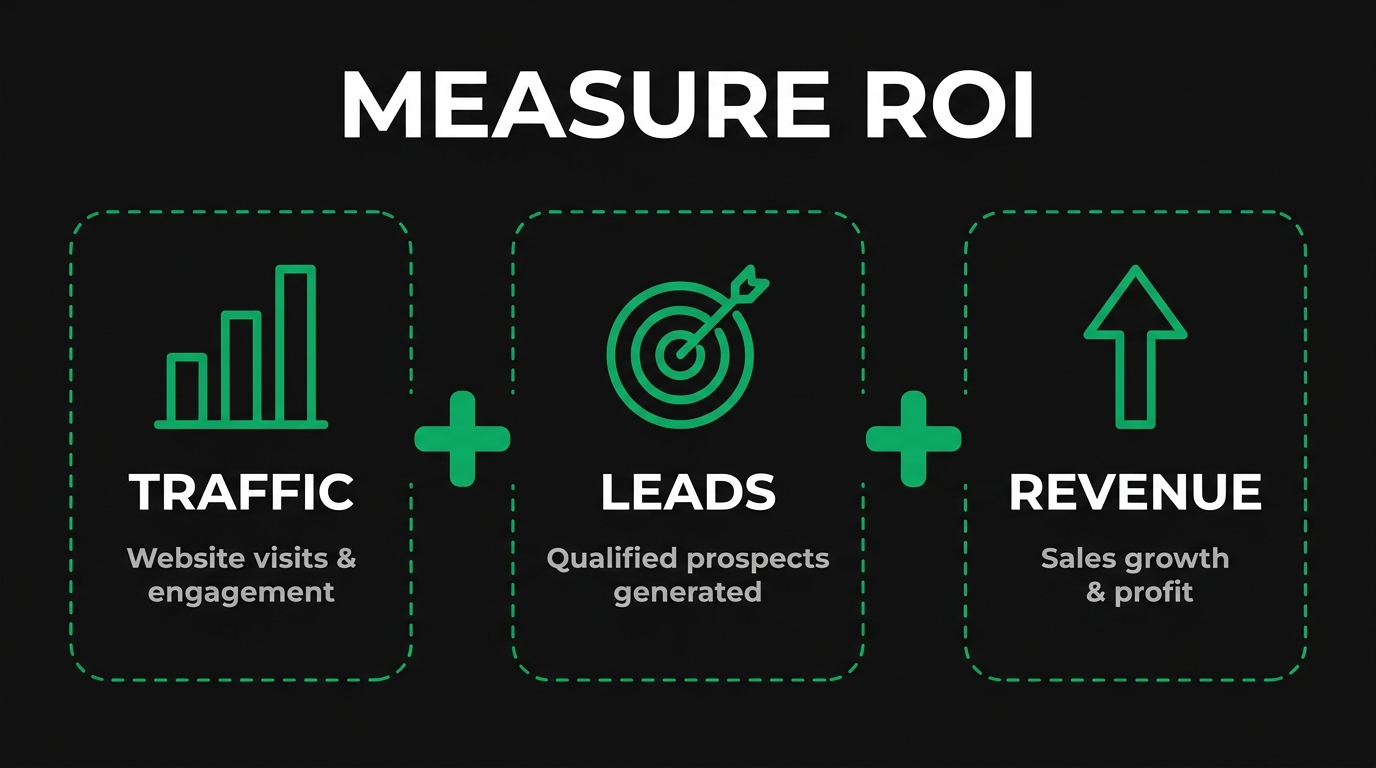
The KPIs that tie SEO to RFQs and closed revenue are organic RFQ volume, organic pipeline value, closed-won revenue attributed to organic, cost per RFQ, average deal size by source, and ranking-weighted capability coverage. Vanity metrics include total traffic, bounce rate, and keyword count without intent filtering. A real SEO dashboard should list the top ten ranking capability pages, the RFQs each produced in the last 90 days, and the pipeline value that followed. In my experience, shops that track RFQ-level attribution cut reporting noise by 80% and spot underperforming capability pages in one look. Keywords without RFQs get rebuilt or deprecated.
How Do You Attribute Pipeline From Organic Search?
You attribute pipeline from organic search by tagging RFQ forms with a source parameter, capturing the entry page, and passing the UTM data into the CRM deal record. Per Search Engine Journal citing a Sistrix study of over 80 million keywords and billions of search results, the first organic result in Google Search has an average click-through rate of 28.5%, and a result in position #1 with a sitelinks extension achieves a CTR of 46.9% (https://www.searchenginejournal.com/google-first-page-clicks/374516/), which is why first-page ranking dominates attribution models. Hidden UTM fields, HubSpot or Salesforce tracking scripts, and server-side form processing keep attribution intact through iframe embeds. Without attribution, SEO investment gets guessed at.
What Tools Help Small Manufacturers Track SEO Performance?
Tools that help small manufacturers track SEO performance include Google Search Console, Google Analytics 4, a rank tracker such as Ahrefs or Semrush, a crawl tool such as Screaming Frog, and a CRM with UTM capture such as HubSpot or Zoho. Tool selection depends on scale: such as Search Console alone covering a 40-page site, a paid rank tracker earning its keep from roughly 80 pages, and a CRM integration paying off once RFQ volume exceeds fifteen per month. Free tools handle 80% of the work for most small shops. The paid layer matters only once the site has enough volume to need differentiated reporting.
How Long Does SEO Take to Pay Off for a Small Manufacturer?
SEO takes to pay off for a small manufacturer in roughly six to twelve months for first meaningful RFQs, twelve to eighteen months for consistent monthly pipeline, and eighteen to thirty-six months for category dominance. The curve bends on four factors: site age, backlink baseline, capability coverage at launch, and publishing cadence. A two-year-old site with twenty backlinks and fifteen capability pages typically ranks faster than a six-month-old site with none. Expecting results in three months wastes the budget. Planning eighteen months produces compounding RFQs. Measurement closes the loop on execution. The next question is whether to hire a vendor or build in-house.
How Should Small Manufacturers Compare SEO Vendors and Approaches?
Small manufacturers should compare SEO vendors and approaches on industrial fluency, procurement-intent strategy, pricing fit, and clear red-flag filters. The sub-sections below work through each comparison lens.
What Should a Small Manufacturer Look for in an SEO Partner?
A small manufacturer should look for an SEO partner with industrial-only client history, procurement-intent strategy, revenue-tied reporting, schema and technical depth, and direct access to senior operators. Vendors should show case studies that name the process, material, and certification ranked, not just "traffic up 200%." A partner who starts with competitive seo analysis manufacturing industry typically outperforms one who starts with a generic audit template. Ask for three live client examples in a comparable vertical, a sample monthly report, and the exact cadence of strategy calls. Silence on any of the four is the filter.
How Does an Industrial SEO Specialist Differ From a General Agency?
An industrial SEO specialist differs from a general agency by indexing on process-material-certification depth, reading engineering drawings, naming tolerance standards, and understanding the RFQ-to-closed-won timeline. Generalist agencies default to traffic volume and domain authority reporting. Industrial specialists rank capability pages, write schema for manufacturing entities, and tie reports to RFQ pipeline. The difference shows in the research brief: a specialist asks for AS9100, ITAR, IATF 16949, and material certifications by grade. A generalist asks for "top blog topics." Similar logic drives the contract manufacturing vs custom manufacturing seo split: a specialist recognizes the two models need different keyword architectures.
What Pricing Models Are Realistic for Small Manufacturer Budgets?
The pricing models realistic for small manufacturer budgets are monthly retainers of $3,000 to $10,000 for standalone-shop scope, $8,000 to $15,000 for multi-process shops, and project-based fees of $15,000 to $40,000 for one-time audits or topical map buildouts. Common pricing structures include fixed monthly retainer, retainer plus performance bonus, per-page content pricing, and hourly consulting. Retainers under $2,000 per month rarely fund enough hours to move rankings in competitive verticals. Retainers over $15,000 per month should fund link building, content, technical, and CRM integration in one scope. Budget transparency at the RFP stage prevents mid-engagement scope creep.
What Red Flags Signal a Bad Manufacturing SEO Vendor?
Red flags that signal a bad manufacturing SEO vendor include traffic-only reporting without RFQ attribution, no manufacturing client portfolio, guaranteed rankings, bulk directory submissions, content written by non-industrial writers, and a refusal to name specific competitor rankings. Additional flags include month-to-month contracts disguised as annual retainers, account manager churn inside the first quarter, and "proprietary tools" that are thin skins over Semrush. A vendor who cannot articulate the difference between oem seo vs b2b manufacturing seo is unlikely to architect a procurement-intent keyword map. Filter hard at the sales stage; switching vendors six months in sets a shop back a year. Vendor selection handled, the final section shows how to start with the right partner.
How Should You Approach SEO Growth With Manufacturing SEO Agency?
You should approach SEO growth with Manufacturing SEO Agency by mapping procurement-intent keywords to capability pages, building topical authority around process, material, and certification coverage, and tying every ranking back to RFQ pipeline. The sub-sections below cover the keyword architecture and the core takeaways.
Can Manufacturing SEO Agency's Procurement-Intent Keyword Architecture Help a Small Manufacturer Win RFQs?
Manufacturing SEO Agency's procurement-intent keyword architecture can help a small manufacturer win RFQs by clustering process, material, and certification queries into capability pages matched to each stage of the procurement journey. Manufacturing SEO Agency maps the initial material research, supplier evaluation, and RFQ submission phases into discrete keyword clusters, then builds capability pages around the combinations that produce RFQs. Manufacturing SEO Agency ties every report to RFQ pipeline and closed revenue, not vanity traffic. The architecture favors shops whose buyers are engineers, purchasing managers, and supply chain directors typing specification-grade queries into Google.
What Are the Key Takeaways About SEO for Small Manufacturing Companies We Covered?
The key takeaways about SEO for small manufacturing companies we covered are:
- Buyers search process, material, and certification phrases to shortlist suppliers.
- Foundations come first: title tags, technical health, site structure, mobile speed.
- Procurement-intent keywords outperform generic terms on RFQ conversion.
- Topical authority compounds across 40 to 120 capability, material, and certification pages.
- Technical articles and case studies earn engineering trust and Featured Snippets.
- Editorial links from trade publications beat directory links on ranking impact.
- Local SEO and Google Business Profile complete the regional authority stack.
- Measurement tying rankings to RFQs and revenue keeps the program honest.
- Vendor selection filters for industrial focus, procurement intent, and revenue reporting.