
The key differences between OEM SEO and B2B manufacturing SEO rest in buyer persona focus, keyword intent, certification weight, content depth, and attribution models. OEM SEO targets approved-vendor workflows for design engineers and specifying engineers who search by part number, assembly, and certification. B2B manufacturing SEO targets broader procurement committees evaluating capabilities, processes, and material specifications across contract manufacturers and custom manufacturers.
This guide covers definitions and positioning, buyer personas and search behavior, keyword architecture, content structures and technical SEO, authority and link building, and measurement.
Definitions and positioning separate OEM SEO from general manufacturing SEO by focusing on specification-driven visibility, approved-vendor inclusion, and long-cycle supply-chain trust. Contract manufacturers and OEMs require distinct strategies because their buyers enter search with different intents.
Buyer personas and search behavior explain why procurement managers, design engineers, plant operators, and supply chain directors use different queries, session depth, and decision triggers. OEM searches skew toward part numbers, datasheets, and approved-vendor lists. B2B manufacturing searches skew toward process, material, tolerance, and capability.
Keyword architecture and content structures show how long-tail process-material-certification clusters, spec-sheet pages, capability pages, case studies, and whitepapers earn rankings and conversions.
Technical SEO and authority building compare schema markup, site architecture, page speed, trade publication links, and supplier directory signals.
Measurement ties organic rankings to RFQs, pipeline revenue, and multi-touch attribution across long industrial sales cycles.
What Is OEM SEO and How Does It Differ From General Manufacturing SEO?
OEM SEO is optimization built around approved-vendor lists, part numbers, and specification-driven queries used by design engineers. General manufacturing SEO covers broader procurement terms across contract and custom shops. The sub-sections define what is oem seo and explain contract manufacturing vs custom manufacturing seo.
What Defines OEM SEO in the Industrial Search Landscape?
OEM SEO is defined by optimization for buyers inside approved-vendor workflows at original equipment manufacturers who search by exact part number, assembly reference, and certification. The NIST Computer Security Resource Center describes an original equipment manufacturer as "an organization that makes devices from component parts bought from other organizations," which shapes how the oem seo vertical ranks pages: content must mirror bill-of-materials language, component part references, and supplier-qualification signals. Design engineers typically reach OEM suppliers through schema-rich product pages, datasheets, and CAD libraries indexed under precise model numbers. General manufacturing SEO rarely reaches this depth of specification granularity.
How Does B2B Manufacturing SEO Position Itself Against OEM SEO?
B2B manufacturing SEO positions itself against OEM SEO by ranking broader capability, process, and material queries across contract manufacturers, custom shops, and multi-facility operations. B2B strategy targets procurement committees searching "5-axis CNC machining aluminum" or "injection molding medical grade polycarbonate." OEM strategy targets engineers searching specific part numbers and revision levels. Capability pages, process taxonomies, and material grade clusters anchor B2B manufacturing SEO. OEM pages anchor around product catalogs, CAD downloads, and certification-bound specifications. The two approaches share technical SEO fundamentals but diverge sharply on intent mapping and keyword depth.
Why Do OEMs Require a Different Search Strategy Than Contract Manufacturers?
OEMs require a different search strategy than contract manufacturers because their buyers arrive pre-qualified through approved-vendor processes rather than open-market sourcing. Contract manufacturers must rank for capability discovery queries such as "tier one aerospace machining supplier" because buyers start without a shortlist. OEMs rank for specification-bound queries where the buyer already knows the part, the certification, and the material grade. Topical maps for OEMs concentrate on product families, replacement components, and service documentation. Topical maps for contract manufacturers concentrate on process-material-industry triples that signal capability breadth and compliance credentials. Each model converts on different triggers.
Who Are the Buyers Targeted by OEM SEO Versus B2B Manufacturing SEO?
The buyers targeted by OEM SEO versus B2B manufacturing SEO are design engineers, procurement managers, plant operators, and supply chain directors, with each persona driving distinct query patterns. The sub-sections below segment personas, search behaviors, and RFQ triggers.
Which Personas Search for OEM Suppliers Online?
The personas who search for OEM suppliers online are design engineers, specifying engineers, procurement managers, plant maintenance leads, and supply chain directors. Design engineers dominate early-cycle OEM queries because they write the bill of materials and specify components by part number. Procurement managers validate approved-vendor status and verify certifications before releasing purchase orders. Plant operators source replacement parts under urgent downtime pressure. According to the International Aerospace Quality Group, every AS9100 certified company must be listed on the Online Aerospace Supplier Information System (OASIS), which engineers cross-reference when shortlisting OEM suppliers. Supply chain directors coordinate tier-one and tier-two qualification across multi-site programs.
How Do Procurement Managers Differ From Design Engineers in Search Behavior?
Procurement managers differ from design engineers in search behavior through query intent, session depth, and source preferences. Engineers search for technical characteristics: tolerances, material certifications, CAD compatibility, and part-level specifications. Thomas Industrial Network reports that design engineers usually recommend products by OEM name and part number, and if the OEM is not on the approved vendor list, the engineer must justify the request. Procurement managers search for supplier credentials: ISO 9001 status, lead times, MOQ, payment terms, and price benchmarks. Engineers prefer datasheets and technical drawings. Procurement managers prefer capability brochures, customer references, and quality management documentation. Both personas demand different landing pages, schema, and calls to action.
What Decision Triggers Move OEM Buyers From Research to RFQ?
The decision triggers that move OEM buyers from research to RFQ include approved-vendor inclusion, verified certifications, specification match, lead-time transparency, and accessible contact paths. McKinsey found that 54% of B2B decision makers say they would abandon a purchase or switch suppliers after a poor-quality omnichannel experience, and buyers use an average of ten interaction channels during the journey. OEM buyers rarely submit an RFQ from one page view. They cross-check certifications, validate case studies, and confirm that the supplier handles their production volume before contacting sales. Friction at any step kills conversion rates, even when rankings are strong.
How Does Keyword Strategy Differ Between OEM SEO and B2B Manufacturing SEO?
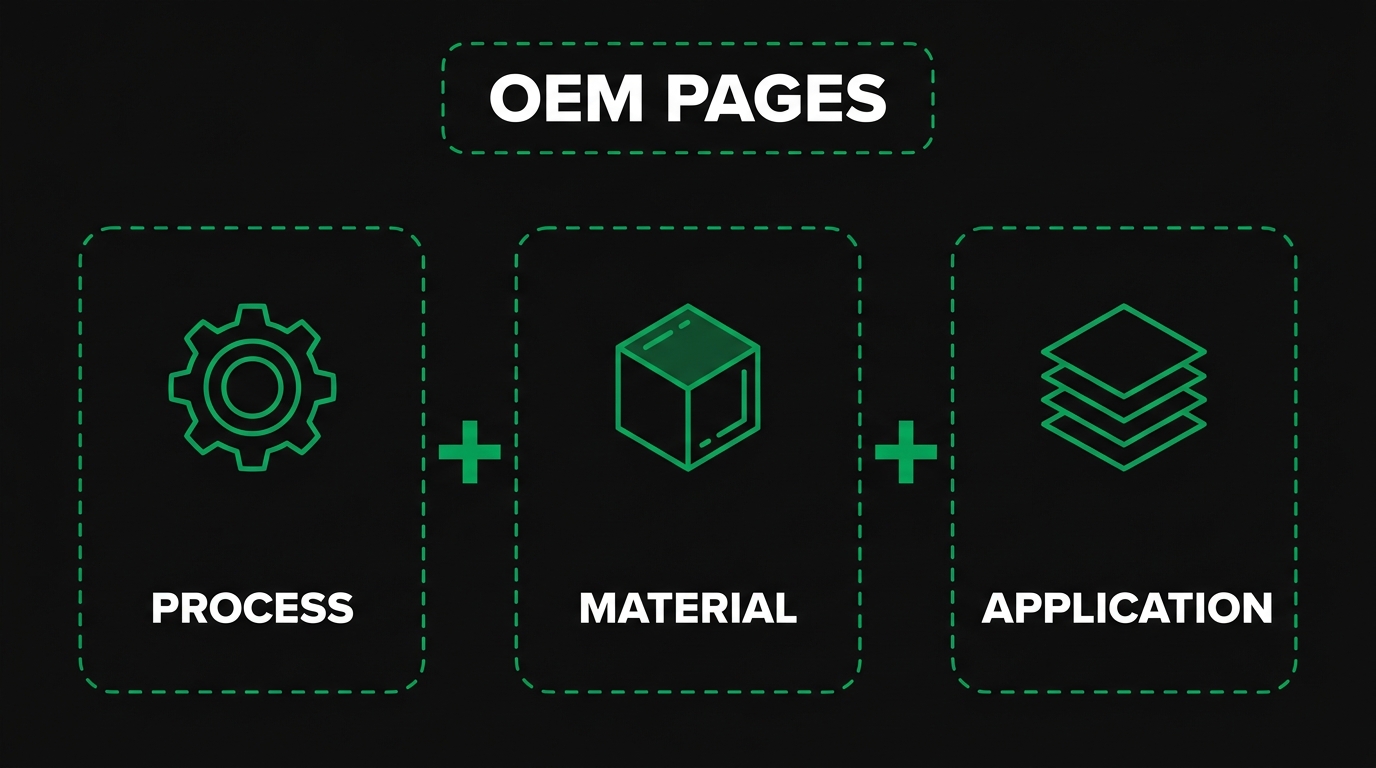
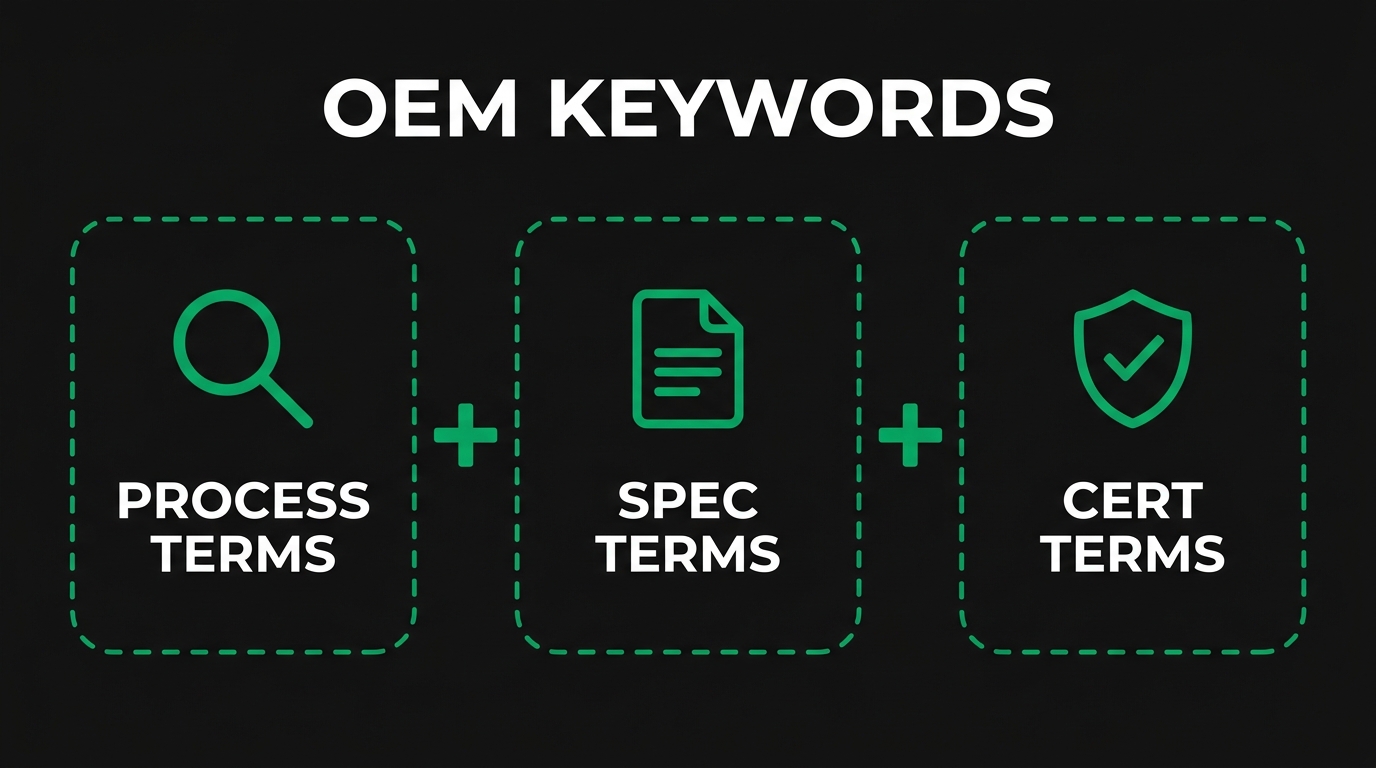
Keyword strategy differs between OEM SEO and B2B manufacturing SEO in query depth, certification weight, and part-number specificity. The sub-sections cover long-tail patterns, cluster structures, certification queries, and spec-sheet intent. See best seo tools for b2b manufacturing and seo strategies for manufacturing specifications.
What Long-Tail Keyword Patterns Dominate OEM Search?
The long-tail keyword patterns that dominate OEM search include part-number plus material, assembly plus certification, and replacement-component plus vehicle or platform references. Backlinko's study of 306 million keywords found that 91.8% of all search queries are long-tail, though long tails account for only 3.3% of total search volume. OEM queries sit deep in the long tail because buyers include revision numbers, OEM codes, platform references, and certification standards in a single query. These queries convert aggressively because intent is explicit. Ranking for "replacement bearing MRC 5309M NACD" beats ranking for "bearings" in every revenue metric that matters to an OEM supplier.
How Should B2B Manufacturers Structure Process and Material Keyword Clusters?
B2B manufacturers should structure process and material keyword clusters as process-material-industry-certification triples arranged in topical maps. Wikipedia defines engineering statistics as involving data concerning manufacturing processes such as component dimensions, tolerances, type of material, and fabrication process control, which mirrors how cluster architecture should mirror buyer taxonomies. A cluster for "CNC machining" branches into 3-axis, 4-axis, and 5-axis; each branch splits by material (aluminum, titanium, Inconel); each material splits by industry (aerospace, medical, automotive). Cluster coverage beats scattered blog posts because search engines reward topical breadth, and procurement buyers browse related pages before submitting an RFQ.
Why Do Certification Keywords Carry More Weight in OEM Queries?
Certification keywords carry more weight in OEM queries because approved-vendor lists gate purchasing decisions in regulated industries. AS9100, ISO 13485, NADCAP, and IATF 16949 appear directly in buyer queries because procurement cannot release a purchase order to an unqualified supplier. The Performance Review Institute notes that Nadcap offers 26 critical process accreditations across nondestructive testing, heat treating, chemical processes, printed board assemblies, materials testing laboratories, and measurement and inspection. Ranking a capability page for "NADCAP heat treat supplier aerospace" converts better than ranking for "heat treat supplier" because the query filters pre-qualified buyers. Certification keywords are the fastest path to RFQs in aerospace, medical, and automotive verticals.
What Role Does Part-Number and Spec-Sheet Search Play in Each Approach?
Part-number and spec-sheet search plays the dominant conversion role in OEM SEO and a supporting role in B2B manufacturing SEO. CADDi describes a product spec sheet as a document providing detailed information about features, specifications, and benefits, including materials, dimensions, tolerances, electrical requirements, and performance criteria. OEM buyers copy part numbers directly from drawings and paste them into Google. B2B manufacturing buyers search capability patterns first and only drill to part numbers after shortlisting. Spec-sheet pages must carry Product schema, downloadable PDFs, and replacement cross-references. This single page type often generates more qualified RFQs than any other asset in a spec-heavy OEM catalog.
What Content Structures Win Rankings for OEM Versus B2B Manufacturing Sites?
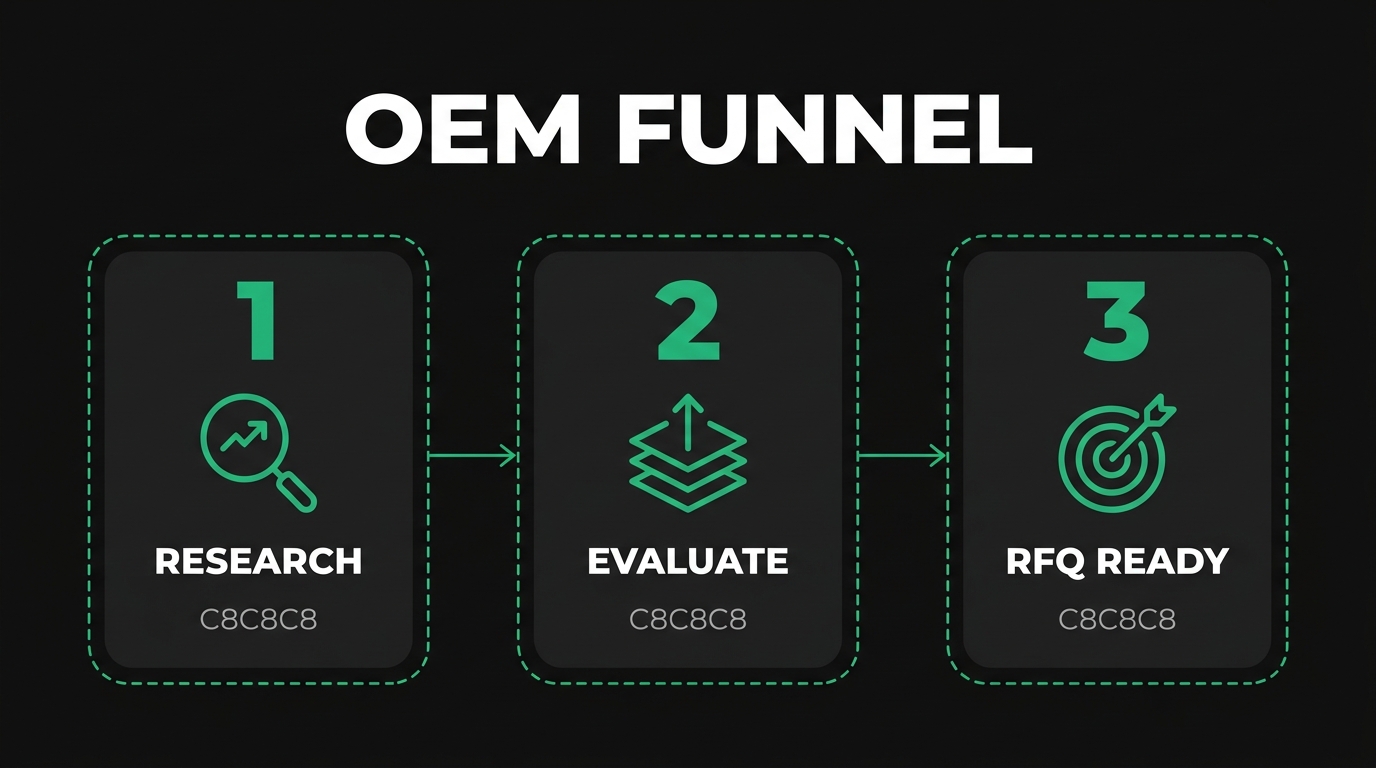
The content structures that win rankings for OEM versus B2B manufacturing sites are product catalogs with schema, capability pages, documentation hubs, and comparative case studies. The sub-sections unpack page types, capability architecture, technical documentation, and case study formats.
Which Page Types Convert Best for OEM Suppliers?
The page types that convert best for OEM suppliers are product catalog pages, spec-sheet PDFs, cross-reference replacement pages, and datasheets with embedded CAD downloads. Product catalog pages indexed under exact model numbers attract specifying engineers through long-tail queries. Cross-reference pages map competitor part numbers to equivalent parts, capturing high-intent replacement searches. Datasheet pages with schema markup surface as rich results and answer specific specification questions directly. Engineers distrust pages that lack tolerances, certifications, or downloadable drawings. Catalog UX that preserves original part numbers and allows filtering by specification converts far more RFQs than pretty but vague product pages.
How Should Capability Pages Be Built for Contract Manufacturers?
Capability pages should be built for contract manufacturers as process-specific pillars layered with material, industry, and certification modifiers. Each page covers one process (for example, 5-axis CNC machining), then branches into material pages (titanium, Inconel, aluminum), then branches into industry applications (aerospace, medical, defense). Strong capability pages display tolerances, lot sizes, equipment lists, lead times, certifications, and representative customer verticals. Case study links within the page validate claims. Video of the production floor strengthens E-E-A-T signals. Internal links from capability pages to project galleries and certification landing pages distribute authority across the topical map and shorten the buyer's research path.
What Technical Documentation Earns Topical Authority for OEMs?
The technical documentation that earns topical authority for OEMs includes installation manuals, service bulletins, application notes, compliance declarations, and engineering drawings. Documentation hubs hosted on the supplier's domain attract backlinks from OEM customers, integrators, and training programs because the content cannot be sourced elsewhere. Application notes document how specific components perform in real operating conditions, which engineers cite when specifying. Service bulletins keep replacement pages ranking for active maintenance queries. Compliance declarations (RoHS, REACH, conflict minerals) reassure procurement managers. Together these assets create a defensible topical moat that scattered blog posts cannot replicate for OEM audiences.
How Do Case Studies and Whitepapers Differ Between OEM and B2B Strategies?
Case studies and whitepapers differ between OEM and B2B strategies in subject focus, technical depth, and conversion role. The Content Marketing Institute found that 45% of manufacturing marketers cite case studies as most effective and 43% value e-books and white papers. OEM case studies focus on component-level engineering wins: tolerance achievement, material selection, or cost reduction on a named platform. B2B manufacturing case studies focus on program-level outcomes: cycle-time reduction, multi-site deployment, or capacity scaling. Whitepapers in OEM content explain technical standards and design considerations. Whitepapers in B2B content explore sourcing strategies, tariff impacts, and process selection. Each audience reads for a different reason.
How Do Technical SEO Requirements Compare for OEM and B2B Manufacturing Websites?
Technical SEO requirements compare across OEM and B2B manufacturing websites in schema coverage, site architecture, page speed, and crawl efficiency. OEM catalogs require granular specification markup; B2B sites prioritize capability hierarchies. The sub-sections examine product schema, architecture, and page-speed weight.
What Schema Markup Best Serves OEM Product Catalogs?
The schema markup that best serves OEM product catalogs is Product schema paired with Offer, AggregateRating, and BreadcrumbList. Schema.org defines the Product type as a "product or service offered by a business," with core properties including name, description, brand, manufacturer, model, sku, gtin, material, color, and itemCondition. OEM catalogs benefit from also exposing MPN (manufacturer part number), compatibleWith relationships, and isSimilarTo cross-references. Google's Merchant listings and Product snippets rely on this structured data to surface price, availability, review ratings, and shipping details. Catalogs missing Product schema forfeit rich results and lose click share to competitors whose technical teams invested in clean JSON-LD.
How Should Site Architecture Support Multi-Process B2B Manufacturers?
Site architecture should support multi-process B2B manufacturers with a capability-first taxonomy layered by material, industry, and certification. Top-level navigation lists processes (CNC machining, injection molding, metal fabrication, additive). Second-level pages split each process by material and industry. Third-level pages document specific services and certifications. Breadcrumbs, internal linking, and XML sitemaps reinforce hierarchy for crawlers. Faceted navigation on capability pages lets engineers filter by tolerance, material, and lead time. Flat architectures collapse topical authority. Hierarchical architectures distribute link equity across the full capability map and let Googlebot crawl the spec-heavy depth that B2B manufacturing sites require for full coverage.
Why Do Page Speed and Crawl Efficiency Matter More for Spec-Heavy OEM Sites?
Page speed and crawl efficiency matter more for spec-heavy OEM sites because catalogs scale to tens of thousands of product pages with PDFs, images, and CAD files. Google Search Central specifies good Core Web Vitals as LCP under 2.5 seconds, INP under 200 milliseconds, and CLS under 0.1. OEM catalogs often miss these thresholds due to heavy imagery and unoptimized CAD previews. Slow catalogs waste crawl budget and delay indexation. Server-side JSON-LD, lazy-loaded images, CDN distribution, and aggressive caching preserve both ranking signals and engineer experience. For guidance on a focused sub-vertical, compare seo for small manufacturing companies.
What Backlink and Authority-Building Tactics Work for OEM Versus B2B Manufacturing SEO?
The backlink and authority-building tactics that work for OEM versus B2B manufacturing SEO are editorial placements in trade publications, association memberships, and supplier-directory citations. OEMs pursue vertical publications; B2B contract manufacturers layer association links with industrial directories. The sub-sections cover trade publications, associations, and directories.
Which Trade Publications Should OEMs Pursue for Editorial Links?
The trade publications that OEMs should pursue for editorial links are vertical-specific outlets with editorial standards and engineering readership. Aerospace OEMs target Aviation Week, Aerospace Manufacturing and Design, and SAE publications. Automotive OEMs target Automotive News, SAE Mobilus, and regional automotive engineering journals. Medical OEMs target Medical Design & Outsourcing and MD+DI. Editorial placement requires original data: benchmark tests, customer case studies with measurable outcomes, or expert commentary on standards revisions. Link building teams should consult the how to use moz link explorer for industrial workflow to audit competitor backlink profiles before pitching editors with clearly differentiated technical angles.
How Do B2B Manufacturers Earn Links Through Industry Associations?
B2B manufacturers earn links through industry associations by joining organizations tied to their processes and certifications. The National Association of Manufacturers, SME, Precision Machined Products Association, American Gear Manufacturers Association, and SAE International all host member directories and publish editorial content that links to member sites. Speaking slots at association conferences generate event-page links, session descriptions, and press coverage. White papers co-authored with association research committees earn persistent citations. Association links carry topical authority because the domain itself is recognized as a subject matter authority, and search engines treat these links as trust signals for the member's niche.
What Role Do Supplier Directories Play in OEM Authority Signals?
Supplier directories play a significant role in OEM authority signals because buyers cross-reference directory listings when validating suppliers. Thomas Industrial Network reports that Thomasnet hosts 1.4 million buyers, OEMs, and procurement professionals searching across more than 80,000 industrial product and service categories each day. Directories such as Thomasnet, MacRAE'S Blue Book, and GlobalSpec feed buyers at the capability-discovery stage and feed search engines with consistent NAP data, structured categories, and citations. OEM directory listings anchored to exact-match capability categories reinforce topical authority far more than scattered guest posts on unrelated domains.
How Do Conversion Goals and Measurement Differ Between OEM SEO and B2B Manufacturing SEO?
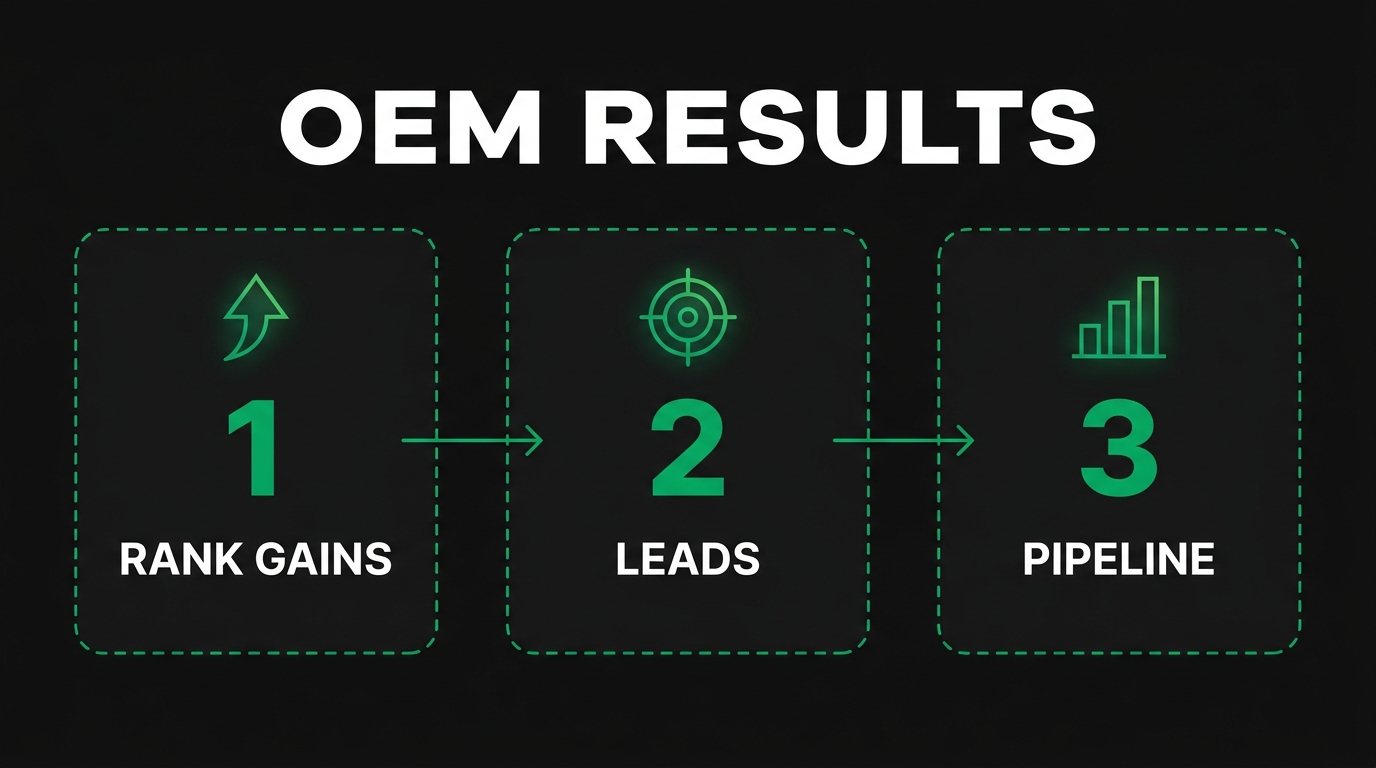
Conversion goals and measurement differ between OEM SEO and B2B manufacturing SEO in KPI weight, pipeline attribution, and sales-cycle accounting. OEM SEO tracks part-level RFQs and replacement-order revenue; B2B tracks program-level RFQs and pipeline-weighted closed revenue. The sub-sections compare KPIs, pipeline attribution, and models.
What KPIs Matter Most for OEM SEO Performance?
The KPIs that matter most for OEM SEO performance are part-level RFQ submissions, catalog page RFQ rate, cross-reference page clicks, and revenue per ranked keyword. Secondary KPIs include spec-sheet downloads, CAD file downloads, and return visits from approved-vendor domains. Rankings on certification-bound queries signal procurement-readiness. Product schema impressions, rich-result clicks, and average time on catalog pages validate engineering engagement. Vanity metrics such as bounce rate and total sessions fail to capture OEM reality because engineering buyers often land, verify, and leave in under 60 seconds while still progressing toward an RFQ.
How Do B2B Manufacturers Tie Organic Traffic to Pipeline Revenue?
B2B manufacturers tie organic traffic to pipeline revenue through CRM-integrated reporting that links ranked keywords, landing pages, and RFQ submissions to closed-won deals. Bain & Company reports that about 80% of consumers now rely on zero-click results in at least 40% of their searches, reducing organic web traffic by an estimated 15% to 25%, which means click-volume metrics alone misrepresent revenue contribution. Pipeline measurement requires tagging RFQ forms with source, landing page, and keyword data, then reconciling against CRM opportunities and invoices. Multi-site manufacturers consolidate reporting at the program level so sales cycles longer than a year still attribute revenue correctly.
Which Attribution Models Suit Long Industrial Sales Cycles?
The attribution models that suit long industrial sales cycles are multi-touch W-shaped and time-decay models paired with CRM-native opportunity tagging. Single-touch first-click or last-click models under-credit long nurture journeys in which engineers research for months before procurement engages. W-shaped attribution credits first touch (discovery), lead conversion (RFQ submission), and opportunity creation equally. Time-decay models boost recent touches near the RFQ event, which suits replacement-order OEM patterns. Attribution must reconcile across paid, organic, direct, email, and trade-show channels to avoid over-crediting the final click. Industrial sales cycles measured in months demand models built for multi-touch reality.
How Should You Approach OEM Versus B2B Manufacturing SEO With Manufacturing SEO Agency?
You should approach OEM versus B2B manufacturing SEO with Manufacturing SEO Agency by aligning keyword architecture, schema, and revenue reporting to the dominant buyer persona. The sub-sections explain the engagement model and summarize the full comparison.
Can Manufacturing SEO Agency Help Tailor a Procurement-Intent Strategy for Both OEM and B2B Manufacturers?
Manufacturing SEO Agency can help tailor a procurement-intent strategy for both OEM and B2B manufacturers through manufacturing-only focus, topical authority buildout, and CRM-integrated revenue reporting. The NIST Manufacturing Extension Partnership has worked with more than 86,000 manufacturers since 1988, signaling how focused expertise scales across industrial sectors. Manufacturing SEO Agency applies the same focus: keyword clusters mapped to procurement journeys, schema tuned for Product catalogs, and reporting tied to RFQs and pipeline. Verticals span CNC machining, injection molding, metal fabrication, aerospace, automotive, medical, and additive. For the additive vertical, review what is additive manufacturing. When benchmarking vendors, explore the top seo agencies for oem.
What Are the Key Takeaways About OEM SEO Versus B2B Manufacturing SEO We Covered?
The key takeaways about OEM SEO versus B2B manufacturing SEO we covered include persona-specific query patterns, certification weight, spec-sheet conversion, and multi-touch attribution. OEM SEO wins on part-number catalogs, Product schema, and approved-vendor visibility. B2B manufacturing SEO wins on process-material-industry clusters, capability pages, and association-backed authority. Technical SEO fundamentals apply to both, but catalog scale shifts the emphasis toward crawl efficiency and structured data for OEMs. Measurement must tie organic activity to RFQs and closed revenue rather than sessions alone. Selecting the right model depends on your buyer mix: specifying engineers at OEM tier-ones or procurement committees at contract manufacturers.