An OEM SEO strategy is a search engine optimization plan tailored to original equipment manufacturers, designed to rank pages for the exact process, material, and certification queries that procurement buyers, design engineers, and supply chain directors enter when sourcing components and assemblies. We approach OEM SEO as procurement-intent engineering, not generic traffic acquisition.
This guide covers strategic foundations, technical and on-page architecture, keyword and topical authority, content systems, off-page authority, AI search visibility, and revenue measurement.
The strategic foundation defines why OEMs require a vertical-specific search approach, who their high-intent audience is, and how OEM SEO differs from broader manufacturing SEO programs.
The technical and on-page foundation explains the schema, site architecture, page-experience targets, and crawl signals that procurement-buyer journeys depend on.
The keyword and topical authority pillars cover procurement-intent keyword discovery, buyer-journey mapping, long-tail process and material query selection, and competitor footprint analysis.
The content systems section frames the technical guides, case studies, datasheets, and application landing pages that move procurement buyers from research to RFQ.
The off-page authority section examines trade publications, industry associations, digital PR, and engineering community link sources that compound domain authority.
The AI search section addresses entity signals, snippet structure, and schema strategies that earn citations inside generative answers.
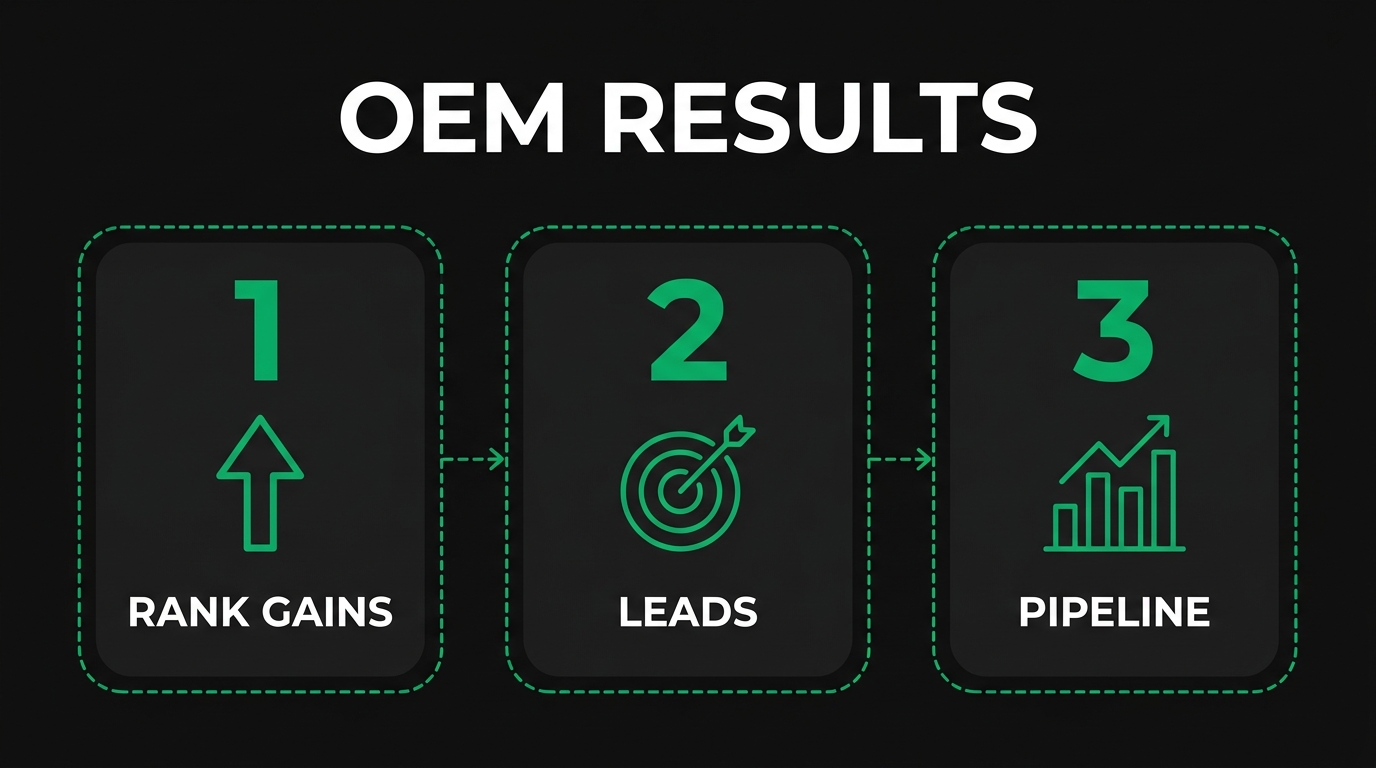
The measurement section closes the loop with KPIs that tie organic rankings to RFQs, pipeline value, and closed manufacturing revenue.
What Is an OEM SEO Strategy and Why Does It Matter?
An OEM SEO strategy is a vertical-specific search program that ranks original equipment manufacturer pages for the procurement queries used by engineers, buyers, and supply chain leaders. The following subsections define how this approach differs from generic manufacturing SEO, why specialization matters, and which audiences it must reach.
How Does OEM SEO Differ from General Manufacturing SEO?
OEM SEO differs from general manufacturing SEO by targeting program-level procurement language tied to platforms, assemblies, and long-lifecycle parts rather than one-off process or shop services. OEM keyword surfaces include OE part numbers, tier-supplier integration terms, and platform-named build specifications. General manufacturing SEO competes on process category terms like "CNC machining" or "injection molding," while OEM SEO competes on assembly-level and build-of-materials queries that procurement teams use during sourcing cycles. A useful primer for the broader category context is what is additive manufacturing, which shows how vertical-specific search demands differ even within manufacturing. OEM strategies map intent to multi-stakeholder buying committees, while broad manufacturing SEO often optimizes for a single keyword cluster.
Why Do OEMs Need a Specialized Search Strategy?
OEMs need a specialized search strategy because their buyers run formal supplier-evaluation cycles that reward depth over breadth. Gartner reports that B2B buyers spend only 17% of their total purchasing time meeting with potential suppliers and engage with multiple vendors simultaneously, which means the supplier website must answer technical and commercial questions during unattended self-research. A specialized strategy aligns content to platform names, certifications, and tolerances. A practical oem seo strategy checklist helps teams audit gaps in their procurement-funnel coverage before launch. Generic tactics underweight long-tail engineering queries and overweight broad branded terms, so OEMs lose visibility at the exact moment buyers shortlist.
Who Is the Target Audience for OEM SEO Content?
The target audience for OEM SEO content is a buying committee that includes design engineers, manufacturing engineers, procurement managers, supplier quality engineers, and supply chain directors. The U.S. Bureau of Labor Statistics reported that miscellaneous assemblers and fabricators is the largest occupation in manufacturing, with employment of about 1.1 million, and over a quarter of these jobs were in motor vehicle or motor vehicle parts manufacturing, which signals where OEM-aligned readers concentrate. Effective OEM content speaks each role in turn: engineers want tolerances and material grades, buyers want certifications and lead times, quality teams want audit history. For sequencing, see implementing an oem seo strategy and consider when to apply oem specific seo versus broader vertical playbooks. This multi-role mapping shapes every page brief.
What Are the Foundational Elements of an OEM SEO Strategy?
The foundational elements of an OEM SEO strategy are crawlable site architecture, machine-readable schema, page-experience targets, and intent-mapped information design. The next subsections detail technical SEO requirements, schema markup, site architecture for procurement journeys, and Core Web Vitals targets.
Which Technical SEO Requirements Apply to OEM Websites?
The technical SEO requirements that apply to OEM websites include HTTPS, mobile rendering parity, complete crawlability of process and material trees, structured data on capability pages, canonical hygiene across multi-region or multi-platform variants, and clean XML sitemaps for capability and certification URLs. According to Google Search Central, all sites are now crawled with mobile Googlebot only, and Google crawls and indexes these sites with only Googlebot Smartphone, which means desktop-only OEM portals risk de-indexing of long-tail capability pages. OEMs should also enforce internal-link parity between desktop and mobile, eliminate parameter-based duplicate URLs, and ensure that PDF datasheets are crawlable and linked from canonical HTML hubs.
What Schema Markup Should OEM Manufacturers Implement?
OEM manufacturers should implement Organization, Product, ProductModel, Service, FAQPage where eligible, BreadcrumbList, and ImageObject schema across their capability and product trees. Schema.org states that ProductModel provides a datasheet or vendor specification of a product when describing a product datasheet rather than an actual product, such as if you are the manufacturer of the product and want to mark up your product specification pages. ProductModel is the correct type for OEM spec sheets that describe a configurable platform rather than a single SKU. Manufacturer pages should also nest Organization references on every capability page, link to authoritative external entities via sameAs, and use mpn or gtin properties where part numbers exist for downstream supplier matching.
How Should OEMs Structure Site Architecture for Procurement Buyers?
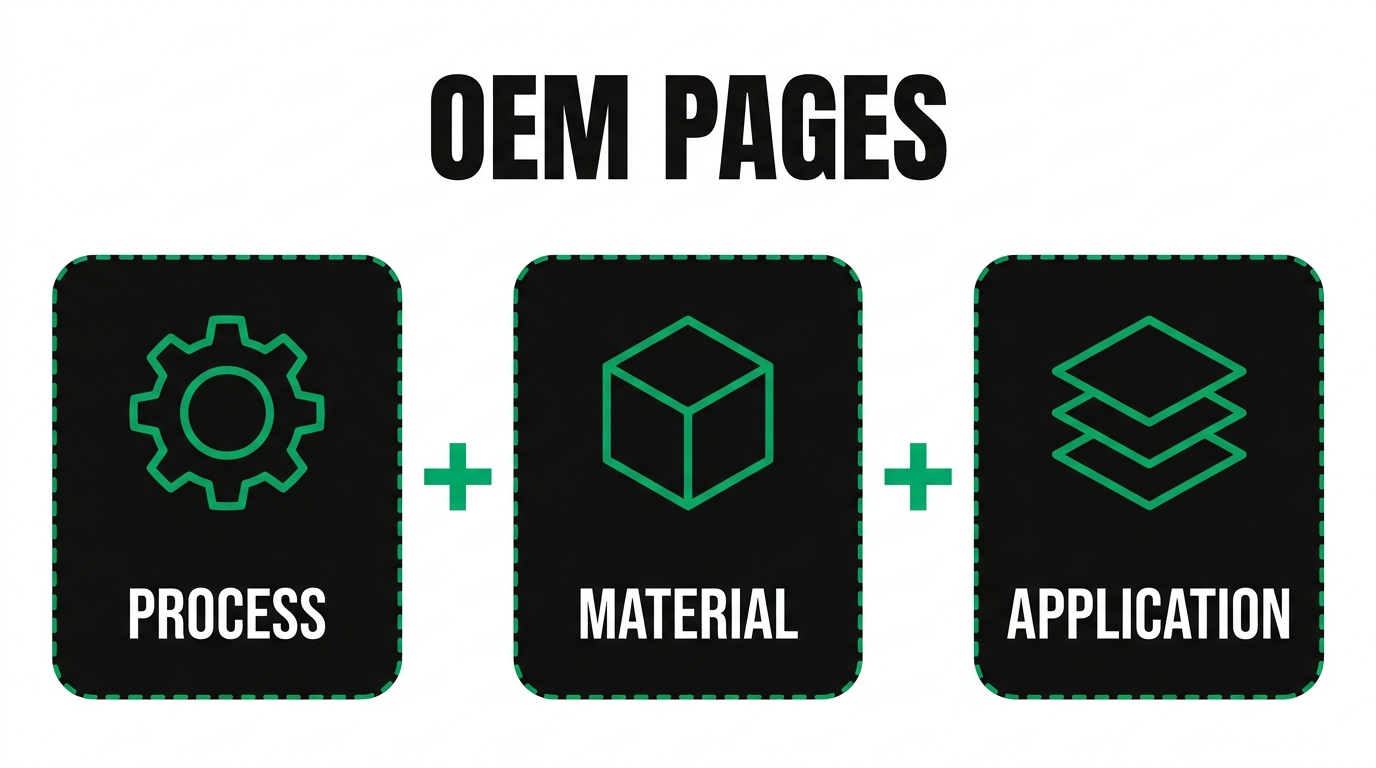
OEMs should structure site architecture for procurement buyers as a three-tier tree: capability hubs at tier one, process or material clusters at tier two, and application or industry landing pages at tier three. Each tier should resolve a buyer question completely before linking deeper. Schema.org documents 823 Types and 1,529 Properties in the schema vocabulary, which gives OEMs ample primitives to encode tier relationships across capability, product, and certification entities. Procurement buyers traverse tiers by certification, then process, then material, then geography, so the architecture must support all four entry points. Internal links should reuse procurement-intent anchors so canonical capability pages accumulate authority instead of competing duplicate spec pages.
Which Page Speed and Core Web Vitals Targets Should OEMs Hit?
OEMs should hit Core Web Vitals targets of LCP under 2.5 seconds, INP under 200 milliseconds, and CLS under 0.1 on capability and spec pages. Google Search Central states that LCP measures load performance and should occur within the first 2.5 seconds of the page starting to load, INP measures interactivity and should be less than 200 milliseconds, and CLS measures visual stability and should be less than 0.1. Image-heavy spec galleries and embedded CAD viewers commonly inflate LCP, so OEMs should defer non-critical assets, serve responsive image formats, and lazy-load below-the-fold renderings. Strong vitals support the technical SEO foundation that downstream content and links depend on.
How Do You Conduct Keyword Research for OEM Manufacturers?
Keyword research for OEM manufacturers is conducted by mining procurement-intent terms across processes, materials, certifications, platforms, and applications, then mapping each cluster to a stage in the supplier-evaluation cycle. The next subsections cover prioritization, journey mapping, long-tail discovery, and competitor footprint analysis.
What Procurement-Intent Keywords Should OEMs Prioritize?
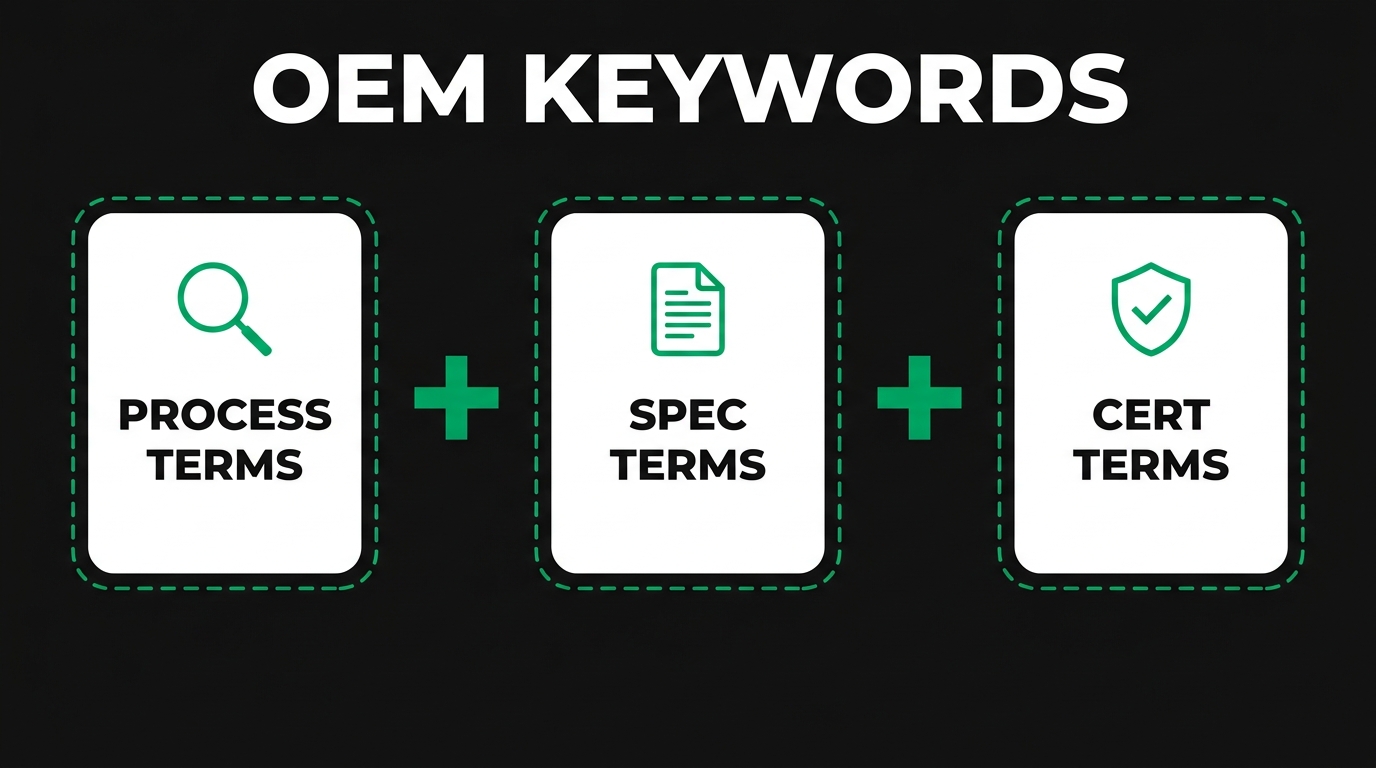
OEMs should prioritize procurement-intent keywords that combine process, material, certification, and application qualifiers, such as "AS9100 titanium machining aerospace bracket" or "IATF 16949 automotive injection molding tier 1 supplier." McKinsey reports that the share of industrial companies that prefer digital interactions and purchases has risen from about 20% historically to around 67% today, which means more procurement intent now reaches OEMs through search rather than field sales. The strongest procurement queries surface buyer constraints directly: certification, tolerance, lead time, and minimum order quantity. Branded platform terms and tier-supplier qualifications convert at higher rates than generic process queries because they signal active sourcing rather than research curiosity.
How Do You Map Keywords to the OEM Buyer Journey?
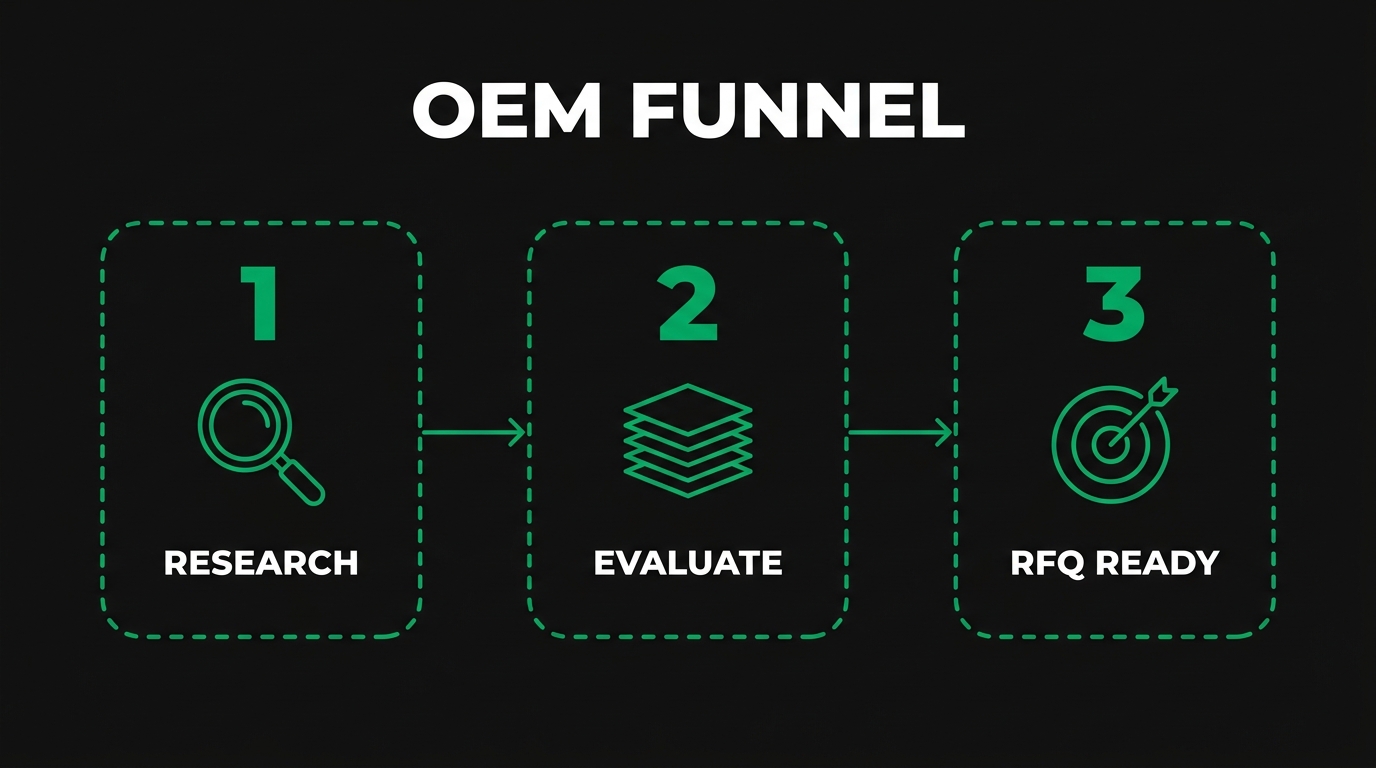
You map keywords to the OEM buyer journey by aligning query intent with the four supplier-evaluation stages: problem identification, solution exploration, requirements building, and supplier selection. Definitional and capability queries belong at the top, comparison and certification queries sit in the middle, and RFQ-form, tolerance, and lead-time queries live at the bottom. Gartner research shows that B2B buyers spend only 17% of their total purchasing time meeting with potential suppliers, which means each journey stage must be answered in unattended detail on the OEM site. A keyword-to-stage matrix prevents capability pages from cannibalizing RFQ pages and keeps every cluster anchored to a single intent.
Which Tools Help OEMs Identify Long-Tail Process and Material Keywords?
The tools that help OEMs identify long-tail process and material keywords include Google Search Console for query-level intent, Google Keyword Planner for volume baselines, server log analyzers for crawl-discovered queries, Schema Markup Testing Tool for entity validation, and SERP-feature scrapers for People Also Ask harvesting. Gartner notes that B2B buyers identify a supplier's website as the most leveraged digital channel during purchase decisions, followed by social media, online search for the supplier, and the supplier's interactive tools, which means search-console data captures the highest-leverage signal. Cross-vertical comparisons such as how to implement seo for robotics show how long-tail process queries fragment differently by sub-industry. OEM teams should triangulate volume, intent, and competitor footprint before committing to a cluster.
How Do You Analyze Competitor Keyword Footprints in OEM SEO?
You analyze competitor keyword footprints in OEM SEO by mapping which capability, certification, and application pages your top-ranking competitors own, then identifying gaps where authoritative coverage exists but your domain has none. A Deloitte Smart Manufacturing and Operations Survey of 600 manufacturing executives found that 80% plan to invest 20% or more of their improvement budgets in smart manufacturing initiatives, signaling rising competitor investment in digital surfaces including SEO content. Footprint analysis should compare URL counts per capability cluster, schema coverage, internal-link concentration, and trade-publication backlink overlap. Gaps in certification or application content typically convert fastest because they sit closest to RFQ intent and face less established competitor depth. This analysis sets priorities for content production.
How Should OEMs Build Topical Authority Across Process and Material Pages?
OEMs should build topical authority by producing complete, interlinked coverage of every process, material, certification, and application a procurement buyer might query. The next subsections cover topical maps, pillar page design, material specification depth, and certification page structure.
What Is a Topical Map for an OEM Manufacturer?
A topical map for an OEM manufacturer is a structured inventory of every process, material, certification, application, and platform entity the brand serves, organized into pillar-and-spoke clusters with explicit internal-link relationships. The U.S. Census Bureau's Annual Survey of Manufactures reported that the value of shipments in the nation's manufacturing sector reached $6.1 trillion, a 16.8% year-over-year increase, which underscores how broad the OEM addressable market is and why complete coverage matters. The topical map should expose entity hierarchy to crawlers via breadcrumb schema and Organization sameAs references. Teams should consult build topical authority in industrial seo for the full mapping methodology before drafting page briefs.
How Do You Create Process-Specific Pillar Pages for OEM Capabilities?
You create process-specific pillar pages for OEM capabilities by giving each major process its own canonical hub that defines the process, lists materials served, names tolerances achieved, surfaces relevant certifications, and links to spoke pages for application use cases. ASTM Committee F42 on Additive Manufacturing Technologies, with about 150+ members attending two days of technical meetings twice a year, has subcommittees on Terminology, Test Methods, Processes, Materials, and Design, and these axes mirror the structure a strong pillar page should expose. Pillar pages should anchor every spoke through descriptive in-context anchors, not generic "learn more" text. This approach signals topical depth to both classical search and generative answer engines.
Why Are Material Specification Pages Critical for OEM SEO?
Material specification pages are critical for OEM SEO because procurement buyers filter suppliers by material grade, alloy, polymer family, and certification before any other criterion, and these queries dominate the long-tail RFQ funnel. Schema.org documents that ProductModel provides a datasheet or vendor specification of a product when describing a product datasheet rather than an actual product, such as if you are the manufacturer of the product and want to mark up your product specification pages, which is the correct schema type for these material pages. Each spec page should expose grade, standard, mechanical properties, and qualification history. Without this layer, OEMs lose visibility for the queries that actually generate sourcing meetings.
How Do Certification Pages Strengthen OEM Topical Authority?
Certification pages strengthen OEM topical authority by mapping each held certification to a dedicated landing page that names the standard, the issuing body, the audit cycle, and the customer programs that require it. The International Organization for Standardization's ISO Survey reported 1,249,317 ISO 9001 certified sites worldwide, which establishes the broad authority weight of the standard and the value of dedicated coverage. Certification pages also let OEMs publish proof artifacts such as audit dates, scope statements, and registrar identities. Procurement buyers cross-reference these signals before issuing an RFQ, so certification depth directly compounds topical authority and bridges the article into content systems.
What Content Types Should an OEM SEO Strategy Include?
An OEM SEO strategy should include technical guides, case studies, datasheets, and application landing pages, each tuned to a different buyer-committee role and journey stage. The next subsections detail what each content type does and how it converts procurement-intent traffic.
Which Technical Guides Convert OEM Procurement Buyers?
The technical guides that convert OEM procurement buyers are step-by-step engineering documents that quantify tolerances, name materials by grade, surface certifications, and resolve common specification trade-offs in a single canonical URL. The Manufacturing Institute reports that a combination of digital skills, soft skills, and high-level technical skills show the fastest compound annual growth rates in manufacturing, signaling rising buyer expectations for technical depth in supplier content. Strong guides include CAD-ready dimensions, finish specifications, and tabulated material trade-offs. The choice of guide depth depends on the manufacturing model: see content strategy for oem vs fabrication for how OEM and fabrication-shop briefs diverge in scope, depth, and stakeholder alignment.
How Do Case Studies Support OEM SEO Goals?
Case studies support OEM SEO goals by giving search engines and procurement buyers concrete proof of capability against named programs, materials, and tolerance bands. Forrester research, summarized through SBI Growth, shows that a meaningful portion of B2B conversions originate from channels that software simply cannot track: private conversations, community referrals, forwarded emails, and word-of-mouth that starts long before a buyer ever appears in your CRM, which is why public case studies seed off-platform discussion. Each case study should name the program family, process, material, certification, and measurable outcome. Numbers carry trust where adjectives do not, and program-level specificity earns long-tail visibility for sourcing teams searching analogous builds.
What Role Do Spec Sheets and Datasheets Play in OEM Content?
Spec sheets and datasheets play the role of the primary technical reference that engineers download, archive, and forward inside buyer committees, which makes them both a conversion asset and a powerful SEO surface. Schema.org documents 823 Types and 1,529 Properties in its vocabulary, including ProductModel, which is the correct type for marking up datasheet pages so search engines extract spec data cleanly. Each datasheet should be reachable from a canonical HTML hub, mirrored as text-extractable PDF, and linked from related material and process pages. Crawlable spec content compounds topical authority while serving the engineer's primary research artifact directly in SERP previews and AI summaries.
How Should OEMs Use Application-Specific Landing Pages?
OEMs should use application-specific landing pages to capture buyers who search by end-use rather than by process, such as "aerospace engine bracket supplier" or "EV battery enclosure machining." The European Commission notes that manufacturing contributes to Europeans' prosperity and provides jobs to 36 million people, which highlights the global scale of application-driven sourcing across automotive, aerospace, energy, and medical end-markets. Each application page should map the use case to qualifying processes, materials, and certifications, then link to the canonical capability hubs. Application pages convert because they answer the buyer's framing directly. They also bridge content production into off-page authority work that earns the inbound links those pages need to rank.
How Do You Build Backlinks for an OEM Manufacturing Website?
Backlinks for an OEM manufacturing website are built through trade publications, industry association membership pages, digital PR placements, and engineering and procurement community citations. The next subsections explain each link source and how to convert technical authority into earned media.
Which Trade Publications Should OEMs Target for Editorial Links?
The trade publications OEMs should target for editorial links are vertical-specific titles serving aerospace, automotive, electronics, medical, and industrial machinery readers, including SAE-affiliated journals, IPC publications, NIST manufacturing reports, and platform-specific editorial channels. SAE International publishes over 6,400 technical documents for the aerospace industry and more than 1,600 technical standards and recommended practices for passenger cars and other roadgoing vehicles, which establishes the editorial scope around which OEMs can pitch contributed engineering articles. Pitches should lead with primary engineering data, not marketing narrative. Editorial links from these sources carry strong topical relevance and earn citations from downstream blogs and supplier directories that compound link equity over time.
How Do Industry Association Memberships Generate OEM Backlinks?
Industry association memberships generate OEM backlinks through member directories, committee participation pages, standards contributor lists, conference speaker bios, and event sponsorship pages. SEMI's global association connects 1.5 million professionals from across the semiconductor and electronics design and manufacturing supply chain, hosting standards work and editorial channels that surface member companies in directory and contributor pages. Active committee participation also yields links from white papers, working-group rosters, and proceedings indexes. OEMs should participate substantively rather than passively listing membership, because contributor links carry more authority than directory entries and signal real domain expertise to both search engines and procurement buyers reviewing supplier qualifications.
What Are the Best Digital PR Tactics for OEM Manufacturers?
The best digital PR tactics for OEM manufacturers are original-data publishing, expert commentary on standards updates, certification milestone announcements, and platform-program release coverage that names customer relationships where contractually permitted. Manufacturing.gov notes that despite manufacturing digitalization's promise, U.S. manufacturers have been particularly slow to adopt digital manufacturing practices, and data on the topic is sporadic, which means original survey or benchmark data from an OEM gets cited because supply is scarce. Pitches should target editors directly with a clean data story. For tooling that supports outreach prospect research and link verification, see how to use moz link explorer for industrial before launching a campaign.
How Do You Earn Links from Engineering and Procurement Communities?
You earn links from engineering and procurement communities by contributing technical answers, publishing peer-reviewed white papers, presenting at industry conferences, and authoring entries in supplier-discovery directories. The U.S. National Science Foundation has invested over $163 million through its Future Manufacturing program, with research grants of up to $3,000,000 for up to four years, which generates an active research community whose published work cites participating supplier capabilities. OEMs should publish under named engineers with institutional affiliations to strengthen E-E-A-T signals. Community links accumulate slowly but carry strong topical and trust weight, which sets the stage for AI search optimization that depends on these citation patterns.
How Do You Optimize OEM Content for AI Search and LLM Citations?
OEM content is optimized for AI search and LLM citations by reinforcing entity signals, structuring answers for snippet extraction, and applying schema strategies that mark up products, organizations, and certifications as queryable knowledge entities. The next subsections detail entity signals, snippet structure, and schema strategies for citation.
What Entity Signals Help OEMs Appear in AI-Generated Answers?
The entity signals that help OEMs appear in AI-generated answers are consistent Organization schema across every page, sameAs references to authoritative external entities such as Wikipedia, ISO, and industry association profiles, named-author bylines on technical content, and exact-match brand naming across digital surfaces. Stanford HAI's AI Index Report found that 78% of organizations reported using AI, up from 55% the prior year, which signals how quickly procurement-side adoption of generative answers is changing supplier discovery. Strong entity grounding gives generative engines an unambiguous brand identity to cite, while weak signals cause the engine to substitute competitor brands that present cleaner entity graphs.
How Should OEMs Structure Content for Featured Snippets and PAA?
OEMs should structure content for featured snippets and People Also Ask boxes by leading every heading-level answer with a direct definitional sentence, followed by a tight list of qualifying attributes, then deeper supporting prose. Pew Research reports that just 8% of one- or two-word searches resulted in an AI summary, but that share rose to 53% for searches with 10 words or more, which means long-tail OEM procurement queries trigger snippet and AI-summary surfaces most often. Each H3 should answer a single question completely in the first 30 to 50 words. Use ordered lists for processes and unordered lists for parallel attributes, and avoid burying the answer behind narrative setup that snippet algorithms skip.
Which Schema Strategies Support LLM Citation of OEM Pages?
The schema strategies that support LLM citation of OEM pages are nested Organization on every page, Product and ProductModel on capability and datasheet pages, BreadcrumbList for site hierarchy, and FAQPage where the page meets eligibility rules. Google Search Central states that FAQ rich results are only available for well-known, authoritative websites that are government-focused or health-focused, so OEMs should use FAQPage primarily for entity grounding rather than expecting rich result display. Research on LLM citation accuracy in the ACL Anthology shows that between 50% and 90% of LLM responses are not fully supported by the sources they cite, which makes verifiable, schema-grounded source pages more likely to be selected as citations by retrieval-augmented systems. This reinforces the measurement layer that follows.
How Do You Measure Success of an OEM SEO Strategy?
You measure success of an OEM SEO strategy by tying organic rankings to RFQs, pipeline value, and closed manufacturing revenue rather than to vanity traffic. The next subsections cover the KPIs that matter, attribution methods that connect rankings to revenue, and reporting cadence for procurement-cycle pacing.
Which KPIs Tie OEM SEO to RFQs and Pipeline Revenue?
The KPIs that tie OEM SEO to RFQs and pipeline revenue are organic-sourced RFQ count, average RFQ value, capability-page assisted pipeline, certification-page RFQ conversion rate, and revenue closed from organic-attributed accounts. Forrester research summarized through SBI Growth shows that a meaningful portion of B2B conversions originate from channels that software simply cannot track, including private conversations and forwarded emails that start long before a buyer ever appears in your CRM, which means RFQ count alone understates SEO's contribution. Composite KPIs that include first-touch organic, pipeline assist, and weighted closed revenue capture the full effect. Tracking should also segment by certification cluster because certification-anchored RFQs typically carry higher contract value.
How Do You Attribute Organic Rankings to Closed Manufacturing Revenue?
You attribute organic rankings to closed manufacturing revenue by stitching first-touch organic capture to CRM opportunity records and weighting multi-touch journeys against deal value. Demand Gen Report cites Dentsu B2B research that found it takes an average of 379 days from the start of initial research around a pain point to a deal being closed, which means single-session attribution misses the majority of organic-influenced revenue. OEMs should build CRM fields for first-touch landing page, last non-direct touch, and certification cluster captured. The full journey often spans dozens of organic visits across capability, material, certification, and case-study pages. Multi-touch weighting reveals which page clusters drive the most pipeline value.
What Reporting Cadence Works Best for OEM SEO Engagements?
The reporting cadence that works best for OEM SEO engagements is monthly tactical reporting paired with quarterly strategic reviews tied to procurement-cycle milestones. The Federal Reserve Board's G.17 release notes that capacity utilization for manufacturing declined 0.2 percentage point to 75.3 percent in March, sitting 2.9 percentage points below its long-run average, which signals macro-cycle volatility that quarterly OEM SEO reviews should account for when interpreting demand-side variance. Monthly reports should cover ranking, RFQ flow, and content velocity. Quarterly reviews should reset the keyword roadmap, certification expansion plan, and link-building priority list against pipeline outcomes. This cadence aligns SEO operations with how procurement teams actually run sourcing cycles.
How Should You Approach OEM SEO with Manufacturing SEO Agency?
You should approach OEM SEO with Manufacturing SEO Agency by combining manufacturing-only domain fluency with procurement-intent keyword architecture, topical authority buildout, AI search visibility engineering, and revenue-tied reporting. The next subsections explain the engagement model and recap the key takeaways from this guide.
Can Manufacturing SEO Agency Help You Build a Winning OEM SEO Strategy?
Manufacturing SEO Agency can help you build a winning OEM SEO strategy through manufacturing audits, procurement-intent keyword architecture, topical authority buildout, PR-grade editorial link building, AI search visibility engineering, technical SEO remediation, and revenue-tied reporting. Manufacturing SEO Agency is U.S.-based and serves OEM and contract manufacturers across CNC machining, injection molding, metal fabrication, additive manufacturing, aerospace, automotive, and electronics verticals. Engagements map every deliverable to RFQ generation, pipeline value, and closed revenue rather than to keyword positions in isolation. For OEMs specifically, Manufacturing SEO Agency offers dedicated oem seo program scoping that anchors capability, certification, and platform coverage around the procurement queries that move sourcing decisions forward.
What Are the Key Takeaways About Building an OEM SEO Strategy We Covered?
The key takeaways about building an OEM SEO strategy are that procurement-intent depth beats traffic volume, certification and material specification pages anchor topical authority, schema and entity grounding feed both classical and generative search, and revenue attribution must replace ranking vanity. OEMs that map keywords to the supplier-evaluation cycle, structure capability and certification trees with crawlable schema, hit Core Web Vitals targets on spec pages, earn links from trade publications and industry associations, and tie KPIs to RFQ-sourced pipeline will outrank generic manufacturing-SEO competitors for the queries that actually generate sourcing meetings. The buyer committee is multi-role, the journey is long, and the page architecture must answer every stage cleanly.