An OEM SEO strategy is a search optimization program built specifically for original equipment manufacturers, mapping the procurement journey of engineers and purchasing managers to process, material, certification, and application queries that drive RFQs. Manufacturers should apply this strategy when generic B2B SEO no longer captures the technical, intent-rich queries that qualified buyers use to source suppliers.
This guide covers the definition of OEM SEO, timing and demand validation, content architecture, on-page optimization, link acquisition, performance measurement, AI search visibility, and common failure modes.
OEM SEO differs from generic manufacturing SEO by ranking exact procurement queries that align process names, material specs, and certifications with how engineers and purchasing managers actually search.
Timing and demand validation establish readiness. Triggers include new product launches, certification milestones, lifecycle inflection points, procurement-funnel saturation, and audit findings that confirm real keyword opportunity.
Content architecture builds rank-worthy depth using pillar, cluster, and spoke topics that mirror process, material, certification, and application combinations across the OEM portfolio.
On-page optimization converts engineering visitors into RFQs through technical specifications, schema markup, FAQs, and conversion paths that engineers and procurement managers expect.
Authoritative backlinks move OEM rankings via trade publications, original research, editorial PR, and tier-2 amplification.
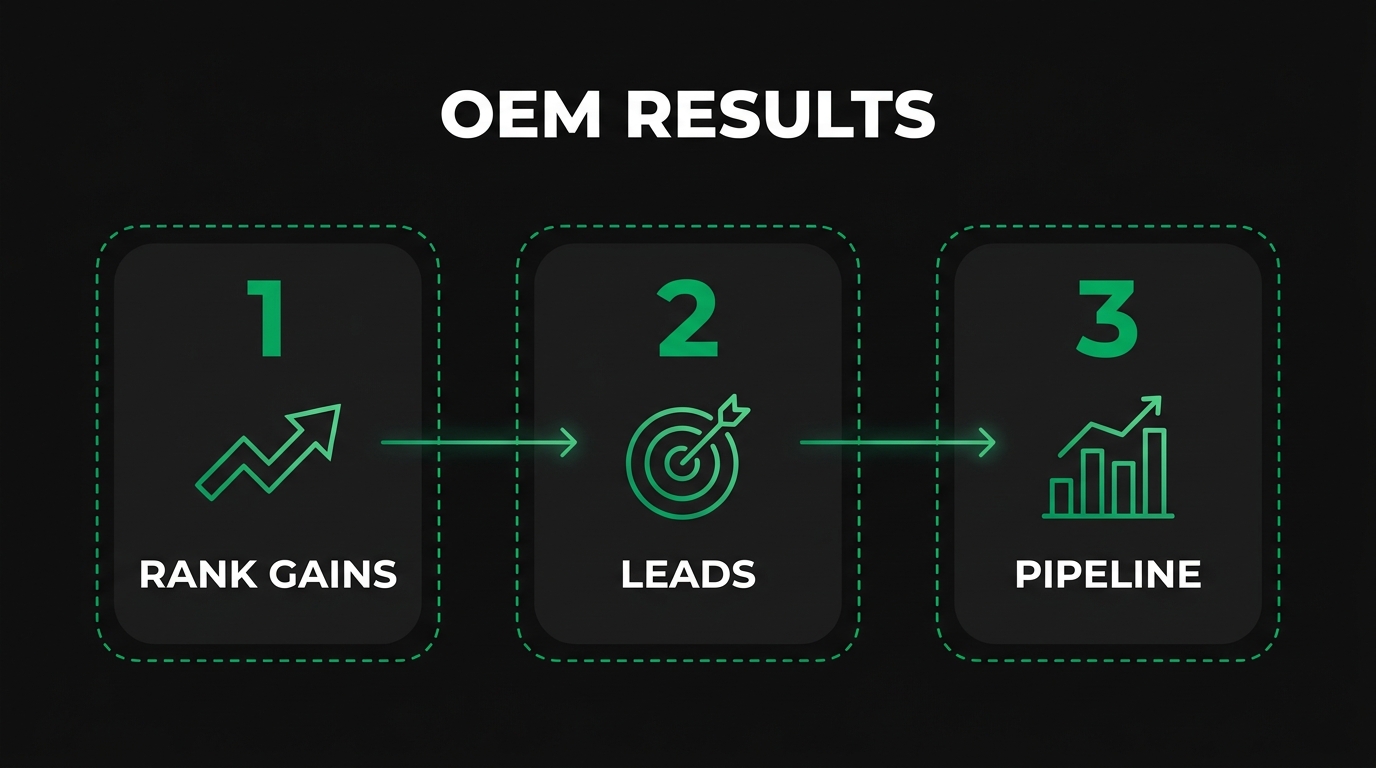
Performance measurement ties rankings to RFQs, pipeline value, closed deals, and CRM-attributed outcomes for engineering and procurement stakeholders.
AI search visibility extends OEM reach through entity signals, structured content formats, and schema patterns that help OEM pages get cited inside AI answer engines.
Common mistakes such as generic keyword targets, thin capability pages, and reporting errors hide the true pipeline impact of OEM SEO investment.
What Is an OEM SEO Strategy and How Does It Differ From Generic B2B Manufacturing SEO?
An OEM SEO strategy is a search program built for original equipment manufacturers, targeting process, material, and certification queries that drive RFQs. Generic B2B manufacturing SEO chases broader traffic. The next subsections define OEM SEO, cover buyer search behavior, and contrast it with related models.
How Is OEM SEO Defined Within the Industrial Search Landscape?
OEM SEO is defined as the practice of ranking original equipment manufacturer pages for procurement-intent queries that engineers and purchasing managers use to source qualified component or system suppliers. The discipline targets process names, material grades, certifications, and application combinations rather than vanity terms. According to the Content Marketing Institute, only 20% of manufacturing marketers say their content strategy is very effective, with 47% citing lack of customer-journey alignment as the primary reason. OEM SEO closes this gap by tying every page to a specific procurement decision, reflecting the same approach used in what is industrial seo at the broader manufacturing level.
Which Search Behaviors of OEM Buyers Make This Strategy Necessary?
The search behaviors of OEM buyers that make this strategy necessary include process-specific queries, certification filters, material grade lookups, and lifecycle-aware comparisons. Buyers consult several distinct sources before contacting suppliers. McKinsey reports that B2B customers now use an average of ten interaction channels in their buying journey, up from five in 2016. Engineers verify tolerances, certifications, and supplier histories across multiple touchpoints, so OEM pages must answer technical questions directly to capture qualified intent.
What Distinguishes OEM SEO From Distributor, Aftermarket, or Contract Manufacturing SEO?
OEM SEO is distinguished from distributor, aftermarket, or contract manufacturing SEO by intent depth, content specificity, and the role of certifications in qualifying suppliers. Distributors target SKU and availability queries. Aftermarket sites target part-number replacement queries. Contract manufacturers compete on capability breadth. OEMs compete on engineered specification depth. A side-by-side look at oem seo vs b2b manufacturing seo shows how procurement language, schema use, and conversion design diverge across these models. Treating them as one program produces shallow content that ranks nowhere.
When Should an OEM Manufacturer Apply an OEM-Specific SEO Strategy?
An OEM manufacturer should apply an OEM-specific SEO strategy when generic content stops capturing RFQs, certifications gate buying decisions, and product depth justifies cluster coverage. The next subsections cover business triggers, lifecycle stages, procurement-funnel readiness, and when generic SEO still suffices.
Which Business Triggers Signal That OEM SEO Is the Right Move?
The business triggers that signal OEM SEO is the right move include declining RFQ volume despite traffic gains, new procurement-intent keyword competition, certification milestones, and supplier-of-choice positioning targets. According to Wikipedia, an original equipment manufacturer is generally perceived as a company that produces parts and equipment that may be marketed by another manufacturer, which means the relevant search audience is engineers vetting components, not consumers comparing brands. When these signals appear, an OEM-specific program is justified. A practical oem seo strategy checklist helps formalize trigger evaluation.
How Do Product Lifecycle Stages Determine the Best Time to Invest?
Product lifecycle stages determine the best time to invest by aligning SEO investment with launch timing, maturity expansion, and end-of-life replacement campaigns. New product launches need topical authority before sales activation. Mature products benefit from clustered comparison content and certification refreshers. End-of-life or replacement programs require migration paths to next-generation parts. Industry experience suggests the highest ROI window opens 6 to 12 months before a major product release, when search demand begins to form and competitor coverage is still thin.
Which Procurement-Funnel Conditions Make OEM SEO Most Effective?
The procurement-funnel conditions that make OEM SEO most effective include long evaluation cycles, multi-stakeholder buying committees, certification-gated qualification, and digital-first sourcing behavior. Forrester predicts that more than half of large B2B purchases (US$1 million or greater) will be processed through digital self-serve channels, including the vendor's website or marketplace. When buyers self-serve, OEM pages must carry the technical and trust signals normally delivered by sales reps. Detailed implementation steps for that shift are covered in how to implement oem seo.
When Is Generic Manufacturing SEO Sufficient and OEM SEO Premature?
Generic manufacturing SEO is sufficient and OEM SEO is premature when product portfolios are narrow, certifications are not required for sales, and buyers are still in single-stakeholder evaluations. According to the IATF, a supplier without a valid IATF 16949 certificate has little chance of supplying a Tier 1 supplier and certainly no chance of supplying a car manufacturer with standard parts if that OEM is a participating member of the IATF. Manufacturers without that pressure can wait. The trigger to escalate is consistent: certification-gated demand and multi-stakeholder evaluations.
How Do You Audit OEM Search Demand Before Applying the Strategy?
You audit OEM search demand before applying the strategy by inventorying procurement-intent keywords, mapping queries to buyer stages, benchmarking competitor coverage, and analyzing SERP features for each query cluster. The next subsections walk through each step so the resulting investment matches real demand.
Which Procurement-Intent Keywords Should an OEM Audit Cover?
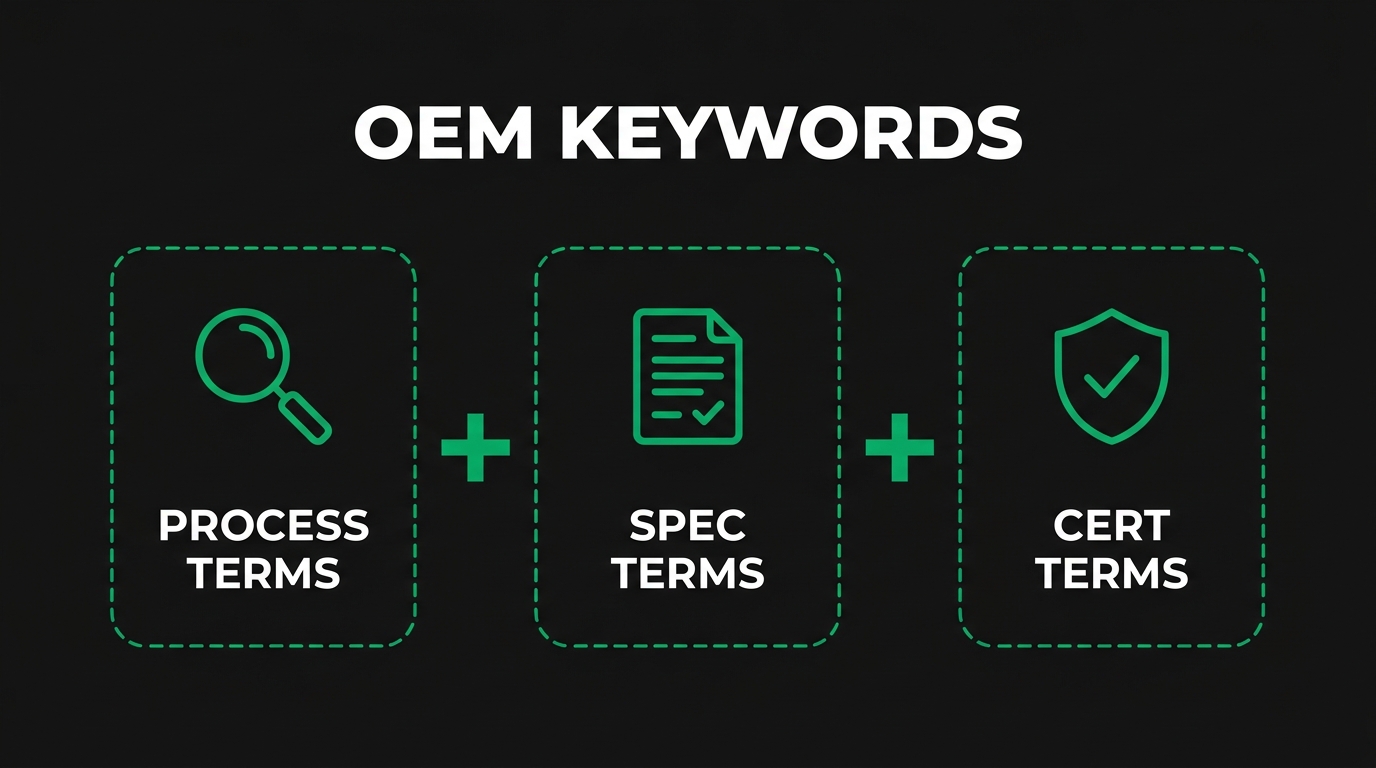
The procurement-intent keywords that an OEM audit should cover include process names, material grades, certifications, application contexts, and tolerance specifications. Examples include "5-axis CNC titanium aerospace parts," "AS9100 sheet metal fabrication," and "ISO 13485 medical injection molding." Thomas reports that industrial buyers are typically 70% of the way through their purchase decision process before they reach out to a supplier, which means the keyword set must serve research-stage and shortlist-stage queries equally. A complete implementing an oem seo strategy workflow shows how to compile and prioritize the seed list.
How Do You Map Process, Material, and Certification Queries to Buyer Stages?
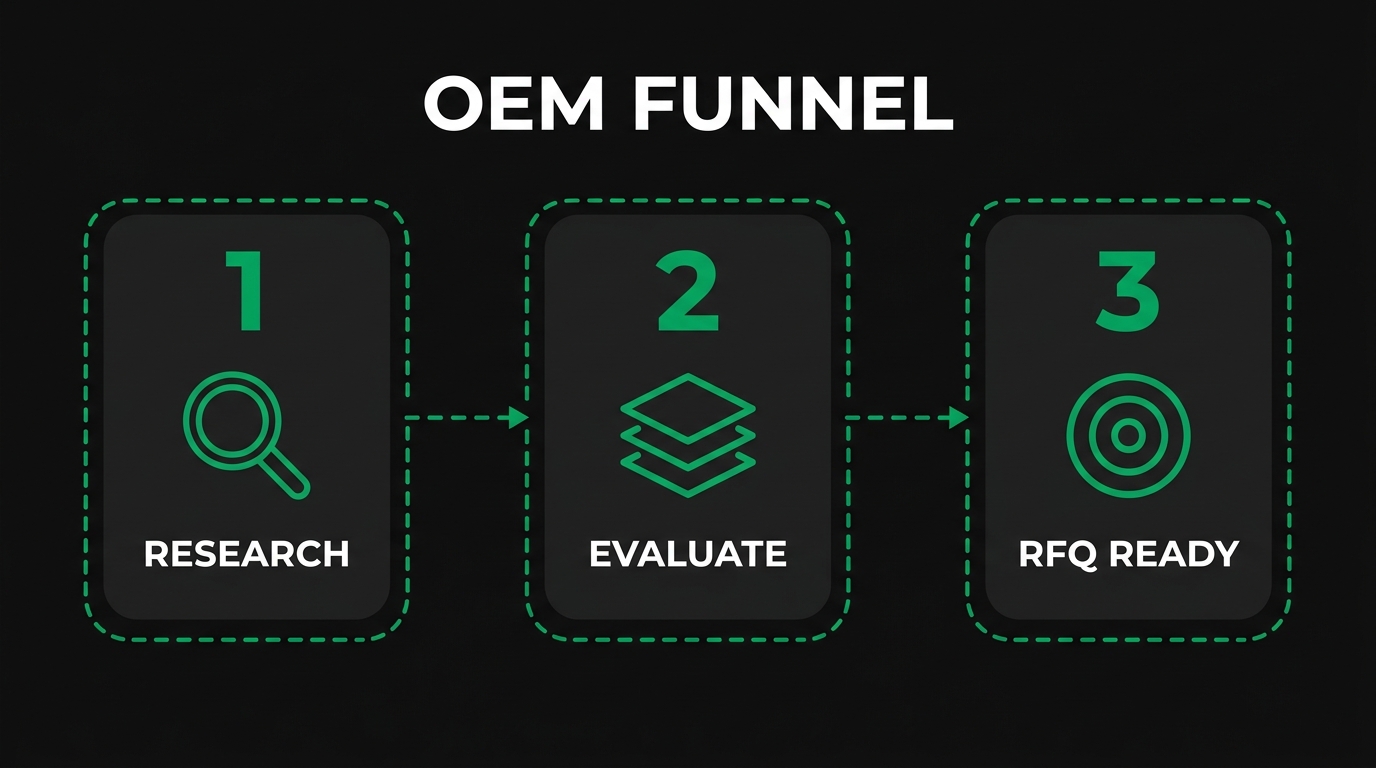
You map process, material, and certification queries to buyer stages by labeling each query as research, evaluation, or RFQ-ready and pairing it with the page format that resolves the buyer's question at that stage. Research queries pair with capability and explainer pages. Evaluation queries pair with comparison and certification proof pages. RFQ-ready queries pair with product spec sheets and quote forms. According to MarketingCharts, B2B buyers rely most on demos (62%), followed by user reviews (55%), ROI calculators (48%) and case studies (48%) at final stages, so RFQ-ready pages must include those formats.
Which Competitor Signals Reveal OEM SEO Opportunity Gaps?
The competitor signals that reveal OEM SEO opportunity gaps include uncovered process and material combinations, missing certifications in title tags, thin capability pages on top-ranking competitors, and SERPs dominated by generic distributors. Each gap represents a defensible OEM ranking opportunity. Auditing the top three SERP results for every priority query exposes where competitor depth ends. The pattern is consistent across most industrial verticals: incumbents publish broad capability pages but rarely cover process-material-certification triples in dedicated content.
What Role Does SERP Feature Analysis Play in OEM Demand Validation?
SERP feature analysis plays the role of validating real OEM demand by showing whether queries trigger featured snippets, People Also Ask boxes, video carousels, or AI Overviews. Each feature signals different content formats and intent. According to Ahrefs, featured snippets receive an average of 35.1% of total click share while regular organic listings receive 44%. Queries with rich SERP features confirm active buyer research and reward optimized formats. Queries with bare results often indicate undeveloped categories worth claiming early.
How Should You Structure an OEM Topical Authority Map?
You structure an OEM topical authority map by anchoring pillar pages on core processes, branching cluster pages around materials and certifications, and expanding spoke pages into application combinations. The next subsections detail pillar selection, coverage logic, and internal linking that distributes authority across the OEM topic graph.
Which Pillar, Cluster, and Spoke Topics Belong in an OEM Site Architecture?
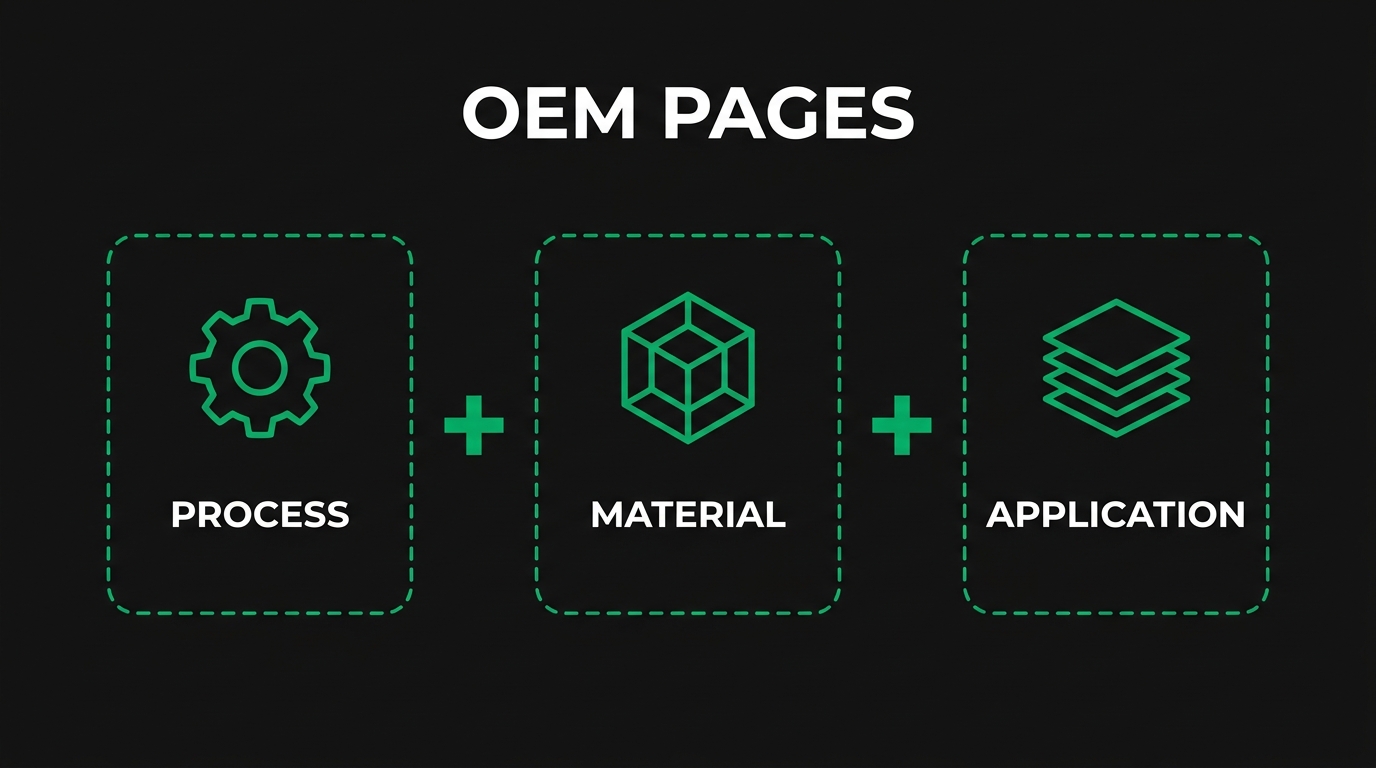
The pillar, cluster, and spoke topics that belong in an OEM site architecture are organized by process at the pillar level, by material and certification at the cluster level, and by application or industry at the spoke level. A pillar might cover "precision CNC machining" or what is additive manufacturing, with clusters on titanium, Inconel, and aluminum, and spokes on aerospace fittings, medical implants, and automotive housings. This structure mirrors how engineers narrow searches from process to material to application. A useful comparison of architectures appears in content strategy for oem vs fabrication.
How Do You Cover Process, Material, Certification, and Application Combinations?
You cover process, material, certification, and application combinations by publishing dedicated pages for the highest-volume triples and using programmatic templates for the long tail. Each page should answer one specific procurement question with technical depth. Industry experience shows the highest-converting pages combine a clear capability statement, concrete tolerance ranges, certification logos, application case examples, and a path to RFQ. Coverage breadth matters less than depth at the triple level.
How Do You Use Internal Linking to Pass Authority Across OEM Topic Clusters?
You use internal linking to pass authority across OEM topic clusters by linking spokes upward to clusters, clusters upward to pillars, and laterally between semantically adjacent topics. According to a Zyppy SEO study analyzing 23 million internal links across 1,800 websites, URLs with 0-4 internal links received an average of 2 clicks from Google Search, while URLs with 40-44 internal links received roughly 4× that traffic. The takeaway for OEM site owners is that strategic links matter more than total volume when they reinforce topical depth and route engineers from spoke pages to certification and capability hubs.
How Should You Optimize Product, Capability, and Service Pages for OEM Buyers?
You optimize product, capability, and service pages for OEM buyers by serving technical specifications, structured data, and conversion paths that engineers and procurement managers expect. The next subsections cover on-page elements, schema and FAQ markup, and the conversion components that move buyers from page visit to RFQ.
What On-Page Elements Do OEM Engineers and Procurement Managers Expect?
The on-page elements that OEM engineers and procurement managers expect are tolerance ranges, material grades, certification logos, dimensional drawings, application examples, lead-time signals, and downloadable spec sheets. According to the Academy of Marketing Science, 70% of B2B buyers and researchers watch video content during their purchasing journey, and 58% of B2B buyers expect detailed product demonstrations before personal contact. OEM pages should embed short demo clips of process capability alongside written specs to satisfy both modalities in one visit.
How Should You Use Schema Markup, FAQs, and Tech Specs for OEM Pages?
You should use schema markup, FAQs, and tech specs for OEM pages by deploying Product, FAQPage, and Organization JSON-LD with explicit material, certification, and capability attributes. According to a Sixth City Marketing analysis of Schema.org data, approximately 45 million of the world's 362.3 million registered domains use Schema.org markup, with only about 12.4% of websites implementing structured data at all. The low adoption rate gives OEM sites an outsized opportunity to claim rich SERP and AI Overview placements by adding structured tech specs, FAQ blocks for common procurement questions, and entity references to certifying bodies like ISO, AS, and NADCAP.
Which Conversion Elements Move OEM Buyers From Visit to RFQ?
The conversion elements that move OEM buyers from visit to RFQ are quote forms with pre-filled spec fields, downloadable CAD or STEP files, certification documentation, response-time commitments, and engineer-to-engineer chat or callback options. The strongest pages reduce friction at the exact moment a buyer has confirmed fit. Procurement managers want clear lead times. Engineers want technical artifacts. Pages that serve both groups in parallel convert at materially higher rates than generic contact-us forms, and the bridge sentence here connects optimization to the link-acquisition work that brings these pages qualified traffic.
How Do You Build Authoritative Backlinks That Move OEM Rankings?
You build authoritative backlinks that move OEM rankings through trade publication coverage, original research that earns editorial citations, and tier-2 amplification that compounds reach. The next subsections cover trade media targeting, original research formats, and digital PR amplification tactics.
Which Trade Publications and Industry Media Influence OEM Search Authority?
The trade publications and industry media that influence OEM search authority include category-specific publishers covering aerospace, automotive, medical, electronics, and food manufacturing, plus engineering associations that publish standards-aligned content. Coverage from these outlets carries domain authority and topical relevance signals that generic backlinks cannot match. Industry experience shows a single feature in a process-specific trade publication often outperforms dozens of low-authority blog placements for ranking impact in OEM verticals. A focused b2b link building strategy prioritizes outlets where engineers and procurement managers already read.
How Do You Earn Editorial Links Through Original OEM Research and Data?
You earn editorial links through original OEM research and data by publishing benchmarks, supplier surveys, certification trend reports, and process-specific datasets that journalists and analysts reference. According to MarketingProfs, B2B buyers pay close attention to content that includes research and data, with 48% pointing to content with relevant or shareable links and 42% valuing content packed with shareable stats and quick-hitting insights. The pattern is consistent in OEM markets: a well-structured industry survey with clear charts and one-line stats earns more high-authority links in 90 days than a year of guest posts.
How Do Tier-2 Amplification and Digital PR Strengthen OEM Link Profiles?
Tier-2 amplification and digital PR strengthen OEM link profiles by reinforcing high-authority placements with secondary citations from forums, association newsletters, supplier directories, and engineer communities. Each tier-2 link increases the topical weight of the original placement. The strongest digital PR programs treat tier-1 and tier-2 as a single sequenced campaign, which produces measurable lifts in ranking velocity for the targeted OEM cluster within a typical certification reporting cycle.
How Do You Measure OEM SEO Performance Beyond Rankings?
You measure OEM SEO performance beyond rankings by tracking RFQs, pipeline value, closed revenue, and stakeholder-facing reports tied to CRM attribution. The next subsections cover the metrics that matter, the reporting structures engineering and procurement audiences expect, and the CRM tools that make revenue attribution possible.
Which RFQ, Pipeline, and Revenue Metrics Should You Tie to OEM Rankings?
The RFQ, pipeline, and revenue metrics that you should tie to OEM rankings are RFQ count by source page, pipeline value by topic cluster, RFQ-to-quote conversion rate, average deal size by procurement segment, and closed revenue per ranking keyword. Each metric should map to a specific page or cluster so SEO investment can be defended at the line-item level. Industry experience shows pipeline value per cluster is the single most persuasive metric in CFO conversations because it converts ranking effort into forecastable revenue rather than vanity traffic.
How Should You Report OEM SEO Outcomes to Engineering and Procurement Stakeholders?
You should report OEM SEO outcomes to engineering and procurement stakeholders by separating technical depth metrics from commercial outcome metrics and tailoring each view. Engineering audiences care about content coverage of process and material combinations, citation accuracy, and schema validity. Procurement audiences care about RFQ volume, lead-time signals, and supplier-of-choice positioning. According to Statista, 93 percent of industrial marketers rely on LinkedIn as part of their overall content distribution strategy, with LinkedIn being the organic social media platform that manufacturing content marketers used the most and produced the best results, which makes LinkedIn the natural channel for distributing both report types.
Which Tools and CRM Integrations Make Revenue Attribution Possible?
The tools and CRM integrations that make revenue attribution possible include HubSpot, Salesforce, and Microsoft Dynamics paired with web analytics platforms that pass UTM and source data into deal records. According to a HubSpot revenue attribution study, 87% of marketers using HubSpot or a similar CRM feel confident in their reporting and strategy, compared to only 52% for those without a CRM or revenue attribution tool. The attribution gap is the single biggest reason OEM SEO budgets get cut: without integrated reporting, ranking gains never reach the deals that justify them.
How Do You Adapt OEM SEO for AI Search and LLM Citation Visibility?
You adapt OEM SEO for AI search and LLM citation visibility by strengthening entity signals, formatting content for extractive citation, and deploying schema patterns that AI engines reward. The next subsections cover entity grounding, content formatting, and structured data patterns for AI Overviews.
Which Entity Signals Help OEM Brands Get Cited by AI Answer Engines?
The entity signals that help OEM brands get cited by AI answer engines are consistent business name use, Wikipedia or Wikidata grounding, certification organization references with sameAs links, structured About pages, and clear product entity definitions. According to OpenAI's State of Enterprise AI report, ChatGPT now serves more than 800 million users every week and 71% of firms reported using generative AI in one or more functions, up from 55% the prior year. OEM brands that build clean entity graphs early are far more likely to appear in answer-engine citations as engineers shift research to AI tools.
How Should You Format Content So LLMs Cite Your OEM Pages?
You should format content so LLMs cite your OEM pages by leading each section with a direct definitional sentence, using subject-predicate-object structure, embedding numerical specifications inline, and grouping facts under question-based headings. Bulleted spec lists, comparison tables, and short paragraph blocks all extract more cleanly than long narrative prose. The principle is simple: AI engines cite content they can lift verbatim. OEM pages structured around procurement questions get cited more often than capability brochures.
Which Schema and Structured Data Patterns Improve AI Visibility for OEMs?
The schema and structured data patterns that improve AI visibility for OEMs are Product, Organization, FAQPage, Article, BreadcrumbList, and HowTo JSON-LD with sameAs references to certification bodies, standards organizations, and Wikipedia entities. According to Search Engine Land coverage of Seer Interactive AI Overview research, organic CTRs for AI Overviews queries dropped from 1.76% to 0.61%, and 76.1% of URLs cited in AI Overviews also rank in the top 10 of Google search results. Schema does not guarantee citation, but its absence almost guarantees exclusion from AI-driven discovery channels.
What Common Mistakes Cause OEM SEO Strategies to Fail?
The common mistakes that cause OEM SEO strategies to fail are generic keyword targeting, thin capability pages, and reporting errors that hide pipeline impact. The next subsections explain each failure mode and how to detect it before the program loses budget or executive support.
Why Do Generic Keyword Targets Underperform for OEM Manufacturers?
Generic keyword targets underperform for OEM manufacturers because broad terms attract distributors, aggregators, and informational sites that out-rank technical pages on volume metrics alone. According to a 6sense Buyer Experience Report, B2B buyers select a favored vendor before engaging sellers and that pre-contact favorite wins the deal roughly 80% of the time, with 94% of buying groups ranking preferred vendors before first contact. OEMs that rank for generic terms attract early-stage researchers but rarely the engineers who pre-select suppliers, so RFQ volume stays flat even as traffic grows.
How Do Thin Capability Pages Undermine OEM Topical Authority?
Thin capability pages undermine OEM topical authority by signaling shallow expertise to both search engines and procurement managers. A page listing "CNC machining" with three sentences fails to compete with a competitor's 1,500-word page covering tolerances, certifications, materials, and applications. According to Brookings, advanced industries employ just 9 percent of the U.S. workforce yet produce 90 percent of private-sector R&D expenditures, which means OEM buyers expect deep technical content because that is the standard their suppliers operate at every day. Thin pages contradict that expectation and lose trust.
Which Reporting Errors Hide Real OEM Pipeline Impact?
The reporting errors that hide real OEM pipeline impact are tracking only rankings and traffic, ignoring assisted-conversion attribution, failing to tag RFQ source pages, and reporting at the channel level instead of the cluster level. Each error obscures the link between SEO work and revenue. The CMO who sees only a traffic graph cannot defend OEM SEO investment to a CFO who asks for closed-deal evidence. Fixing reporting first often saves a program that looks underperforming on surface metrics, and the pattern echoes broader what is industrial seo measurement principles.
How Should You Approach an OEM SEO Strategy With Manufacturing SEO Agency?
You should approach an OEM SEO strategy with manufacturing seo agency by starting with a procurement-intent audit, then layering topical authority, link acquisition, and CRM-tied reporting. The next subsections cover how Manufacturing SEO Agency's procurement-intent architecture supports OEM rollout and recap the article's key takeaways.
Can Manufacturing SEO Agency's Procurement-Intent Architecture Help With Your OEM SEO Rollout?
Manufacturing SEO Agency's procurement-intent architecture helps with OEM SEO rollout by mapping every page to a stage of the procurement journey, from material research through supplier evaluation to RFQ submission. Manufacturing SEO Agency builds keyword clusters around process, material, and certification combinations, applies schema for entity grounding, and ties every ranking to RFQs and pipeline value through CRM integration. The firm focuses exclusively on industrial manufacturing, including aerospace, automotive, medical, and dedicated oem seo programs, which means strategy is built from procurement reality rather than generic B2B playbooks.
What Are the Key Takeaways About Applying an OEM SEO Strategy We Covered?
The key takeaways about applying an OEM SEO strategy are clear. OEM SEO targets process, material, and certification queries that engineers and procurement managers actually search. Applying it makes sense when generic content stops generating RFQs, when certifications gate buying decisions, and when the product portfolio is deep enough to justify cluster-level coverage. The execution sequence is consistent: audit demand, build a topical authority map, optimize pages with schema and conversion paths, earn authoritative backlinks, measure with CRM-tied reporting, and adapt for AI search visibility. Skipping any step weakens the rest. Manufacturing SEO Agency exists to run that sequence end-to-end for OEMs that need procurement-funnel results, not vanity rankings.