Implementing an OEM SEO strategy means architecting a website, content library, and link profile that ranks for the exact process, material, and certification queries that procurement engineers, design teams, and supply chain buyers type when sourcing original equipment manufacturers. We treat OEM SEO as a procurement-intent discipline, not a generic marketing channel.
This guide covers the foundations of OEM search visibility, technical groundwork, keyword and content architecture, link authority, AI search readiness, ROI measurement, and the common implementation pitfalls.
We start by defining what separates OEM SEO from general manufacturing SEO and why procurement-driven search behavior shapes every downstream decision.
We then walk through how to audit an existing OEM website, surface technical gaps, and map the keyword and competitor footprints that anchor the strategy.
After the diagnostic phase, we build a procurement-intent keyword architecture, organize on-page elements around buyer queries, and develop topical authority across processes, materials, and certifications.
We address the technical SEO foundations OEM sites require, including schema markup, crawl budget, and Core Web Vitals tuning for engineering-document-heavy catalogs.
We cover how OEMs earn editorial backlinks from industrial trade media, optimize for AI search and large language model citations, and tie organic performance to RFQs, pipeline value, and closed revenue.
We close with the most common implementation mistakes that derail OEM SEO programs and how a manufacturing-only agency partnership accelerates execution.
What Is OEM SEO and Why Does It Matter for Manufacturers?
OEM SEO is the practice of ranking original equipment manufacturer websites for the procurement-intent queries that engineers and supply chain buyers use when sourcing parts. It matters because procurement decisions now begin in search.
How Does OEM SEO Differ From General Manufacturing SEO?
OEM SEO differs from general manufacturing SEO by targeting buyers who specify exact part numbers, tolerances, and certifications rather than browse for generic capabilities. OEM queries embed component-level intent: "AS9100 titanium bracket supplier" or "automotive Tier-1 injection molded housing." General manufacturing SEO often chases shorter, higher-volume head terms that attract distributors and end-users instead of design engineers. Understanding the operational contrast between what is oem seo and broader industrial search practice helps OEMs prioritize the buyer personas who actually issue purchase orders. Reviewing oem seo vs b2b manufacturing seo clarifies how funnel stages, content depth, and certification signaling diverge between the two disciplines.
Why Should OEMs Prioritize Search Visibility for Procurement Buyers?
OEMs should prioritize search visibility for procurement buyers because organic search consolidates the early-stage research that precedes every RFQ. Procurement teams qualify suppliers against process tolerances, material grades, and certification scope before requesting quotes, and they do that qualification through search.
As an oem seo discipline, search visibility compresses sales cycles by surfacing certified suppliers before procurement contacts a single representative.
What Buying Behaviors Shape OEM Search Demand Today?
OEM search demand today is shaped by self-directed digital research, multi-stakeholder buying committees, and rising preference for vendor-free information gathering.
Procurement engineers now compile shortlists of three to five qualified suppliers entirely through search before any human contact. This behavior elevates content depth, certification clarity, and process specificity to ranking-grade differentiators. OEMs that ignore self-service research lose deals before quoting them.
How Do You Audit an OEM Website Before Implementing SEO?
You audit an OEM website by combining technical crawls, keyword footprint mapping, competitor reverse-engineering, and indexation diagnostics. The audit baseline shapes every downstream decision in the strategy.
Which Technical SEO Issues Damage OEM Site Performance Most?
Technical SEO issues that damage OEM site performance most include slow rendering of engineering documents, broken canonical signals across product variants, excessive thin pages from CMS templating, and missing structured data on capability pages. Many OEM sites publish PDF datasheets without HTML equivalents, hiding ranking-eligible content behind file downloads.
Resolving these issues unlocks indexation of high-value capability pages. Manufacturing SEO Agency runs manufacturing audit and competitive intelligence engagements that reverse-engineer every competitor ranking above the client.
How Do You Map Existing Keyword and Page Footprints?
You map existing keyword and page footprints by exporting Search Console queries by URL, cross-referencing with rank tracking data, and tagging each ranking page by process, material, and certification cluster.
Tag pages by buying-stage intent so that the audit reveals coverage gaps in awareness, evaluation, and RFQ stages. The footprint map becomes the source of truth for what to keep, consolidate, redirect, or rewrite.
What Competitor Signals Should an OEM Audit Capture?
An OEM audit should capture competitor signals across keyword overlap, ranking page templates, internal link density, schema deployment, and editorial backlink sources. Pull the top ten competitors for your highest-value procurement queries and reverse-engineer their topical maps. Identify which certification, material, and process pages they rank for that you lack. Capture their backlink anchor profiles to see which trade publications cite them.
Document content depth: comparing how many process variants each competitor covers exposes coverage gaps and translates directly into a prioritized content gap list.
How Do You Diagnose Schema, Crawl, and Indexation Gaps?
You diagnose schema, crawl, and indexation gaps by combining Google Search Console coverage reports, log-file analysis, and structured-data validation tools. Schema gaps appear as missing Organization, Product, and FAQPage markup on pages that already qualify for rich results. Crawl gaps show up as orphaned pages and excessive crawl waste on parameterized URLs. Indexation gaps surface as "Discovered, currently not indexed" entries that signal thin content or duplication. Cross-reference each diagnostic with traffic-loss patterns to triage remediation order. The diagnostic output feeds directly into the technical SEO foundations work covered later.
How Should OEMs Build a Procurement-Intent Keyword Architecture?
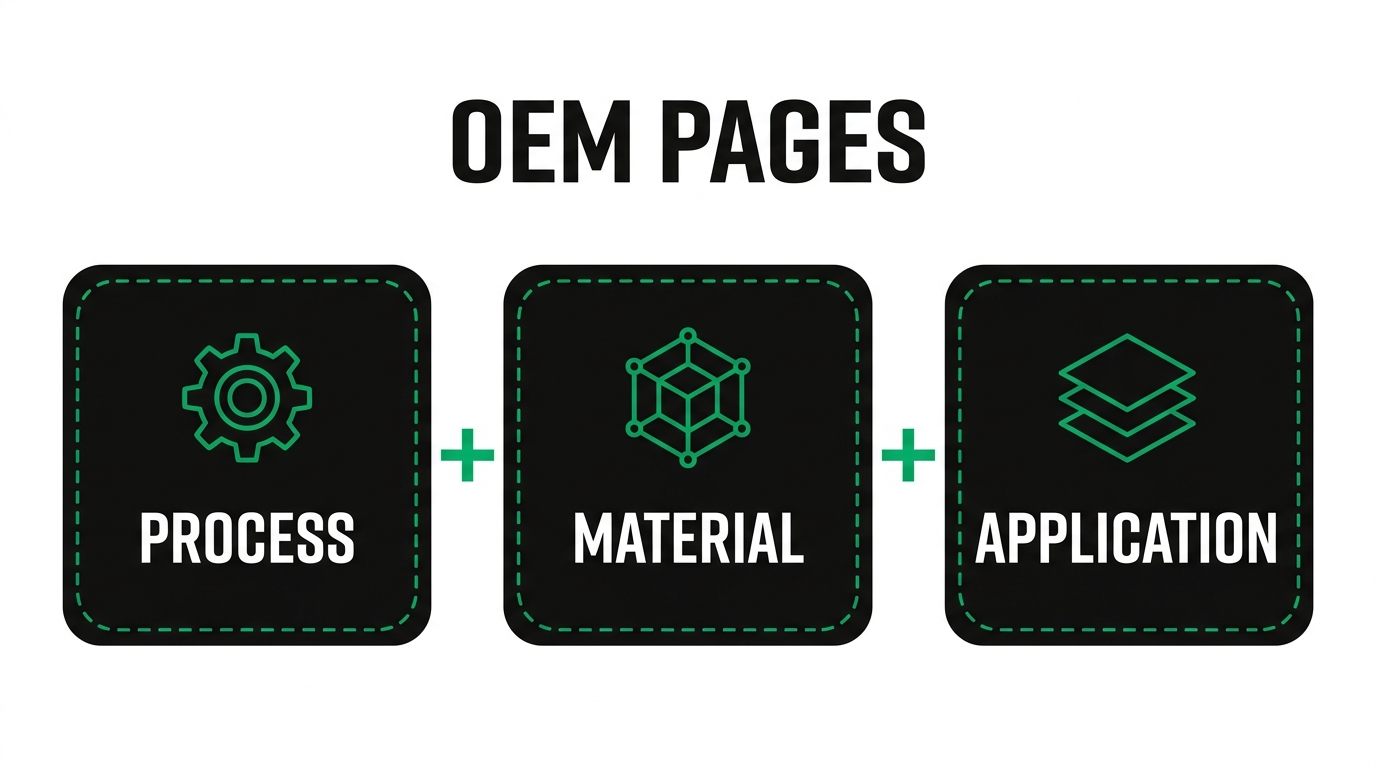
OEMs build a procurement-intent keyword architecture by grouping queries around processes, materials, and certifications, then mapping each cluster to a specific RFQ funnel stage. The architecture aligns page inventory with how engineers actually source suppliers.
Which Keyword Categories Reflect Real OEM Buyer Searches?
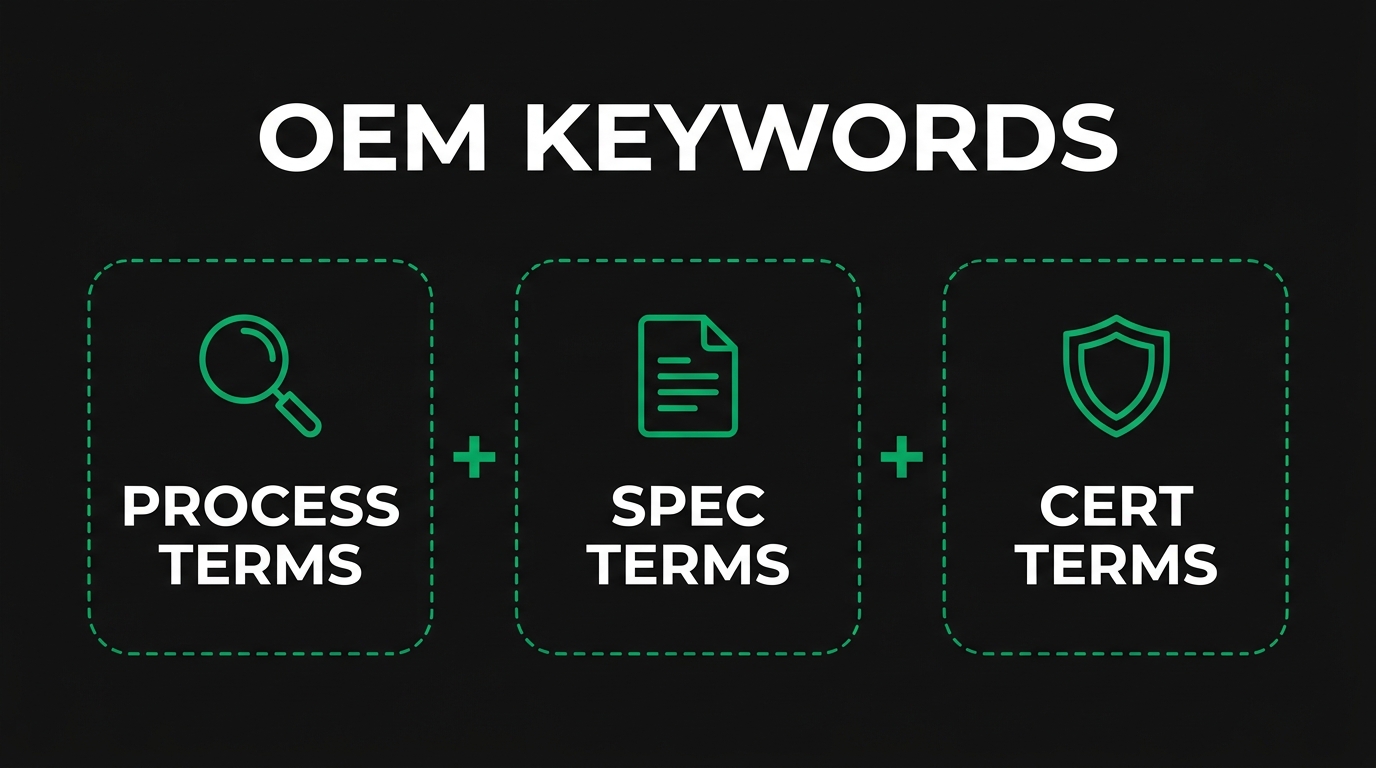
The keyword categories that reflect real OEM buyer searches are process queries, material specification queries, certification queries, application-specific queries, and tolerance or dimension modifiers. Process terms include "5-axis CNC machining" and "thermoset injection molding." Material terms embed grade detail such as "Inconel 718" or "PEEK medical grade." Certification terms anchor compliance-gated buying: AS9100, IATF 16949, ISO 13485. Application modifiers tie part function to industry vertical.
Procurement engineers specify part geometry, tolerance, and certification in a single search string.
How Do You Cluster Process, Material, and Certification Queries?
You cluster process, material, and certification queries by building a three-axis taxonomy where every cluster inherits properties from all three dimensions. Each cluster anchors a pillar page and spawns sub-pages for every process-material-certification combination. Reviewing an oem seo strategy checklist confirms coverage against the procurement decision tree.
This structure prevents the scattered-page problem that dilutes topical authority.
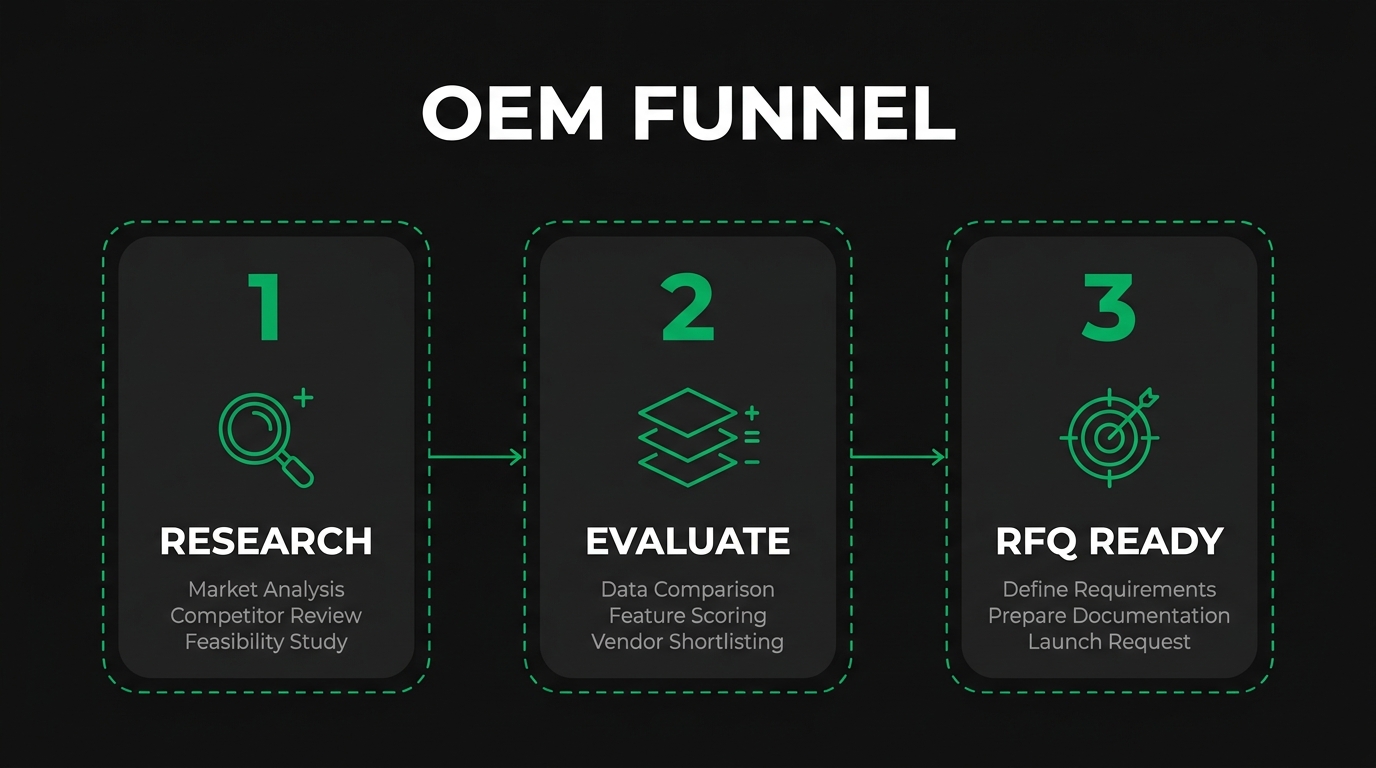
How Do You Map Keywords to RFQ Funnel Stages?
You map keywords to RFQ funnel stages by tagging each query with awareness, evaluation, or RFQ intent signals. Awareness queries include "what is" and "types of" modifiers. Evaluation queries compare suppliers, processes, or certifications. RFQ-stage queries name exact parts, tolerances, and quantities.
Each funnel stage must have dedicated landing pages capturing multi-channel search paths. RFQ-stage pages convert far better than awareness pages when copy surfaces tolerance and certification proof in the first fold.
Which Long-Tail Modifiers Capture High-Intent OEM Buyers?
The long-tail modifiers that capture high-intent OEM buyers are certification codes, material grades, geometric tolerances, application verticals, and quantity or volume signals. Examples include "AS9100D titanium 6Al-4V machining aerospace low-volume prototype" or "IATF 16949 PPAP plastic injection molding automotive."
Layering modifiers builds long-tail architecture matching how basic seo strategies for manufacturers advise specificity over volume. Long-tail capture converts faster because buyers arrive pre-qualified.
What On-Page SEO Tactics Should OEM Manufacturers Apply?
The on-page SEO tactics OEM manufacturers should apply are structured capability pages, buyer-specific title and meta patterns, rigorous header hierarchy on process content, and cluster-aware internal linking. Each tactic converts procurement intent into crawlable, rankable page architecture.
How Do You Structure OEM Service and Capability Pages?
You structure OEM service and capability pages by leading with a direct process definition, specifying materials and tolerances, listing certifications, and closing with an RFQ call.
Every capability page must answer procurement qualification questions above the fold. Include tolerance ranges, machine specifications, material options, and certification scope.
Which Title Tag and Meta Description Patterns Convert OEM Buyers?
The title tag and meta description patterns that convert OEM buyers lead with the primary process and material, include certification scope, and end with a location or capability modifier. A converting title pattern reads: "5-Axis CNC Machining Titanium | AS9100 Aerospace Parts." Meta descriptions should reinforce tolerance grades, lead times, and quantity capability.
Keep titles under 60 characters and meta descriptions under 155 characters to avoid SERP truncation, and prioritize procurement-qualifying modifiers over brand filler.
How Should OEMs Use Header Hierarchy on Process Pages?
OEMs should use header hierarchy on process pages by assigning one H1 to the process name, H2s to buyer-qualifying facets like materials, tolerances, certifications, and applications, and H3s to supporting detail.
Header depth signals topical coverage to Google's passage-indexing system, helping each facet rank independently for its own long-tail queries.
What Internal Linking Strategy Connects OEM Topical Clusters?
The internal linking strategy that connects OEM topical clusters is pillar-to-cluster spoking, where each process pillar links outward to every material, certification, and application sub-page, and each sub-page links back to the pillar.
Anchor text should carry process or material specificity rather than generic "learn more" phrasing. Cluster-aware linking sets up the topical authority work covered next.
How Do You Build Topical Authority for an OEM Manufacturing Site?
You build topical authority for an OEM manufacturing site by publishing complete coverage across processes, materials, certifications, and applications, supported by long-form engineering content, case studies, and routine refresh cycles. Coverage breadth and depth both matter.
Which Process, Material, and Certification Pages Form a Topical Map?
The process, material, and certification pages that form a topical map include every capability your shop runs, every grade you machine or mold, every standard you hold, and every industry vertical you serve. A complete map for a precision-machining OEM would cover CNC milling, turning, EDM, grinding, titanium, Inconel, PEEK, AS9100, IATF 16949, aerospace, automotive, and medical subsections.
Exploring content strategy for oem vs fabrication helps OEMs calibrate which cluster depth separates them from fabrication competitors.
How Do You Plan Long-Form Content for Engineering Buyers?
You plan long-form content for engineering buyers by anchoring each piece to a procurement decision an engineer must make, such as selecting a material grade, specifying a tolerance, or comparing processes. The article depth should cover material properties, process parameters, common defects, inspection methods, and certification requirements. Engineering buyers skim for specification tables and process diagrams, so embed data early.
Pair each long-form page with a downloadable spec sheet to capture contact data from qualified leads.
How Do Case Studies and Application Notes Strengthen OEM Authority?
Case studies and application notes strengthen OEM authority by demonstrating process fluency on real parts under real constraints, which search engines and buyers both read as experience signals.
Each case study should name the part family, material grade, tolerance achieved, certification scope, and measurable outcome. Application notes translate case learnings into reusable technical guidance, proving E-E-A-T by anchoring claims in verifiable production history rather than marketing prose.
How Often Should an OEM Refresh Existing Content?
An OEM should refresh existing content on a quarterly audit cycle, prioritizing pages tied to active RFQ demand or shifting certification scopes. Refresh triggers include new equipment on the floor, updated certification audits, changed material supplier lists, and Google ranking slippage. Update the copy, refresh the schema, re-link across the cluster, and log the change date for crawl signals.
Quarterly refresh sustains authority as the technical foundations work picks up next.
What Technical SEO Foundations Do OEM Sites Require?
The technical SEO foundations OEM sites require are rigorous schema markup, fast loading on document-heavy pages, efficient crawl budget management across large catalogs, and strong mobile Core Web Vitals. Each foundation protects procurement-intent pages from indexation and performance decay.
Which Schema Markup Types Should OEMs Implement First?
The schema markup types OEMs should implement first are Organization, Product, BreadcrumbList, FAQPage, and HowTo. Schema.org provides shared vocabularies that webmasters can use to mark up pages in ways the major search engines understand, covering each of these types natively. Organization schema anchors the brand entity. Product schema exposes capability, material, and certification properties. FAQPage schema captures procurement-intent long-tail queries. HowTo schema surfaces process steps.
How Do You Optimize Site Speed for Engineering Document Pages?
You optimize site speed for engineering document pages by compressing technical PDFs, lazy-loading CAD previews, serving spec images in modern formats like AVIF or WebP, and caching aggressively at the edge.
Host large CAD files off the critical rendering path and prefetch only the first fold. Convert image-heavy datasheets into HTML equivalents so the content ranks rather than hiding inside PDFs.
How Should OEMs Handle Crawl Budget Across Large Catalogs?
OEMs should handle crawl budget across large catalogs by consolidating faceted navigation, blocking parameterized URLs in robots.txt, maintaining clean XML sitemaps segmented by content type, and pruning thin or duplicate product variants. Log-file analysis shows where Googlebot wastes cycles on filter combinations that hold no ranking value. Canonicalize variant pages that share materials and tolerances.
Efficient crawl routing directs Google to the procurement-intent pages that earn revenue.
What Mobile and Core Web Vitals Issues Affect OEM Sites?
The mobile and Core Web Vitals issues that affect OEM sites are slow Largest Contentful Paint from heavy spec images, poor Interaction to Next Paint from legacy CMS scripts, and Cumulative Layout Shift from injected spec tables.
Vodafone (Italy), per web.dev, improved Largest Contentful Paint by 31% to achieve 8% more sales after Core Web Vitals optimization, showing how performance gains translate into measurable business outcomes. Strong vitals also prime the backlink acquisition work covered next.
How Should OEMs Earn High-Quality Backlinks From Industry Sources?
OEMs should earn high-quality backlinks from industry sources by publishing editorial contributions in trade media, pitching specification-grade data to industrial journalists, layering tier-2 amplification, and policing the link profile for toxic sources. Each lever compounds domain authority in the manufacturing vertical.
Which Trade Publications Drive the Strongest OEM Referral Authority?
The trade publications that drive the strongest OEM referral authority are vertical-specific editorial outlets with long domain histories, such as Modern Machine Shop, Plastics Technology, Aerospace Manufacturing and Design, Automotive Manufacturing Solutions, and Industrial Distribution. These outlets carry procurement readers who outrank generic business press for OEM referral value.
How Do You Pitch Editorial Content to Industrial Media?
You pitch editorial content to industrial media by leading with a proprietary data point, tying it to an active industry narrative, and offering an expert interview with a named engineer or plant leader.
Pitches should include specification data, case photography, and a named source willing to answer follow-up questions. Pitches that lead with data land; pitches that lead with brand claims get deleted.
What Tier-2 Link Amplification Tactics Work for OEMs?
The tier-2 link amplification tactics that work for OEMs are syndicating editorial placements to industry newsletters, earning podcast mentions from process engineers, securing speaker slots at trade shows, and cross-linking from partner supplier directories. Tier-2 links amplify the authority of the original editorial placement by pointing secondary signals to the tier-1 source. Engineer-led podcasts like MakingChips and Manufacturing Happy Hour produce show-notes links that pass topical relevance.
How Do You Avoid Toxic Backlinks in the Industrial Sector?
You avoid toxic backlinks in the industrial sector by auditing referring domains monthly, disavowing low-quality directory placements, refusing paid link schemes, and rejecting private blog network outreach. Toxic profiles in manufacturing most often come from foreign-language scraper sites, spun-content directories, and pay-to-play "industrial index" pages with no editorial standard. Use Search Console link reports and third-party link graphs to triage suspicious referrers.
How Do You Optimize an OEM SEO Strategy for AI Search and LLM Citations?
You optimize an OEM SEO strategy for AI search and LLM citations by strengthening entity signals, structuring content for language model extraction, cultivating Knowledge Graph references, and tracking visibility across AI engines. Each layer positions the brand to be quoted, not just ranked.
Which Entity Signals Help OEMs Appear in AI-Generated Answers?
The entity signals that help OEMs appear in AI-generated answers are consistent brand name usage, Wikipedia or Wikidata presence, Schema.org Organization markup with sameAs references, and clustered mentions across authoritative trade publications. Consistency across NAP citations, company profiles, and trade directory listings grounds the brand as a stable entity.
Embedding verifiable statistics and expert quotations lifts AI citation odds more than tone or voice adjustments.
How Do You Structure Content for LLM Extraction?
You structure content for LLM extraction by leading with direct question-answer pairs, embedding precise specification data, using clean heading hierarchy, and writing sentences as subject-predicate-object triples. LLMs lift text in chunks, so self-contained paragraphs that resolve a single question outperform rambling narrative. Include hard numbers, certification codes, and named entities in the same sentence so the extracted span carries full context.
What Role Do Knowledge Graph References Play for OEM Brands?
Knowledge Graph references play the role of verified entity anchors for OEM brands, linking the brand node to processes, materials, certifications, and parent industries.
Build Knowledge Graph presence through verified Wikidata entries, consistent Schema.org sameAs links, and earned Wikipedia citations. OEMs without a Knowledge Graph entity are invisible to AI engines that resolve answers by entity first and URL second.
How Do You Track Visibility in AI Search Engines?
You track visibility in AI search engines by running prompt-based audits across ChatGPT, Perplexity, Claude, and Google AI Overviews, logging citation frequency, co-occurring brands, and answer positioning. Monitor procurement-intent prompts monthly and record whether the brand is cited, competitors are cited, or neither.
Closing the AI visibility gap sets up measurable ROI tracking against procurement pipeline.
How Do You Measure ROI From an OEM SEO Strategy?
You measure ROI from an OEM SEO strategy by tying keyword rankings to RFQ volume, attributing organic sessions to closed manufacturing revenue, aligning reporting cadence with sales cycles, and forecasting outcomes for executive stakeholders. Each layer converts ranking data into pipeline evidence.
Which KPIs Tie SEO Performance to RFQs and Pipeline Value?
The KPIs that tie SEO performance to RFQs and pipeline value are organic RFQ submissions, organic-sourced pipeline dollars, organic-influenced closed-won revenue, procurement-intent keyword rankings, and qualified contact rate per landing page. Vanity metrics like total sessions and bounce rate obscure procurement reality. Route RFQ form fields with UTM parameters so the CRM captures the originating page and query cluster.
How Do You Connect Organic Traffic to Closed Manufacturing Revenue?
You connect organic traffic to closed manufacturing revenue by integrating CRM data with analytics, matching RFQ submissions to deals, and crediting every touched page across the buying committee. Manufacturing sales cycles often span six to twelve months, so multi-touch attribution beats last-click models. Tag RFQs, quotes, purchase orders, and invoices with originating campaigns and landing pages.
Closed-revenue attribution converts SEO from cost center to profit lever.
What Reporting Cadence Suits OEM Marketing and Sales Alignment?
The reporting cadence that suits OEM marketing and sales alignment is weekly RFQ and ranking pulses, monthly pipeline and revenue reviews, and quarterly strategic reforecasting against the topical map. Weekly cadences catch ranking slippage or campaign spikes fast. Monthly reviews align marketing and sales on which clusters are feeding pipeline and which need content or link investment. Quarterly reviews reset priorities as certifications expand, processes change, or competitors publish.
How Do You Forecast SEO Outcomes for OEM Stakeholders?
You forecast SEO outcomes for OEM stakeholders by modeling ranking gains against keyword volume, applying conversion rate assumptions from existing RFQ data, and projecting pipeline contribution by cluster.
Build scenarios: conservative, base, and stretch, each tied to content and link investment levels. Publish assumptions transparently so stakeholders trust the numbers. Accurate forecasts frame the conversation for implementation mistake avoidance next.
What Common Mistakes Derail OEM SEO Implementation?
The common mistakes that derail OEM SEO implementation are targeting generic keywords that miss procurement intent, publishing scattered blog content that fails to build topical authority, accepting internal process gaps between marketing and engineering, and underinvesting in technical SEO maintenance. Each mistake quietly drains pipeline value.
Why Do OEMs Fail When They Target Generic Keywords?
OEMs fail when they target generic keywords because generic terms attract distributors, students, and browsers rather than procurement engineers with authority to issue RFQs. A page ranking for "CNC machining" receives hundreds of unqualified visits for every qualified one. Procurement-intent queries embed process, material, certification, and tolerance specificity that pre-qualifies the visitor.
Comparing your keyword set against how to implement oem seo exposes which terms match procurement intent.
How Does Scattered Blog Content Hurt OEM Topical Authority?
Scattered blog content hurts OEM topical authority by fragmenting crawl signals across unrelated topics, diluting internal linking equity, and confusing Google about which entity the site represents. A blog publishing industry news, team announcements, and one-off how-tos fails to build the process-material-certification mesh that signals topical expertise.
Replace scattered posts with planned clusters tied to capability pages.
Which Internal Process Gaps Slow OEM SEO Execution?
The internal process gaps that slow OEM SEO execution are disconnected marketing and engineering teams, missing subject-matter review workflows, slow legal clearance on certification claims, and no defined publishing cadence.
Fix the gaps by assigning a named engineering reviewer per cluster, pre-clearing certification language, and defining weekly publishing slots.
How Do You Avoid Underinvesting in Technical SEO Maintenance?
You avoid underinvesting in technical SEO maintenance by budgeting for quarterly technical audits, allocating developer hours to schema and Core Web Vitals remediation, and treating technical debt as a ranking risk rather than a nice-to-have. OEM sites often launch solid and decay because templated CMS updates break canonical tags, spec images bloat, and plugin upgrades regress Core Web Vitals. Schedule monthly crawl health checks and quarterly log-file reviews.
Avoiding these mistakes sets the stage for agency partnership decisions next.
How Can Manufacturing SEO Agency Help OEMs Implement a Winning Strategy?
Manufacturing SEO Agency helps OEMs implement a winning strategy by combining procurement-intent keyword architecture, topical authority buildout, editorial link building, AI search visibility engineering, and CRM-integrated revenue reporting. The subsections below cover pipeline acceleration and key takeaways.
Can Manufacturing SEO Agency's Procurement-Intent SEO Services Accelerate OEM Pipeline Growth?
Yes, Manufacturing SEO Agency's procurement-intent SEO services can accelerate OEM pipeline growth by ranking client pages for the exact process, material, and certification queries engineers use when sourcing suppliers.
Manufacturing SEO Agency is industrial-only, covering audits, keyword architecture, topical authority buildout, editorial link building, AI search engineering, technical SEO, and revenue-tied reporting.
Manufacturing seo agency extends what is industrial seo foundations into OEM-specific execution and vertical manufacturing seo content programs.
What Are the Key Takeaways About Implementing an OEM SEO Strategy We Covered?
The key takeaways about implementing an OEM SEO strategy we covered are: procurement-intent separates OEM SEO from generic manufacturing SEO, audits anchor every downstream decision, keyword architecture must cluster around processes, materials, and certifications, on-page structure should mirror buyer qualification workflows, topical authority requires complete coverage not scattered posts, technical SEO protects rankings from decay, editorial backlinks from trade media carry procurement relevance, AI search optimization anchors entity signals and quotable specification data, ROI reporting must tie to RFQs and closed revenue, and common mistakes usually trace to generic keyword targeting or underinvestment in maintenance. Manufacturing SEO Agency brings manufacturing-only focus to each of these layers, including cross-vertical experience from what is additive manufacturing to OEM precision machining.