A B2B link building strategy for industrial SEO is a structured program that earns editorial backlinks from trade publications, standards bodies, supplier directories, and engineering media so manufacturers rank for the procurement queries their buyers actually type. Industrial link building differs from consumer link building because the audience is engineers and purchasing managers vetting suppliers against certifications, tolerances, and process capabilities.
This guide covers what industrial B2B link building means, the core techniques used in manufacturing, how to identify high-value link prospects, the content assets that earn editorial citations, how to execute outreach to trade editors, how to measure ROI tied to procurement pipeline, and the compliance risks every manufacturer must manage.
We define industrial B2B link building inside the procurement funnel and explain why backlinks correlate with rankings on the technical queries that drive RFQs.
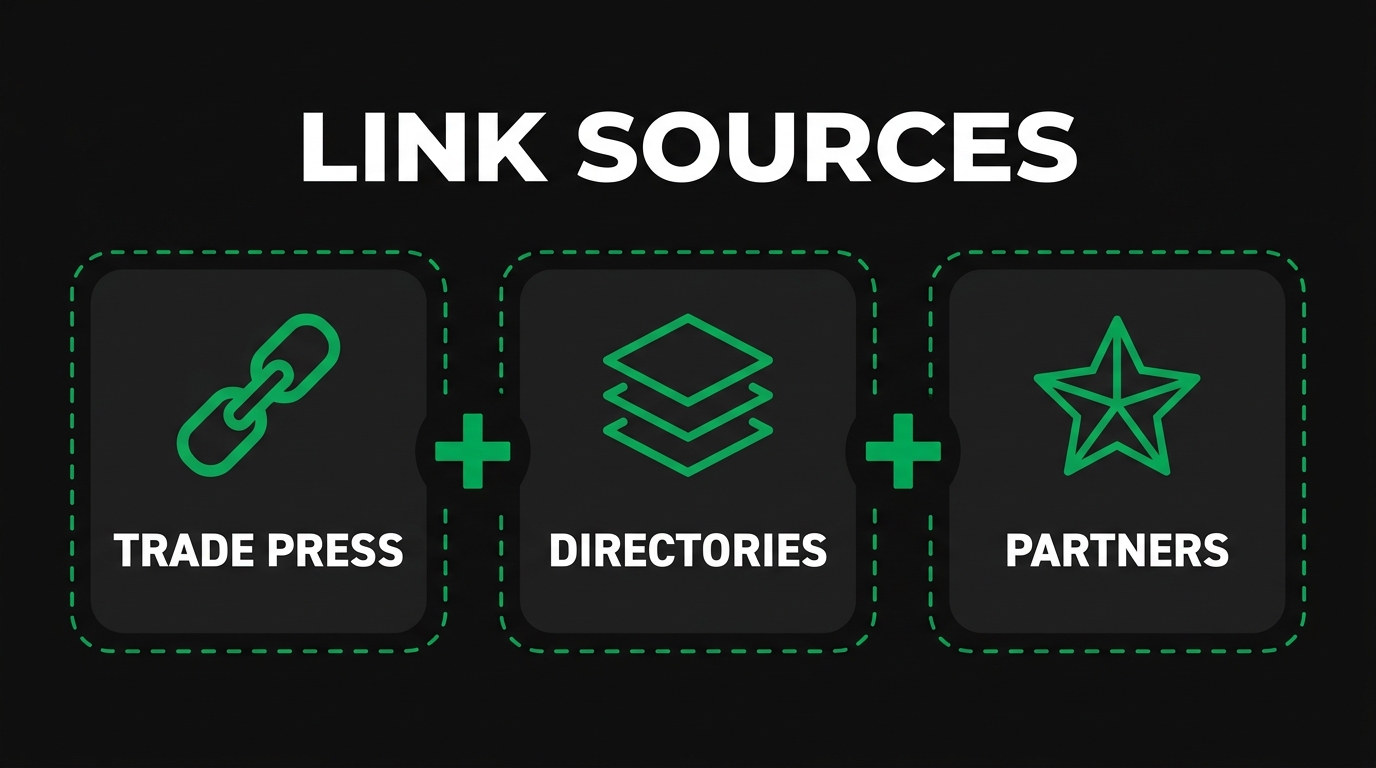
We then walk through the core techniques: trade publication outreach, digital PR, resource page placements, supplier directory listings, and broken link reclamation built specifically for industrial sites.
We explain how to identify high-value prospects by evaluating trade publication domain authority, vetting standards bodies, applying the right linking-domain metrics, and reverse engineering competitor backlink profiles.
We outline the content assets that consistently attract industrial citations, including original research, technical whitepapers, manufacturing case studies, process specification guides, and interactive engineering calculators.
We cover outreach execution, from subject lines that get manufacturing editors to open, to personalization, follow-up cadence, and reply-rate measurement that maps to landed editorial coverage.
We close with measurement, compliance, and a bridge that explains how Manufacturing SEO Agency approaches industrial backlink acquisition for manufacturers operating in regulated procurement markets.
What Does B2B Link Building Mean in the Industrial Sector?
B2B link building in the industrial sector means earning editorial backlinks from trade publications, standards bodies, supplier directories, and technical sources that influence how procurement teams qualify manufacturers. The subsections cover B2C differences, manufacturer ranking impact, and backlink roles in procurement search.
How Does B2B Link Building Differ From B2C Link Building?
B2B link building differs from B2C link building in source authority, anchor intent, and audience. Industrial campaigns target trade publications, standards organizations, and engineering directories rather than mass consumer media or influencer placements. Anchors map to process names, material grades, and certifications such as AS9100 or IATF 16949, not brand affinity or product reviews. The audience is purchasing managers and design engineers vetting suppliers, so the link's surrounding editorial context must read as technically credible.
Why Is Link Building Critical for Industrial Manufacturer SEO?
Link building is critical for industrial manufacturer SEO because backlinks remain the dominant signal Google uses to rank technical procurement queries against thin or generic competitors. Manufacturers competing for narrow process and material queries lose to rivals with stronger trade-publication coverage even when on-page content is comparable. A foundational understanding of what is industrial seo makes clear that link equity from credentialed industry sources separates suppliers that rank for RFQ-stage searches from suppliers that never appear at all.
What Role Do Backlinks Play in Procurement-Driven Search?
Backlinks play a qualifying role in procurement-driven search by signaling that a manufacturer's content has been vetted by recognized industry sources. Procurement teams click results that appear authoritative because supplier risk is high, certifications are non-negotiable, and switching costs are large.
An article cited by ASME, ASTM, or a supplier directory ranks for the certification and process queries that gate inclusion on RFQ shortlists. Without that signal, even technically correct content stays buried.
What Are the Core Techniques for Industrial B2B Link Building?
The core techniques for industrial B2B link building are trade publication outreach, digital PR campaigns, resource page placements, supplier directory listings, and broken link reclamation. The subsections below walk through each tactic with manufacturer-specific guidance.
How Do You Build Links Through Trade Publication Outreach?
You build links through trade publication outreach by mapping editors, contribution guidelines, and editorial calendars of credentialed industrial outlets, then pitching original technical analysis tied to procurement themes. Pitches supplying original test data, plant case studies, or new process applications convert at editorial rates. Many manufacturers syndicate expert authorship across top manufacturing trade publications for content submission instead of one-off placements.
How Does Digital PR Generate High-Authority Industrial Backlinks?
Digital PR generates high-authority industrial backlinks by packaging proprietary data, plant tour insights, or supply-chain analysis into newsroom-ready stories that trade and business reporters reference and link. Industrial digital PR leads with one quantified hook (downtime saved, scrap reduced, lead time cut) and a named expert. Stories anchored to ISO 9001 transitions, reshoring data, or NIST MEP findings get picked up by trade press because they map to active editor beats.
What Is Resource Page Link Building for Manufacturers?
Resource page link building for manufacturers is the practice of getting a brand's technical guides, calculators, or specification documents listed on curated industry resource pages hosted by associations, universities, and trade groups. The asset itself must be evergreen and non-promotional: a tolerance reference table, a material selection chart, or a certification crosswalk. Publishers add such assets because they extend the resource, not because they are pitched as marketing.
How Do Supplier Directory Listings Contribute Link Equity?
Supplier directory listings contribute link equity by placing a manufacturer's domain inside curated, high-traffic industrial portals that procurement teams use to shortlist suppliers. Directory equity compounds two ways: the inbound link signals industry validation, and the listing exposes the brand to procurement traffic already in evaluation mode. Listings that include certifications, NAICS codes, and process capabilities match how RFQ filters work. These placements cluster among the best industrial link building strategies used by manufacturers.
How Does Broken Link Building Work for Industrial Sites?
Broken link building works for industrial sites by finding dead outbound links on trade publications, university libraries, and association resource pages, then offering an equivalent live page on the manufacturer's domain as a replacement. Effective execution targets links on pages with real organic traffic and topical relevance to a manufacturer's process or material expertise. Teams can apply a walkthrough such as how to use moz link explorer for industrial backlink discovery to surface dead links on high-authority domains.
How Do You Identify High-Value Link Prospects in Manufacturing?
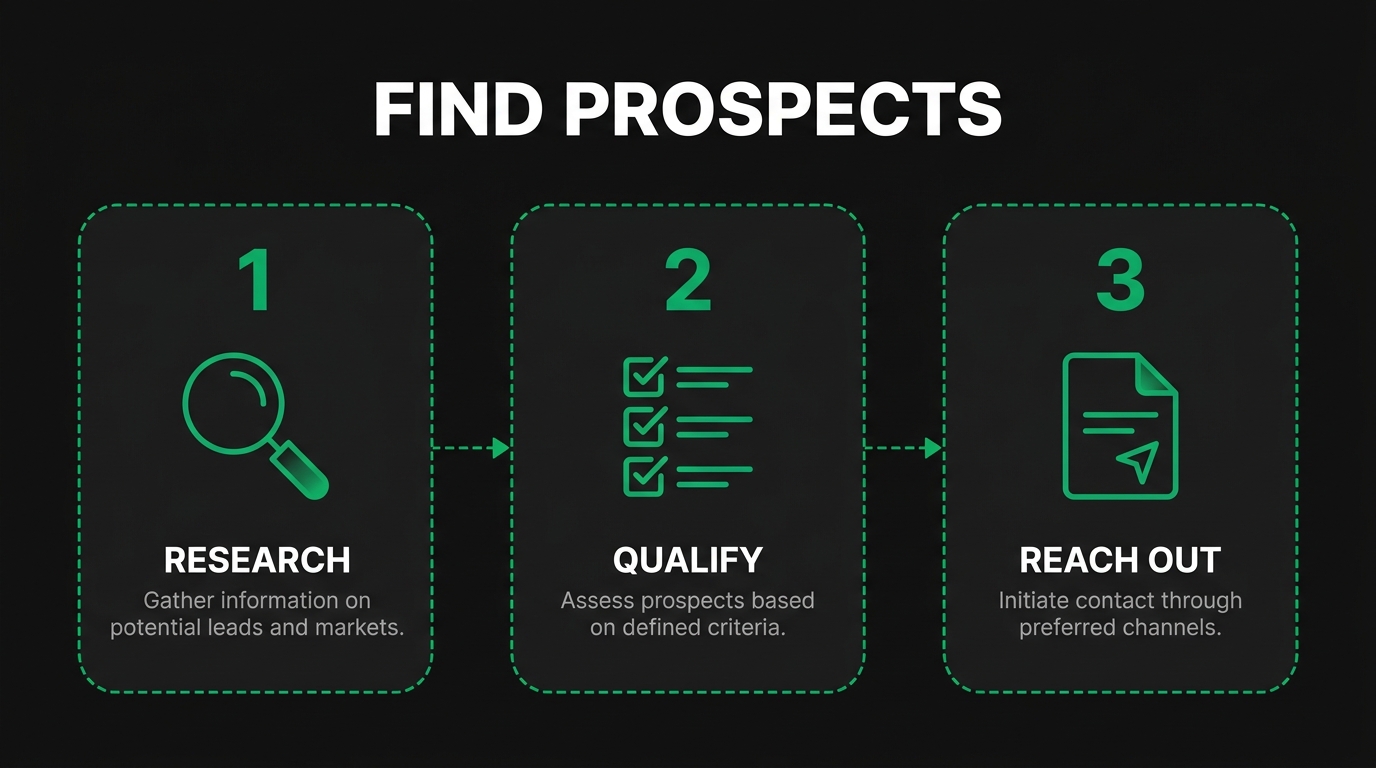
You identify high-value link prospects in manufacturing by ranking trade publications by domain authority, vetting standards bodies for relevance, applying linking-domain quality metrics, and reverse engineering the backlink profiles of competing suppliers. The subsections explain each step.
Which Trade Publications Carry the Most Domain Authority?
The trade publications that carry the most domain authority are credentialed flagships of engineering societies, large industrial newswires, and long-running editorial brands serving design and production engineers. Examples include ASME's Mechanical Engineering, IEEE Spectrum, Design News, Machine Design, and the syndication network behind PR Newswire.
Ranking publications by Ahrefs DR or Moz DA gives a baseline, but pair that with traffic to the specific topical category page where your link will sit. A high-DA homepage is meaningless if the section page has no organic traffic within the manufacturing vertical.
How Do You Vet Industry Associations and Standards Bodies?
You vet industry associations and standards bodies by confirming they author or steward recognized standards, hold formal accreditation, and publish independent technical content rather than vendor-paid placements. Vet each association by checking three signals: standards stewardship, member governance, and editorial independence from sponsors.
What Metrics Should You Use to Evaluate a Linking Domain?
The metrics you should use to evaluate a linking domain are domain authority, organic traffic to the linking page, topical relevance, anchor diversity in the existing profile, and outbound link hygiene. Treat any single metric as a filter rather than a verdict.
Pair DR or DA with topical fit: a DR 60 aerospace standards site outweighs a DR 80 generic news site for an AS9100 query. Check the linking page's own backlinks; a strong page on a weak domain still passes meaningful equity.
How Do You Find Competitor Backlink Patterns to Replicate?
You find competitor backlink patterns to replicate by exporting the referring-domain lists of three to five top-ranking suppliers for your priority procurement queries, then clustering links by domain type, anchor pattern, and acquisition tactic. Look for repeatable sources: the same trade publications, standards body resource pages, and supplier directories appearing across competitor profiles. Filter the list against domain quality and topical relevance before outreach. Choosing the right discovery tooling matters, and a comparison of the best backlink analysis tools for manufacturing shortens the prospecting cycle.
What Content Assets Attract Industrial Backlinks Naturally?
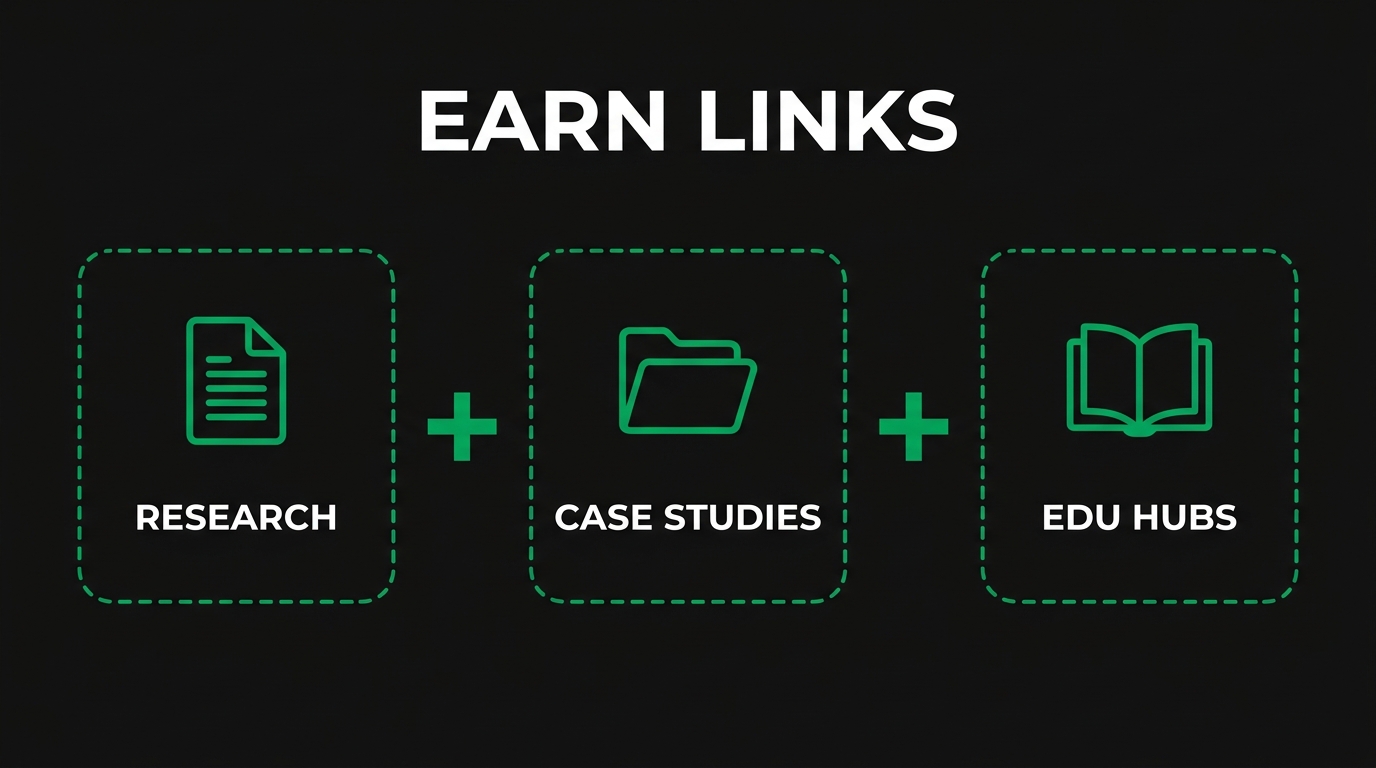
Content assets that attract industrial backlinks naturally are original research, technical whitepapers, manufacturing case studies, process specification guides, and interactive engineering calculators. The subsections explain what makes each asset linkable and how to scope them for procurement-stage searches.
Why Do Original Research Reports Earn Editorial Links?
Original research reports earn editorial links because trade editors and analysts cite primary data they cannot obtain elsewhere. Reports that survey purchasing managers, audit supplier lead times, or quantify scrap-rate distributions across processes get linked because they fill an evidence gap. The asset must be defensible: explicit methodology, sample size, and date range. Recycled vendor data does not earn editorial links.
How Do Technical Whitepapers Drive Backlink Acquisition?
Technical whitepapers drive backlink acquisition by giving editors and engineers a single canonical reference for a specific process, material decision, or compliance topic. Whitepapers that crosswalk standards (AS9100 to ISO 9001), benchmark a process across materials, or document a regulated workflow get cited by trade journalists and embedded on association resource pages.
What Makes Manufacturing Case Studies Linkable Assets?
Manufacturing case studies become linkable assets when they document a quantified outcome on a named process, with a real client problem and an auditable result. Generic "we helped a customer succeed" narratives do not earn citations. Linkable case studies report numbers: scrap reduction, cycle time saved, ppm defect rate change, or first-pass yield improvement. Trade editors cite case studies inside trend pieces; instructors reference them as teaching examples; directories embed them as capability evidence. Vendor selection guides assembled by top manufacturing marketing firms frequently link to case-study libraries.
How Do Process Specification Guides Generate Citations?
Process specification guides generate citations by serving as the reference page engineers, students, and journalists land on when they need a definitive description of a process such as 5-axis machining, MIG welding, or selective laser sintering. The guides earn citations because they consolidate fragmented information into a structured technical reference. Effective guides include process step diagrams, material compatibility tables, tolerance ranges, and certification touchpoints.
When Do Interactive Calculators Earn Engineering Backlinks?
Interactive calculators earn engineering backlinks when they solve a recurring numeric task that designers and procurement engineers face during specification work. Examples include feed-and-speed calculators, tolerance stack-up tools, draft-angle estimators for injection molding, and material yield-strength comparators. The calculator must be technically correct, mobile-functional, and embeddable so trade publications and university courses can reference it without rebuilding the math. Calculators outlast static content because the use case repeats.
How Do You Execute an Industrial Outreach Campaign?
You execute an industrial outreach campaign by writing subject lines that earn opens from manufacturing editors, personalizing every pitch to the editor's beat, sequencing follow-ups, and measuring reply-to-link conversion. The subsections detail each step.
What Subject Lines Get Manufacturing Editors to Open?
Subject lines that get manufacturing editors to open name a specific process, material, or data point and signal the angle within the first 50 characters. Avoid generic phrases like "guest post idea." Use formats such as "New benchmark on AS9100 audit findings across 30 shops" or "Cycle-time data across 12 CNC shops, can I share?" Subject lines that promise data outperform subject lines that promise opinion.
How Should You Personalize Pitches to Trade Editors?
You should personalize pitches to trade editors by referencing a specific recent article they wrote, naming the publication's section, and tying your offer to that beat. Skip boilerplate compliments and lead with a one-line connection: "Your piece on additive in turbine blades raised the question of post-process inspection cost, and I have new data on it." Reference the editor's last three to five articles, not their bio.
What Follow-Up Cadence Works for B2B Outreach?
The follow-up cadence that works for B2B outreach is one initial pitch followed by two to three spaced follow-ups, each adding new value rather than repeating the first message. Industrial editors run on production calendars; a follow-up four to seven business days after the first pitch reaches them at a different point in their week. Each follow-up should adjust the angle: a new data point, an alternate format, or a shorter version of the original ask. After three follow-ups without reply, archive the contact for a future cycle.
How Do You Measure Outreach Reply Rates and Conversion?
You measure outreach reply rates and conversion by tracking five metrics: open rate, reply rate, positive-response rate, link placement rate, and time from pitch to live link. Track positive replies separately from declines and out-of-office responses; positive-reply-to-link conversion is the metric that predicts editorial yield. A campaign with a 12% reply rate and 60% positive-to-link conversion produces more landed coverage than one with a 20% reply rate and 15% conversion.
How Do You Measure Industrial Link Building ROI?
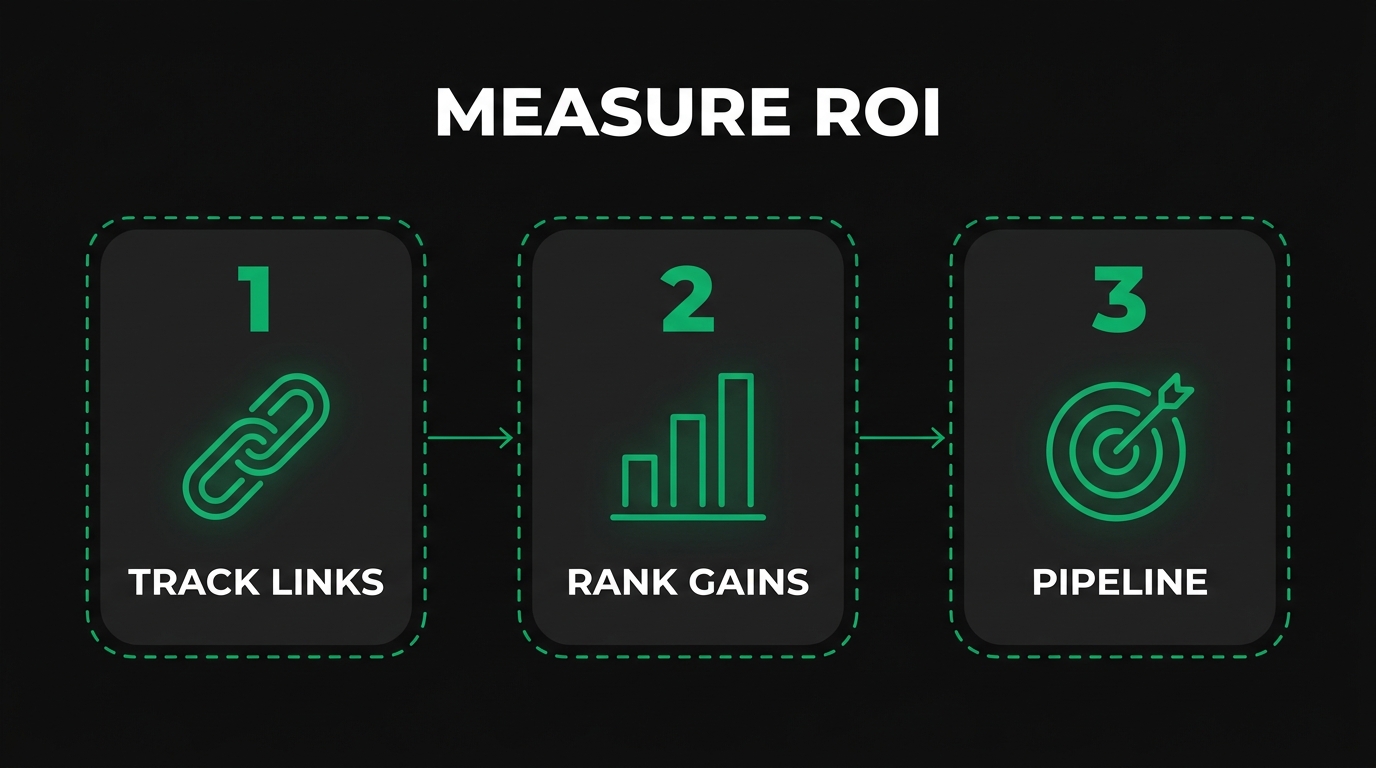
You measure industrial link building ROI by tracking KPIs that reflect link quality, monitoring backlink health over time, mapping referring domains to procurement pipeline value, and reporting to stakeholders on the cadence they actually consume. The subsections explain each layer.
Which KPIs Reflect True Link Building Performance?
The KPIs that reflect true link building performance are referring domain growth, average DR or DA of new placements, topical relevance of linking pages, branded anchor share, and ranking gains on procurement-stage queries. Volume metrics like total backlinks acquired mislead because quality dominates. Industrial KPI dashboards therefore report new referring domains by tier (engineering society, trade publication, supplier directory, association), with anchor distribution checks to flag over-optimization.
How Do You Track Backlink Quality Over Time?
You track backlink quality over time by re-pulling your full referring-domain list monthly, comparing tier distribution and DR averages quarter over quarter, and flagging any spike of low-quality domains for investigation. Quality tracking watches three patterns: tier mix, anchor evolution, and link decay rate. Set alerts for sudden link velocity that does not match active campaign activity, since organic spikes can signal negative SEO. Manual review of the top 25 new and lost links each month catches issues before they affect rankings.
How Do Backlinks Influence Procurement Pipeline Value?
Backlinks influence procurement pipeline value by lifting rankings on the technical procurement queries that drive RFQ submissions, which then feed the sales pipeline. The path is sequential: editorial link earned, ranking improvement on a process or material query, organic visit by a buyer, RFQ form submission, qualified opportunity, closed deal. Tie each stage with attribution: link equity to position, position to sessions, sessions to RFQ rate, RFQ to revenue. An oem seo strategy checklist lays out the same funnel for OEM-specific contexts where buying cycles run six to eighteen months.
What Reporting Cadence Suits Industrial Stakeholders?
The reporting cadence that suits industrial stakeholders is monthly tactical reports for marketing teams and quarterly executive reviews for the C-suite. Monthly reports cover new links acquired, anchor distribution, ranking movements, and outreach pipeline health. Quarterly reports roll up to pipeline outcomes: RFQ volume from organic, top procurement queries gained, and revenue tied to ranking changes. CFOs and procurement-savvy executives respond to dollars, not domain rating averages.
What Compliance and Quality Risks Must You Manage?
Compliance and quality risks you must manage include Google policy violations from manipulative tactics, accumulation of toxic backlinks, mishandled disavow files, and FTC disclosure breaches on sponsored editorial coverage. The subsections explain each risk and the practices that contain it.
Which Link Building Tactics Violate Google Guidelines?
Link building tactics that violate Google guidelines include paid links without proper attribution, excessive link exchanges, automated link generation, contractual link requirements, and undisclosed advertorials. The compliant path is to mark sponsored links with rel="sponsored" and user content with rel="ugc". Manufacturers running PR campaigns must brief editors on attribute requirements before publication.
How Do You Audit a Toxic Backlink Profile?
You audit a toxic backlink profile by exporting the complete referring-domain list, segmenting by quality signals, and manually reviewing flagged domains before any disavow decision. Audit signals include domains with zero organic traffic, domains in unrelated languages, link-farm footers, hacked-page placements, and irrelevant directory networks. Cross-reference Search Console's "Top linking sites" with a third-party crawler to catch links Google indexes but you have not seen.
What Disavow Practices Protect Manufacturer Domains?
Disavow practices that protect manufacturer domains follow Google's narrow guidance: attempt removal first by emailing the linking site, document outreach attempts, then disavow only the unremoved subset at the domain level for clear spam patterns. Avoid disavowing entire categories of legitimate-but-low-DR sites; Google already discounts them, and over-disavowing can suppress equity from genuine industry placements that look thin on surface metrics.
How Do You Stay Within FTC and Industry Disclosure Rules?
You stay within FTC and industry disclosure rules by disclosing every material connection between your brand and the publisher of any earned or sponsored coverage, "clear and conspicuous" in placement and language. Industrial PR programs commonly trigger disclosure on plant-tour articles, sponsored research, and free product reviews. Native advertising must carry direct attribution such as "Sponsored by," not buried hyperlinks. Build disclosure language into editor briefs and contributor agreements.
How Should You Approach Industrial B2B Link Building With Manufacturing SEO Agency?
You should approach industrial B2B link building with Manufacturing SEO Agency as a manufacturing-only program built around procurement-intent rankings and editorial trade coverage, not generic SEO link tactics. The subsections explain how Manufacturing SEO Agency executes industrial backlink acquisition and recap the article's core takeaways.
Can Manufacturing SEO Agency's Industrial Link Building Services Help With B2B Backlink Acquisition?
Manufacturing SEO Agency's industrial link building services help with B2B backlink acquisition by combining manufacturing-only focus, PR-grade editorial outreach, and revenue-tied measurement. Manufacturing SEO Agency operates only in industrial verticals such as CNC machining, injection molding, metal fabrication, additive manufacturing, aerospace, automotive, and contract manufacturing, which means outreach lists already include the trade publications, supplier directories, and engineering authorities procurement audiences read. The team builds industrial link building services around process, material, and certification queries (AS9100, ISO 9001, NADCAP, IATF 16949) rather than vanity domain metrics.
What Are the Key Takeaways About B2B Link Building Strategy for Industrial SEO We Covered?
The key takeaways about B2B link building strategy for industrial SEO we covered are five practical priorities. First, target trade publications, standards bodies, and supplier directories procurement teams trust, not generic media. Second, build content assets engineers cite: original research, technical whitepapers, manufacturing case studies, and engineering calculators. Third, personalize outreach to the editor's beat and follow up with new value, not repeated asks. Fourth, measure ROI on referring-domain quality and pipeline impact, not raw link counts. Fifth, manage compliance with Google spam policies and FTC disclosure rules from the first pitch. Working with manufacturing seo agency on industrial link building keeps every link investment tied to procurement-stage rankings and RFQ pipeline value.