The best keyword research tools for B2B manufacturing are platforms that surface procurement-intent queries built around process names, material grades, and certifications, including Ahrefs, Semrush, Moz Pro, Google Keyword Planner, SE Ranking, AnswerThePublic, and KWFinder. These tools differ in database depth, accuracy, intent filtering, and pricing, which determines how well they support industrial SEO programs.
This guide covers the foundational concepts of manufacturing keyword research, the features that matter most in industrial use cases, profiles of leading tools, free versus paid comparisons, the workflow that turns keyword data into pipeline, common mistakes that drain budget, and how procurement-intent keyword architecture connects research to revenue.
We define manufacturing keyword research as mapping engineer and procurement-manager queries to processes, materials, and certifications, then explain why specification-level terms matter to industrial buyers.
We describe the tool features that earn their keep in industrial niches: long-tail and low-volume coverage, intent filtering for RFQ-ready queries, handling of part numbers and specifications, and SERP analysis depth.
We profile the major tools used by B2B manufacturers, comparing database scope, accuracy benchmarks, and pricing so readers can match a platform to company size and competitive density.
We compare free and paid options, examine which tools justify their cost, and outline how to calculate return on keyword research software when value flows through to closed RFQ revenue.
We walk through a buyer-aligned workflow that maps queries to procurement stages, clusters keywords by process, material, and certification, validates intent, and connects keyword performance to pipeline, while flagging the mistakes most likely to derail an industrial program.
What Is Keyword Research for B2B Manufacturing?
Keyword research for B2B manufacturing identifies the process names, material specifications, certifications, and procurement queries engineers and buyers use when sourcing suppliers. This foundational work, covered in our industrial keywords? ultimate guide, shapes tool selection, feature priorities, and workflow design.
How Does B2B Manufacturing Keyword Research Differ from Generic SEO?
B2B manufacturing keyword research differs from generic SEO by prioritizing low-volume, high-intent specification queries over broad consumer terms, anchoring topical authority to engineering language, and tying rankings to RFQ pipeline rather than session volume. Generic SEO chases traffic; industrial programs chase qualified specification hits.
Most platforms index consumer queries far more deeply than industrial ones, which forces manufacturing teams to combine multiple data sources, apply stricter intent filters, and audit tool coverage against real engineer vocabulary before trusting any single volume estimate.
Why Do Procurement-Intent Keywords Matter for Industrial Buyers?
Procurement-intent keywords matter for industrial buyers because these queries signal active sourcing and map directly to RFQ submissions from engineers and purchasing managers. Industrial buyers use specification-heavy phrases when a real project and budget exist, so ranking for those phrases places the supplier in front of readiness-to-buy moments.
Procurement-intent terms also feed supplier directories such as Thomasnet, which indexes 78,000 industrial categories, so manufacturers who model queries around buyer vocabulary win visibility in both organic SERPs and sourcing platforms.
What Role Do Process, Material, and Certification Keywords Play?
Process, material, and certification keywords play the role of capability signals that confirm a supplier can deliver the part. Process terms, such as swiss screw machining, press brake forming, and MIG welding, describe what the shop does. Material terms, such as 6061-T6 aluminum, Inconel 718, and PEEK, describe what the shop runs. Certification terms, such as AS9100, ISO 13485, and ITAR, describe which regulated work the shop qualifies for.
This three-pillar model shapes every tool evaluation that follows.
Which Features Should a Keyword Research Tool Offer for B2B Manufacturing?
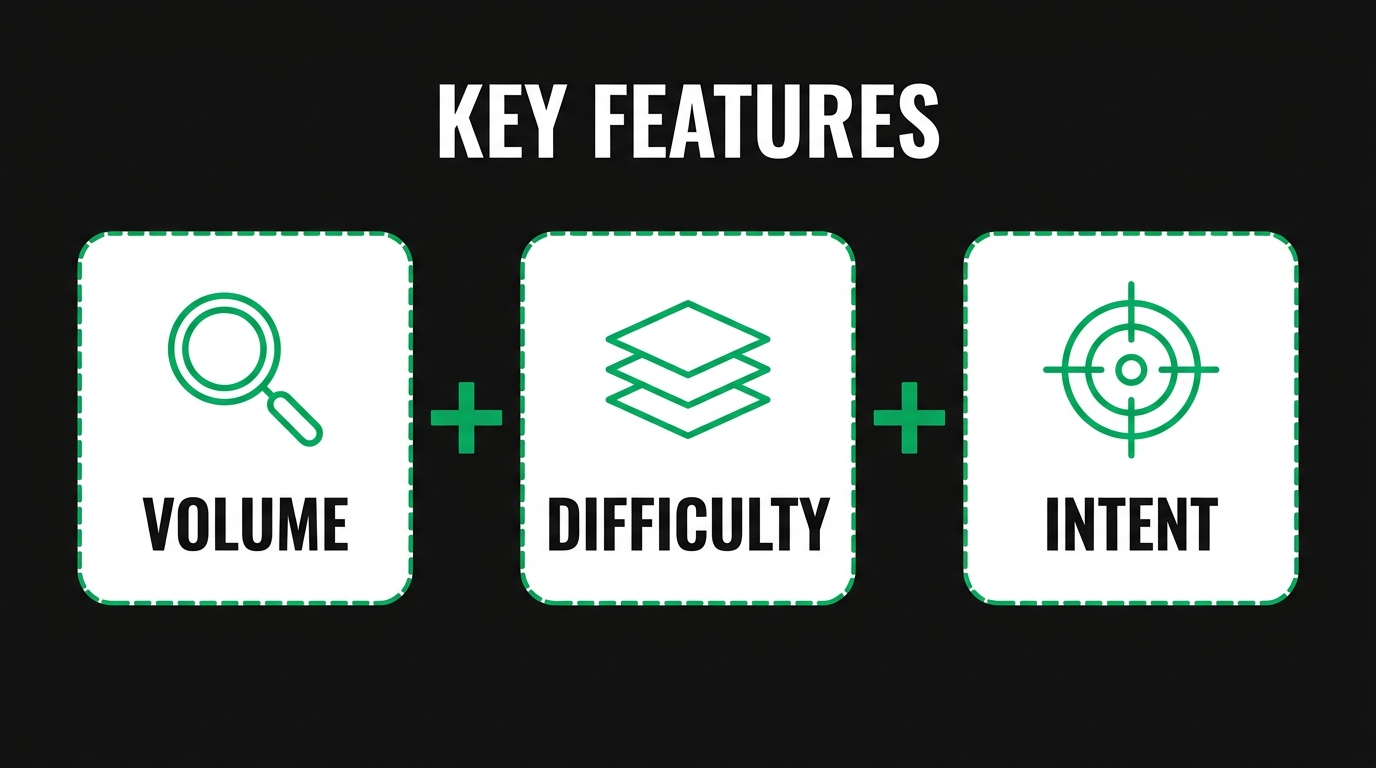
A keyword research tool for B2B manufacturing should offer long-tail coverage, strict intent filtering, specification and part-number handling, and deep SERP analysis. These four feature families decide whether a platform surfaces RFQ-ready queries or drowns them in consumer noise.
How Important Is Long-Tail and Low-Volume Coverage for Industrial Niches?
Long-tail and low-volume coverage is critical for industrial niches because most engineer searches return fewer than 50 monthly queries yet carry very high procurement intent.
A tool that truncates volume below a 10-per-month floor will hide exactly the queries manufacturers need, such as 3-axis CNC aluminum prototype or AS9100 stamping New Jersey. Platforms that preserve low-volume keywords, expose zero-volume seeds, and pull from autocomplete and People Also Ask panes give industrial teams the raw surface area a supplier-capability page actually needs.
Which Search Intent Filters Help Manufacturers Find RFQ-Ready Queries?
Search intent filters that help manufacturers find RFQ-ready queries are commercial-investigation and transactional modifiers combined with geographic and specification qualifiers. Useful filters include queries containing supplier, manufacturer, shop, services, near me, RFQ, quote, and capability modifiers tied to a material or certification.
Intent filters must therefore be paired with cross-source volume validation, because even strict filters still return enough volume to build procurement-led content roadmaps against the global Google query stream.
How Should the Tool Handle Technical Specifications and Part Numbers?
The tool should handle technical specifications and part numbers by preserving exact-match strings, indexing alphanumeric tokens, and returning variants that include unit suffixes such as mm, in, AWG, and ASTM grades. Engineers often search 6061-T6 billet 2 inch, MS35649 fastener stainless, or ASTM A36 plate cut to size, and a tool that strips punctuation or merges these into generic phrases destroys the signal. The best platforms also cluster part-number searches by parent family, which lets manufacturers map a single catalog page to every SKU variant without building hundreds of thin pages.
What SERP Analysis Capabilities Are Essential for Industrial Suppliers?
SERP analysis capabilities essential for industrial suppliers are feature-level breakdowns of the top 10 results, including domain type, content format, SERP feature presence, and internal Google entity coverage. Manufacturers need to see whether a query returns supplier-directory pages such as Thomasnet, OEM product pages, or blog content, because that mix determines the realistic ranking target.
Suppliers that layer this SERP intelligence onto specification keywords build publishing plans that target winnable positions and measurable RFQ capture.
What Are the Top Keyword Research Tools Used by B2B Manufacturers?
The top keyword research tools used by B2B manufacturers are Ahrefs, Semrush, Moz Pro, Google Keyword Planner, SE Ranking, AnswerThePublic, and KWFinder. Each platform trades off database size, intent filtering, accuracy, and price, which shapes how manufacturers layer them into a stack.
How Does Ahrefs Perform for Industrial Keyword Discovery?
Ahrefs performs strongly for industrial keyword discovery because its database scope captures long-tail specification queries that shorter indexes miss.
For manufacturing teams chasing tools for global keyword research, Ahrefs' breadth surfaces country-level splits for terms such as injection molding supplier Germany or CNC machining Mexico, which matters when export pipelines drive page priorities. Its Keywords Explorer parent-topic clustering and SERP-feature filters also help industrial users separate informational queries from procurement-ready searches.
What Makes Semrush Useful for Manufacturing SEO Workflows?
Semrush is useful for manufacturing SEO workflows because its Keyword Magic Tool, Keyword Strategy Builder, and topical clustering features map well to process, material, and certification families. Manufacturers building topic silos for CNC machining, sheet metal fabrication, or medical device molding can generate branched keyword trees that mirror capability pages, then track those clusters inside the same dashboard used for competitor gap analysis.
The result is a single workflow that connects keyword seeds, content production, and pipeline tracking.
How Does Moz Pro Support Industrial Topical Authority Mapping?
Moz Pro supports industrial topical authority mapping through its Keyword Explorer lists, Page Optimization scores, and Domain Authority benchmarking. Moz is best suited to manufacturers who already rank for several capability terms and want to reinforce topical clusters rather than discover broad new territory. The platform's Priority metric blends volume, difficulty, and organic CTR to highlight terms worth pursuing when publishing bandwidth is limited. Because Moz's keyword index is smaller, most industrial teams pair it with a broader platform for discovery while leaning on Moz for on-page guidance and authority tracking across process, material, and certification hub pages. This narrow but opinionated scope makes it a complement rather than a standalone stack.
What Are the Strengths of Google Keyword Planner for Manufacturing PPC and SEO?
Google Keyword Planner's strengths for manufacturing PPC and SEO are free access, direct Google Ads forecasting, and broad category ideation.
For industrial teams, this means Keyword Planner works as a seed generator and PPC-forecast tool, not an accurate SEO volume source. Its value lies in pulling commercial modifiers for paid campaigns, validating branded-term competition, and surfacing geographic expansion ideas third-party tools sometimes miss.
How Does SE Ranking Compare for Niche B2B Manufacturing Queries?
SE Ranking compares well for niche B2B manufacturing queries because its rank-tracking granularity, local-level SERP pulls, and competitor research fit the smaller geographic footprints most shops operate in. Manufacturers evaluating broader SEO stacks often weigh SE Ranking against the best seo tools for b2b manufacturing and against the consolidated best keyword research tools for b2b lists to map feature overlap. SE Ranking's lower price tier makes daily tracking of two hundred specification keywords economically viable, which Ahrefs and Semrush can make cost-prohibitive. Its competitor discovery module also surfaces smaller regional suppliers that enterprise-focused tools routinely overlook.
When Is AnswerThePublic Best Used for Engineer-Driven Search Behavior?
AnswerThePublic is best used for engineer-driven search behavior when teams need to map how engineers phrase questions about processes, materials, and specifications rather than measure exact search volume.
For manufacturers, this surfaces question-form queries such as what is the minimum wall thickness for injection molding or how does TIG welding differ from MIG, which feed directly into FAQ schema, People Also Ask capture, and supporting content around core capability pages. Use it for ideation, then validate volumes in a paid platform before committing production time.
How Does KWFinder Help Smaller Manufacturers with Limited Budgets?
KWFinder helps smaller manufacturers with limited budgets by offering a low-cost interface focused on long-tail discovery, local volume data, and straightforward SERP difficulty scoring. Shops with budgets under $100 monthly can run seed research for dozens of capability pages without the seat-license overhead of enterprise platforms. KWFinder's geographic targeting filters pair well with service-area manufacturers, such as regional machine shops, prototype foundries, and contract packagers, where city-level and state-level volume matter more than global totals. Combined with Google Search Console for validation, KWFinder gives under-resourced industrial teams a credible entry stack. This affordability makes it the practical on-ramp before a full platform migration becomes worthwhile.
How Do Free and Paid Keyword Research Tools Compare for Manufacturers?
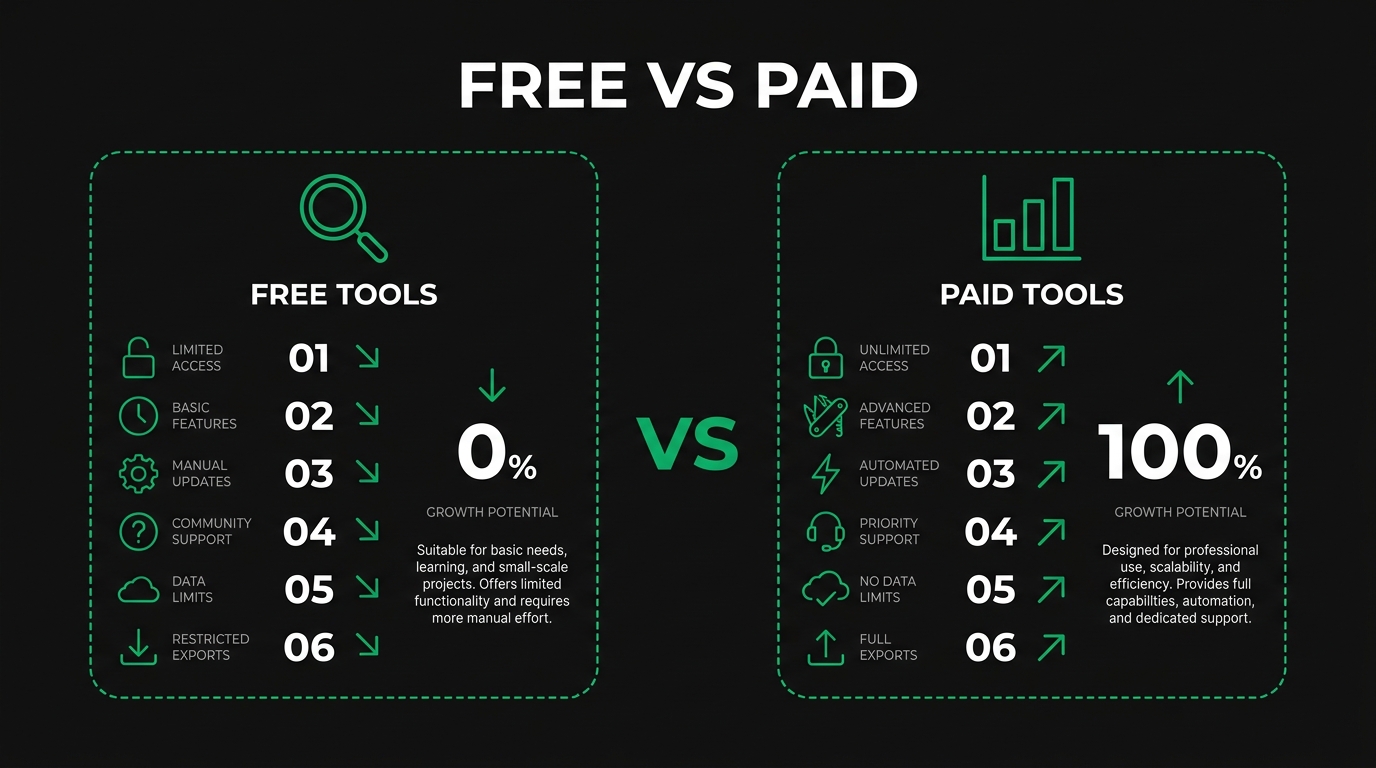
Free and paid keyword research tools compare across three axes for manufacturers: data depth, intent-filter sophistication, and workflow integration. Free tools work for seed discovery and basic validation, while paid tools deliver the volume accuracy, clustering, and tracking required for pipeline-grade industrial programs.
What Free Tools Deliver Reliable Industrial Keyword Data?
Free tools that deliver reliable industrial keyword data are Google Search Console, Google Trends, Google autocomplete, and the free tier of Ubersuggest or Keyword Surfer. Google Search Console is the single most reliable source because it reports actual Impressions, Clicks, and CTR for the manufacturer's own domain, grounded in real user behavior rather than modeled estimates. Google Trends adds relative-volume shape over time, useful for seasonal commodity processes such as agricultural equipment fabrication or HVAC coil production. Autocomplete exposes the long-tail variations buyers actually type, including part-number prefixes and regional supplier phrases.
Which Paid Tools Justify Their Cost for B2B Manufacturing Programs?
Paid tools that justify their cost for B2B manufacturing programs are Ahrefs, Semrush, and SE Ranking because each delivers accurate volume modeling, deep backlink data, and intent-tagged SERP analysis at the scale industrial topical authority requires. The U.S. Census Bureau's Annual Survey of Manufactures covers employment, shipments, capital expenditures, and value added across the sector, underlining how large the addressable keyword universe is.
Paid tool budgets should therefore be sized against RFQ value, not seat cost.
How Should Manufacturers Calculate ROI on Keyword Research Software?
Manufacturers calculate ROI on keyword research software by tying tool spend to incremental RFQ value produced, using a formula of RFQ revenue attributable to ranking gains divided by annual subscription and labor cost. A $500-per-month platform that supports ten capability pages, each generating one additional qualified RFQ per quarter at a $25,000 average order value, returns several multiples after labor. Industrial teams should track three inputs: ranking positions for specification keywords, organic sessions on capability pages, and RFQ submissions tagged by landing page. Pipeline-tied measurement separates tools that stay in the stack from tools cut during budget reviews. This ROI discipline then feeds the workflow design that comes next.
How Should Manufacturers Build a Keyword Research Workflow Using These Tools?
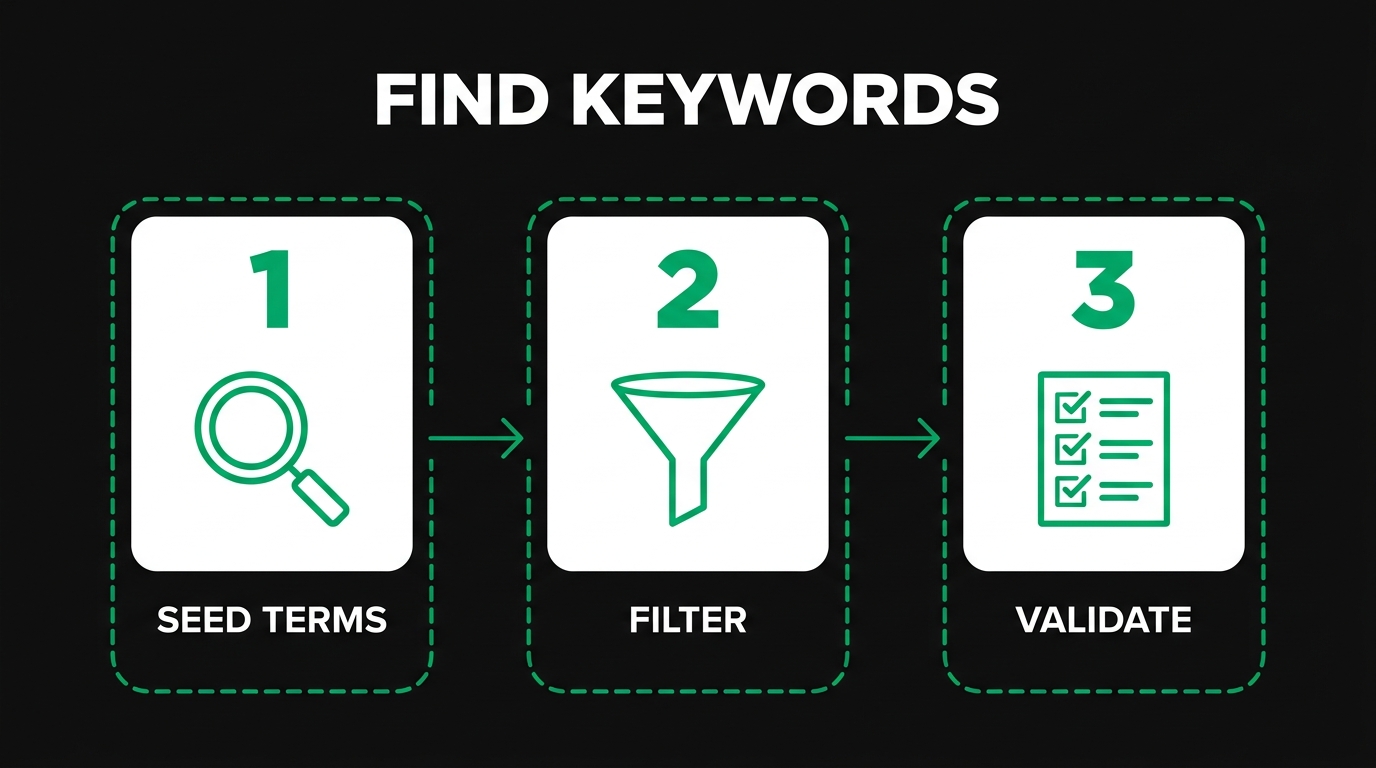
Manufacturers should build a keyword research workflow that moves from RFQ funnel mapping, to process-material-certification clustering, to intent validation, and finally to performance and pipeline tracking. Each step layers a specific tool against a specific output.
How Do You Map Keywords to the RFQ and Procurement Funnel?
You map keywords to the RFQ and procurement funnel by assigning every seed term to one of four stages: awareness, consideration, qualification, and RFQ. Awareness queries include broad process questions such as what is press brake forming. Consideration queries compare techniques or suppliers, such as press brake vs stamping for thick steel. Qualification queries add specification and region modifiers, such as 10-gauge stainless press brake supplier Ohio. RFQ queries combine capability, certification, and intent, such as AS9100 press brake quote Cleveland. This four-stage map lets planners assign Ahrefs or Semrush clusters to specific page types, attribute traffic to funnel position, and publish deliberately against stages with the thinnest existing capability pages. The funnel becomes the publishing brief.
How Do You Cluster Process, Material, and Certification Keywords?
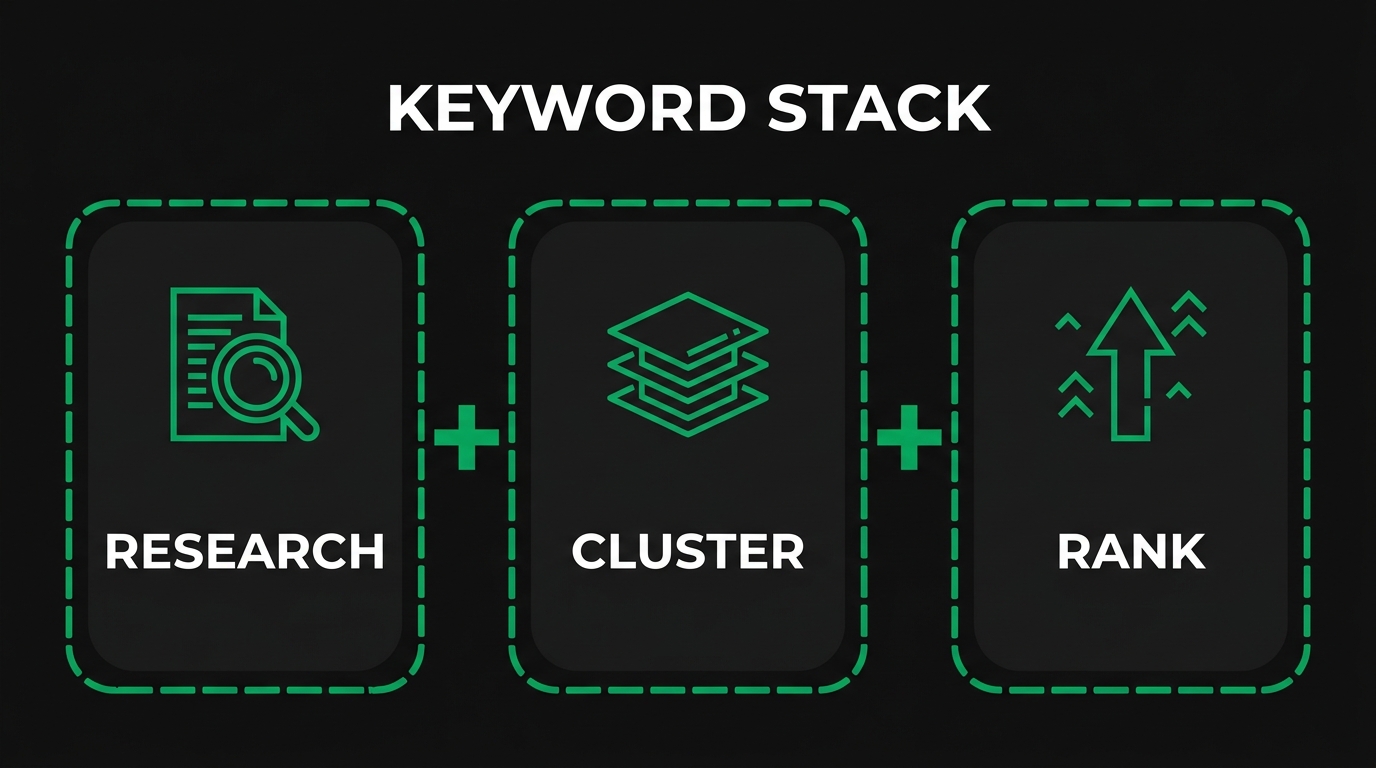
You cluster process, material, and certification keywords by building a three-axis matrix where each process pillar expands across its qualifying materials and the certifications those materials demand. For example, the CNC machining pillar expands into aluminum 6061, titanium Grade 5, stainless 316, and PEEK, then cross-references AS9100, ISO 13485, and ITAR requirements for each material-industry pairing. Tools such as Ahrefs' Parent Topic view, Semrush's Keyword Strategy Builder, and Moz Pro Keyword Lists let teams save, tag, and reuse these clusters.
How Do You Validate Industrial Search Intent Before Targeting?
You validate industrial search intent before targeting by inspecting the live SERP for dominant content format, reviewing the top-ranking page types, and confirming the result mix matches the buyer stage you expect. If a query such as swiss machining services California returns mostly supplier directory pages and shop capability pages, the intent is procurement. If it returns educational articles and process explainers, the intent is awareness. Queries that return mixed SERPs require layered content, usually a hub page plus supporting FAQ articles. SERP validation must precede publishing because volume alone lies: a 30-per-month procurement query converts better than a 3,000-per-month awareness query across every industrial vertical we have tracked.
How Do You Track Keyword Performance and Pipeline Impact?
You track keyword performance and pipeline impact by connecting rank-tracker data, Search Console impressions and clicks, and CRM-sourced RFQ outcomes inside a single reporting layer. Daily rank tracking for specification keywords, weekly Search Console exports, and monthly RFQ attribution reviews give the closed-loop view industrial teams need. Off-page factors feed this tracking, which is where the best backlink analysis tools for manufacturing strengthen the picture by revealing whether ranking gains correlate with trade-publication link acquisition. The most disciplined programs attach every capability page to a dollar value, recalculate quarterly, and retire pages that fail to earn RFQs within two quarters. Manufacturing SEO Agency applies this same revenue-tied reporting discipline across every client engagement, integrating rank data with CRM-sourced RFQ outcomes. This measurement discipline also reveals the mistakes covered next.
What Common Mistakes Should Manufacturers Avoid When Using Keyword Research Tools?
Common mistakes manufacturers should avoid when using keyword research tools are chasing high-volume generic terms, ignoring buyer personas, and skipping competitor keyword gap analysis. Each mistake drains budget and masks the specification queries that actually generate RFQs.
Why Is Chasing High-Volume Generic Terms a Costly Trap?
Chasing high-volume generic terms is a costly trap because broad consumer-style keywords attract non-buyer traffic, inflate vanity metrics, and pull publishing resources away from specification queries that close RFQs. A term such as manufacturing may report 30,000 monthly searches, but the intent spans students, researchers, analysts, and casual readers, almost none of whom issue a purchase order. A long-tail query such as stainless 316L CNC machining medical Ohio may report 20 monthly searches with 60% procurement intent.
How Does Ignoring Buyer Personas Distort Keyword Selection?
Ignoring buyer personas distorts keyword selection because engineers, procurement managers, and quality leads phrase the same sourcing need differently, and a tool-only approach misses those phrasing differences. An engineer searches by tolerance, geometry, and material grade. A procurement manager searches by certification, lead time, and region. A quality lead searches by audit readiness, documentation, and process control. Publishing against only one persona leaves the other two unaddressed. Buyer-persona mapping should shape the seed list before any tool opens, then the tool validates volume and competition against that persona-aware set. The workflow must stay buyer-led, not data-led.
What Happens When You Skip Competitor Keyword Gap Analysis?
When you skip competitor keyword gap analysis, you publish blind, miss high-intent queries rivals already rank for, and leave capability-page gaps that shift RFQs to better-mapped suppliers. Competitor gap analysis reveals which process, material, and certification keywords rivals own, which pages rank, and which SERPs remain open. Platforms such as Ahrefs Content Gap, Semrush Keyword Gap, and purpose-built best seo competitor analysis tools manufacturing surface these opportunities. Pairing that with the best backlink analysis tools for competitive research reveals not just which keywords rivals rank for but why, so the next publishing sprint targets winnable gaps.
How Should B2B Manufacturers Approach Keyword Research with Manufacturing SEO Agency?
B2B manufacturers should approach keyword research with Manufacturing SEO Agency by pairing tool output with procurement-intent architecture, engineer-vocabulary validation, and RFQ-tied reporting. Manufacturing SEO Agency is an industrial seo agency serving B2B manufacturers across CNC machining, injection molding, metal fabrication, additive manufacturing, aerospace, automotive, and medical industries.
Can Manufacturing SEO Agency's Procurement-Intent Keyword Architecture Service Improve Industrial Keyword Targeting?
Manufacturing SEO Agency's procurement-intent keyword architecture service can improve industrial keyword targeting by structuring specification, process, material, and certification queries against real procurement workflows rather than generic volume scores. Manufacturing SEO Agency specializes in ranking manufacturers for the exact process names, material specifications, and certifications procurement managers and design engineers search when sourcing suppliers.
Teams wanting a deeper briefing can review the industrial keyword research services Manufacturing SEO Agency offers alongside manufacturing audits, topical authority buildout, and revenue-tied reporting engagements.
What Are the Key Takeaways About the Best Keyword Research Tools for B2B Manufacturing We Covered?
The key takeaways about the best keyword research tools for B2B manufacturing we covered are five. First, industrial keyword research centers on process, material, and certification queries that signal procurement intent. Second, tool selection should prioritize long-tail coverage, intent filtering, specification fidelity, and SERP analysis depth. Third, Ahrefs, Semrush, Moz Pro, Google Keyword Planner, SE Ranking, AnswerThePublic, and KWFinder each occupy a distinct role in a layered stack. Fourth, free tools cover seed discovery and validation, while paid tools justify cost through RFQ-tied accuracy. Fifth, workflow discipline beats tool brand: funnel mapping, three-axis clustering, SERP validation, and closed-loop tracking are what convert keyword data into pipeline.