The best B2B keyword research tools for industrial and niche SEO are platforms that surface procurement-intent queries, low-volume technical terms, and process-plus-material-plus-certification phrases that engineers and purchasing managers actually type when sourcing suppliers. Suitable tools combine deep crawler coverage, verified click data, SERP feature visibility, and question-level intent clustering, not just headline search volume.
This guide covers what makes a research tool suitable for industrial B2B SEO, which paid platforms lead this market, which free tools still work for niche topics, how to evaluate long-tail capability, how AI-powered tools fit in, and how to build, combine, and validate a complete keyword stack against real manufacturing demand.
We explain why industrial keyword research differs from consumer SEO, which data points matter most for procurement-intent discovery, and why generic volume metrics often mislead manufacturers chasing the wrong terms.
We compare paid leaders including Ahrefs, Semrush, Moz Pro, SE Ranking, Mangools, Sistrix, and seoClarity on database size, refresh cadence, and industrial use cases, then match each to specific B2B workflows.
We show where free tools still earn a place in the stack: Google Keyword Planner for paid-intent sanity checks, Google Search Console for existing query mining, AnswerThePublic and AlsoAsked for question discovery, and Bing Webmaster Tools and Reddit search for supplemental, non-Google signal.
We look at how to evaluate long-tail patterns unique to manufacturing, how different tools handle multi-variable technical combinations, and which metrics reliably signal real buyer intent on low-volume terms.
We assess AI-powered tools such as Keyword Insights, Surfer, and Frase for topical mapping and gap discovery, alongside the documented risks of relying on LLM output without verification.
We outline workflows that pair volume tools with intent tools, layer SERP analysis, and produce a procurement-intent keyword map that you can then validate against CRM and RFQ records, sales-team feedback, and pilot content performance.
What Makes a Keyword Research Tool Suitable for Industrial B2B SEO?
A keyword research tool is suitable for industrial B2B SEO when it surfaces low-volume procurement queries, captures process plus material plus certification combinations, and exposes SERP intent signals that generic volume dashboards hide. The tool must map to engineer and buyer workflows, not consumer shopping patterns. See this industrial keywords? ultimate guide for deeper context.
How Do Industrial Keyword Research Needs Differ From Consumer SEO?
Industrial keyword research needs differ from consumer SEO in three core ways: query volume, buyer specificity, and conversion economics. Industrial queries are typically low-volume, highly technical, and tied to a single RFQ rather than a mass-market purchase. Consumer SEO chases breadth; industrial SEO chases exact-fit supplier match. A single buyer typing "AS9100 5-axis titanium machining New England" may generate a six-figure contract, so volume metrics stop being the primary signal. Suitable tools must expose such long-tail combinations as first-class objects, not filter them out as noise.
Which Data Points Matter Most for Procurement-Intent Discovery?
The data points that matter most for procurement-intent discovery are SERP feature presence, refreshed backlink and ranking signals, question-format variants, and supplier-level competitor overlap. Crawler freshness is non-negotiable because procurement terms shift with standards updates and certification changes.
Useful tools expose parent topic mapping, click-through rate by position, and zero-click probability so teams can separate reference traffic from real buyer intent.
Why Do Generic Volume Metrics Mislead Manufacturers?
Generic volume metrics mislead manufacturers because they aggregate bucketed estimates, omit clickstream corrections, and suppress terms below threshold, which hides the exact phrases procurement teams use. Rounded volumes group terms of vastly different intent into identical numbers, masking which variant actually triggers RFQs. A keyword reading "10 searches per month" may carry more closed revenue than one showing "1,000" if the former is a certification-specific phrase used by qualified buyers.
Manufacturing SEO Agency applies CRM-integrated revenue reporting so every ranking ties directly to RFQs and closed revenue for manufacturing clients.
This framing sets up the paid-tool comparisons that follow.
Which Paid Keyword Research Tools Lead the B2B Industrial Market?
The paid keyword research tools that lead the B2B industrial market are Ahrefs, Semrush, Moz Pro, SE Ranking, Mangools, Sistrix, and seoClarity. Each excels on a different vector such as crawl freshness, enterprise reporting, or keyword clustering. Compare options in this roundup of tools for global keyword research and these top keyword research tools b2b manufacturing.
How Does Ahrefs Support Industrial Keyword Discovery?
Ahrefs supports industrial keyword discovery through a deep crawl index, SERP-feature filters, and question-based keyword views that surface engineer language.
That depth matters for industrial terms that appear on trade-publication PDFs, spec sheets, and supplier directories rather than consumer sites. Ahrefs' parent-topic clustering groups certification and material variants under one root so teams can map a process category end to end.
What Makes Semrush Useful for Niche Manufacturing Queries?
Semrush is useful for niche manufacturing queries because its Keyword Magic Tool exposes large question databases, long-tail modifiers, and SERP-intent tags that match procurement phrasing.
The modifier filters surface process and certification combinations that typed searches often fragment. Semrush's position tracking by location is useful when a manufacturer serves regional buyers, and its topic research tool suggests adjacent engineer questions that often map to supplier-evaluation intent.
How Does Moz Pro Handle Low-Volume Industrial Terms?
Moz Pro handles low-volume industrial terms using clickstream-corrected volume ranges and a priority score that balances difficulty against projected click share.
The range output, rather than a single rounded number, tells industrial teams when a term is directionally worth pursuing even at sub-10 monthly searches. Moz Pro's SERP analysis shows which domains currently capture clicks, useful for gauging whether a trade publication or a supplier dominates a query.
What Industrial Use Cases Suit SE Ranking and Mangools?
The industrial use cases that suit SE Ranking and Mangools are mid-market manufacturers needing affordable rank tracking, quick question discovery, and clean SERP snapshots without enterprise overhead. SE Ranking offers local and national position tracking alongside keyword grouping, useful when a fabricator targets specific metro procurement clusters. Mangools' KWFinder returns question variants, autocomplete expansions, and keyword-difficulty scoring in a streamlined interface suited to lean marketing teams.
Why Do Manufacturers Choose Sistrix or seoClarity for Enterprise Workflows?
Manufacturers choose Sistrix or seoClarity for enterprise workflows because both platforms scale across large keyword universes, multi-brand domains, and regulated reporting requirements. Sistrix's Visibility Index provides a stable cross-period score for tracking overall organic health against peer suppliers, while seoClarity offers granular share-of-voice reporting, enterprise content recommendations, and role-based dashboards suited to multi-site manufacturers. Both tools support large team workflows with scheduled exports, API access, and custom segmentation. Enterprise buyers typically use one of these as the master system of record and layer Ahrefs or Semrush underneath for discovery. The next section turns to free tools that still earn shelf space beside these paid platforms.
Which Free Keyword Research Tools Work for Niche B2B Topics?
The free keyword research tools that work for niche B2B topics are Google Keyword Planner, Google Search Console, AnswerThePublic, AlsoAsked, Bing Webmaster Tools, and Reddit search. Each captures a different signal slice that paid databases often under-sample.
How Useful Is Google Keyword Planner for Industrial Buyers?
Google Keyword Planner is useful for industrial buyers at the paid-intent sanity-check stage, though its volume buckets limit precision on low-traffic procurement terms.
Industrial teams should treat its numbers as directional, not absolute. The tool does expose related commercial-intent terms and forecasted CPC, which helps distinguish research queries from RFQ-driving phrases.
What Can Google Search Console Reveal About Existing Industrial Queries?
Google Search Console reveals existing industrial queries by showing impressions, clicks, average position, and CTR for every indexed URL, giving manufacturers a direct window into what buyers already type.
Despite sampling, GSC remains the only first-party query source and routinely exposes hundred-word, certification-specific phrases that paid databases omit. Export these queries as the seed for every paid-tool expansion.
How Do AnswerThePublic and AlsoAsked Surface Buyer Questions?
AnswerThePublic and AlsoAsked surface buyer questions by mining autocomplete and People Also Ask data to produce branching question maps around a seed term.
AlsoAsked focuses on Google's PAA graph, producing a tree visualization that mirrors how buyers drill from a broad process into a certification or material sub-question. Manufacturers use both to build H2 and H3 architectures that match real buyer decision paths.
What Role Do Bing Webmaster Tools and Reddit Search Play?
Bing Webmaster Tools and Reddit search play a supplemental role in B2B keyword research by surfacing non-Google demand signal and unfiltered practitioner language.
Reddit returns the raw phrasing engineers use in technical subreddits, which often predates how those phrases later appear in mainstream search indexes.
How Should You Evaluate Tools for Long-Tail Industrial Keywords?
Evaluate tools for long-tail industrial keywords by testing how they capture multi-token combinations, whether they report low-volume terms at all, and how they score true buyer intent. The right tool exposes thousand-variant clusters rather than collapsing them. Peer industrial seo strategies depend on this precision.
Which Long-Tail Patterns Define Manufacturing Search?
Long-tail patterns that define manufacturing search are process-plus-material-plus-certification phrases, tolerance-range queries, and application-specific variants such as "AS9100 titanium 5-axis milling aerospace." These patterns rarely exceed double-digit monthly volume yet dominate RFQ-generating traffic.
A suitable industrial tool must represent thousands of such variants without merging them into parent rollups.
How Do Tools Handle Process, Material, and Certification Combinations?
Tools handle process, material, and certification combinations differently based on whether they store raw terms or bucketed approximations. Ahrefs and Semrush tend to retain rare combinations as discrete entries because their crawlers surface them from spec sheets and supplier pages. Moz Pro preserves them through clickstream-derived ranges. Google Keyword Planner frequently merges near-identical combinations into a shared bucket, which hides variant-level intent. For certification-gated industries, a tool that collapses "AS9100" and "NADCAP" variants into one cluster loses the procurement signal entirely. The cleanest test is searching three specific three-token combinations you already rank for and confirming each returns distinct data.
Which Metrics Signal True Buyer Intent on Low-Volume Terms?
The metrics that signal true buyer intent on low-volume terms are SERP-feature presence, click distribution at position one, referring-domain quality of current rankers, and question-format frequency in PAA boxes. High CTR at position one, combined with a SERP dominated by supplier sites rather than definitional pages, usually marks a buying query. Zero-click rates are elevated for informational terms and lower for RFQ-oriented ones. Tools should expose these signals per keyword, not just aggregated volume.
How Do AI-Powered Keyword Tools Compare for Niche Manufacturing?
AI-powered keyword tools compare favorably for niche manufacturing when used for clustering and gap analysis, but they underperform on low-volume verification. Use AI tools as accelerators on top of traditional crawler data, never as the sole source. The best seo tools for b2b manufacturing stack layers AI on verified data.
What Do Tools Like Keyword Insights, Surfer, and Frase Add?
Tools like Keyword Insights, Surfer, and Frase add clustering speed, SERP-aware content briefs, and semantic gap detection that would take a human analyst days to produce. Keyword Insights groups thousands of variants into parent-child clusters based on SERP overlap, producing a ready-made topical architecture. Surfer pairs keyword clusters with content editor scoring tied to live SERPs. Frase generates briefs that pull PAA questions, entities, and heading patterns from top-ranking pages.
How Do LLM-Driven Tools Reveal Topical Gaps in Industrial Niches?
LLM-driven tools reveal topical gaps in industrial niches by comparing a site's existing coverage against inferred category graphs, then flagging missing process, material, and certification nodes. They synthesize hundreds of SERPs into a single gap map in minutes. For industrial teams with scattered historical blog content, that clustering produces a clear consolidation path. LLM-driven tools also suggest adjacent topics that buyers often research in sequence, such as related tolerances or certification equivalents.
What Risks Come With Relying on AI-Only Keyword Suggestions?
The risks of relying on AI-only keyword suggestions are fabricated volume numbers, invented search terms, misattributed entities, and hallucinated competitor rankings.
An AI tool may suggest an industrial term that reads plausible but that no buyer actually types, wasting months of content effort. AI outputs must be validated against a crawler-verified database such as Ahrefs or Semrush and against first-party GSC data before any term enters a topical map. This verification step is non-negotiable before moving into stack-building workflows.
How Can You Combine Tools for a Complete Industrial Keyword Stack?
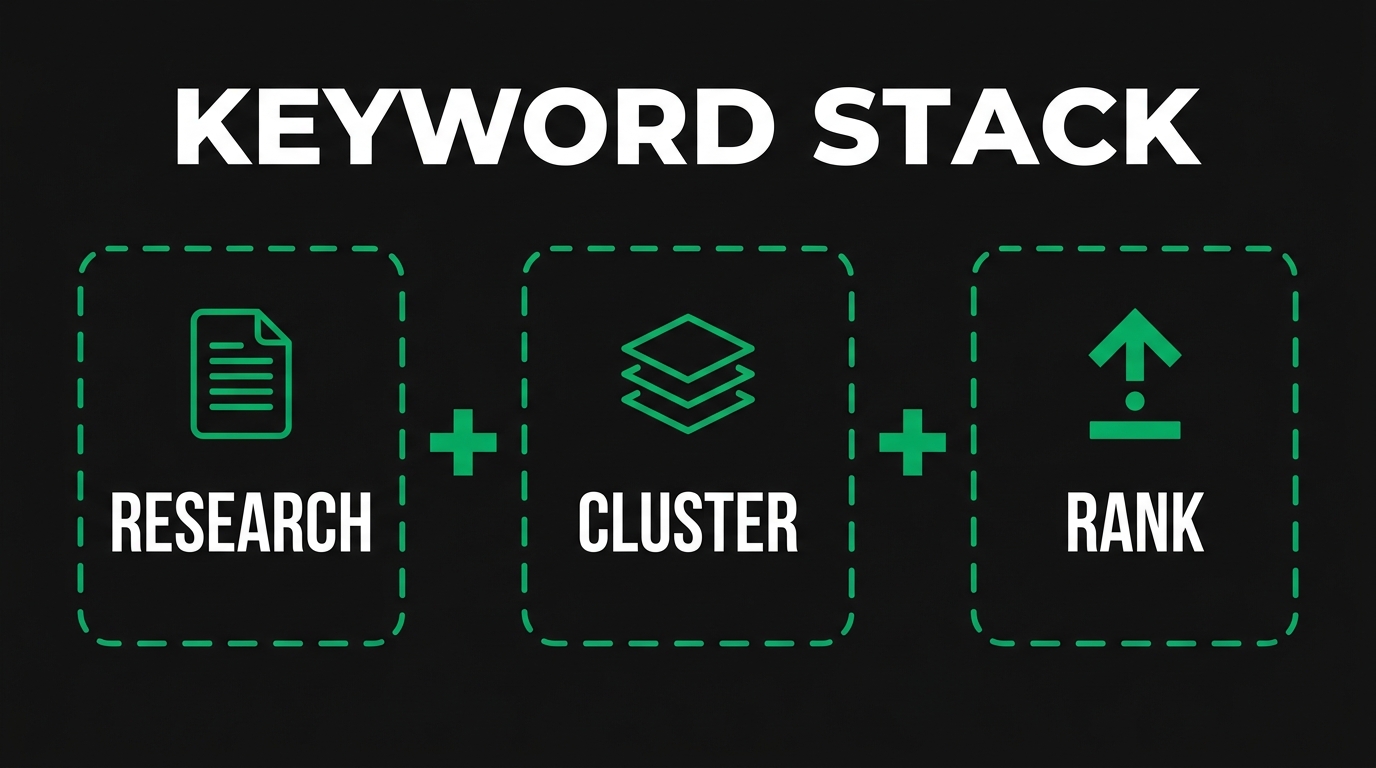
Combine tools for a complete industrial keyword stack by pairing a volume crawler, a question discovery tool, a SERP analyzer, and a first-party data source so each layer covers the other's blind spots. No single tool captures full procurement intent. Deep competitor analysis for industrial seo extends the stack.
What Workflow Pairs Volume Tools With Intent Tools Most Efficiently?
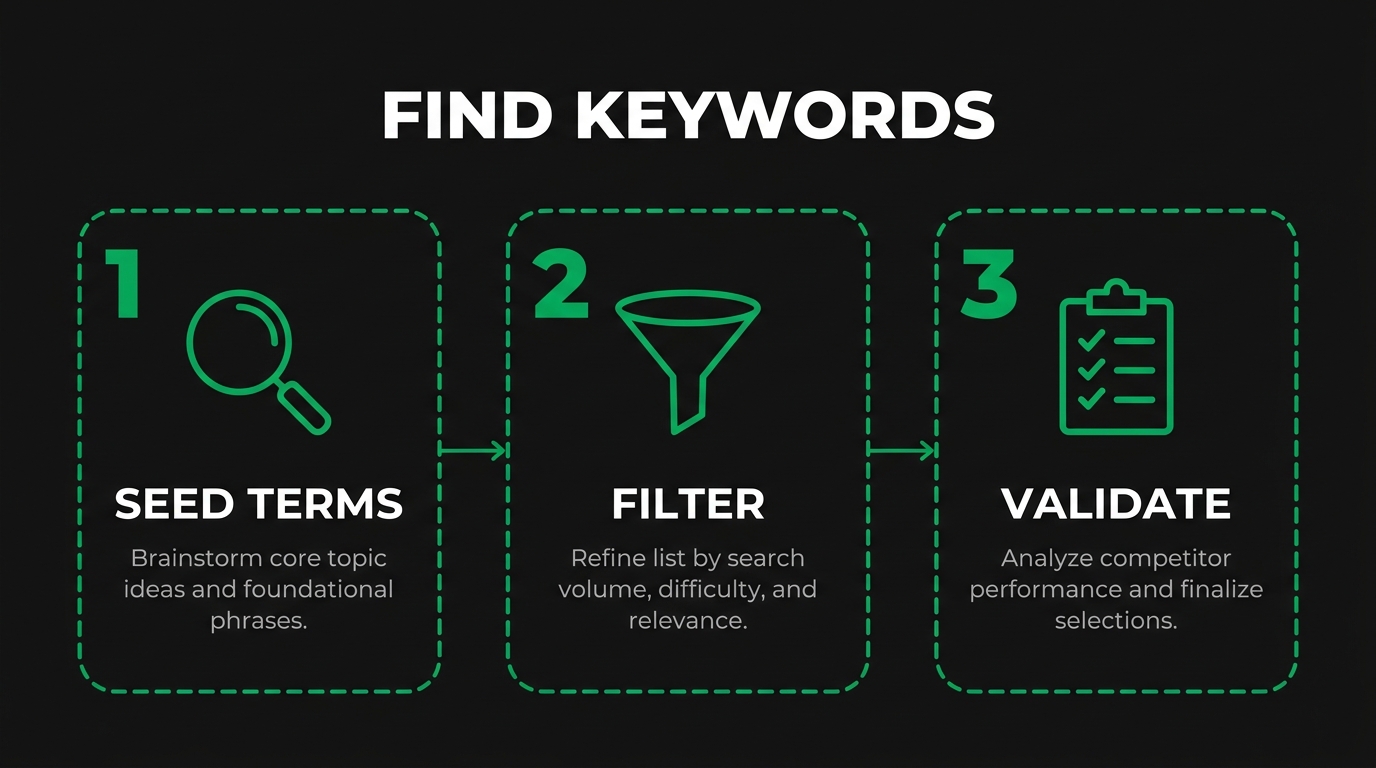
The workflow that pairs volume tools with intent tools most efficiently runs in four stages: seed discovery in GSC, expansion in Ahrefs or Semrush, question layering from AnswerThePublic and AlsoAsked, and intent confirmation through SERP analysis.
That gap matters because industrial buyers increasingly mix voice and typed queries during sourcing. The stack should capture both modes in a single master sheet with volume, intent, and source-of-record columns.
How Should You Layer SERP Analysis Onto Keyword Lists?
Layer SERP analysis onto keyword lists by pulling the current top ten results for every priority term and tagging each result as supplier, directory, trade publication, definitional, or vendor blog. Terms with mostly supplier SERPs are buying-intent and deserve transactional pages. Terms with definitional SERPs belong in topical-authority content, not RFQ pages. SERP feature presence such as PAA, featured snippets, and AI Overviews further shifts targeting strategy. This tagging converts an unordered keyword list into an ordered production plan. Tools like Ahrefs and Semrush expose SERP snapshots in the keyword view so analysts can tag quickly at scale.
Which Outputs Belong in a Procurement-Intent Keyword Map?
The outputs that belong in a procurement-intent keyword map are process clusters, material clusters, certification clusters, application clusters, a funnel-stage tag for each term, and a CRM-linked conversion score. Each cluster should include parent phrases, variant phrases, question variants, and the target URL type. The map must clearly separate awareness queries from supplier-evaluation queries and RFQ-oriented queries. Every row should tie back to a data source citation so the map survives audit.
How Do You Validate Tool Output Against Real Manufacturing Demand?
Validate tool output against real manufacturing demand by cross-checking volume estimates with CRM and RFQ records, gathering direct input from sales and engineering, and running pilot content on priority terms before broad rollout. Tools show estimates; revenue shows truth.
How Do You Cross-Check Volume Data With CRM and RFQ Records?
Cross-check volume data with CRM and RFQ records by exporting every closed opportunity from the last year, extracting the exact procurement phrase that appeared in the first lead touch, then matching those phrases against your keyword list.
Even at that accuracy, a CRM-matched term with zero tool volume can outperform a high-volume decoy.
Which Sales and Engineering Inputs Refine Tool Suggestions?
The sales and engineering inputs that refine tool suggestions are buyer call transcripts, RFQ intake forms, inbound chat logs, and the exact phrasing engineers use in technical discovery meetings. Sales teams hear procurement phrases before any search tool indexes them. Engineers know certification synonyms and material-grade shorthand that autocomplete often misses. Collect these inputs on a recurring cadence, not as a one-time exercise.
Manufacturing SEO Agency builds procurement-intent keyword architecture around process, material, and certification clusters used by engineers and purchasing managers.
How Do You Test Keyword Lists With Pilot Content?
Test keyword lists with pilot content by picking five to ten priority terms, publishing a single technical page per term, and tracking ranking progression, click behavior, and downstream RFQ activity over ninety days. Pilot results separate real demand from tool hallucination. Track not just rankings but click-to-form rates, form-to-qualified-lead rates, and qualified-lead-to-RFQ rates. Terms that rank but do not drive RFQs get deprioritized regardless of volume. Terms that rank and drive RFQs get expanded into full topical clusters. Use how to use moz link explorer for industrial to accelerate pilot-page authority. This pilot-first method is the final check before any keyword map receives full production investment.
How Should You Approach B2B Industrial Keyword Research With Manufacturing SEO Agency?
Approach B2B industrial keyword research with Manufacturing SEO Agency by scoping a procurement-intent audit, mapping process plus material plus certification clusters, and tying every term to RFQ outcomes. Manufacturing SEO Agency is a manufacturing-focused seo agency that builds strategies around engineer and purchasing-manager search, not vanity volume.
Can Manufacturing SEO Agency Provide Industrial Keyword Research Services Tailored to Your Niche?
Yes, Manufacturing SEO Agency can provide industrial keyword research services tailored to your niche. Manufacturing SEO Agency offers industrial keyword research services built specifically for B2B manufacturers across CNC machining, injection molding, metal fabrication, aerospace, automotive, medical, and contract manufacturing. Manufacturing SEO Agency combines manufacturing audits, procurement-intent keyword architecture, topical authority buildout, and CRM-integrated revenue reporting so keyword choices map directly to RFQ pipeline.
See what is industrial seo for the foundational discipline.
What Are the Key Takeaways About Best B2B Keyword Research Tools for Industrial and Niche SEO We Covered?
The key takeaways about best B2B keyword research tools for industrial and niche SEO are:
- Industrial B2B keyword research demands tools that preserve low-volume procurement variants, expose SERP-intent signals, and handle process plus material plus certification combinations as discrete entries.
- Paid leaders such as Ahrefs, Semrush, Moz Pro, Sistrix, and seoClarity each excel on a different vector, so pair them rather than replace them.
- Free tools including Google Keyword Planner, Google Search Console, AnswerThePublic, AlsoAsked, Bing Webmaster Tools, and Reddit still capture signal that paid databases under-sample.
- AI-powered tools accelerate clustering and gap detection but must be validated against crawler-verified data and first-party GSC queries before content decisions.
- A complete industrial stack layers a volume crawler, a question discovery tool, a SERP analyzer, and CRM and RFQ data so every keyword ties to real buyer intent and closed revenue.