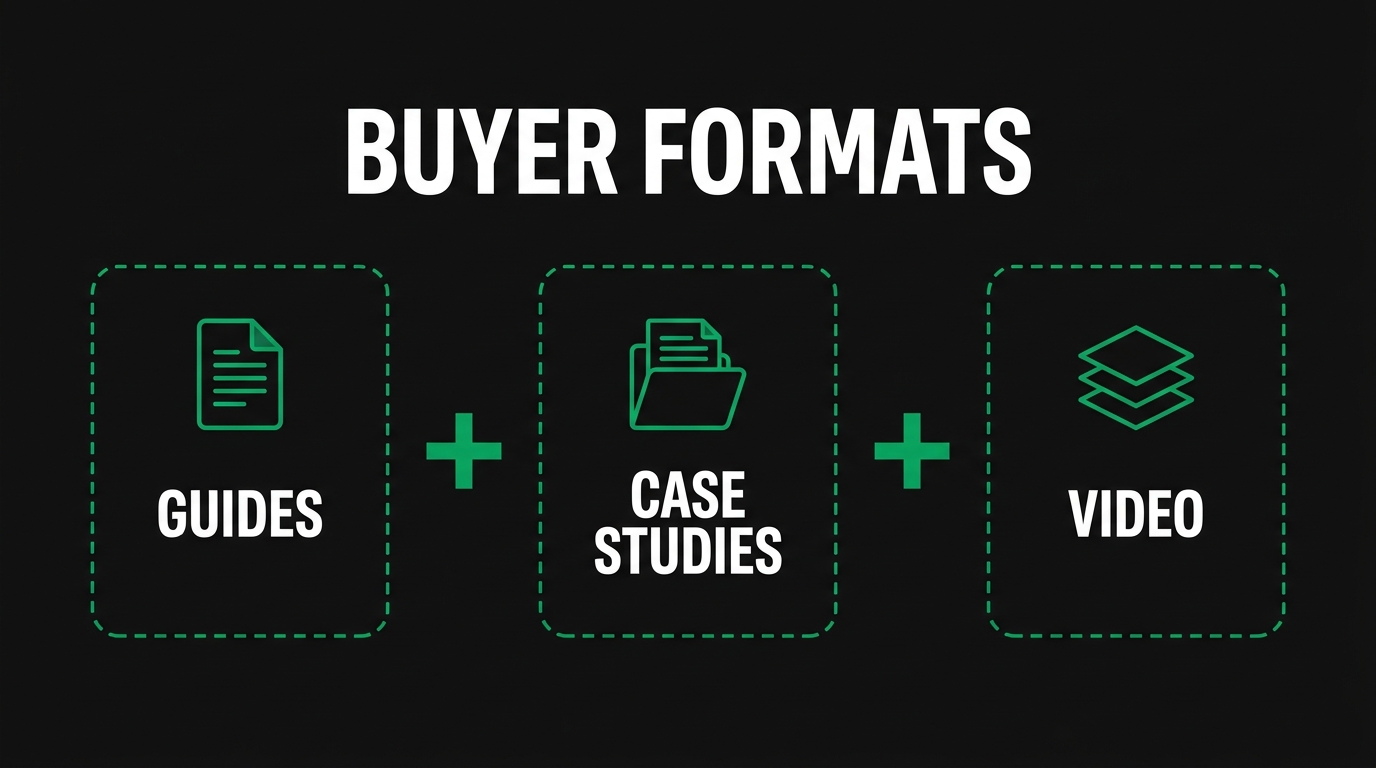
The best content formats for supply chain marketing are long-form technical guides, white papers and benchmark reports, customer case studies, explainer videos and webinars, podcasts, infographics, interactive calculators, LinkedIn short-form posts, and newsletters, each mapped to a specific stage of the procurement journey. We treat format selection as an engineering decision: every asset answers a defined buyer question, carries verifiable specifications, and earns a precise role in the lead-generation funnel.
This guide covers the audience and decision dynamics behind supply chain content, the long-form written formats that anchor topical authority, the case-study patterns that move buyers toward an RFQ, the video and audio formats that engage decision-makers, the visual and interactive assets that lift conversion, the short-form social and newsletter channels that amplify reach, journey-stage matching, multi-format calendar planning, performance measurement, and how Manufacturing SEO Agency operationalizes this work.
Audience and format-impact sections explain who actually consumes supply chain content, how formats steer buying decisions, and what distinguishes industrial supply chain marketing from generic B2B output.
Long-form written formats and case studies cover the depth-driven assets that earn organic visibility, qualify buyers, and feed sales-enablement workflows with verifiable evidence.
Video, audio, visual, and interactive sections address the formats that translate complex logistics topics, deepen engagement on already-ranked pages, and surface qualified leads through tools and dashboards.
Short-form distribution, journey matching, calendar planning, and measurement sections close with the channels that compound reach, the prioritization logic that aligns format to intent, the KPIs that reveal format-level ROI, and how an industrial SEO partner sustains the program.
What Is Supply Chain Marketing and Why Do Content Formats Matter?
Supply chain marketing is the discipline of producing technical, evidence-rich content that wins buyer trust across procurement, logistics, and operations functions. Content formats matter because each buyer question maps to a different asset type. The sub-sections below cover the audience, the format-to-decision link, and how industrial supply chain content differs from generic B2B marketing.
Who Are the Buyers Consuming Supply Chain Marketing Content?
The buyers consuming supply chain marketing content are procurement managers, supply chain directors, logistics operations leads, plant and warehouse managers, sourcing engineers, and the cross-functional finance and IT stakeholders who sign off on supplier and software decisions.
Most are credentialed through APICS or ASCM coursework and expect content that respects that baseline. Buyer concerns cluster around reliability, cost-to-serve, lead times, and risk, which means content must answer specifications before it tells stories.
How Do Content Formats Influence Supply Chain Buying Decisions?
Content formats influence supply chain buying decisions by shaping how quickly a buyer can verify a supplier's capability, certifications, and operational fit.
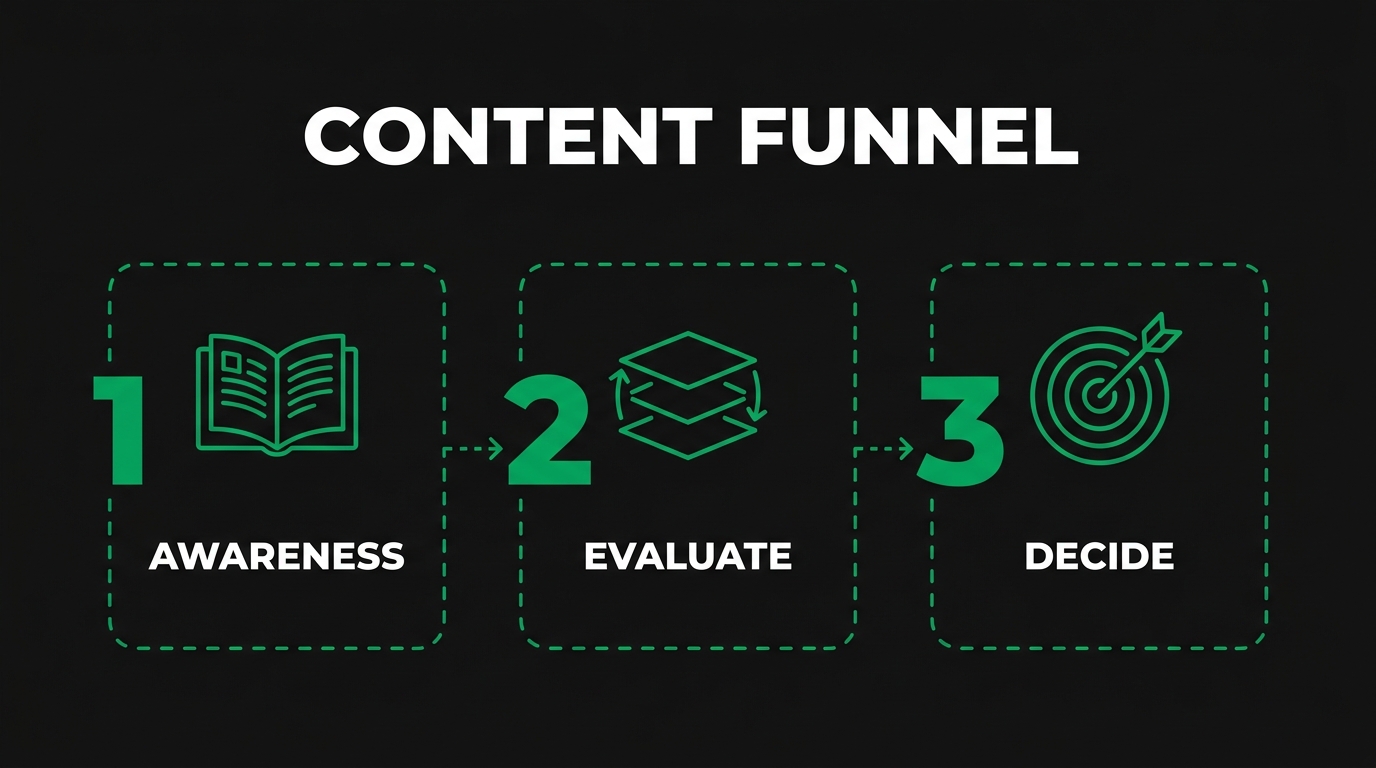
Long-form guides anchor early research; case studies and spec sheets advance shortlisting; calculators and webinars validate fit late in the cycle.
What Distinguishes Supply Chain Content From Generic B2B Marketing?
Supply chain content differs from generic B2B marketing because it is built around hard operational entities (carriers, modes, lanes, SKUs, lead times, certifications, ERP and TMS systems) rather than persona-led storytelling, and our content strategy for oem vs fabrication breakdown shows how the same scope shift applies on the production side.
Supply chain audiences expect data, schematics, and verifiable case outcomes. Generic top-of-funnel formats underperform because logistics buyers reject vague claims; specificity is the trust signal that converts research into pipeline.
Which Long-Form Written Content Formats Perform Best for Supply Chain Marketing?
The long-form written content formats that perform best for supply chain marketing are in-depth guides, white papers, industry benchmark reports, and pillar pages that anchor topical coverage. The sub-sections below cover when each format converts logistics buyers, how to use industry reports, and when pillar pages outperform standalone posts.
Why Do In-Depth Guides and White Papers Convert Logistics Buyers?
In-depth guides and white papers convert logistics buyers because they deliver the specification depth procurement teams require to validate a supplier or software vendor before initiating contact.
Long-form formats earn this gap because they answer multi-stage questions in one place: process scope, certification coverage, lead time, cost-to-serve, and verifiable outcomes. The white paper becomes a portable shortlisting document procurement can circulate inside the buying committee. For vertical-specific examples, see our content ideas for medical device manufacturers seo breakdown.
How Should You Use Industry Reports and Benchmark Studies in Supply Chain Content?
You should use industry reports and benchmark studies in supply chain content as proof anchors that lend third-party credibility and as data scaffolding for pillar narratives.
Reference benchmarks from CSCMP, MHI, MIT CTL, and ASCM to ground claims in recognized authorities. Publish original benchmarks where you have proprietary lane, mode, or fulfillment data.
When Are Pillar Pages More Effective Than Standalone Blog Posts?
Pillar pages are more effective than standalone blog posts when the topic spans multiple sub-questions a buyer must answer before requesting a quote, because the pillar consolidates authority and routes internal link equity to clusters.
Standalone posts win on long-tail single-intent queries, but pillar pages win on category-defining queries like "third-party logistics," "cold chain compliance," or "supplier risk management" because they exhaust the topic. Use clusters around each pillar to capture the full long tail, then bridge to format-matching tactics next.
How Do Case Studies and Customer Stories Drive Supply Chain Lead Generation?
Case studies and customer stories drive supply chain lead generation by providing the verified, specification-grade evidence procurement requires before adding a supplier to the shortlist. The sub-sections below cover what a logistics case study must include, how to structure a customer story, and where to distribute case studies across the buyer journey.
What Should a Logistics Case Study Include to Earn Buyer Trust?
A logistics case study should include the customer industry, the operating problem (lane, mode, SKU mix, lead time, or compliance constraint), the solution scope, the measurable outcome, and the verified data point that anchors the story. Procurement teams scan for hard numbers: percent reduction in transit time, percent improvement in on-time-in-full delivery, percent inventory reduction, and dollars saved.
Include the customer's certifications (ISO 9001, AS9100, ISO 13485) where relevant, the technology stack (TMS, WMS, ERP), and a named operations contact when permission allows.
How Do You Structure a Supply Chain Customer Story for Engagement?
You structure a supply chain customer story for engagement by leading with the operating outcome, then anchoring the narrative in problem-solution-result-evidence sequence, and closing with a portable summary procurement can circulate.
Open with the headline metric, follow with a short context paragraph (industry, scale, constraint), present the intervention with its operational mechanics, present the result with a chart or pull quote, and close with a "what to ask your supplier" recap. Buyers consume the headline first; the body must reward deeper reading with specifics, not adjectives.
Where Should You Distribute Case Studies Across the Buyer Journey?
You should distribute case studies across the buyer journey by placing teaser snippets in awareness content, full studies on solution and capability pages, and printable PDFs inside sales-enablement libraries for late-stage shortlisting.
Awareness placements use a one-paragraph proof point inside a long-form guide. Mid-funnel placements feature the full case study on the relevant capability page with a related-stories sidebar. Late-stage placements package three to five studies into industry-specific PDFs sales can attach to RFQ responses. Format choice and channel placement together determine pull-through.
Which Video and Audio Formats Engage Supply Chain Decision-Makers?
The video and audio formats that engage supply chain decision-makers are short explainer videos, on-demand and live webinars, customer-interview videos, and podcast episodes that profile operators, technologies, or trends. The sub-sections below cover explainers for complex topics, when to deploy webinars, and why podcasts are gaining traction with supply chain professionals.
How Do Explainer Videos Translate Complex Logistics Topics for Buyers?
Explainer videos translate complex logistics topics for buyers by combining diagrammatic motion with concise narration so a viewer can understand a multi-stage process (cross-docking, drayage flow, warehouse slotting, AS/RS deployment, customs clearance) in two to four minutes without reading a manual. Visual motion clarifies sequence and dependencies that prose forces the reader to assemble. Embed explainer videos at the top of capability pages and inside long-form guides so engaged readers can switch modalities without leaving the URL.
When Should You Use Webinars and On-Demand Video for Supply Chain Topics?
You should use webinars and on-demand video for supply chain topics when the subject is timely (regulatory change, peak-season planning, capacity tightening), when a customer or partner can co-present credibly, or when a deep technical drill-down justifies a 30 to 60 minute session.
Live webinars generate the registration list; on-demand replays generate the recurring inbound traffic. Repurpose every recording into transcripts, highlight clips, and a written summary so the asset earns long-tail organic traffic after the live event ends.
Why Are Podcasts Gaining Traction Among Supply Chain Professionals?
Podcasts are gaining traction among supply chain professionals because the audience commutes, walks distribution floors, and travels between sites, creating long uninterrupted listening windows where a 30 to 60 minute episode fits naturally into the workday. Subscribers self-select for depth, which yields a small but high-fit audience of operators and decision-makers.
When launching, structure each episode around one operating problem, host a guest with verifiable credentials, and publish full transcripts to capture organic search demand. Audio extends reach into moments other formats cannot.
How Do Visual and Interactive Content Formats Strengthen Supply Chain Marketing?
Visual and interactive content formats strengthen supply chain marketing by compressing complex data into scannable graphics, generating qualified leads through self-service tools, and surfacing real-time operational insight through dashboards. The sub-sections below cover infographics, interactive calculators, and when to invest in data visualizations.
What Role Do Infographics Play in Supply Chain Storytelling?
Infographics play a hub role in supply chain storytelling by translating complex datasets (lane volumes, freight modes, lead-time variability, carbon footprints by transport mode) into one-screen visuals readers grasp in seconds and share without reading. Strong logistics infographics combine flow diagrams, comparative bar charts, and labeled icons to make the structure of a process immediately legible.
How Do Interactive Tools and Calculators Generate Qualified Logistics Leads?
Interactive tools and calculators generate qualified logistics leads by asking visitors to input operating variables (annual freight spend, average shipment weight, lane mix, inventory turns) and returning a personalized result that demonstrates expertise while capturing intent data.
The same self-selection logic applies to calculators that require structured inputs. Useful tool ideas include landed-cost calculators, mode-mix optimizers, total-cost-of-ownership comparators, and freight-class lookups. Tools earn high engagement and convert traffic that passive content would never qualify.
When Should You Invest in Data Visualizations and Dashboards?
You should invest in data visualizations and dashboards when you have proprietary or aggregated industry data that buyers cannot find elsewhere, because dashboards turn that data into a recurring traffic and reference asset that compounds authority. Build a public freight-rate index, a carrier on-time benchmark, or a regional capacity tracker that updates monthly or quarterly.
Tag every chart with attribution metadata so press citations carry your domain reference.
Which Short-Form and Social Content Formats Build Supply Chain Authority?
The short-form and social content formats that build supply chain authority are LinkedIn text and document posts, executive newsletters, content carousels, and topic-focused microsites that orbit a pillar narrative. The sub-sections below cover LinkedIn distribution, newsletter cadence, and when carousels and microsites earn their place in the mix.
How Should You Use LinkedIn Posts to Reach Supply Chain Buyers?
You should use LinkedIn posts to reach supply chain buyers by publishing under a small set of named operators (CEO, COO, head of logistics, supply chain director) rather than the corporate handle, because individual voices outperform brand pages on the platform.
Post short evidence-led commentary on a benchmark, a regulatory shift, or a customer outcome two or three times per week per voice, and reserve longer document posts (PDF carousels) for original benchmark releases.
What Role Do Newsletters Play in Logistics Content Distribution?
Newsletters play a recurring-touch role in logistics content distribution by delivering curated insight directly to subscribers who already raised their hand, which sustains a one-to-one relationship that algorithmic channels cannot match. A weekly or biweekly cadence works for most logistics audiences; daily formats only suit market-data publishers. Anchor each issue around one operating theme, three curated external links, and one original asset (a benchmark snippet, a chart, or a case-study teaser).
Track open rate, click-through, and reply rate per issue, and run subject-line A/B tests monthly.
Why Are Carousels and Microsites Effective for Supply Chain Topics?
Carousels and microsites are effective for supply chain topics because they package a single narrative into a dedicated, distraction-free experience that procurement teams can review without competing site navigation.
Microsites work for benchmark releases, multi-chapter playbooks, and event hubs where a discrete URL with its own analytics earns clearer attribution. For deeper distribution leverage, our list of top manufacturing trade publications for content submission maps the outlets that amplify carousels and original benchmark releases.
How Do You Match Content Formats to Each Stage of the Supply Chain Buyer Journey?
You match content formats to each stage of the supply chain buyer journey by mapping awareness queries to long-form guides and explainer videos, mid-funnel research to case studies and comparison tables, and late-stage decision queries to spec sheets, calculators, and proposal-ready PDFs. The sub-sections below cover the formats that win at each stage.
Which Formats Win Awareness for Logistics and Supply Chain Topics?
The formats that win awareness for logistics and supply chain topics are long-form pillar guides, explainer videos, infographics, and benchmark report announcements, because each surfaces broad operating questions buyers issue before they have a vendor in mind.
Awareness formats earn organic visibility through topical depth, not paid amplification. Pair each awareness asset with a journey-aware CTA so the next-step content is one click away when a buyer is ready to advance.
Which Formats Convert Mid-Funnel Supply Chain Research?
The formats that convert mid-funnel supply chain research are case studies, comparison guides, webinars, podcasts, and capability-specific landing pages, because these answer the "is this supplier credible and a fit" question buyers ask once a category is defined. The decision around paid versus organic discovery often comes up here, and our breakdown of ppc vs organic search for industrial marketing covers when each channel earns the mid-funnel touch.
Which Formats Close Late-Stage Supply Chain Buyers?
The formats that close late-stage supply chain buyers are spec sheets, calculators, ROI models, vendor-comparison matrices, customer-reference packs, and tailored proposal templates, because late-stage buyers need verification, not education. At this point the buying committee has already shortlisted vendors and is collecting evidence to defend an internal recommendation. Provide downloadable PDFs your champion can attach to internal procurement reviews.
The next section covers planning a multi-format calendar.
How Do You Plan a Multi-Format Supply Chain Content Calendar?
You plan a multi-format supply chain content calendar by ranking topics on procurement intent and resource availability, assigning each topic to a primary format and two to three derivative formats, and sequencing publication so each pillar releases with a coordinated cluster. The sub-sections below cover prioritization, ownership, and repurposing.
How Do You Prioritize Formats by Procurement Intent and Resource Availability?
You prioritize formats by procurement intent and resource availability by scoring each candidate topic on revenue potential per inquiry, current SERP coverage, and the production cost of the most-fitting format, then publishing the highest-leverage topics first. High-intent topics with thin competitor coverage justify long-form pillars and original benchmarks; lower-intent topics warrant short blog posts or LinkedIn threads.
For a complete walkthrough of cluster mechanics, our content marketing guide for manufacturers explains how to scope, brief, and stage each layer.
Who Should Produce, Review, and Publish Supply Chain Marketing Content?
Supply chain marketing content should be produced by writers with operations or logistics fluency, reviewed by a subject-matter expert (operations VP, supply chain director, or technical engineer), and published by a marketing operations lead who owns metadata, schema, and internal linking.
A documented b2b manufacturing content strategy gives the editorial chain its operating cadence.
How Do You Repurpose One Asset Into Multiple Supply Chain Content Formats?
You repurpose one asset into multiple supply chain content formats by treating the deepest version (a benchmark report, a long-form guide, or a webinar recording) as the source-of-truth and atomizing it into derivatives across at least five channels.
From one webinar, derive: an on-demand replay, a written transcript, a 700-word blog post, three to five LinkedIn document carousels, an infographic, a podcast cut, and a sales-team one-pager. Repurposing multiplies reach without multiplying production cost.
How Do You Measure the Performance of Supply Chain Marketing Content Formats?
You measure the performance of supply chain marketing content formats by tying each asset to a format-level KPI set, attributing influence across multi-touch buying groups, and running a quarterly refresh-or-retire cycle. The sub-sections below cover KPIs, attribution, and lifecycle decisions.
Which KPIs Reveal Format-Level ROI for Logistics Content?
The KPIs that reveal format-level ROI for logistics content are organic sessions per asset, qualified-lead conversion rate, average sales-cycle days from first touch, pipeline value sourced or influenced, and cost per qualified inquiry.
Each format type also carries native KPIs: long-form guides report scroll depth and time-on-page; webinars report registration-to-attendance ratio and live-question count; calculators report completion rate and email capture; case studies report download-to-meeting conversion. Tie every metric back to RFQs and pipeline value.
How Do You Attribute Multi-Touch Supply Chain Content Influence?
You attribute multi-touch supply chain content influence by stitching first-touch, last-touch, and assisted-touch data across web analytics, marketing automation, and CRM, then applying a weighted multi-touch model that credits each format proportional to its position in the buyer path.
Capture UTM parameters on every distributed asset, map gated-asset downloads to CRM contacts, and use a documented buying-group account-based view so the credit reflects committee influence, not just the lead who filled the form.
How Do You Refresh and Retire Underperforming Supply Chain Formats?
You refresh and retire underperforming supply chain formats by running a quarterly content audit that flags every asset failing two of three thresholds (organic traffic, conversion rate, ranking-keyword count), then deciding to refresh, consolidate, or retire each one. Refresh assets that still target valuable procurement queries but have stale specifications, citations, or references. Consolidate cannibalizing assets into a single canonical guide. Retire assets whose target query has lost commercial relevance.
The next section covers how to operationalize this work with an industrial SEO partner.
How Should You Approach Content Format Strategy With an Industrial SEO Agency?
You should approach content format strategy with an industrial SEO agency by selecting a partner with manufacturing-only domain fluency, a documented procurement-intent methodology, and revenue-tied reporting. The sub-sections below cover the agency capability set and the takeaways for the format playbook.
Can Manufacturing SEO Agency's Content Marketing Service Strengthen Supply Chain Marketing Formats?
Manufacturing SEO Agency's content marketing service can strengthen supply chain marketing formats because Manufacturing SEO Agency builds long-form technical content and topical authority maps around procurement-intent keywords, then ties every asset to RFQ and pipeline outcomes.
Manufacturing SEO Agency operates as an industrial seo agency focused on B2B manufacturers across CNC machining, injection molding, metal fabrication, aerospace, automotive, and medical operations. The team's manufacturing content marketing services cover topical authority buildout, technical content, and AI search visibility.
What Are the Key Takeaways About the Best Content Formats for Supply Chain Marketing We Covered?
The key takeaways about the best content formats for supply chain marketing are that format selection is a procurement-funnel decision, depth-first formats win technical buyers, and measurement discipline sustains ROI. Treat long-form guides, white papers, and benchmark reports as topical authority anchors. Use case studies, comparison guides, webinars, and capability landing pages to qualify mid-funnel buyers. Close late-stage buyers with spec sheets, calculators, ROI models, and reference packs. Match every format to a buyer-journey stage, document the calendar with a primary asset and atomized derivatives, and audit performance quarterly to refresh, consolidate, or retire underperformers. Manufacturing SEO Agency executes this format-to-funnel mapping for industrial clients across the United States.