Schema markup is a standardized vocabulary of structured data that tells search engines what the content on a manufacturing website actually means. Industrial sites use schema to classify products, components, processes, specifications, certifications, and the parent organization so that search engines, AI answer engines, and procurement buyers can parse every detail correctly.
This guide covers what schema markup is and why it matters for procurement-driven search, which schema types manufacturers should implement first, how to deploy and validate JSON-LD on industrial pages, how schema behaves differently on large industrial e-commerce and catalog sites, mistakes to avoid, tooling choices for deployment at scale, and the connection between schema and broader technical SEO.
The first theme explains the core definition, the procurement search context, and how structured data influences AI-generated manufacturing answers. We cover why buyers who search for specific processes, materials, and certifications rely on machine-readable pages.
The second theme walks through the priority schema types for industrial websites. Product, Organization, Service, and PropertyValue form the backbone of most manufacturing deployments, and each type carries specific attributes that must match buyer queries.
The third theme details implementation, including JSON-LD syntax, attribute mapping for manufacturing data, script placement, and validation against Google's Rich Results Test and the Schema.org Validator.
The fourth theme addresses catalog-scale implementation, component and assembly modeling, and rich result eligibility for industrial e-commerce.
The fifth theme documents common errors, thin attribute penalties, and the consequences of schema contradicting visible page content.
The sixth theme reviews tools, WordPress plugin options, and monitoring workflows. The final theme ties schema into site architecture, Core Web Vitals, crawl efficiency, and specification pages.
What Is Schema Markup and Why Does It Matter for Manufacturers?
Schema markup is a standardized vocabulary of structured data that labels page content for search engines, AI answer systems, and procurement databases. The sections below cover how schema influences industrial SERPs, why procurement buyers rely on it, and how it shapes AI-generated manufacturing answers.
What Does Schema Markup Do for Industrial Search Results?
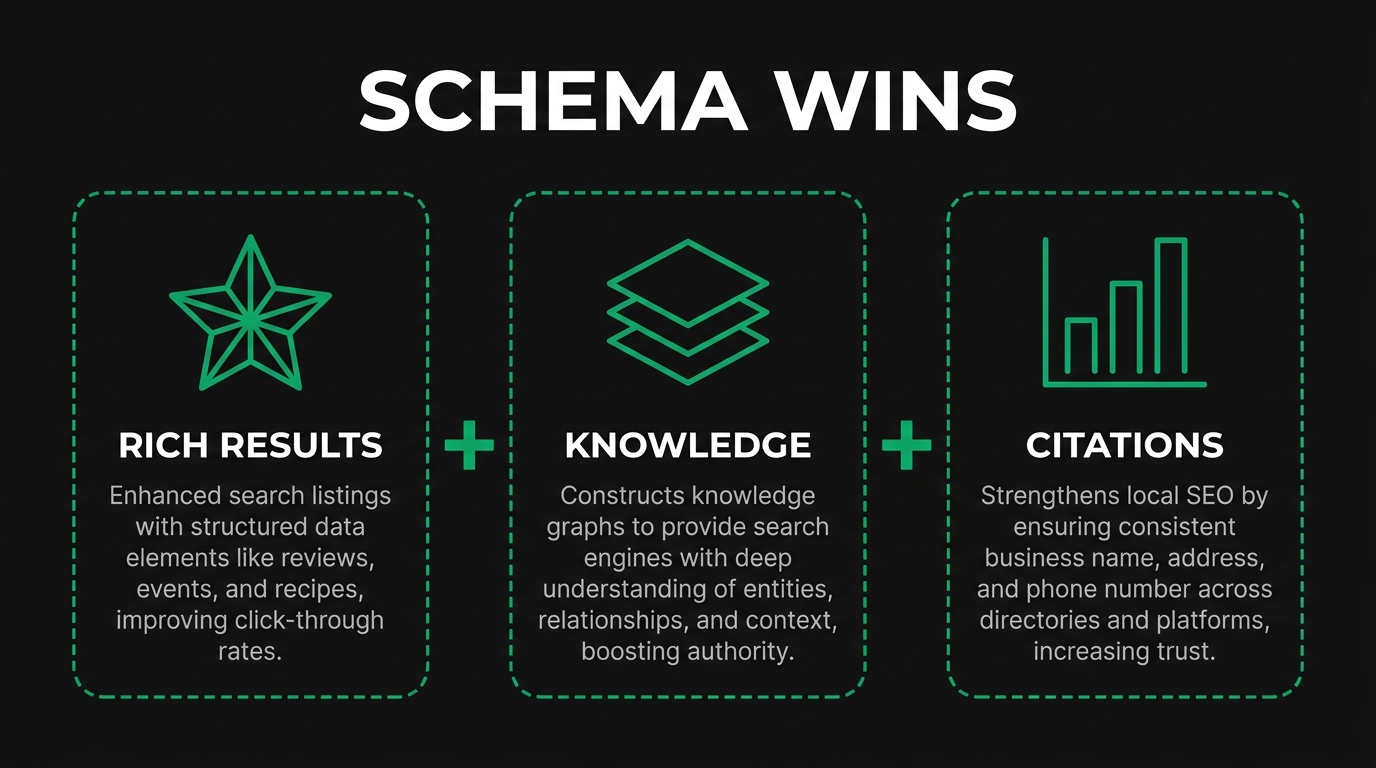
Schema markup does three things for industrial search results: it classifies page content, qualifies it for rich results, and feeds machine-readable entity data to the search engine.
Industrial pages that expose process names, material grades, certifications, and part identifiers as structured properties become far more visible in category-specific SERPs. For the foundations that make schema effective, see what is industrial seo.
Why Is Structured Data Critical for Procurement-Driven Buyers?
Structured data is critical for procurement-driven buyers because it converts catalog, spec, and process pages into machine-readable facts the search engine can match to precise supplier queries.
How Does Schema Markup Influence AI Search Answers for Manufacturing Queries?
Schema markup influences AI search answers for manufacturing queries by giving generative systems clean, attributable facts to cite instead of inferring them from prose.
AI Overviews favor pages where PropertyValue, QuantitativeValue, and Manufacturer triples resolve entities cleanly for queries like "tensile strength of 6061-T6 aluminum." Schema does not guarantee citation, but it removes interpretation risk. Structured markup turns a spec page into a quotable source, which is the lever manufacturers need to enter AI answer surfaces.
Which Schema Types Should Manufacturers Implement First?
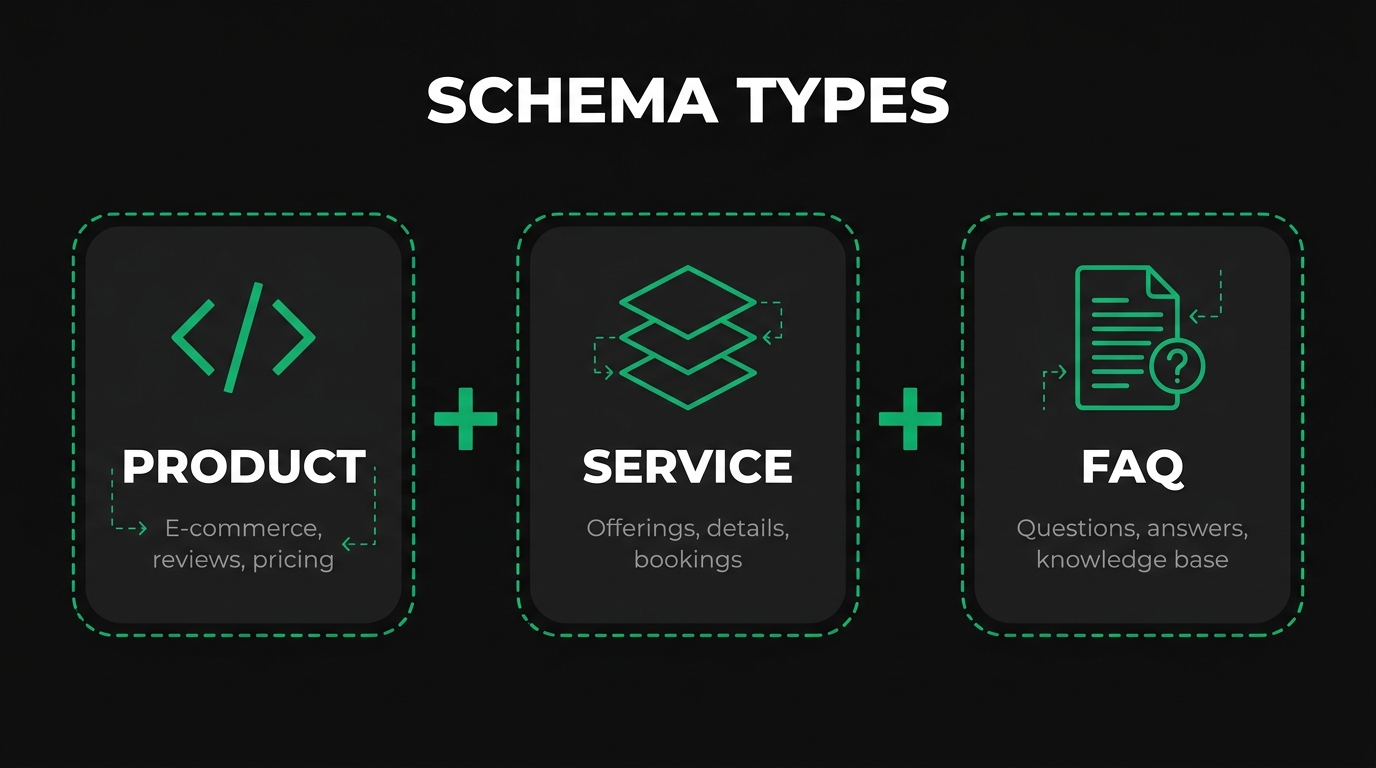
Manufacturers should implement Product, Organization, Service, and PropertyValue schema first, followed by BreadcrumbList, FAQPage, and Review. The H3s below cover product pages, organization and manufacturer entities, service schema for process pages, and specification schema.
Which Schema Type Works Best for Product Pages on Industrial Sites?
The schema type that works best for product pages on industrial sites is Product, nested with Offer, PropertyValue, and a brand or Manufacturer reference.
Pair Product with isAccessoryOrSparePartFor to map components to parent assemblies. See our step-by-step guide to product schema.
How Should Manufacturers Use Organization and Manufacturer Schema?
Manufacturers should use Organization schema to establish the parent entity and connect it to products via the brand or manufacturer property.
Place one Organization block site-wide in the header, include logo, legal name, sameAs references to Wikipedia or Wikidata for entity grounding, contactPoint for procurement inquiries, and an optional Manufacturer subtype on factory-owned domains. Every Product should reference the Organization via manufacturer so the knowledge graph links parts to the producing entity.
When Should Industrial Sites Use Service Schema for Process Pages?
Industrial sites should use Service schema for process pages that describe capabilities such as 5-axis CNC machining, wire EDM, injection molding, or sheet metal fabrication. Service schema defines provider, areaServed, serviceType, hoursAvailable, and termsOfService. Pair Service with OfferCatalog to list sub-capabilities, and with the parent Organization via provider. This pattern works for contract manufacturers whose RFQ-intent pages describe what the facility does, not what it sells off the shelf. The schema for industrial components vs finished products distinction matters here: process pages describe Service, whereas component pages describe Product with isAccessoryOrSparePartFor. Process-specific markup applies across every vertical, including what is additive manufacturing workflows.
Which Schema Covers Specifications, Materials, and Certifications?
Specifications, materials, and certifications are covered by PropertyValue, QuantitativeValue, MaterialType, and additionalProperty. Use PropertyValue with propertyID, value, and unitCode for tolerances and dimensions. Use additionalProperty on Product to attach certifications such as AS9100, ISO 13485, NADCAP, or IATF 16949 as name-value pairs. Use QuantitativeValue for ranges like operating temperature or working pressure. Read why use schema on industrial e-commerce sites for the business case on complete specification markup. Certifications and material grades are the procurement-gating attributes, so they must appear as structured properties, not just body text.
How Do You Implement Schema Markup on Manufacturing Websites?
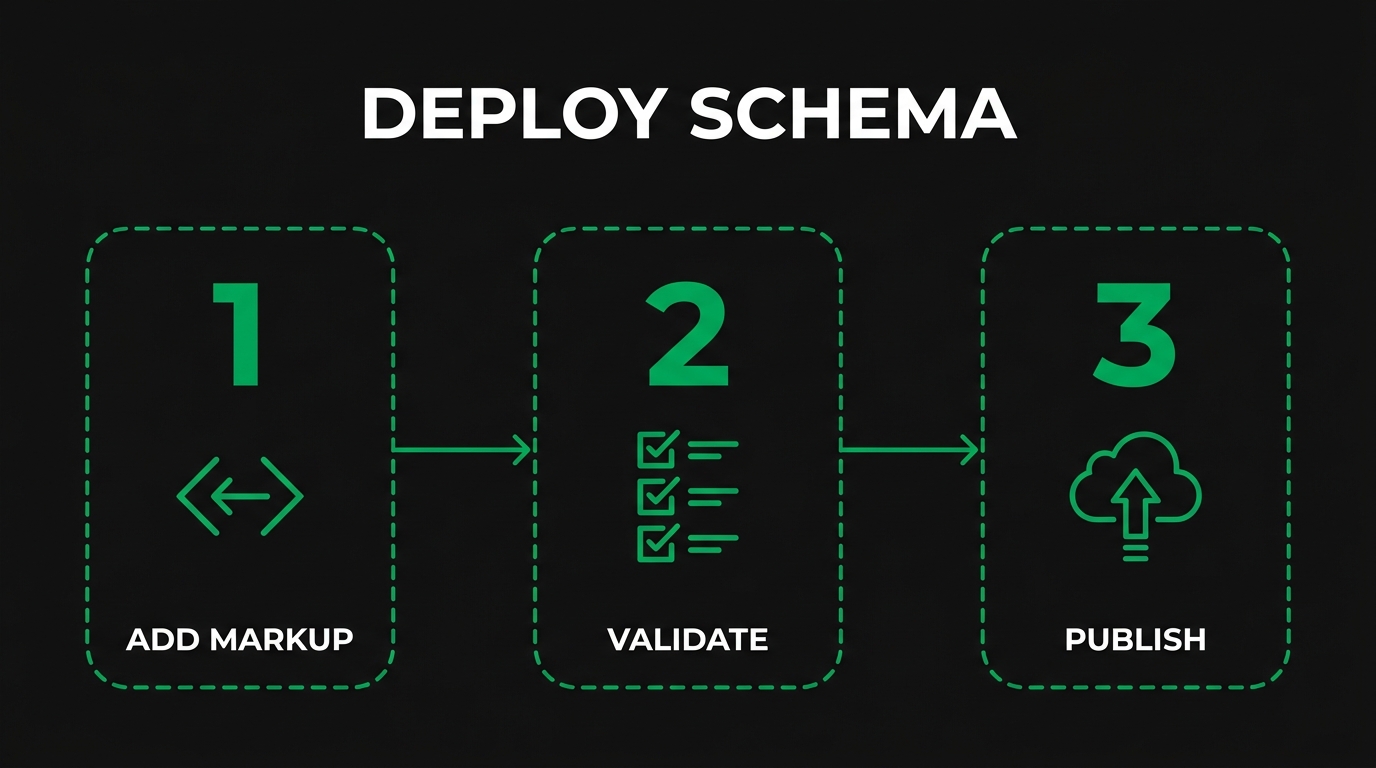
Implementing schema markup on manufacturing websites means choosing JSON-LD, mapping product and process attributes to Schema.org properties, placing the script block correctly, and validating with Google's testing tools. The H3s below cover format, attribute mapping, placement, and validation.
What Is the Correct JSON-LD Format for Industrial Schema?
The correct JSON-LD format for industrial schema is a standards-compliant JSON block wrapped in a script tag with type application/ld+json.
A valid industrial Product block starts with @context set to https://schema.org and @type set to Product, then declares name, image, description, sku, mpn, brand or manufacturer, and nested PropertyValue entries under additionalProperty. Keep every property name exactly as Schema.org defines. JSON-LD supports cross-references via @id, which lets catalog-scale deployments link products to a parent Organization without duplicating data.
How Do You Map Manufacturing Attributes to Schema Properties?
Mapping manufacturing attributes to schema properties requires matching each product or process field to its closest Schema.org counterpart, then falling back to additionalProperty when no native match exists. Map part numbers to mpn, SKUs to sku, GTINs to gtin, materials to material, and tolerances or grades to PropertyValue blocks nested under additionalProperty. Map certifications (AS9100, ISO 9001, IATF 16949) to additionalProperty with propertyID set to "certification" and value set to the standard name. Map countries of manufacture to countryOfOrigin and processes to a Service block referenced via isRelatedTo.
Where Should Schema Code Be Placed on a Manufacturing Page?
Schema code should be placed inside a script tag in either the head or the body of the HTML document, with type set to application/ld+json. Placement in the head is preferred for site-wide blocks such as Organization. Page-specific blocks like Product or Service can live in the head or immediately after the opening body tag.
Avoid injecting JSON-LD via client-side JavaScript on critical pages unless server-side rendering or prerendering is in place.
How Do You Validate Schema Using Google Rich Results and Schema.org Tools?
Validating schema requires two complementary tools: the Rich Results Test for Google-eligibility checks and the Schema.org Validator for vocabulary compliance.
Valid items appear in the rich result report in Search Console. After confirming fixes, click Validate fix on the issue's details page; validation can take two weeks or more depending on crawl frequency. The Schema.org Validator catches vocabulary-level errors the Rich Results Test does not flag. Run both on every template before launch.
How Does Schema Markup Differ for Industrial E-commerce and Catalog Sites?
Industrial e-commerce and catalog sites require schema patterns that handle tens of thousands of parts, variant explosions, assemblies, and bills of materials. The H3s below cover catalog-scale schema, component and assembly modeling, and available rich results.
What Schema Is Needed for Large Industrial Product Catalogs?
Large industrial product catalogs need Product, ProductGroup, Offer, OfferCatalog, and Organization schema working together. ProductGroup models a family of variants that share attributes, with individual Products linked via hasVariant. OfferCatalog organizes products into hierarchical categories that mirror the navigation. Catalog sites that fail to use ProductGroup end up with duplicate Product entries, wasted crawl budget, and conflicting variant signals.
How Do Components, Assemblies, and BOMs Require Different Schema?
Components, assemblies, and BOMs require different schema because each represents a different relationship in the product tree.
Components use Product with isAccessoryOrSparePartFor pointing to the parent assembly. Assemblies use Product with isRelatedTo or an OfferCatalog of constituent parts. Bills of materials have no native Schema.org type; model them as Product with additionalProperty entries listing quantities, or as a custom Dataset linked via subjectOf. See schema for industrial components vs finished products for multi-level BOM flattening.
Which Rich Results Are Available for Industrial E-commerce?
Industrial e-commerce qualifies for several rich results: Product snippets, Merchant listings, Breadcrumb trails, FAQ rich results, HowTo cards, and Review snippets.
Product snippets require a name plus at least one of review, aggregateRating, or offers. Breadcrumb markup makes category trails visible in SERPs. FAQPage markup surfaces specification questions directly in results. See why use schema on industrial e-commerce sites for the full business case. Missing a required property means the rich result never appears regardless of page authority.
What Mistakes Should Manufacturers Avoid With Schema Markup?
Manufacturers should avoid three categories of schema mistakes: syntax and missing-property errors, thin or incomplete attribute sets, and schema that contradicts visible page content. The H3s below cover each failure mode and its consequences.
Which Schema Errors Most Commonly Trigger Google Warnings?
The schema errors that most commonly trigger Google warnings are missing required properties, unparsable JSON syntax, invalid data types, and empty string values.
Common triggers include omitting name on Product, using a string where Number is expected, malformed URL values, and forgetting @context. Fix parse errors first because they block all downstream rich result eligibility.
How Do Incomplete or Thin Attributes Hurt Industrial Rankings?
Incomplete or thin attributes hurt industrial rankings by disqualifying pages from rich results and weakening the entity signals that search engines use to match procurement queries. A Product block with only name and image loses to a competitor's Product with material, sku, mpn, brand, manufacturer, additionalProperty, and Offer populated. Thin markup also reduces AI citation probability because answer engines prefer pages where every claim has a structured property to reference.
What Happens When Schema Contradicts On-Page Content?
When schema contradicts on-page content, Google may ignore the markup or, in severe cases, issue a manual action against the site.
Examples include a Product block listing a price that does not appear on the page, Review markup with ratings the page never shows, or PropertyValue entries claiming certifications the company does not hold. Every property declared in JSON-LD must be visible and accurate on the rendered page. Contradictions destroy trust signals faster than any technical error, and recovery from a manual action is slow.
Which Tools and Plugins Help Manufacturers Deploy Schema at Scale?
Manufacturers deploy schema at scale using CMS plugins, server-side template generators, validation tools, and ongoing monitoring workflows. The H3s below cover WordPress plugin options, testing tools, and maintenance routines.
Which WordPress Plugins Are Best for Industrial Schema?
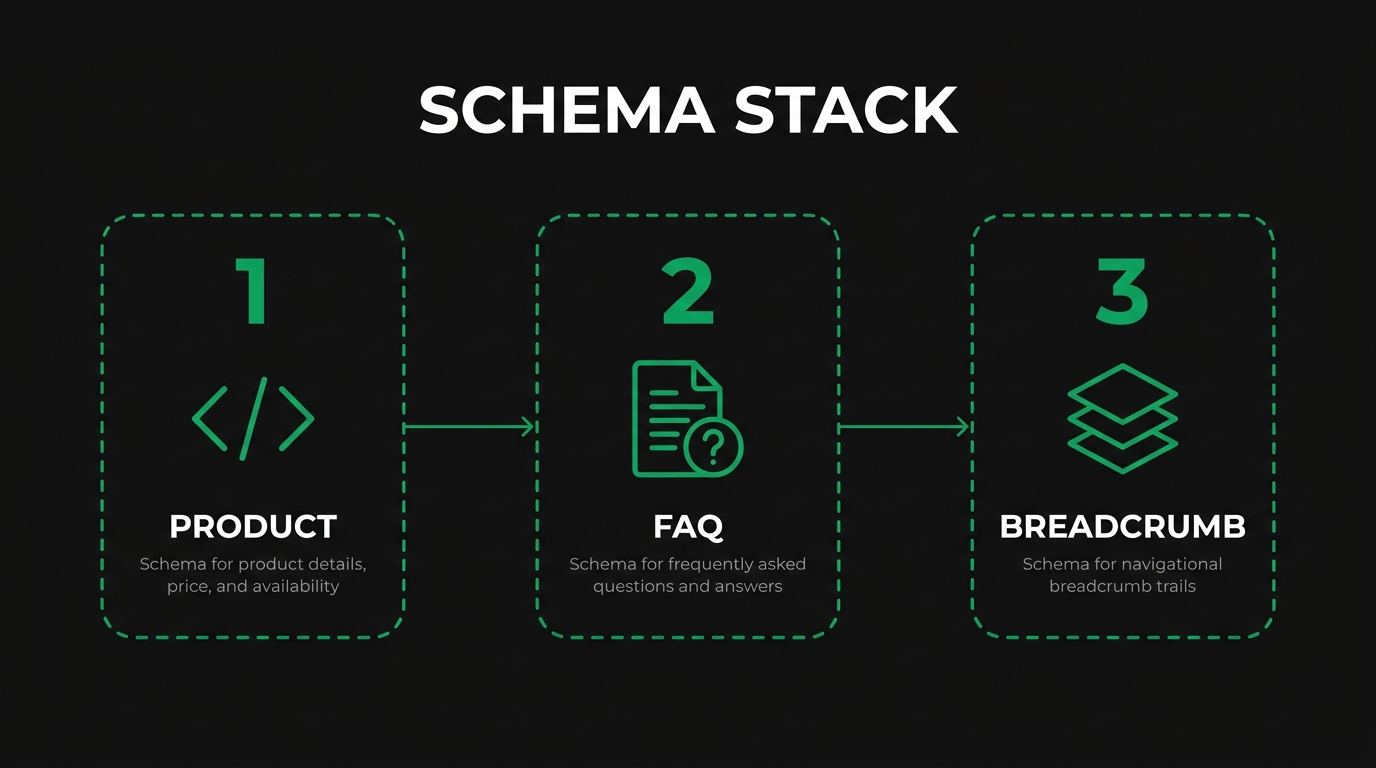
The best WordPress plugins for industrial schema support Product, Organization, Service, FAQPage, BreadcrumbList, and custom field mapping. Candidates include Rank Math, Yoast SEO with its Schema API, Schema Pro, and WP Schema Pro, each with different tradeoffs in custom property support and developer hooks. See our review of the best schema markup plugins for industrial sites for field mapping depth and JSON-LD cleanliness. For catalogs over 5,000 SKUs, plugin-only deployments break down; a server-side template generator pulling from WooCommerce or a PIM becomes necessary. When evaluating partners rather than software, our list of top manufacturing marketing firms covers agencies equipped for schema-heavy deployments.
How Do Testing Tools Confirm Valid Markup for Manufacturing Pages?
Testing tools confirm valid markup for manufacturing pages by parsing the JSON-LD block, checking Schema.org vocabulary conformance, and simulating Google's rich result eligibility.
Run the Rich Results Test on live URLs after each release, the Schema.org Validator for vocabulary checks, and Search Console's URL Inspection tool to see what Googlebot actually rendered. Always test both desktop and mobile versions because SSR and client-side JSON-LD can diverge across user agents.
What Monitoring Workflows Keep Schema Healthy Over Time?
Monitoring workflows that keep schema healthy over time combine Search Console alerts, scheduled validator runs, and change-detection on template files. Subscribe to the rich result reports in Search Console so every new error triggers an email. Schedule weekly automated runs of the Schema.org Validator against a sample of URLs from each template. Diff JSON-LD output on every deploy and fail the build if required properties disappear. Monitor crawl stats for spikes that indicate schema-induced duplication.
How Does Schema Connect to Broader Technical SEO for Manufacturers?
Schema markup connects to broader technical SEO through site architecture, crawl efficiency, Core Web Vitals, and specification page structure. The H3s below explain each connection.
How Do Schema, Site Architecture, and Internal Linking Work Together?
Schema, site architecture, and internal linking work together to form a coherent entity graph that search engines traverse efficiently.
BreadcrumbList schema mirrors the URL hierarchy and clarifies parent-child relationships. Organization schema anchors every page to the same entity. Internal links pass PageRank while schema passes entity identity. Strong manufacturing sites align the linked-page set for any category with the Schema.org OfferCatalog.
How Does Schema Affect Core Web Vitals and Crawl Efficiency?
Schema markup affects Core Web Vitals and crawl efficiency indirectly through script weight, server-side rendering strategy, and duplicate markup.
Inline JSON-LD in the head adds minimal weight and does not block rendering, so its impact on LCP and INP is negligible. Plugin-generated schema that injects via client-side JavaScript can delay rendering and should be avoided. Duplicate or bloated markup wastes crawl budget and dilutes entity signals.
How Does Schema Support Specification and Data Sheet Pages?
Schema supports specification and data sheet pages by mapping each attribute to a structured property that search engines and AI systems retrieve independently.
Use PropertyValue for every spec row (tolerance, material, dimension, finish), QuantitativeValue for ranges, and additionalProperty for certifications. Link the data sheet as a downloadableResource via subjectOf if a PDF exists. Structured spec pages are the single highest-leverage schema investment for technical manufacturers.
How Should Manufacturers Approach Schema Markup With Manufacturing SEO Agency?
Manufacturers should approach schema markup as structured data infrastructure, not a one-time plugin install, and partner with industrial seo specialists that understand industrial catalogs, procurement intent, and certification-gated queries. The H3s below cover how Manufacturing SEO Agency supports schema implementation and summarize the guide's key takeaways.
Can Manufacturing SEO Agency Help Implement Schema for Industrial Sites?
Manufacturing SEO Agency can help implement schema for industrial sites. Manufacturing SEO Agency is a United States industrial-only SEO firm delivering technical SEO remediation covering schema, crawl health, and page experience. Services include audits, procurement-intent keyword architecture, AI search visibility engineering, and technical content for CNC machining, injection molding, metal fabrication, aerospace, and contract manufacturing. Manufacturing SEO Agency maps Schema.org properties to certifications such as AS9100, ISO 13485, NADCAP, and IATF 16949. Buyers evaluating manufacturing schema and technical seo engagements receive a roadmap tied to RFQs and closed revenue.
What Are the Key Takeaways About Schema Markup for Manufacturers We Covered?
The key takeaways about schema markup for manufacturers are clear: structured data is the machine-readable layer that qualifies industrial pages for rich results, procurement queries, and AI citations. Start with Product, Organization, Service, and PropertyValue as the priority types, then add BreadcrumbList and FAQPage for coverage. Use JSON-LD exclusively, validate with both the Rich Results Test and the Schema.org Validator, and place blocks server-side. Catalog-scale sites require ProductGroup and OfferCatalog, and component libraries need isAccessoryOrSparePartFor relationships. Avoid thin attributes and never let schema contradict visible content. Tie schema into site architecture, crawl efficiency, and Core Web Vitals, and monitor continuously. Schema is infrastructure, not a plugin setting.