Industrial components and finished products carry different data models, and schema markup plus bill of materials structure expose that difference to search engines. Components feed assemblies; finished products ship to buyers. Both need distinct structured-data treatment to rank for procurement-intent queries.
This guide covers component and finished-product classification, schema.org product types and properties, bill of materials structure and hierarchy, implementation patterns for each product class, BOM-to-schema modeling, common catalog mistakes, search and AI visibility impact, and operational tooling.
Classification sets the baseline: a raw material, subassembly, component, and finished good each occupy a different node in the product structure and require a different markup strategy.
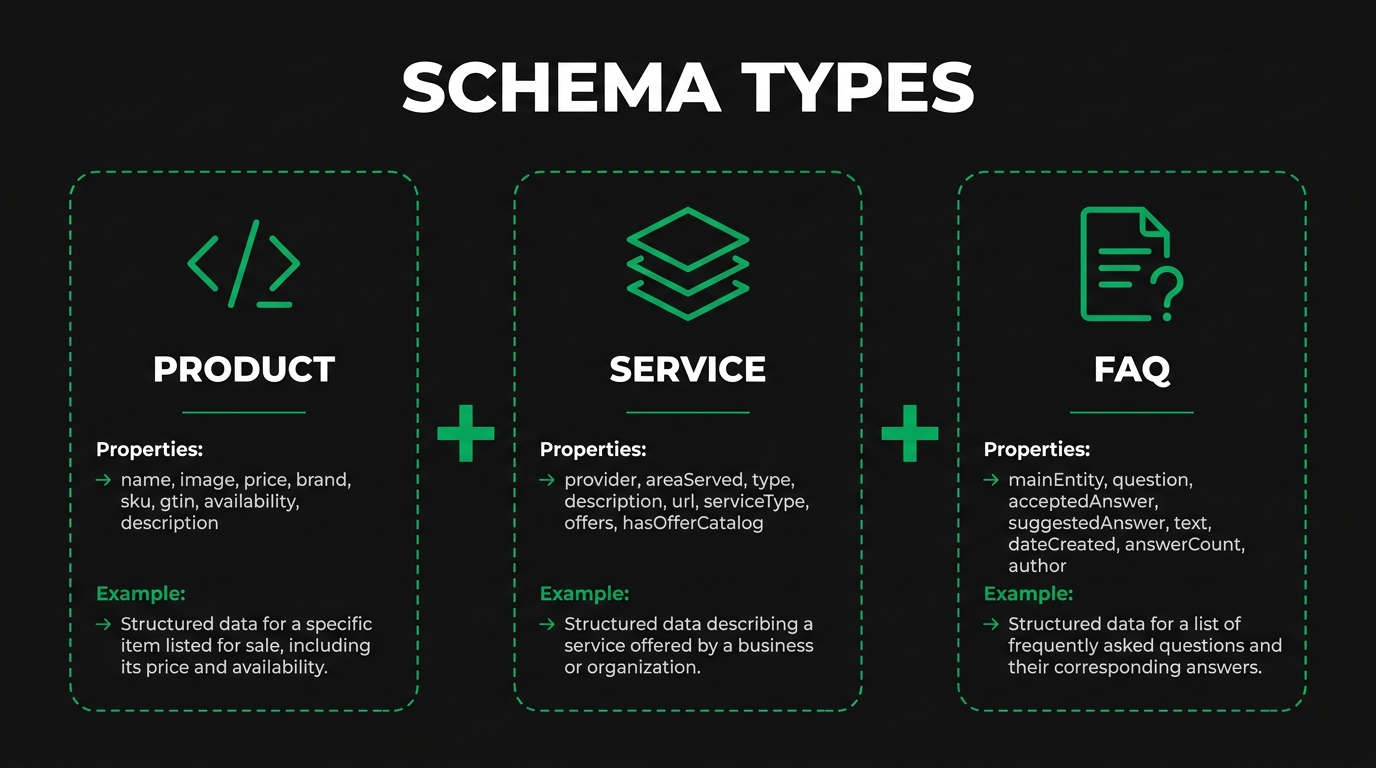
Schema.org offers Product, IndividualProduct, ProductGroup, and ProductModel types plus properties like hasPart, isPartOf, isAccessoryOrSparePartFor, isConsumableFor, isVariantOf, GTIN, MPN, and SKU to describe every level of a catalog.
Bill of materials structure, whether engineering, manufacturing, single-level, multi-level, or indented, maps directly to parent-child product relationships and informs how markup should reflect assemblies.
Implementation diverges for components versus finished products, with different required fields, variant handling, and spare-part declarations.
BOM-to-schema modeling turns product structure into crawlable relationships through hasPart, isPartOf, and ProductGroup patterns.
Common mistakes include missing identifiers, broken parent-child links, and validation errors flagged by rich results testing.
Search visibility and AI answer inclusion depend on clean markup, entity grounding, and rich result eligibility.
Processes and tooling, including PIM systems, CMS plugins, engineering change order triggers, and validation utilities, keep schema and BOM aligned at catalog scale.
What Defines an Industrial Component Versus a Finished Product in Manufacturing?
An industrial component is a part used inside an assembly, while a finished product is a complete item ready for sale or deployment. The distinction drives classification, product data, and how pages get modeled for search. The sub-sections below cover raw material boundaries, finished-good readiness criteria, and why this split shapes catalog SEO.
How Does an Industrial Component Differ From a Subassembly or Raw Material?
An industrial component differs from a subassembly or raw material by its position in the product hierarchy and its manufacturing state. Raw material is unprocessed input like bar stock, resin pellets, or sheet metal. A component is a single manufactured part, such as a machined fitting or an injection-molded housing. A subassembly is a group of components joined together but not yet a finished product, like a pump housing with seal installed.
Components feed subassemblies; subassemblies feed finished goods.
What Classifies a Product as a Finished Good Ready for Sale?
A product is classified as a finished good when it has completed all manufacturing, quality, and packaging steps required for sale or end use. Four criteria typically apply: completion of every routing operation, pass of final inspection and quality release, assignment of a salable SKU or catalog identifier, and readiness for shipment. Regulated industries add certification gates such as AS9100 release, material test reports, or FDA 510(k) clearance.
Why Does the Component Versus Finished-Product Distinction Matter for Catalog SEO?
The component versus finished-product distinction matters for catalog SEO because each product class attracts a different buyer intent and requires different markup. Component queries target engineers and procurement agents sourcing sub-parts, while finished-product queries target end buyers.
Treating a bracket the same as an end product dilutes relevance signals. Proper structure for multiple product lines separates component templates from finished-product templates, which is also foundational basic seo for industrial products. Clean classification is the precondition for every markup decision that follows.
What Is Schema Markup and Why Does It Matter for Industrial Products?
Schema markup is structured vocabulary embedded in a page that tells search engines what the content represents. For industrial products, it labels components, assemblies, identifiers, and relationships so crawlers and AI answer engines can map the catalog accurately. The H3s below define Product schema properties, Google's use of markup, and which types fit components.
What Is Product Schema and Which Properties Apply to Industrial Items?
Product schema is the schema.org type that labels an item as an offered product or service. Industrial items rely on property clusters for identity, physical attributes, and part relationships. Identity properties include name, brand, manufacturer, gtin, mpn, and sku. Attribute properties include material, color, size, and weight.
For a full catalog rollout, this schema markup services manufacturing covers the property taxonomy end to end.
How Does Google Use Schema to Understand Manufacturing Pages?
Google uses schema to extract product facts, resolve entity relationships, and decide rich result eligibility for manufacturing pages. Markup maps raw HTML to machine-readable entities like manufacturer, GTIN, and ProductModel.
Stable URLs let Google accumulate signal on each component and finished-product page across ranking cycles. Without persistent URLs, crawlers keep re-learning the catalog and markup value dilutes.
Which Schema Types Support Components Like IndividualProduct and ProductGroup?
Schema types that support components include Product, IndividualProduct, ProductModel, and ProductGroup. Product is the general class. IndividualProduct describes a single identifiable instance, such as a serialized machine. ProductModel describes a datasheet or vendor specification. ProductGroup represents a set of variants sharing properties.
Choosing the right type is the first implementation decision; this overview of types of product schema shows how to map each to a manufacturing catalog node. Type selection drives which properties are required and which are optional.
What Is a Bill of Materials and How Does It Structure Product Data?
A bill of materials is the authoritative list of parts, subassemblies, and quantities needed to build a product. It structures product data as a hierarchical tree of parent-child relationships that mirrors the physical build. BOM structure drives engineering, procurement, and downstream schema modeling decisions explored below.
How Is a Manufacturing BOM Different From an Engineering BOM?
A manufacturing BOM differs from an engineering BOM by capturing how a product is actually built rather than how it is designed.
The eBOM originates in CAD and reflects design intent. The mBOM adds routing, sourcing, phantom assemblies, and consumables needed on the factory floor. Each feeds different systems and, ultimately, different page types.
What Are Single-Level, Multi-Level, and Indented BOM Structures?
Single-level, multi-level, and indented BOM structures describe how deeply a parts list is nested. A single-level BOM lists only the immediate children of the parent item without showing sub-tiers. A multi-level BOM expands every branch down to raw materials. An indented BOM displays the highest-level item closest to the left margin with child components progressively indented, organizing parts in a tree-like hierarchy.
Indentation depth reflects assembly complexity.
How Does a BOM Hierarchy Map to Parent and Child Product Relationships?
A BOM hierarchy maps to parent and child product relationships through explicit containment links. Each node has a unique part number, quantity, and reference to its parent assembly. This structure translates cleanly to schema: the parent assembly uses hasPart pointing to components, and each component uses isPartOf pointing back to the assembly.
For example, a pump finished good has hasPart links to its housing, impeller, and shaft; each sub-part has isPartOf back to the pump. The mapping preserves procurement traceability and gives crawlers the assembly graph explicitly.
How Does Schema Implementation Differ for Components Versus Finished Products?
Schema implementation differs because components and finished products answer different buyer questions and require different properties. Components emphasize fitment, compatibility, and parent-assembly references. Finished products emphasize variants, offers, and purchase-ready fields. The three H3s below detail component-unique properties, finished-product variant handling, and spare-part or consumable declarations.
Which Structured Data Properties Are Unique to Industrial Components?
Structured data properties unique to industrial components include isPartOf, isAccessoryOrSparePartFor, isConsumableFor, and material-grade attributes that tie a part to its parent assembly and use case.
RDF provides the underlying data model on which schema.org builds these relationships. A full step-by-step guide to product schema walk-through shows each property inside a JSON-LD block.
How Should Finished-Product Schema Handle Variants, Models, and SKUs?
Finished-product schema should handle variants by wrapping them in a ProductGroup that declares common properties once and lists each variant as a Product member. The ProductGroup holds brand, manufacturer, and shared images; each variant Product carries its own SKU, GTIN, offer, size, and color. Use inProductGroupWithID to link each variant back to the group and variesBy to declare the differentiating axes such as size or material.
ProductModel fits datasheet pages that describe a specification without a direct offer. This separation is the foundation of manufacturing specifications SEO for spec-level content.
When Should You Use isAccessoryOrSparePartFor or isConsumableFor?
You should use isAccessoryOrSparePartFor when the product is an accessory or replacement part for one or more parent products, and isConsumableFor when the product is consumed during the operation of another product. Spare parts include bearings, seals, filters, and replacement blades. Consumables include welding wire, cutting inserts, lubricants, and printer toner. Both properties accept a pointer to one or multiple parent products.
Correct use lets search engines surface the part next to the machine it serves. Proper declaration turns a parts bin into a discoverable catalog.

How Can You Model a BOM as Structured Data for Search Engines?
You model a BOM as structured data by translating each BOM node into a Product or ProductModel entity and each parent-child link into hasPart and isPartOf properties. The graph mirrors the assembly tree and becomes crawlable. The H3s below cover parent-child properties, hasPart and isPartOf placement, and ProductGroup's role for BOM families.
Which Schema.org Properties Represent Parent-Child Component Relationships?
Schema.org properties that represent parent-child component relationships include hasPart, isPartOf, isAccessoryOrSparePartFor, and isConsumableFor. hasPart lives on the parent and points to its children; isPartOf is the inverse and lives on the child.
The weight property captures the physical mass of each part. Combined, these properties describe both the graph and the metadata on each node, which matters especially for large catalog site architecture where thousands of nodes need consistent markup.
How Does hasPart and isPartOf Reflect BOM Assemblies on Product Pages?
hasPart and isPartOf reflect BOM assemblies on product pages by mirroring the indented structure of the underlying parts list. A finished-product page uses hasPart to enumerate each top-level subassembly and component; each subassembly page uses both isPartOf (pointing up) and hasPart (pointing down to its own children).
Use ProductModel for datasheet-style pages that describe specs without a direct offer. The resulting graph matches the engineering reality.
What Role Does ProductGroup Play in Representing BOM Families?
ProductGroup represents a BOM family by grouping variants that share a common design but differ on specific attributes such as size, material, or fitting type. A fastener family spanning M6 to M12 threads becomes one ProductGroup with each individual thread size as a Product variant. The group carries brand, manufacturer, and shared images once; each variant carries its own SKU, GTIN, and offer.
Proper ProductGroup usage gives Google variant pickers in rich results. Accurate family modeling is the final BOM-to-schema discipline.
What Are the Common Schema and BOM Mistakes on Industrial Catalog Sites?
Common schema and BOM mistakes on industrial catalog sites include missing identifiers, broken parent-child links, and validation errors that block rich results. These errors strip eligibility, confuse crawlers, and suppress AI citations. The H3s below cover identifier gaps, incorrect hierarchies, and the most frequent rich results test failures.
Why Do Missing GTIN, MPN, and SKU Fields Hurt Component Visibility?
Missing GTIN, MPN, and SKU fields hurt component visibility because search engines rely on these identifiers to disambiguate near-identical parts across catalogs. A bearing page without an MPN looks identical to thousands of other bearing pages; the same page with the manufacturer part number becomes a unique entity.
Industrial components often lack GTIN but always have MPN; omitting MPN forfeits most merchant listing eligibility. Manufacturing SEO Agency's technical SEO remediation line audits identifier coverage across entire catalogs and maps every component page to its correct MPN, GTIN, or SKU before rolling markup into production.
How Do Incorrect Parent-Child Relationships Confuse Crawlers?
Incorrect parent-child relationships confuse crawlers because hasPart and isPartOf must mirror the physical assembly exactly. Three error patterns recur: circular references where A hasPart B and B hasPart A, orphan components with no isPartOf link, and duplicate declarations where the same component is listed under different parents without ProductGroup context.
Each error breaks the assembly graph. Run an internal audit mapping every component page to its BOM node, then regenerate markup from the BOM. This is where large catalog site architecture planning pays off.
Which Validation Errors Appear Most Often in Rich Results Testing?
Validation errors that appear most often in rich results testing center on missing required fields and invalid values.
The top failure modes are: missing offers with price and priceCurrency, missing image, missing review or aggregateRating where eligibility depends on it, malformed GTIN values, and missing name. Test every product template, not just the homepage, before publishing. Clean validation is the baseline for visibility.
How Do Schema and BOM Data Influence Search Visibility and AI Answers?
Schema and BOM data influence search visibility and AI answers by giving crawlers and LLMs a structured, machine-readable model of the catalog. Clean markup earns rich results, deeper indexing, and higher citation frequency in AI-generated answers. The H3s below cover rich result eligibility, AI citation behavior, and entity grounding through sameAs.
How Do Structured Data Signals Affect Rich Result Eligibility for Industrial Pages?
Structured data signals affect rich result eligibility for industrial pages by controlling whether Google can render price, availability, identifier, and variant information beside the listing.
The practical implication is binary: meet every required property or lose the rich result slot. The why use schema on industrial e-commerce sites case extends beyond CTR into procurement pipeline impact.
Why Do AI Answer Engines Cite Pages With Clean Component Schema?
AI answer engines cite pages with clean component schema because structured data gives LLMs verified, extractable facts with clear entity boundaries. When ChatGPT, Perplexity, or Google AI Overviews answer "what spare parts fit this pump," the models prefer sources where each part is a typed Product entity with MPN, manufacturer, and isAccessoryOrSparePartFor links.
Clean markup reduces hallucination risk and earns citation credit. Structured data is now an AI-visibility prerequisite, not just a ranking feature.
How Does Entity Grounding Through sameAs Strengthen Manufacturing Topical Authority?
Entity grounding through sameAs strengthens manufacturing topical authority by linking a page's entity to authoritative external identifiers. Adding sameAs values pointing to Wikipedia, Wikidata, industry registries, or standards bodies confirms to search engines that the entity on the page matches the entity in the knowledge graph.
For a manufacturer, this means linking the brand entity to its Wikipedia page, linking standards like AS9100 to ISO or ASTM records, and linking process names to authoritative glossaries. This grounding builds topical authority across the catalog. Entity grounding is the compounding layer on top of clean product schema.
What Processes and Tools Help Manufacturers Maintain Schema and BOM at Scale?
Processes and tools that help manufacturers maintain schema and BOM at scale include PIM and CMS systems that auto-generate markup, engineering change order workflows that trigger schema updates, and validation utilities that catch drift. The H3s below cover generation automation, ECO-driven updates, and verification tooling.
Which CMS and PIM Systems Generate Schema From BOM Data Automatically?
CMS and PIM systems that generate schema from BOM data automatically include enterprise PIM platforms, headless commerce stacks, and schema-aware plugins on traditional CMSes. These systems ingest ERP or PLM BOM feeds, map each node to Product or ProductGroup schema, and render JSON-LD at page build.
For smaller catalogs, the best schema markup plugins for industrial sites cover the same ground at a lower entry point.
How Should Engineering Change Orders Trigger Schema Updates?
Engineering change orders should trigger schema updates because every ECO potentially changes product attributes, parent-child links, or identifiers that appear in markup. The workflow ties the PLM ECO approval event to a downstream catalog job: when an ECO releases, the affected part's PIM record updates, the CMS regenerates its page, and the JSON-LD reflects the new specs, weight, or BOM position.
Automated ECO-to-schema pipelines keep thousands of pages accurate without manual editing.
What Testing Tools Verify Component and Finished-Product Markup?
Testing tools that verify component and finished-product markup include Google's Rich Results Test, the Schema Markup Validator, and bulk crawlers such as Screaming Frog with structured data reporting.
The Schema Markup Validator catches generic schema.org errors across all types, not just those tied to Google rich results. Site-wide crawlers identify coverage gaps across thousands of pages, flagging templates that silently shipped without markup. Manufacturing SEO Agency integrates these validation tools into its technical SEO engagements so catalog markup stays aligned with procurement-intent keyword clusters after every release. Verification is the closing discipline that keeps catalog markup reliable over time.
How Should You Approach Schema and BOM Strategy With Manufacturing SEO Agency?
You approach schema and BOM strategy with industrial seo agency Manufacturing SEO Agency by combining technical SEO remediation with procurement-intent keyword architecture that reflects component and finished-product catalogs. Manufacturing SEO Agency focuses exclusively on industrial SEO and maps markup work to revenue, not vanity metrics, grounded in what is industrial seo principles rather than generic playbooks.
Can Manufacturing SEO Agency's Technical SEO Services Fix Component and Finished-Product Schema?
Manufacturing SEO Agency's technical SEO services can fix component and finished-product schema through its manufacturing schema and technical seo remediation line, which covers schema, crawl health, and page experience tuned for manufacturing intent. Manufacturing SEO Agency audits existing product templates, maps each catalog node to the correct schema type (Product, IndividualProduct, ProductGroup, or ProductModel), regenerates markup from BOM source data, and ties every fix to procurement-intent keyword clusters.
Manufacturing SEO Agency also uses schema.org structured data with Wikipedia sameAs references for entity grounding, raising topical authority alongside technical correctness. Every engagement ties rankings to RFQs, pipeline value, and closed revenue.
What Are the Key Takeaways About Schema and BOM for Industrial Components Versus Finished Products?
The key takeaways about schema and BOM for industrial components versus finished products are four-fold. Classify every page first: raw material, component, subassembly, or finished good determines schema type and required properties. Model BOM hierarchy with hasPart, isPartOf, and ProductGroup so the markup graph mirrors the engineering graph. Use isAccessoryOrSparePartFor and isConsumableFor for spare parts and consumables, and always include GTIN, MPN, or SKU identifiers. Automate generation from PIM or BOM feeds, trigger updates on ECOs, and validate with Rich Results Test and Schema Markup Validator.
Clean component and finished-product schema drives both rich result eligibility and AI citation frequency, turning a static catalog into a procurement-ready discovery surface.