Schema markup gives search engines and AI systems a machine-readable description of every SKU, specification, certification, and offer on an industrial e-commerce catalog. We use it to translate engineering data into structured facts that Google, Bing, and large language models can quote with confidence.
This guide walks through the foundations of schema for industrial catalogs, the specific schema types that matter for B2B suppliers, the SEO and revenue impact you can expect, the buyer experience it unlocks, the implementation playbook, and the measurable outcomes manufacturers see after deployment.
Schema foundations anchor the discussion of structured data, JSON-LD encoding, and why product pages carrying engineering attributes need a different treatment than retail SKUs.
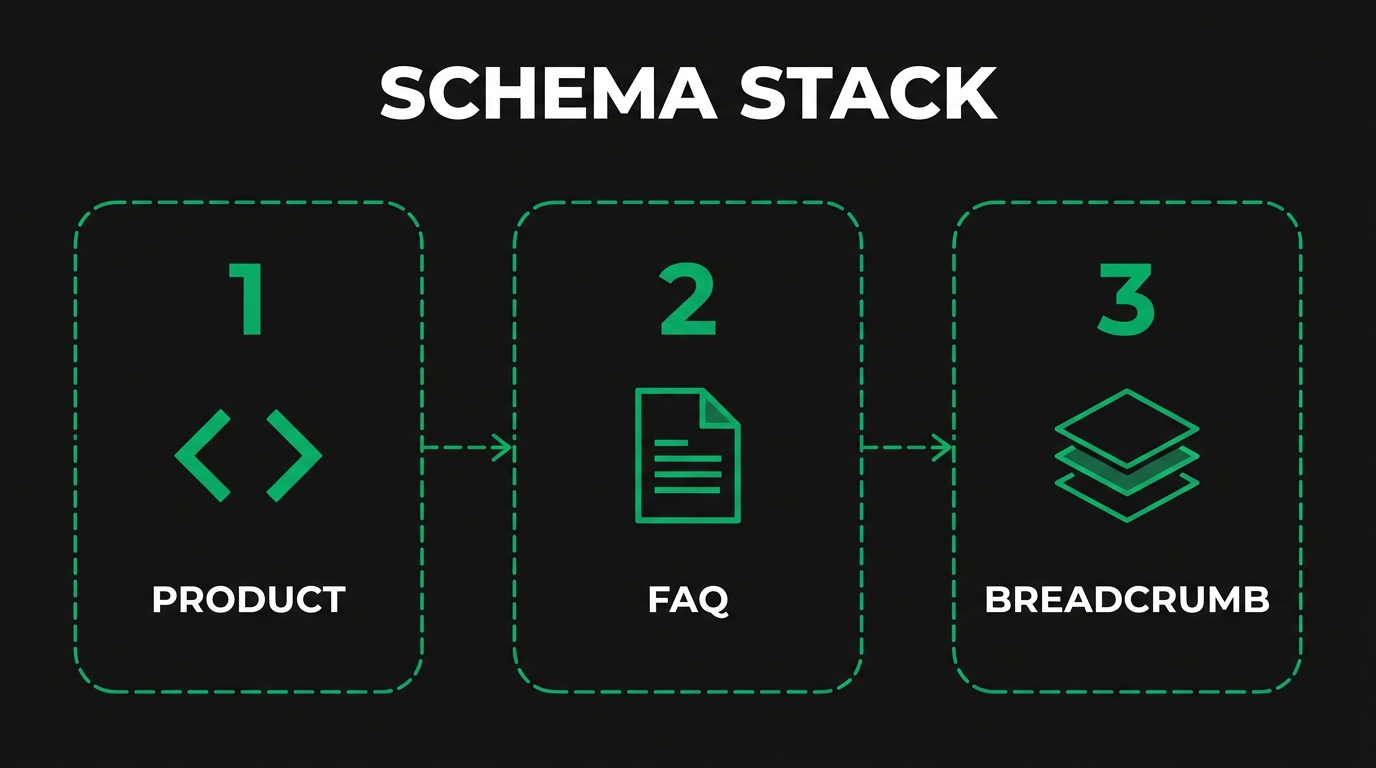
The catalog of schema types covers Product, Offer, AggregateOffer, Review, QAPage, BreadcrumbList, Organization, and specialized vocabulary that maps cleanly to processes, materials, tolerances, and certifications.
The SEO benefits section quantifies how schema earns rich results, wins long-tail procurement queries, and feeds AI Overviews and LLM citations that now influence a meaningful share of B2B discovery.
The buyer-experience portion explains how engineers and procurement managers scan structured spec data during supplier evaluation and RFQ workflows.
Implementation guidance describes JSON-LD templating against a PIM, validation at scale, and the mistakes that silently disqualify rich results on large catalogs.
The results section frames the KPIs, the time horizon, and the case-study patterns we see across manufacturing e-commerce deployments.
What Is Schema Markup and Why Does It Matter for Industrial E-commerce?
Schema markup is standardized structured data that labels every product attribute, specification, and offer so search engines and AI systems can parse industrial catalogs correctly. The sub-sections below explain how search engines consume it, why it matters for complex SKUs, and how it differs from conventional on-page SEO.
How Does Structured Data Help Search Engines Understand Product Catalogs?
Structured data helps search engines understand product catalogs by giving every attribute (name, SKU, GTIN, brand, price, availability, aggregateRating) an explicit, machine-readable label instead of forcing parsers to infer meaning from free text. Crawlers then map those labels to entities in a product graph and expose them as rich results, AI Overviews, and shopping surfaces.
Large industrial catalogs, where every page carries dozens of engineering attributes, benefit the most because unlabeled spec tables are the single largest source of missed queries.
Why Is Schema Especially Important for Complex Industrial SKUs?
Schema is especially important for complex industrial SKUs because a single part number can carry material grade, diameter, tolerance class, finish, certification, and lead time that buyers filter against, and prose alone hides those attributes from crawlers. Structured properties such as `material`, `gtin`, `mpn`, `isAccessoryOrSparePartFor`, and `additionalProperty` expose each facet as its own indexable fact, which is what procurement queries actually match.
How Does Schema Differ from Standard On-Page SEO?
Schema differs from standard on-page SEO because on-page SEO optimizes human-readable signals (title tags, headings, copy, internal links) while schema provides a parallel machine-readable layer that declares entity identity, properties, and relationships in JSON-LD. On-page SEO tells Google what the page is about; schema tells Google exactly what the page is, a Product, an Offer, an Organization, a BreadcrumbList, and which verified attributes apply.
Both layers work together; neither replaces the other. Accurate schema reinforces ranking signals only when the visible copy already supports the same claims.
Which Types of Schema Matter Most for Industrial E-commerce Sites?
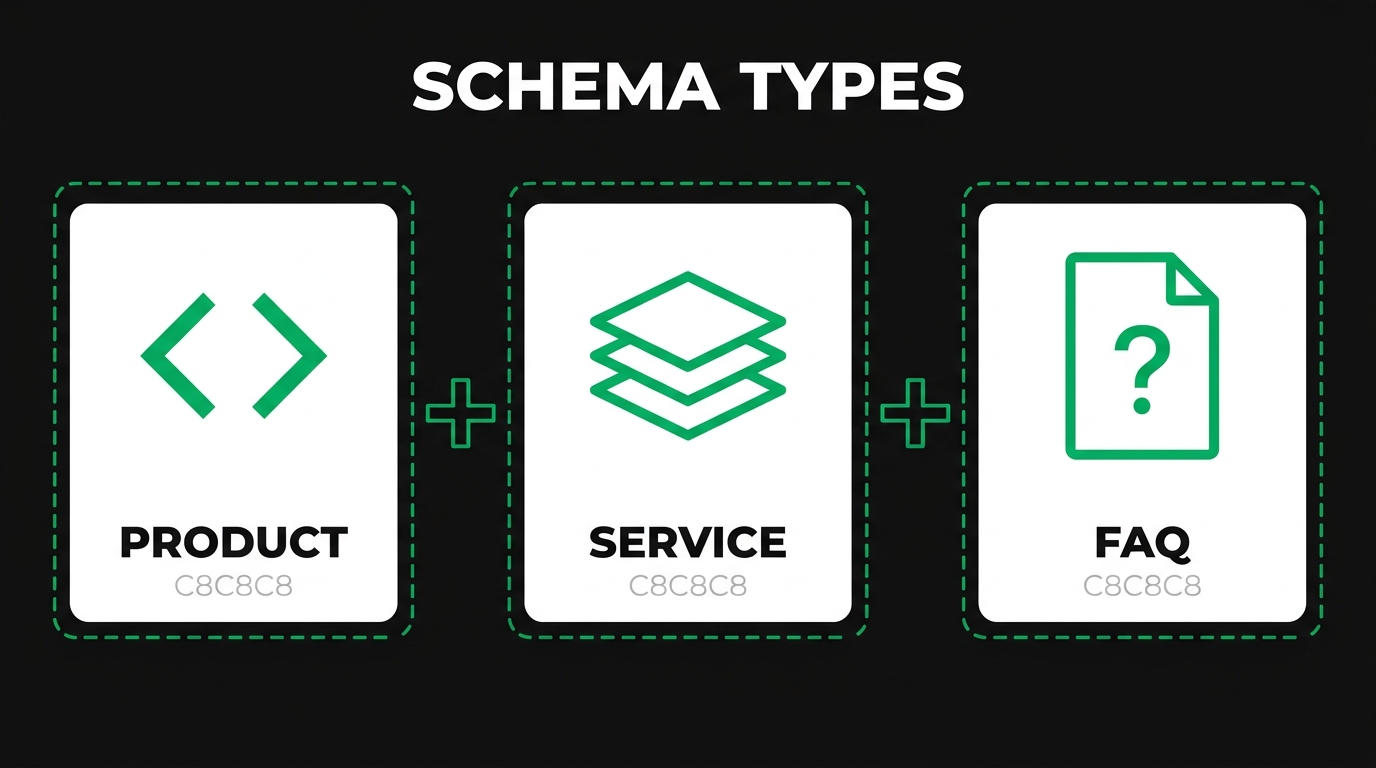
The types of schema that matter most for industrial e-commerce sites are Product, Offer, AggregateOffer, Review, AggregateRating, QAPage, BreadcrumbList, Organization, and specialized manufacturing vocabulary. The sub-sections below rank each by procurement-intent impact and explain where each belongs across a large catalog.
How Does Product Schema Improve Visibility for Industrial Parts?
Product schema improves visibility for industrial parts by exposing SKU, GTIN, MPN, brand, material, and `isAccessoryOrSparePartFor` as discrete indexable fields that procurement queries match against. When Google parses those values, it can connect a long-tail query like "SS316 1/4-20 hex bolt AS9100" to the exact part page, which a title tag alone cannot achieve.
Picking the right tooling matters at catalog scale; review the best schema markup plugins for industrial sites before settling on an approach.
Populate `brand` and `material` before anything else; those two fields move the most long-tail rankings.
When Should You Use Offer, AggregateOffer, and Price Schema?
Use Offer for a single SKU at one price, AggregateOffer when a product lists multiple seller prices or a price range, and UnitPriceSpecification when pricing varies by quantity, length, or weight. Industrial distributors commonly show tiered pricing and minimum order quantities, which map cleanly to `referenceQuantity` and UnitPriceSpecification.
Quote-only SKUs should still expose availability and lead time even without a published price.
Why Are Review, AggregateRating, and QAPage Schemas Useful for Industrial Buyers?
Review, AggregateRating, and QAPage schemas are useful for industrial buyers because procurement decisions hinge on peer validation and application-specific questions that a static spec sheet cannot answer. A QAPage tied to a bearing SKU can surface answers about load ratings or lubrication compatibility directly in the SERP, and AggregateRating (when reviews are first-party) reinforces trust during supplier evaluation.
Never aggregate or syndicate reviews from third parties; Google disqualifies those rich results.
How Can BreadcrumbList and Organization Schema Strengthen Site Architecture?
BreadcrumbList and Organization schema strengthen site architecture by exposing the category hierarchy and the publisher identity to search engines in a single machine-readable layer. BreadcrumbList signals the path from category to subcategory to SKU, which reinforces faceted navigation and prevents orphan-page misreads on large catalogs.
Pair Organization with `sameAs` links to Wikipedia, LinkedIn, and industry directories to ground the brand in the Knowledge Graph.
Which Specialized Schemas Apply to Manufacturers and Distributors?
The specialized schemas that apply to manufacturers and distributors include ProductGroup for parametric families, `isAccessoryOrSparePartFor` for BOM relationships, `additionalProperty` for custom specs, HowTo for installation procedures, and FAQPage for application questions. Component catalogs carry parent-child structures that ProductGroup and `isAccessoryOrSparePartFor` express natively, while finished-goods catalogs rarely need them, making the distinction between schema for industrial components vs finished products a strategic choice, not a cosmetic one.
Schema selection sets up the SEO benefits quantified next.
What SEO Benefits Does Schema Markup Deliver for Industrial E-commerce?
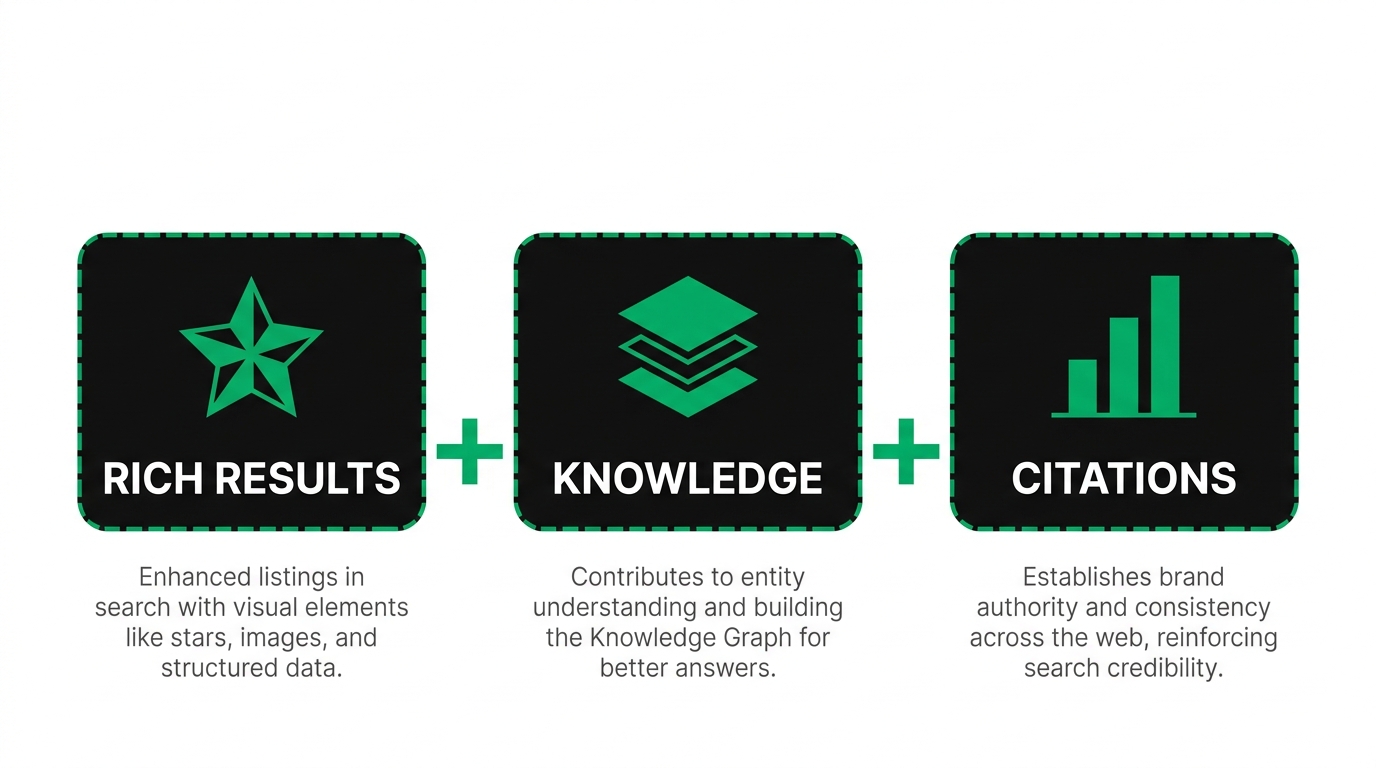
Schema markup delivers SEO benefits that include rich result eligibility, stronger long-tail rankings, AI search visibility, and improved on-site engagement. The sub-sections below quantify each lever and explain how industrial catalogs compound them over time.
How Does Schema Increase Click-Through Rates from Rich Results?
Schema increases click-through rates from rich results by qualifying pages for enhanced SERP treatments that occupy more visual real estate than a standard blue link. Product rich results surface price, availability, rating, and image directly in the snippet, which pulls click share from competitors with plain listings.
Why Does Schema Improve Rankings for Long-Tail Procurement Queries?
Schema improves rankings for long-tail procurement queries because it gives Google explicit attribute matches instead of relying on keyword density in body copy. Procurement queries routinely combine material, process, tolerance, and certification, for example "5-axis CNC titanium aerospace bracket AS9100," and Product schema exposes each facet as a structured claim that Google can match against the exact query terms.
That precision converts low-volume, high-intent queries into qualified RFQ traffic that shorter-tail category pages cannot earn on their own.
How Does Schema Support AI Search and LLM Citation Visibility?
Schema supports AI search and LLM citation visibility by publishing clean entity facts in the same subject-predicate-object form that language models use internally, which makes the page easier to extract and quote. Google's AI Overviews draw answers from pages with well-structured content, and schema is the most reliable signal that a page states facts unambiguously.
As buyers shift from classical SERPs to AI answers, schema becomes the admission ticket for citation, not a bonus.
Can Schema Reduce Bounce Rate and Improve On-Site Engagement?
Yes, schema can reduce bounce rate and improve on-site engagement because pre-qualified clicks arrive with accurate expectations set in the SERP. Buyers who already saw price, availability, and rating in the rich result land ready to continue the journey, not to verify a headline.
Those engagement gains feed directly into the buyer-experience signals covered next.
How Does Schema Markup Enhance the Buyer Experience on Industrial Sites?
Schema markup enhances the buyer experience on industrial sites by making specifications, certifications, and availability scannable at every stage of the procurement journey. The sub-sections below cover why engineers rely on structured data, how schema exposes engineering attributes, and the role schema plays inside supplier evaluation and RFQ workflows.
Why Do Engineers and Procurement Managers Rely on Structured Data?
Engineers and procurement managers rely on structured data because their workflows demand verifiable, filterable facts rather than marketing copy, and structured data is the only layer that exposes attributes to search, internal site search, and third-party procurement tools simultaneously. Engineers download datasheets; purchasing managers compare MOQ, lead time, and price.
How Does Schema Help Display Specifications, Tolerances, and Certifications?
Schema helps display specifications, tolerances, and certifications by mapping each engineering attribute to a Schema.org property such as `material`, `additionalProperty`, `hasCertification`, or `isConsumableFor`. A titanium bracket can expose `material` as "Ti-6Al-4V," `additionalProperty` for tolerance as "plus or minus 0.005 in," and a certification reference for AS9100 or NADCAP in the same JSON-LD block.
The structured representation lets Google pull specs into the product rich result and lets LLMs cite them accurately.
What Role Does Schema Play in Supplier Evaluation and RFQ Workflows?
Schema plays the role in supplier evaluation and RFQ workflows of exposing the qualification signals buyers use to shortlist vendors: certifications, capacity, lead time, and geographic coverage. A buyer evaluating a CNC machining supplier scans for AS9100, ISO 9001, IATF 16949, or NADCAP before sending an RFQ, and Organization schema with `hasCredential` and `areaServed` compresses that evaluation into a single SERP impression. Manufacturing SEO Agency builds procurement-intent keyword architecture around exactly these signals, mapping RFQ-stage queries to process, material, and certification combinations.
Those workflow gains make schema worth the implementation lift covered next.
How Do You Implement Schema Markup on an Industrial E-commerce Site?
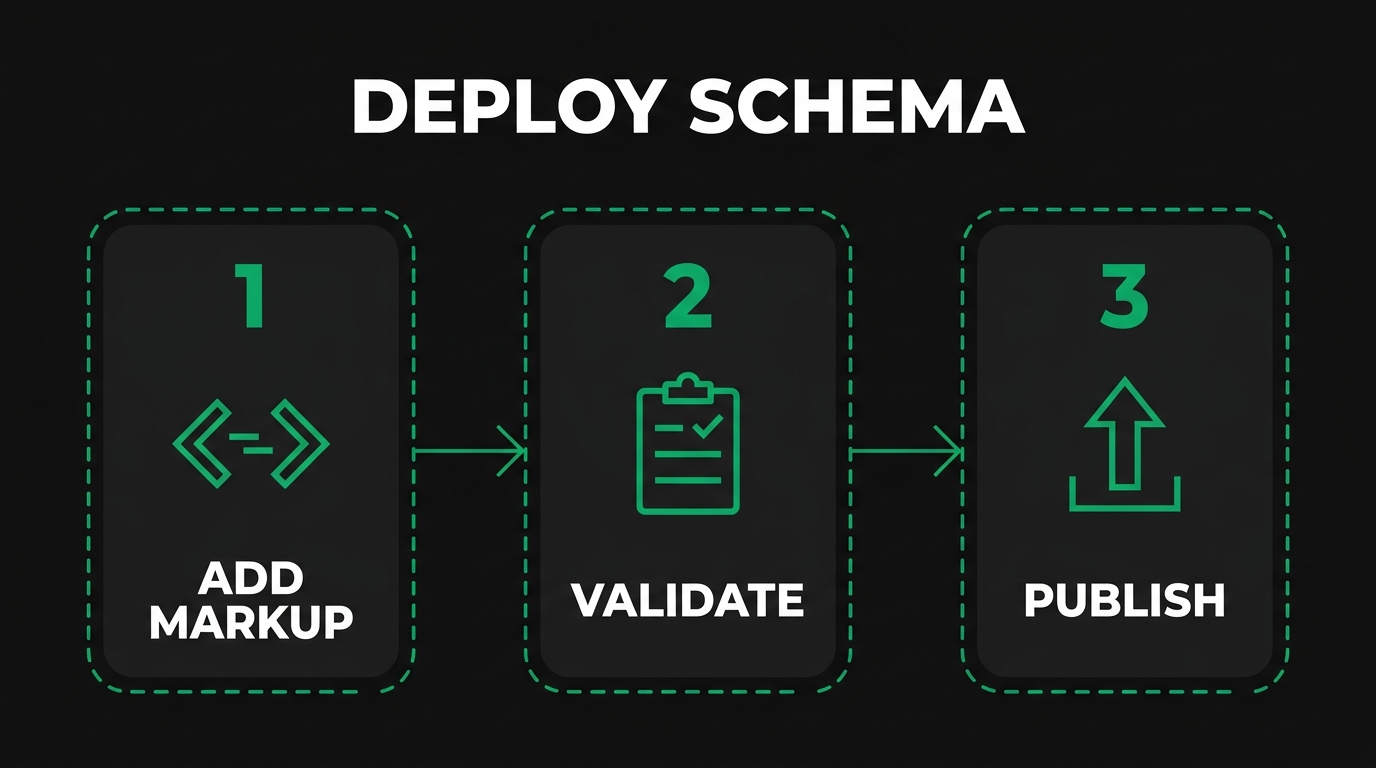
You implement schema markup on an industrial e-commerce site by choosing JSON-LD, templating against a PIM, validating at scale, and running continuous drift checks. The sub-sections below walk through methods, validation, the mistakes catalogs repeat, and how to keep markup accurate once inventory moves.
Which Implementation Methods Work Best for Large Product Catalogs?
The implementation methods that work best for large product catalogs are PIM-driven JSON-LD templates rendered server-side, edge-rendered JSON-LD for headless storefronts, and schema generators embedded in the CMS. Parametric families, accessories, and spare parts map cleanly to ProductGroup and `isAccessoryOrSparePartFor`, which avoids duplicating data across variants. Teams new to the pattern can follow our step-by-step guide to product schema before writing a template.
How Should You Validate Schema Across Thousands of SKUs?
You validate schema across thousands of SKUs by combining three layers: unit tests against the JSON-LD template, crawl-based sampling of rendered pages, and live monitoring inside Google Search Console Enhancements. Spot-test edge cases (out-of-stock, price-on-request, discontinued) because those states break required properties most often.
Weekly sampling catches most drift; pair it with robots.txt best practices industrial sites so validator traffic and Googlebot both reach every SKU template.
What Common Schema Mistakes Should Industrial Sites Avoid?
The common schema mistakes industrial sites should avoid are missing required properties, stale availability, mismatched offer counts, inflated or syndicated reviews, and marking up content that is not visible on the page. Currency mismatches (USD versus EUR storefronts), incorrect GTIN formats, and `additionalProperty` values that drift from the visible spec table also disqualify rich results quietly.
Performance disqualifies rich results too; reference our playbook on how to improve core web vitals industrial sites before blaming schema.
How Do You Keep Schema Accurate as Inventory and Specs Change?
You keep schema accurate as inventory and specs change by binding the JSON-LD template directly to the PIM or ERP so availability, price, and attribute updates propagate automatically. Scheduled ETL from ERP to PIM to site guarantees that the machine-readable layer mirrors the visible layer on every SKU. Pair the data contract with a deliberate internal linking strategy for large industrial sites so crawlers reach new SKUs quickly and re-score schema the same week it ships.
Those implementation choices determine the measurable results covered next.
What Results Can Industrial E-commerce Sites Expect from Schema Markup?
The results industrial e-commerce sites can expect from schema markup include higher rich result coverage, improved long-tail impressions, stronger RFQ conversion, and clearer attribution in AI answers. The sub-sections below cover the KPIs worth tracking, realistic timing, and the case-study patterns we see across manufacturing catalogs.
Which KPIs Should You Track to Measure Schema Impact?
The KPIs you should track to measure schema impact are rich result coverage, impressions, click-through rate, average position, RFQ conversion rate, and pipeline value per organic session. Pair those search-side KPIs with RFQ-start rate and closed-won revenue from the CRM so schema work ties to pipeline, not vanity rankings.
How Long Does It Take to See SEO Gains from Schema?
SEO gains from schema typically take four to twelve weeks to appear for established catalogs and up to six months for new domains, because gains depend on crawl frequency, catalog size, and the competitive density of the keyword set. Week one to two brings re-crawl and re-indexing. Week three to six surfaces rich results. Month two to six compounds into long-tail ranking gains and AI citation pickup.
What Do Real Manufacturing E-commerce Case Studies Show?
Real manufacturing e-commerce case studies show that disciplined schema rollouts increase rich result coverage, long-tail impressions, and RFQ volume within a single quarter, especially on multi-facility catalogs that template JSON-LD against the PIM. When evaluating vendors, benchmark against the top manufacturing marketing firms that publish their schema methodology rather than ones that hide it behind retainers.
The catalogs that win treat schema as an engineering project with PIM ownership, which sets up the engagement path covered next. Manufacturing SEO Agency has delivered this engineering-led approach across 127+ manufacturing clients with a documented 340% average organic traffic increase and $18M+ in client-attributed revenue.
How Should You Approach Schema for Industrial E-commerce with Manufacturing SEO Agency?
You should approach schema for industrial e-commerce with Manufacturing SEO Agency by starting with a technical audit, mapping PIM fields to Schema.org properties, and tying coverage to RFQ pipeline. The sub-sections below cover the service fit and the key takeaways from the full guide.
Can Manufacturing SEO Agency's Technical SEO Service Solve Your Schema Gaps?
Yes, Manufacturing SEO Agency's technical SEO service can solve schema gaps by pairing a full technical crawl with remediation tuned for manufacturing intent. Manufacturing SEO Agency delivers manufacturing schema and technical seo that covers Schema.org validation, PIM-to-JSON-LD templating, crawl health, and page experience for industrial catalogs. Engagements start at $5,000 per month and scale with catalog size. Manufacturing SEO Agency also reviews schema markup services manufacturing workflows end-to-end before remediation.
What Are the Key Takeaways About Schema on Industrial E-commerce Sites?
The key takeaways about schema on industrial e-commerce sites are that structured data translates engineering attributes into ranking and citation signals, specialized Schema.org vocabulary fits manufacturing catalogs better than generic ecommerce markup, rich results and AI answers both depend on validated JSON-LD, implementation must bind to the PIM to stay accurate at scale, and measurable gains arrive within four to twelve weeks when execution is clean.
Manufacturing SEO Agency runs this exact playbook for industrial-only clients across CNC, injection molding, fabrication, aerospace, medical, and automotive supply chains.