
An internal linking strategy for large industrial sites is a documented system that connects category, process, material, certification, application, and location pages with crawlable hyperlinks so search engines and procurement buyers reach every revenue page within a few clicks. It governs anchor text, link depth, hierarchy, and equity flow across thousands of URLs in a manufacturing catalog.
This guide covers why internal linking matters at industrial scale, the core components of a linking strategy, how to plan links across thousands of pages, the right site architecture for large catalogs, scaled implementation tactics, schema and structured data reinforcement, common mistakes to avoid, performance measurement, multi-facility local linking, and how Manufacturing SEO Agency approaches the work.
Internal linking matters because it directly controls crawl budget, distributes PageRank, lifts rankings for procurement queries, and shortens the path engineers and buyers take to spec sheets and capability pages.
The core components include hub-and-spoke topical models, pillar pages, structured anchor text, controlled link depth, and balanced links per page across the catalog.
Planning across thousands of manufacturing pages requires a link-graph audit, orphan detection, procurement-intent keyword mapping, equity prioritization, and a repeatable workflow.
Site architecture for industrial catalogs sets the rules for category and product linking, faceted navigation handling, industry-application crosslinks, multi-facility connections, and crawlability.
Scaled implementation uses programmatic linking modules, related-content blocks, breadcrumb reinforcement, contextual in-body links, and publish-time link insertion.
Schema markup and structured data reinforce the link graph through BreadcrumbList, Product, plugin tooling, and entity references that strengthen knowledge graph signals.
Common mistakes such as generic anchors, footer stuffing, broken redirects, orphaned spec sheets, and inconsistent URLs erode authority on industrial sites.
Performance measurement tracks linking KPIs, crawl logs, click depth, page-level authority, and audit cadence.
Local SEO linking ties plant location pages to capabilities, service areas, and state-region-city pages without duplication. Manufacturing SEO Agency applies this entire framework as part of a manufacturing technical SEO discipline built for multi-facility catalogs.
Why Does Internal Linking Matter for Large Industrial Manufacturing Websites?
Internal linking matters for large industrial manufacturing websites because it controls how Google crawls thousands of process and product URLs, how PageRank flows to revenue pages, and how engineers reach spec sheets. The following sub-sections cover crawl budget, link equity, ranking impact, and engineer experience.
How Does Internal Linking Influence Crawl Budget on Sites With Thousands of Product Pages?
Internal linking influences crawl budget on sites with thousands of product pages by deciding which URLs Googlebot reaches, how often, and how quickly new pages enter the index. Industrial catalogs with tens of thousands of part numbers and material variants compete for finite crawler attention, so the link graph decides which URLs get fetched first.
Pages that receive more internal links from the homepage and high-authority hubs signal importance, pulling Googlebot deeper into the catalog. Adopting the basics of seo friendly content tightens that signal further.
How Does Internal Linking Distribute PageRank and Link Equity Across a Manufacturing Catalog?
Internal linking distributes PageRank and link equity across a manufacturing catalog by sending a fractional share of each page's authority through every outbound `<a>` link to its destination.
How Does Internal Linking Affect Rankings for Process, Material, and Certification Queries?
Internal linking affects rankings for process, material, and certification queries by feeding Google strong topical signals through descriptive anchor text and tight clusters of supporting pages. Engineers search for specific terms such as 5-axis CNC machining, 6061-T6 aluminum, or AS9100 certification, and ranking for these procurement queries depends on consistent internal anchors that match the target page's intent.
How Does Internal Linking Improve User Experience for Engineers and Procurement Buyers?
Internal linking improves user experience for engineers and procurement buyers by shortening the path from landing page to RFQ-ready spec sheet, capability detail, or certification proof. Buyers arrive looking for tolerances, material grades, and lead times, and contextual links surface adjacent answers without forcing repeated navigation. Procurement managers comparing suppliers value catalogs where related processes, applications, and case studies sit one click away. Strong linking guides a procurement journey to the request quote action.
What Are the Core Components of an Internal Linking Strategy for Industrial Sites?
The core components of an internal linking strategy for industrial sites are a topical hub-and-spoke model, pillar pages, structured anchor text, controlled link depth, and balanced link counts. The following sub-sections walk through each component as it applies to a manufacturing catalog.
What Is a Topical Hub-and-Spoke Model and How Does It Apply to Manufacturing Catalogs?
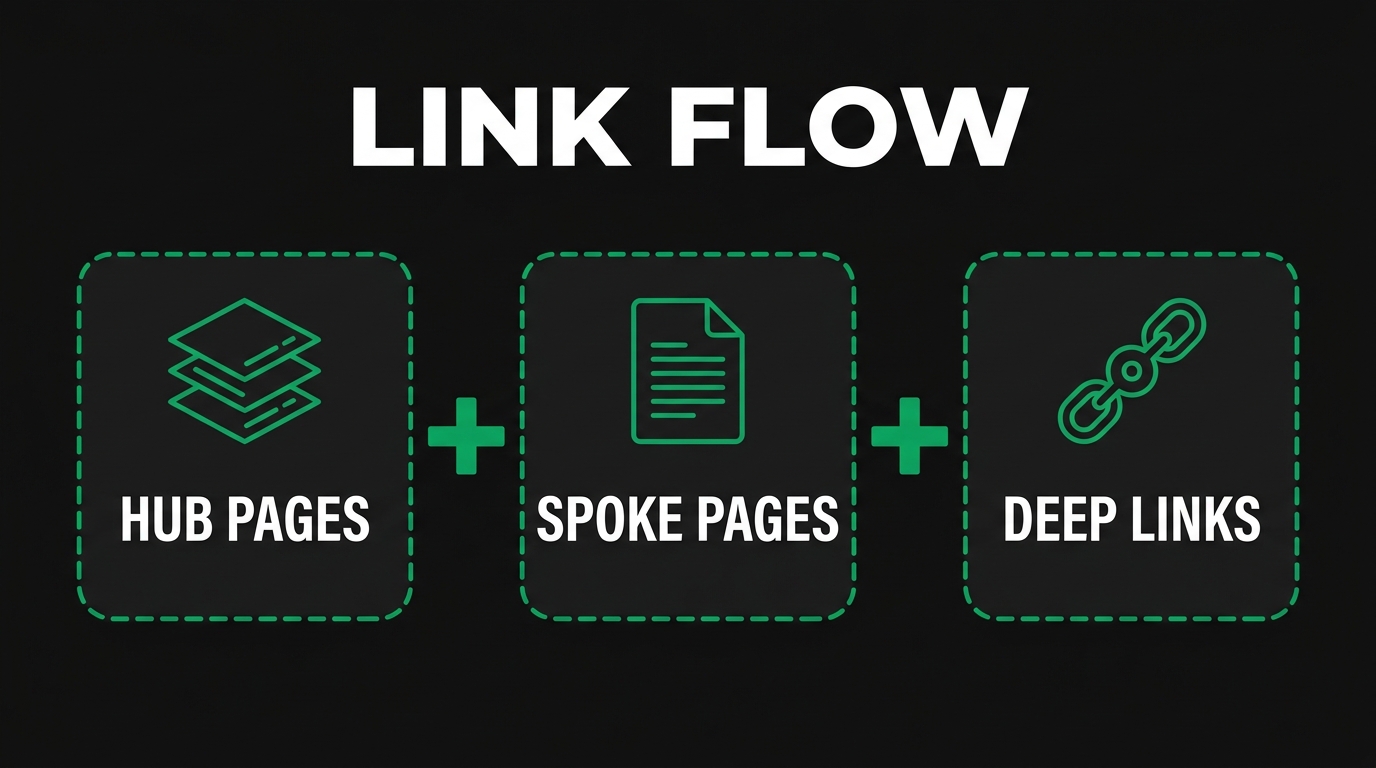
A topical hub-and-spoke model is a content architecture where one comprehensive hub page links outward to many narrower spoke pages, and each spoke links back to the hub and to sibling spokes within the same topic cluster. Applied to a manufacturing catalog, the hub becomes a process page such as injection molding, with spokes covering materials (ABS, polycarbonate), tolerances, mold types, and industries served.
What Role Do Pillar Pages Play in Linking Out to Process and Material Subpages?
Pillar pages play the role of broad topical anchors that link outward to every process and material subpage covering a discipline in depth. A CNC machining pillar links to subpages on 3-axis, 4-axis, 5-axis, Swiss machining, and material-specific machining pages such as titanium or Inconel. Each subpage answers a narrower procurement query while the pillar consolidates equity. Treating pillars as the catalog's first-tier landing pages keeps commercial pages within two clicks of the homepage and lifts crawl frequency on the connected subpages.
How Should Anchor Text Be Structured Across Process, Material, and Certification Links?
Anchor text should be structured across process, material, and certification links using descriptive noun phrases that match the target page's primary keyword, varied with synonyms and modifiers to avoid robotic repetition.
Process anchors name the process plus a qualifier such as "5-axis CNC machining titanium." Material anchors include grade and form; certification anchors include the standard with industry context such as "AS9100 aerospace machining." This pattern aligns with how to improve core web vitals industrial sites when both render fast.
What Link Depth Should Critical Industrial Pages Sit At From the Homepage?
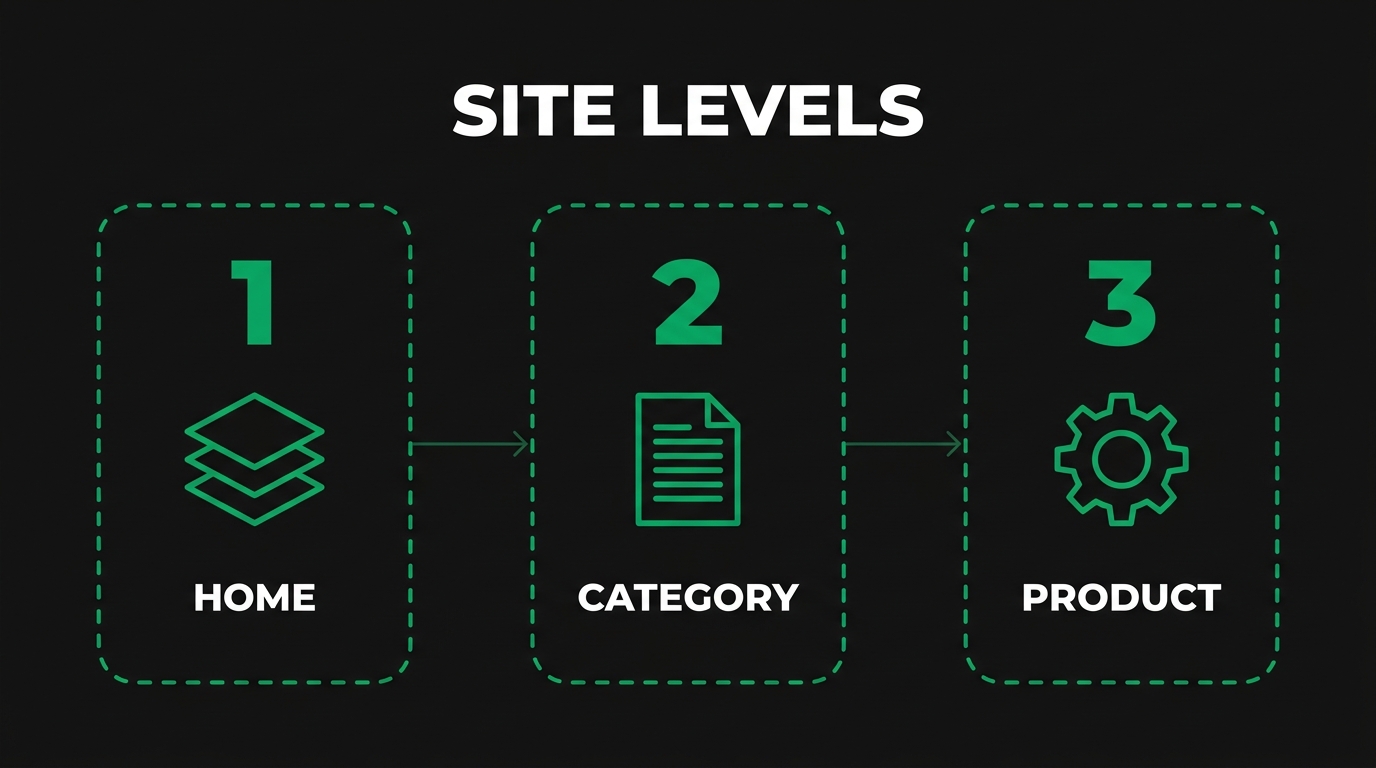
Critical industrial pages should sit at one to three clicks from the homepage so Googlebot reaches them quickly and procurement buyers find them with minimal navigation. Capability pages, primary process pages, and high-margin product categories belong at depth one or two, linked directly from the main navigation or homepage hubs. Spec sheets, application case studies, and technical detail pages sit at depth two or three through category links. Pages buried deeper than four clicks lose crawl frequency and rarely accumulate enough equity to rank for competitive procurement queries.
How Many Internal Links Should Each Page Send and Receive at Scale?
Each page should send and receive enough internal links to justify its commercial role, typically 30 to 100 outbound links and inbound counts proportional to the page's revenue priority.
Industrial homepages and process hubs should receive the highest inbound counts, while individual spec sheets need at least three to five inbound links from related pages.
How Do You Plan Internal Links for Thousands of Manufacturing Pages?
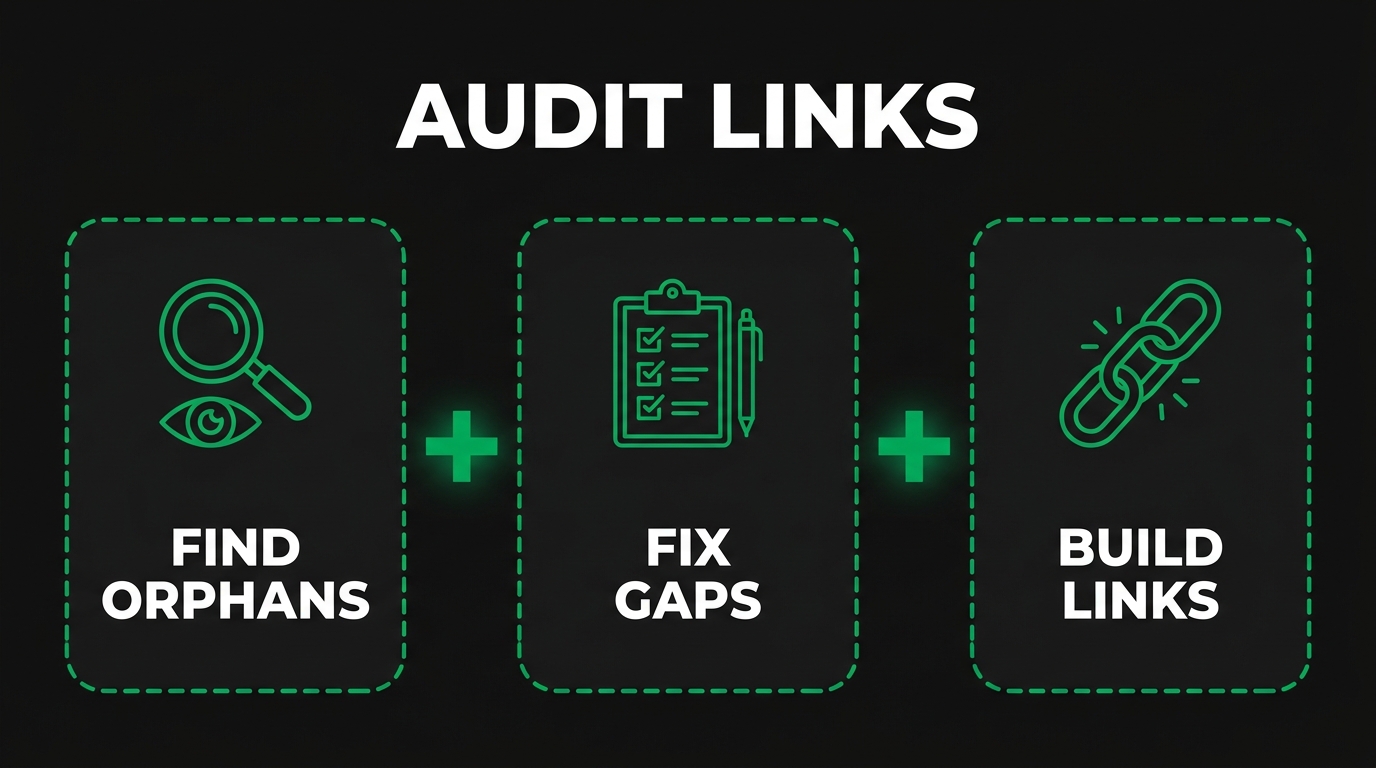
You plan internal links for thousands of manufacturing pages by auditing the current link graph, identifying orphans, mapping procurement-intent clusters, prioritizing equity, and codifying a repeatable workflow. Each step below scales from a few hundred URLs to enterprise catalogs of tens of thousands.
How Do You Audit the Current Internal Link Graph on a Large Industrial Site?
You audit the current internal link graph on a large industrial site by crawling every URL, exporting source and target pairs, and grouping links by template, depth, and topical cluster. The audit captures inbound link counts per page, anchor text patterns, broken internal links, redirect chains, and pages that receive zero inbound links. Crawlers such as Screaming Frog, Sitebulb, and OnCrawl surface this data, while server log analysis confirms whether Googlebot follows the discovered links. Combine the audit with site architecture best practices for large manufacturing catalogs for a sharper baseline.
How Do You Identify Orphan Pages and High-Value Pages With Insufficient Inbound Links?
You identify orphan pages and high-value pages with insufficient inbound links by joining the full URL inventory from the XML sitemap and CMS database against the crawl's discovered URL set, then flagging URLs absent from the link graph. Orphans appear in the sitemap but receive zero inbound internal links, so Googlebot can only find them through the sitemap submission. High-value pages with weak link support appear when commercial URLs (capabilities, certifications, RFQ landing pages) receive fewer than five inbound links. Tag each orphan with its target keyword cluster, then assign it inbound links from the most relevant hub and three sibling spokes.
How Do You Map Procurement-Intent Keyword Clusters to Internal Link Targets?
You map procurement-intent keyword clusters to internal link targets by grouping queries into stages of the buyer journey, then assigning each cluster to a single canonical landing page with supporting links from cluster siblings. Material research queries map to material pages, supplier evaluation queries map to capability and certification pages, and RFQ-stage queries map to contact, quote request, and case study pages.
How Do You Prioritize Which Pages Receive the Most Internal Link Equity?
You prioritize which pages receive the most internal link equity by ranking URLs against a scoring matrix of revenue contribution, search volume, conversion rate, and existing rankings.
Pages tied to the highest revenue per visitor receive direct homepage and pillar links. Mid-tier pages get hub links and contextual mentions. Low-priority pages stay reachable through breadcrumbs without consuming hub link slots.
How Do You Build a Linking Workflow That Scales Across Tens of Thousands of URLs?
You build a linking workflow that scales across tens of thousands of URLs by combining programmatic templates, editorial guidelines, and continuous audits inside the CMS. Programmatic modules generate breadcrumb, related-product, and category links from structured catalog data. Editorial guidelines tell content writers which target pages to link from new articles using approved anchor text. Quarterly audits surface new orphans, broken links, and equity imbalances. Documenting this workflow keeps linking consistent as catalogs add SKUs, locations, and process variants over time.
What Is the Best Site Architecture for Internal Linking on Large Industrial Catalogs?
The best site architecture for internal linking on large industrial catalogs is a shallow hierarchical structure where category, subcategory, and product pages connect through breadcrumbs, navigation menus, and contextual links that mirror procurement logic. The sub-sections below cover taxonomy, faceted navigation, application crosslinks, multi-facility patterns, and crawlability.
How Should Category, Subcategory, and Product Pages Be Linked in a Manufacturing Taxonomy?
Category, subcategory, and product pages should be linked in a manufacturing taxonomy through a top-down hierarchy where each layer links downward to its children and back upward to its parent.
Top categories sit one click from the homepage; subcategories sit one click below; product pages sit at depth three, linked from their direct subcategory and related sibling subcategories. Reference site architecture best practices for large manufacturing catalogs for fuller blueprints.
How Do Faceted Navigation and Filter Pages Affect Internal Link Equity?
Faceted navigation and filter pages affect internal link equity by multiplying URL combinations that compete for crawl budget and dilute equity across near-duplicate pages.
Block low-value facet combinations through robots.txt, mark them noindex, and use canonical tags to consolidate equity on the canonical category page. Following robots.txt best practices industrial sites prevents wasted crawler attention on filter noise.
How Should Industry-Application Pages Link to Process and Material Pages?
Industry-application pages should link to process and material pages by including contextual links inside the body content wherever a process or material is named, plus a structured "related capabilities" block at the bottom of the application page. An aerospace application page covering engine bracket production links to 5-axis CNC machining, AS9100 certification, and Inconel 718 material pages.
How Should Multi-Facility or Multi-Location Pages Be Linked Across the Site?
Multi-facility or multi-location pages should be linked across the site through a central locations hub, location-to-capability cross-references, and breadcrumbs that anchor each location in its state and region context.
Each location page links to the capabilities offered at that plant, the certifications held by that facility, and any case studies tied to local clients.
Why Does a Logical Site Architecture Matter for Manufacturing Catalog Crawlability?
A logical site architecture matters for manufacturing catalog crawlability because Googlebot reaches pages through links, and a clear hierarchy means fewer wasted crawls on duplicate parameter URLs and orphaned templates. Manufacturers running thousands of part numbers face crawl waste when categories nest too deeply or when filter URLs explode without canonicalization. A logical hierarchy concentrates crawler attention on commercial pages, accelerates indexation of new SKUs, and gives buyers a navigation pattern that matches how they search.
How Do You Implement Internal Linking at Scale Across an Industrial Site?
You implement internal linking at scale across an industrial site by combining programmatic CMS modules with editorial controls that surface related content, breadcrumbs, in-body links, and publish-time link insertion. The sub-sections below cover each implementation pattern.
How Do You Use Programmatic Linking Modules in CMS Platforms Like WordPress or Magento?
You use programmatic linking modules in CMS platforms like WordPress or Magento by configuring template logic that pulls related URLs from category, tag, or product attribute fields in the database, then renders them as `<a>` links inside the page template. WordPress sites use plugins or custom queries to surface related posts by taxonomy. Magento uses related, upsell, and cross-sell product associations stored against each SKU.
How Do You Use Related-Content and "You May Also Need" Modules to Surface Adjacent Pages?
You use related-content and "You May Also Need" modules to surface adjacent pages by querying the catalog for items sharing material, process, industry, or certification attributes with the current page, then displaying three to six links in a structured block. A 5-axis CNC machining page surfaces related modules linking to titanium machining, AS9100 capabilities, and aerospace bracket case studies. The module gives buyers a logical next step and feeds Googlebot fresh internal links from every product view. Curate the rules so each module surfaces commercially relevant pages, not random catalog noise.
How Do You Use Breadcrumbs to Reinforce Hierarchical Linking and Schema Signals?
You use breadcrumbs to reinforce hierarchical linking and schema signals by rendering a visible breadcrumb trail at the top of every catalog page and wrapping it in BreadcrumbList structured data.
Each breadcrumb link points to a parent page, giving Googlebot a deterministic hierarchy signal and giving buyers a one-click path back to broader categories.
How Do You Use Contextual In-Body Links to Pass Topical Relevance Between Long-Form Pages?
You use contextual in-body links to pass topical relevance between long-form pages by embedding descriptive anchor text inside paragraphs that genuinely discuss the linked topic, rather than at the foot of the page.
Contextual links carry stronger relevance weight than navigational links because they sit inside topical prose and inherit surrounding semantic context.
How Do You Use a Content Management Workflow to Add Internal Links to New Pages on Publication?
You use a content management workflow to add internal links to new pages on publication by requiring every draft to include an internal-link checklist before it can be published. Editors review whether the new page links to its parent hub, three sibling pages, and at least one supporting blog post, and whether at least three existing pages have been updated to link to the new page. Build the checklist into the editorial calendar and the CMS publish form so it cannot be skipped. This single discipline prevents new pages from launching as orphans.
How Do You Use Schema Markup and Structured Data to Strengthen Internal Linking?
You use schema markup and structured data to strengthen internal linking by adding BreadcrumbList, Product, and entity-reference markup that mirrors the visible link graph and gives Google explicit hierarchy signals. The sub-sections below cover each schema pattern. The case for schema-led linking is laid out in why use schema on industrial e-commerce sites.
How Do BreadcrumbList and ItemList Schema Reinforce Internal Link Hierarchy?
BreadcrumbList and ItemList schema reinforce internal link hierarchy by giving Google explicit machine-readable trails of parent-child URL relationships that match the visible breadcrumb on the page.
Each ListItem in BreadcrumbList declares position, name, and item URL, building a clear ladder from homepage to category to product. ItemList works similarly for ranked or curated lists such as featured capabilities. The markup confirms hierarchy intent the link graph already implies.
How Does Product Schema Connect Industrial Catalog Pages to Their Parent Categories?
Product schema connects industrial catalog pages to their parent categories by exposing the category property, which informally indicates the catalog hierarchy using greater-than signs or slashes.
A 5-axis CNC titanium part declares category "Machining > 5-Axis CNC > Titanium" so Google parses the lineage even before crawling the breadcrumb. Combined with BreadcrumbList, Product schema also exposes brand, manufacturer, and material properties that ground the page in entity-level signals.
Which Schema Plugins Help Industrial Manufacturers Implement Linking-Friendly Structured Data?
Schema plugins that help industrial manufacturers implement linking-friendly structured data are mature WordPress and CMS extensions that auto-generate BreadcrumbList, Product, Organization, and FAQ markup based on existing taxonomy fields. Tools such as Schema App, Yoast SEO, Rank Math, and All in One SEO render structured data without manual JSON-LD coding for every page.
The best schema markup plugins for industrial sites review compares the leading options.
How Do Knowledge Graph Connections and SameAs References Strengthen Entity Linking?
Knowledge graph connections and SameAs references strengthen entity linking by giving Google verified pointers from your pages to authoritative entity records on Wikipedia, Wikidata, LinkedIn, and industry standards bodies. Each `sameAs` URL inside Organization, Person, or Product schema confirms that the entity on your page is the same entity recognized in Google's knowledge graph. A manufacturer's Organization schema referencing its Wikipedia page, trade association membership, and ISO certification body grounds the brand inside Google's entity index. Stronger entity grounding lifts visibility for branded procurement queries and AI-generated answer placements.
What Are the Most Common Internal Linking Mistakes Made by Large Industrial Sites?
The most common internal linking mistakes made by large industrial sites are generic anchor text, footer link stuffing, broken or redirected links, orphaned spec sheets, and inconsistent URL structures. The sub-sections below explain why each pattern damages crawl efficiency and procurement visibility.
Why Are Generic Anchor Texts Like "Click Here" or "Learn More" Harmful at Scale?
Generic anchor texts like "Click Here" or "Learn More" are harmful at scale because they strip Googlebot of relevance signals and leave engineers guessing what sits behind the link.
Industrial catalogs lose ranking opportunities every time an inbound anchor reads "view details" instead of "AS9100 aerospace machining" or "6061-T6 aluminum spec sheet." Replace generic anchors with descriptive noun phrases that match the target page's primary keyword to recover topical signals across thousands of templates.
Why Do Footer Link Stuffing and Sitewide Mega-Menu Links Dilute Ranking Power?
Footer link stuffing and sitewide mega-menu links dilute ranking power because every page on the site sends the same outbound links, fractioning equity across hundreds of low-priority destinations.
Mega-menus that surface every category from every page produce the same dilution. Rely on contextual links inside section content for deeper destinations.
Why Do Broken Internal Links and Redirect Chains Hurt Crawl Efficiency?
Broken internal links and redirect chains hurt crawl efficiency because each broken link wastes a crawl request and each chained redirect costs additional fetches before Googlebot reaches the final URL. A catalog with thousands of broken links forces Googlebot to spend its budget chasing 404s instead of indexing new SKUs. Redirect chains compound the problem when an old URL hops through two or three intermediate redirects before resolving. Audit broken and redirected links every quarter, then update source pages to point directly at the final target URL.
Why Do Orphan Product and Spec Sheet Pages Lose Procurement Visibility?
Orphan product and spec sheet pages lose procurement visibility because Google rarely surfaces URLs that no other page links to, even when those URLs sit in the XML sitemap. Buyers searching for a specific part number or material grade need spec sheets to appear in results, but orphaned pages accumulate no equity and stay buried. Spec sheets are particularly vulnerable because they often launch as standalone PDFs or product detail pages without inbound links. Tag every spec sheet to its parent product, parent material, and at least one application use case, then add inbound links from each parent page on publication.
Why Does Inconsistent URL Structure Break Internal Link Authority?
Inconsistent URL structure breaks internal link authority because the same logical page accessed through multiple URLs splits equity across duplicates that compete for the same query.
When trailing slashes, capitalization, or query parameters create variant URLs, internal links anchor to different versions and dilute authority. Enforce one canonical URL pattern, set rel=canonical tags, and rewrite legacy URLs through 301 redirects to consolidate equity.
How Do You Measure the Performance of an Internal Linking Strategy on Industrial Sites?
You measure the performance of an internal linking strategy on industrial sites by tracking inbound link counts per priority page, crawl log behavior, click depth distribution, page-level authority scores, and audit cadence. The sub-sections below cover the operating metrics.
Which KPIs Track Internal Linking Health on Large Manufacturing Catalogs?
The KPIs that track internal linking health on large manufacturing catalogs are inbound internal links per page, click depth from the homepage, percentage of catalog URLs reachable within three clicks, orphan page count, average anchor text relevance score, broken link count, and crawl coverage from server logs.
Track these before rankings drop so deterioration is visible early.
How Do Crawl Logs Reveal Whether Search Engines Are Following Your Internal Links?
Crawl logs reveal whether search engines are following your internal links by recording every Googlebot fetch with its source IP, user agent, requested URL, status code, and timestamp.
Compare the URLs you intend Googlebot to crawl with the URLs the logs show were actually fetched. Pages with strong inbound links should receive frequent crawls; orphans should appear rarely. Log-driven audits expose linking gaps that crawl simulators miss.
How Do Click-Depth Reports Show Whether Critical Pages Are Reachable Within Three Clicks?
Click-depth reports show whether critical pages are reachable within three clicks by computing the shortest path through internal links from the homepage to every URL in the catalog. Crawler tools render this as a histogram of pages by depth, exposing whether key spec sheets, capability pages, and certifications sit beyond depth three. Pages buried at depth five or deeper signal navigation problems. Use the report to redirect inbound link sources from deep pages back to surface-level hubs, then re-run the crawl until critical commercial pages cluster around depth two and three.
How Do Page-Level Authority Scores Validate Link Equity Distribution?
Page-level authority scores validate link equity distribution by quantifying how much PageRank-style equity each URL holds based on inbound internal and external links. Tools like URL Rating, Page Authority, and similar models translate the raw link graph into a comparable score per URL. Comparing scores across the catalog reveals whether high-revenue pages outrank low-priority pages on internal authority.
Treat the scores as relative diagnostics, not absolute numbers.
How Often Should You Re-Audit Internal Linking on a Site With Thousands of Pages?
You should re-audit internal linking on a site with thousands of pages quarterly for full-link-graph passes and monthly for orphan detection and broken-link sweeps. Quarterly audits track structural changes such as new categories, retired SKUs, and content migrations. Monthly sweeps catch broken links from product retirements and surface new orphans before they accumulate. Larger catalogs adding hundreds of pages per month benefit from continuous CI-style audits run weekly inside the CMS pipeline.
How Do You Use Local SEO Linking for Multi-Facility Manufacturers?
You use local SEO linking for multi-facility manufacturers by tying each plant location page to the capabilities offered there, the service areas it covers, and a clean state, region, and city hierarchy that avoids duplicate content. The sub-sections below cover the linking patterns that hold up at scale. Coordinate this work with a gbp multi-location strategy for industrial companies for full local coverage.
How Should Plant Location Pages Link to Process and Capability Pages?
Plant location pages should link to process and capability pages by listing the exact processes performed at the plant with descriptive anchors that match each capability page's primary keyword. A Cleveland plant page links to "5-axis CNC machining," "anodizing finishes," and "AS9100 aerospace machining" using the same anchors a procurement engineer would search.
How Do Internal Links Reinforce Multi-Location Service-Area Pages?
Internal links reinforce multi-location service-area pages by connecting each service-area URL to its parent plant page, sibling service areas in the same region, and the corporate locations hub. A service-area page covering metro Cleveland links to its Ohio plant, neighboring service areas in Akron and Toledo, and the national locations hub. Service-area URLs that lack inbound links lose ranking power for "near me" procurement queries even when buyers in those zones search actively. Reciprocal linking across the local cluster signals geographic relevance to Google.
How Should State, Region, and City Pages Be Internally Linked Without Duplication?
State, region, and city pages should be internally linked without duplication by establishing one canonical hierarchy where the state page links to its regions, each region links to its cities, and every city page links back upward to its region and state. Each level holds unique content covering the geographic context, capabilities served, and case studies relevant to that area. Avoid creating duplicate city pages that recycle the same body copy, since Google consolidates duplicate URLs and may drop the variants from the index. Canonical tags on overlapping pages and rel=canonical pointers to the strongest version preserve equity on the chosen URL.
How Should Manufacturers Approach Internal Linking With Manufacturing SEO Agency?
Manufacturers should approach internal linking with manufacturing seo agency by treating the link graph as a procurement asset and engaging Manufacturing SEO Agency for a full audit, taxonomy redesign, and ongoing linking workflow built around process, material, and certification queries. Manufacturing SEO Agency is an industrial-only SEO firm, and reviewing the top manufacturing marketing firms helps frame the comparison.
Can a Manufacturing Technical SEO Audit Strengthen Internal Linking on a Large Industrial Site?
A manufacturing technical SEO audit can strengthen internal linking on a large industrial site by surfacing every orphan page, broken link, redirect chain, anchor pattern, and click depth issue inside one consolidated report.
A manufacturing technical seo audit from Manufacturing SEO Agency maps the current link graph against revenue priorities, then sequences fixes by procurement impact. Manufacturing SEO Agency delivers the audit as a working document the in-house team or the agency can execute against quarterly.
What Are the Key Takeaways About Internal Linking Strategy for Large Industrial Sites We Covered?
The key takeaways about internal linking strategy for large industrial sites we covered are that internal links shape crawl budget and PageRank distribution, hub-and-spoke clusters with descriptive anchors lift procurement rankings, and disciplined audits keep thousands of catalog URLs reachable within three clicks.