
Site architecture best practices for large manufacturing catalogs are the structural rules that organize thousands of product, process, material, and application pages into a hierarchy that crawlers can fully index and procurement buyers can quickly navigate. Strong architecture aligns URL structure, internal linking, faceted navigation, technical SEO, and scalability decisions with how engineers and purchasing managers actually search for parts, capabilities, and certifications.
This guide covers why architecture matters for industrial sites, the core principles of scalable manufacturing hierarchies, taxonomy strategies for process, material, and application, faceted navigation handling, internal linking models, technical SEO controls, and long-term scalability planning.
We start by explaining how architecture shapes both crawl efficiency and procurement-buyer experience, and where most large manufacturing catalogs fail when they outgrow their original site map.
We then move into core scalable principles, including flat hierarchy, controlled crawl depth, descriptive URL structure, and information architecture aligned to procurement intent rather than internal org charts.
We examine how to organize catalogs by manufacturing process, material grade, end-use application, and cross-cutting attributes such as ISO, AS9100, IATF, NADCAP certifications, and tolerance ranges that buyers filter against.
We cover faceted navigation discipline, including crawl-trap prevention, indexable versus blocked filters, canonical handling, and AJAX or PRG patterns that protect crawl budget on filterable listings.
We explore internal linking patterns for hub-and-spoke catalog models, link equity routing to high-intent RFQ pages, breadcrumb signals, and anchor text patterns suited to industrial product pages.
We close with technical SEO controls, including XML sitemap structure for tens of thousands of SKUs, crawl budget optimization, pagination, and schema markup, plus scalability planning for new product lines, multi-region catalogs, legacy migrations, and ongoing architecture health monitoring.
Why Does Site Architecture Matter for Large Manufacturing Catalogs?
Site architecture matters for large manufacturing catalogs because it determines whether crawlers can fully index thousands of process, material, and SKU pages and whether procurement buyers can find the exact part they need to source. The next sub-sections cover SEO impact, buyer experience, and the failure patterns most commonly seen in industrial catalogs.
How Does Site Architecture Affect SEO Performance for Industrial Sites?
Site architecture affects SEO performance for industrial sites by controlling how search crawlers discover, prioritize, and index product, capability, and category pages across deep catalogs. According to the U.S. General Services Administration, "Information Architecture (IA) focuses on how information is organized, structured, and presented to users," and site hierarchy is the arrangement of pages a visitor traverses from the home page down to specific destinations. On industrial sites, that arrangement decides which capability and SKU pages receive crawl priority, which receive internal link equity, and which become invisible to engineers running procurement queries. Strong architecture also keeps duplicate variant pages, faceted permutations, and legacy URLs from cannibalizing the canonical hubs that compete for high-intent searches. Architecture is a quiet ranking factor that compounds across every category.
How Does Site Architecture Influence Procurement Buyer Experience?
Site architecture influences procurement buyer experience by reducing the cognitive load engineers and purchasing managers face when validating a supplier against tight technical and certification requirements. Procurement buyers do not browse like consumers: they verify process capability, tolerance, material grade, and certification before requesting a quote, and architecture either accelerates or blocks that verification. A clear hierarchy lets a buyer move from a process landing page to a material variant to a tolerance-specific SKU in three predictable clicks. For small manufacturers building this discipline from scratch, seo for small manufacturing companies covers the foundational decisions that shape architecture downstream. Disorganized navigation forces buyers to abandon the site for a competitor whose structure mirrors their evaluation logic.
What Are the Common Architecture Failures in Manufacturing Catalogs?
Common architecture failures in manufacturing catalogs include orphaned SKU pages, deep nesting that buries capability content, fragmented taxonomies, and uncontrolled faceted permutations that flood the index with low-value URLs. The most damaging failures are structural: parent category pages without canonical hubs, certification and tolerance attributes scattered across PDFs instead of indexable pages, and migrations that drop redirects and lose accumulated authority. Manufacturing e-commerce shipments made up 67.3% or nearly $4.0 trillion of the $6.0 trillion in total value of manufacturing shipments, while retail e-commerce sales were only 9.9% or $519.6 billion of the $5.3 trillion in total retail sales, according to the U.S. Census Bureau, underscoring how much B2B revenue depends on discoverable industrial catalogs. These failures compound as catalog size grows past a few thousand SKUs, and they cap visibility regardless of how strong the underlying products are.
What Are the Core Principles of Scalable Manufacturing Site Architecture?
The core principles of scalable manufacturing site architecture are flat hierarchy, controlled crawl depth, descriptive URLs, and an information hierarchy aligned to procurement intent. The next sub-sections explain why flat structures outperform deep nesting, how to manage crawl depth across thousands of pages, what URL patterns work, and how to mirror buyer decision logic.
Why Is a Flat Hierarchy Preferred Over Deep Nesting in Industrial Catalogs?
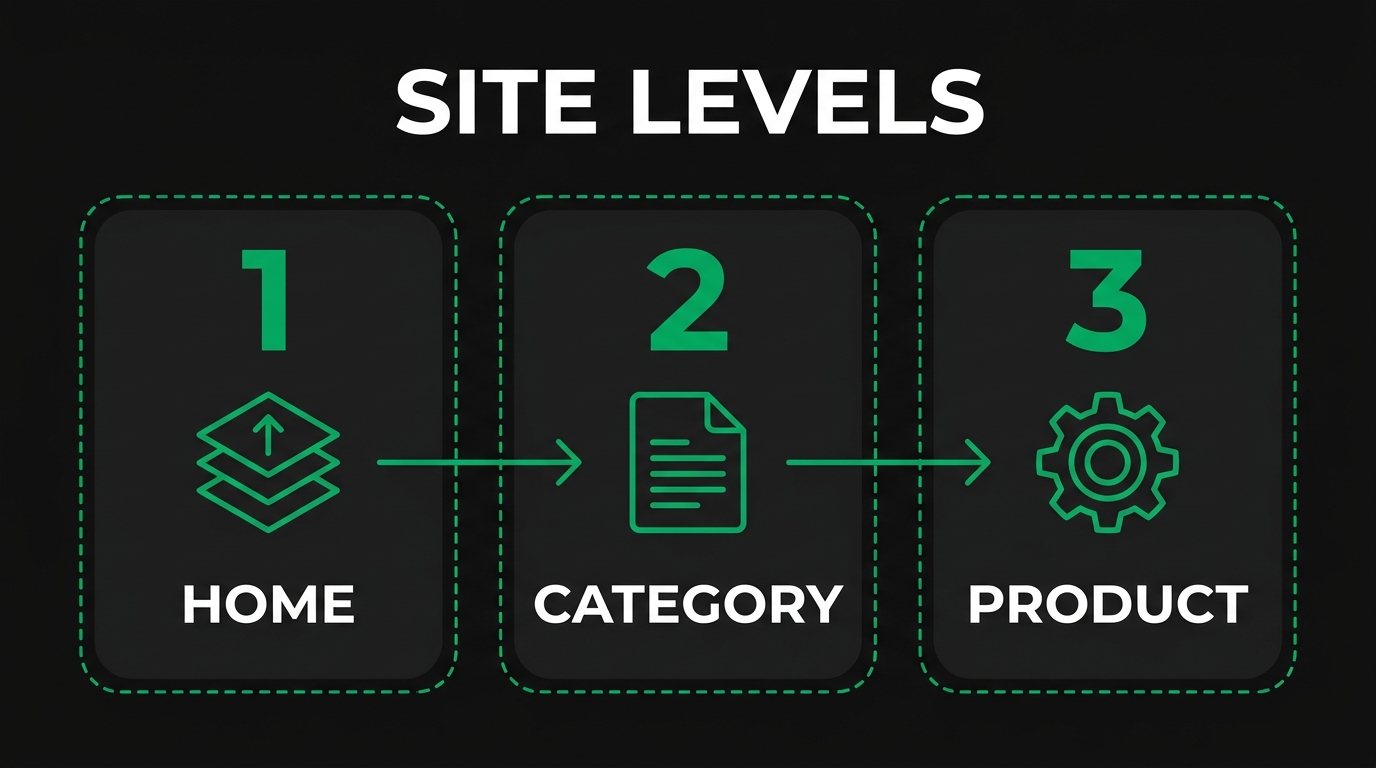
A flat hierarchy is preferred over deep nesting in industrial catalogs because shorter click paths concentrate internal link equity on capability and SKU pages that compete for procurement queries, and they keep crawlers from exhausting their budget on intermediate category shells. Industrial catalogs frequently nest five or six levels deep when org-chart logic drives the structure: division, business unit, product family, subfamily, series, SKU. That depth dilutes link equity at every hop and pushes high-intent pages out of crawl reach. A flat structure, typically three clicks from home to any indexable destination, lets every capability page inherit authority directly from the homepage and primary hubs. Flat structures also map better to how procurement buyers actually search: by process and material, not by internal department.
How Should Crawl Depth Be Controlled for Thousands of Product Pages?
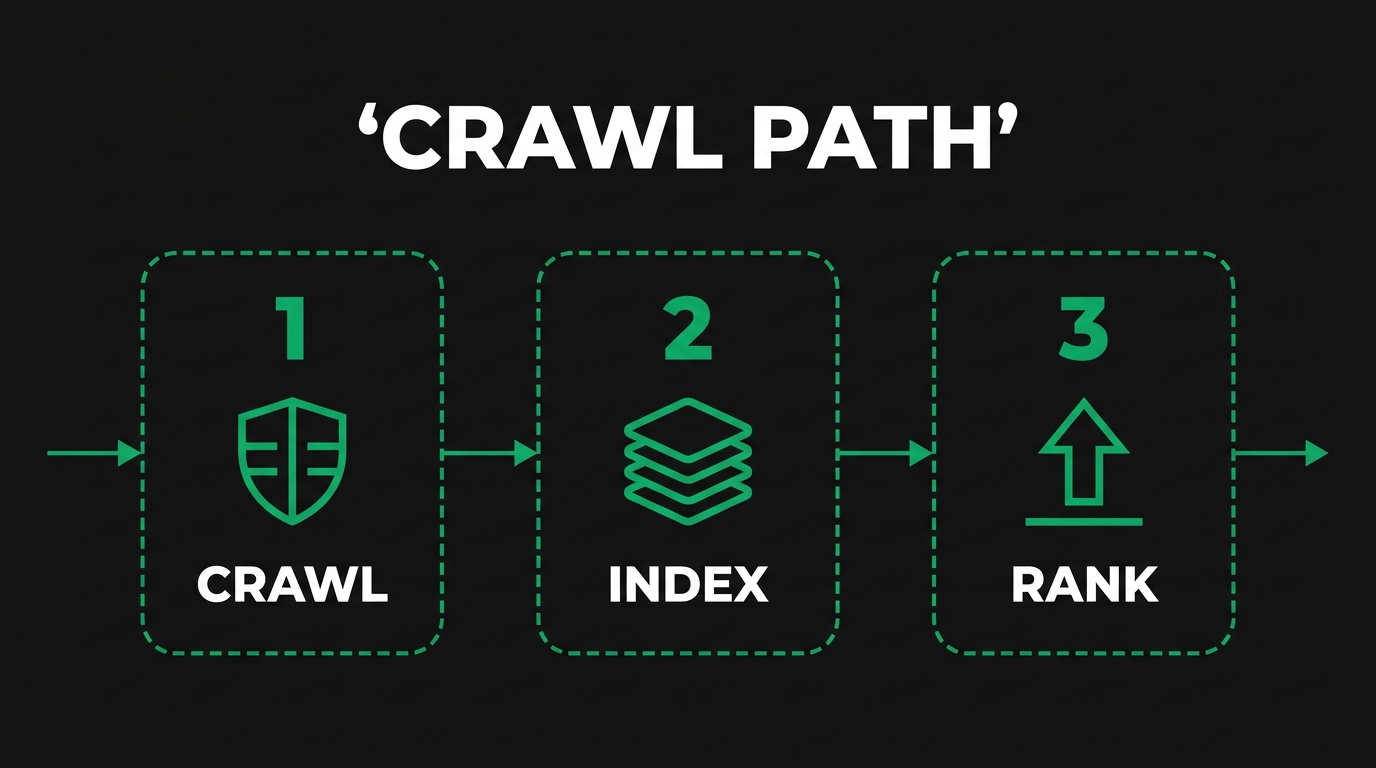
Crawl depth should be controlled for thousands of product pages by limiting click depth to three or four levels, removing crawl traps, and prioritizing high-value pages through internal links and sitemap inclusion. Google Search Central states that crawl budget management is needed for "Large sites (1 million+ unique pages) with content that changes moderately often (once a week)" and "Medium or larger sites (10,000+ unique pages) with very rapidly changing content (daily)." Industrial catalogs with tens of thousands of SKUs sit squarely in that band. Use hub pages to reduce average crawl depth, prune low-value variant pages, and route Googlebot toward the canonical SKU rather than every faceted permutation. Server response time, sitemap freshness, and consistent internal linking together determine how much of the catalog Googlebot can fully explore in a given crawl window.
What Role Does URL Structure Play in Manufacturing Site Architecture?
URL structure plays a foundational role in manufacturing site architecture because it signals hierarchy, establishes canonical identity, and surfaces taxonomy directly in search results. According to Google Search Central, "a critical challenge for any ecommerce website is being discovered in Search," and URL design is the first signal Google uses to parse content. Industrial URLs should follow the pattern domain/process/material/spec, use hyphens between words, avoid session IDs, and stay short enough to expose hierarchy at a glance. Stable URLs also lock in canonical identity across faceted variations and pagination, preventing duplicate content issues that fragment ranking signals across multiple URLs that resolve to the same SKU.
How Should Information Hierarchy Reflect Procurement Intent?
Information hierarchy should reflect procurement intent by organizing top-level navigation around the dimensions buyers evaluate first: manufacturing process, material, certification, and end-use application. Procurement buyers do not enter a site looking for a brand story or a corporate division; they enter looking for a process capability that meets a material spec under a certification standard, and they want that path mapped explicitly. Use process and material as primary navigation axes, expose certifications and tolerance ranges as filterable attributes, and treat application or industry as a secondary hub that re-aggregates the same SKUs through a use-case lens. Hierarchy that mirrors RFQ logic shortens evaluation, reduces bounce, and routes buyers to indexable pages search engines can rank.
How Should You Organize Manufacturing Catalogs by Process, Material, and Application?
Organizing manufacturing catalogs by process, material, and application means using process as the primary axis, material as the secondary axis, and application or industry as a re-aggregation lens, with cross-cutting attributes like certifications and tolerances exposed as filterable facets. The next sub-sections cover process categorization, material grouping, application mapping, and certification handling.
How Do You Categorize Pages by Manufacturing Process?
You categorize pages by manufacturing process by creating a top-level hub for each capability, such as CNC machining, injection molding, sheet metal fabrication, additive manufacturing, or casting, and treating each hub as a canonical destination for procurement queries tied to that process. Each process hub should describe equipment, tolerance ranges, lot sizes, lead times, and certifications served, then link down to material, finish, and application sub-pages within that capability. Process is the dominant search axis because RFQs are scoped by process first; UNSPSC, the United Nations Standard Products and Services Code, organizes commodities into Segment, Family, Class, and Commodity levels with approximately 100,000 commodity codes across four clearly defined levels, giving a useful external taxonomy reference when designing internal process hierarchies for industrial catalogs.
How Do You Group Products by Material Specification?
You group products by material specification by creating dedicated material hubs under each process, with sub-pages for grade families and individual specs that buyers search by name. A CNC machining hub, for example, should branch into aluminum, stainless steel, titanium, and engineering plastics, with each material page enumerating the grades supported (6061-T6, 7075-T6, 304, 316L, Ti-6Al-4V) along with relevant ASTM, AMS, or SAE specifications. Material pages should expose density, yield strength, machinability rating, and typical applications inline so engineers can confirm fit without leaving the page. The structure should also accommodate material certifications, mill traceability, and lot-control requirements common in regulated industries. Group by spec, not by marketing category, because procurement queries name the spec exactly.
How Do You Map Pages to End-Use Application or Industry?
You map pages to end-use application or industry by creating a parallel hub layer that re-aggregates process and material pages through use-case lenses such as aerospace, medical, defense, automotive, oil and gas, and semiconductor. These application hubs do not duplicate SKU pages; they curate the subset of process and material capabilities relevant to that vertical and surface vertical-specific certifications, traceability requirements, and case studies. A medical hub, for example, links to ISO 13485 capabilities, biocompatible material grades, and Class III device experience. Application hubs catch buyers who search by industry rather than by process, and they internally link back to canonical process and material hubs to consolidate ranking signals on a single set of SKU pages.
How Do You Handle Cross-Cutting Attributes Like Certifications and Tolerances?
You handle cross-cutting attributes like certifications and tolerances by exposing them as filterable facets layered on top of process and material hubs, with dedicated indexable hub pages for high-volume certification queries. Certifications such as ISO 9001, AS9100, IATF 16949, NADCAP, ISO 13485, and ITAR registration are evaluated on most RFQs and deserve dedicated hub pages buyers can find directly. Tolerance ranges, surface finishes, and inspection capabilities should appear as filters on process and material listings, not as separate URLs that fragment indexation. NIST notes that "the Digital Thread for Smart Manufacturing Systems project will deliver methods and protocols that extend and complete the digital thread for information running through design, manufacturing and product support processes," reinforcing that capability metadata should be structured and machine-readable across the catalog. Treat certifications as both content hubs and faceted attributes for layered discovery.
What Are the Best Practices for Faceted Navigation on Large Catalogs?
The best practices for faceted navigation on large catalogs are blocking low-value filter combinations from crawl, selectively indexing high-intent facets, applying canonical and parameter rules consistently, and using AJAX or PRG patterns to keep useless URLs out of the crawl path. The next sub-sections detail crawl-trap design, indexing decisions, canonical handling, and rendering patterns.
How Do You Design Faceted Filters Without Creating Crawl Traps?
You design faceted filters without creating crawl traps by limiting filter combinations crawlers can reach, blocking parameterized URLs that produce duplicate or near-empty results, and returning a clear status code when no products match. Google Crawling Infrastructure states, "use robots.txt to disallow crawling of faceted navigation URLs. Oftentimes there's no good reason to allow crawling of filtered items, as it consumes server resources for no or negligible benefit; instead, allow crawling of just the individual items' pages along with a dedicated listing page that shows all products without filters applied." Cap the maximum number of facets a single URL can combine, return 404 for empty filter sets, and never link to filter URLs from primary navigation. The full pattern is documented in robots.txt best practices industrial sites, which covers the syntax used to block parameterized facet URLs at scale.
When Should Faceted URLs Be Indexable Versus Blocked?
Faceted URLs should be indexable when they correspond to a legitimate, frequently searched buyer query and blocked when they produce duplicate, near-empty, or low-intent permutations. Indexable facets typically include single-attribute combinations such as material, certification, or process subtype that map to real search demand: stainless-steel-cnc-machining, AS9100-cnc-machining, micro-machining. Blocked facets include multi-attribute permutations, sort orders, view modes, and session-state parameters that produce thousands of low-value URLs without unique content. The decision should be made per facet category, documented in a facet matrix, and enforced through robots.txt for blocking and indexable-route templates for promotion. Promote only the facets that earn search traffic; block the rest aggressively.
How Do Canonical Tags and Parameter Handling Apply to Filters?
Canonical tags and parameter handling apply to filters by consolidating signals from variant URLs onto a single representative version that Google should rank. Google Search Central advises, "if you use optional query parameters to identify variants, use the URL with the query parameter omitted as the canonical URL," and to "minimize the number of alternative URLs that return the same content to avoid Google making more requests." Apply self-referencing canonicals on indexable facet hubs, point sort and view-mode parameters to the unfiltered base URL, and use the industry-standard "&" separator with key=value pairs so crawlers parse parameters predictably. Treat canonicals as a hint, not a rule; pair them with consistent internal linking and sitemap inclusion so the canonical signal is reinforced everywhere.
How Do You Use AJAX, PRG Patterns, or Selective Indexing for Facets?
You use AJAX, PRG patterns, or selective indexing for facets by rendering filter changes client-side without producing new crawlable URLs unless the resulting page has unique, indexable value. The Post-Redirect-Get pattern submits filter selections via POST and redirects to a clean URL, preventing crawlers from following form actions into the filtered space. AJAX-driven filtering updates the listing in place without changing the URL, which keeps crawl budget focused on canonical hubs. Selective indexing reverses the default by allowing only a curated whitelist of facet URLs into the index through allow rules in robots.txt and sitemap inclusion. Use these patterns together: AJAX for the long tail of low-value combinations, PRG for transactional filter sets, and selective indexing for the small set of facets that earn organic search demand.
How Should You Implement Internal Linking Across a Large Manufacturing Site?
Internal linking across a large manufacturing site should follow a hub-and-spoke model that routes link equity from the homepage and primary hubs into high-intent procurement pages, reinforces hierarchy through breadcrumbs, and uses descriptive anchor text on every connection. The next sub-sections cover linking patterns, equity distribution, breadcrumb signals, and anchor text discipline.
What Are the Best Internal Linking Patterns for Hub-and-Spoke Catalog Models?
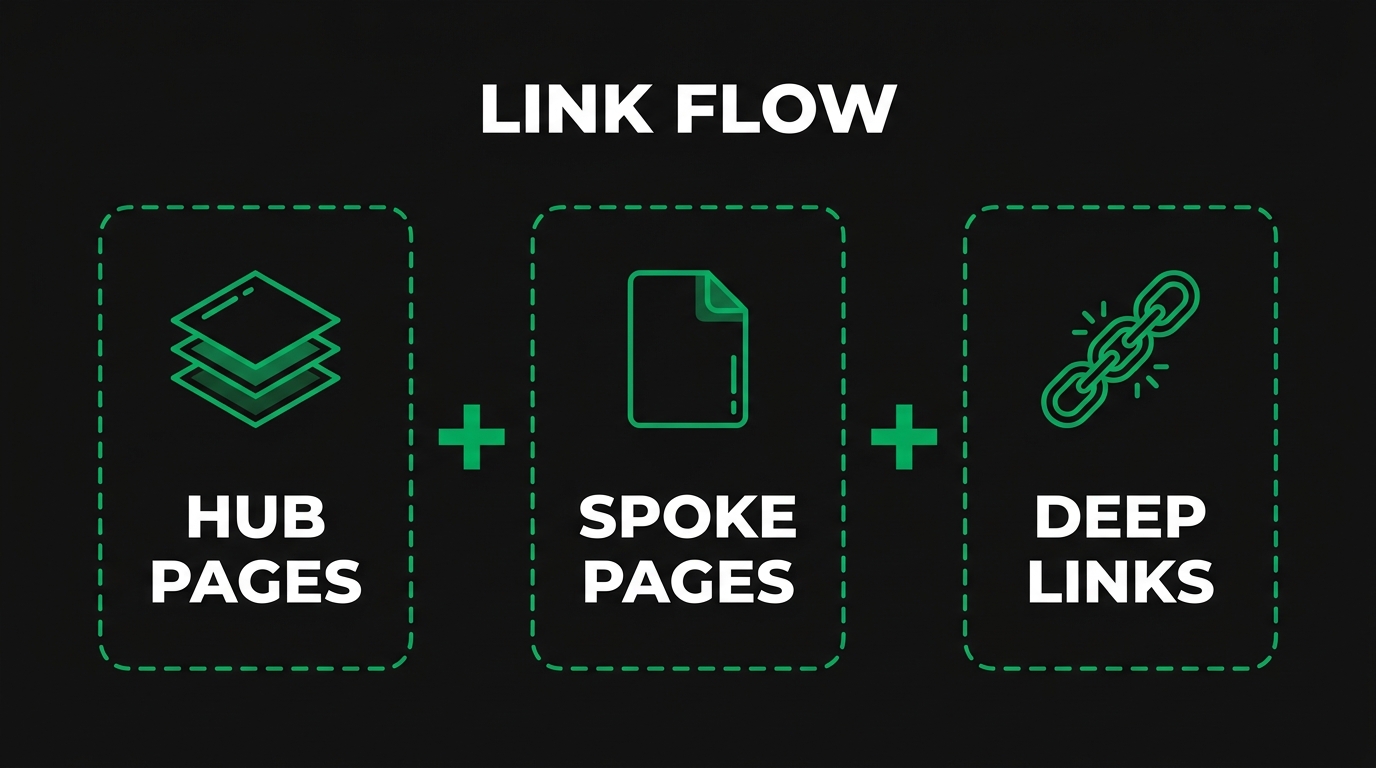
The best internal linking patterns for hub-and-spoke catalog models are dense reciprocal links between a process or material hub and its child SKU pages, sibling links between adjacent capability pages, and curated cross-links from application hubs back to canonical process hubs. Each hub should link to all of its primary children, each child should link back to its hub through breadcrumbs and contextual prose, and adjacent hubs (CNC machining and Swiss machining, for example) should reference each other to expose alternative capabilities to buyers comparing options. Google Search Central advises that "every page you care about should have a link from at least one other page on your site," which means orphaned SKU pages must be eliminated by surfacing them in a hub, sitemap, and at least one contextual link from a parent. Disciplined hub-and-spoke linking compounds authority on the pages that earn RFQs.
How Do You Distribute Link Equity to High-Intent Procurement Pages?
You distribute link equity to high-intent procurement pages by reducing click depth from the homepage to RFQ-eligible pages, prioritizing those pages in primary navigation, and concentrating contextual internal links on capability and SKU destinations rather than informational content. High-intent pages include process hubs, material-grade pages, certification hubs, and direct quote-request landing pages. These pages should sit within two to three clicks from home and receive sitewide footer or mega-menu links where the navigation structure supports it. Auditing the internal link graph quarterly reveals where equity is leaking into low-intent pages such as blog tags or legacy news posts; rerouting those links toward procurement pages produces measurable lifts in keyword visibility and quote volume on the targeted hubs.
How Do Breadcrumbs Reinforce Hierarchy and Crawl Efficiency?
Breadcrumbs reinforce hierarchy and crawl efficiency by exposing the parent path on every page and creating a second internal link channel that crawlers can follow back up the tree. Google Search Central explains that "a breadcrumb trail on a page indicates the page's position in the site hierarchy, and it may help users understand and explore a site effectively," and to specify breadcrumbs you "define a `BreadcrumbList` that contains at least two `ListItems`." Breadcrumbs should reflect the canonical path, not the user's traversal history, so the structure is stable for crawlers and predictable for buyers. Implement BreadcrumbList JSON-LD on every product, category, and hub page so the breadcrumb trail also appears in SERP listings, increasing click-through on procurement queries. A linking pattern aligned with b2b manufacturing content strategy ensures breadcrumbs reinforce both procurement hierarchy and topical authority.
What Anchor Text Patterns Work Best for Industrial Product Pages?
Anchor text patterns that work best for industrial product pages are descriptive noun phrases that name the process, material, or specification of the destination page. Google Search Central states, "Google can only crawl your link if it's an `<a>` HTML element with an `href` attribute," and "good anchor text is descriptive, reasonably concise, and relevant to the page." Use anchors like "Swiss CNC machining services," "AS9100 certified machining," or "316L stainless steel parts" instead of generic "click here" or branded variants. Vary anchors naturally across the site to avoid over-optimization while keeping the dominant pattern aligned with the destination page's primary query. Reserve the strongest exact-match anchors for the most authoritative contextual placements, such as the first link in a hub-page paragraph that introduces the destination capability.
What Technical SEO Considerations Are Critical for Manufacturing Catalog Architecture?
The critical technical SEO considerations for manufacturing catalog architecture are XML sitemap structure for tens of thousands of SKUs, crawl budget optimization, pagination handling, and schema markup that exposes product, list, and breadcrumb metadata. The next sub-sections cover each control in turn.
How Should XML Sitemaps Be Structured for Tens of Thousands of SKUs?
XML sitemaps should be structured for tens of thousands of SKUs by splitting the catalog into multiple sitemap files grouped by content type or hierarchy and submitting them through a sitemap index. Google Search Central states, "all formats limit a single sitemap to 50MB (uncompressed) or 50,000 URLs. If you have a larger file or more URLs, you must break your sitemap into multiple sitemaps." Group sitemaps logically: one per process category, one for material pages, one for application hubs, one for blog content. Include accurate lastmod timestamps so Google can prioritize freshly updated pages, and reference each sitemap from a single sitemap index registered in Search Console. The grounding pattern is in the basics of seo friendly content, which explains how content hygiene supports sitemap freshness signals at scale.
What Crawl Budget Optimizations Apply to Large Industrial Catalogs?
Crawl budget optimizations that apply to large industrial catalogs include pruning low-value URLs, blocking faceted parameters, consolidating duplicate variant pages, and serving fast, cacheable responses. According to Google Crawling Infrastructure, "the amount of time and resources that Google devotes to crawling a site is commonly called the site's crawl budget," and it is determined by crawl capacity (the maximum number of simultaneous parallel connections that Google can use to crawl a site, plus the time delay between fetches) and crawl demand. Eliminate soft 404s, return clean HTTP status codes, and use server logs to identify which Googlebot requests are wasted on low-value URLs. Static rendering or partial server-side rendering for product pages further reduces the rendering tax JavaScript catalogs pay against the available budget. A grounding in the basics of technical seo for engineers helps engineering teams operationalize these controls.
How Should Pagination Be Handled for Long Product Listings?
Pagination should be handled for long product listings by giving each page a unique URL, using self-referencing canonicals on each page in the sequence, and exposing crawlable links between pages. Google Search Central states, "give each page a unique URL. For example, include a `?page=n` query parameter, as URLs in a paginated sequence are treated as separate pages by Google," and "don't use the first page of a paginated sequence as the canonical page. Instead, give each page its own canonical URL." Avoid URL fragments for page numbers, do not collapse paginated pages into the first page through canonicals, and ensure the linked-from anchor text or page indicator is crawlable HTML rather than JavaScript. Provide a "view all" page only when it loads quickly enough not to harm crawl efficiency.
What Schema Markup Improves Visibility for Manufacturing Catalogs?
Schema markup that improves visibility for manufacturing catalogs includes Product, ProductModel, ItemList, and BreadcrumbList JSON-LD applied at the SKU, hub, and category levels. Schema.org defines that a ProductModel "gives a datasheet or vendor specification of a product (in the sense of a prototypical description), and you should use this type when describing a product datasheet rather than an actual product, e.g. if you are the manufacturer of the product and want to mark up your product specification pages." Use Product or ProductModel on each SKU or capability spec page, ItemList on category and search-result pages, and BreadcrumbList on every page that sits inside a hierarchy. Validate every template through the Schema Markup Validator before deployment. Strong schema turns category pages into eligible candidates for richer SERP treatment and helps AI search systems parse capability metadata accurately.
How Do You Plan for Scalability and Future Growth in Site Architecture?
Planning for scalability and future growth in site architecture means designing extensible taxonomies for new product lines, handling multi-region and multi-language catalogs cleanly, executing migrations without losing equity, and instrumenting architecture-health monitoring. The next sub-sections cover each scalability lever.
How Do You Architect for New Product Lines and Categories?
You architect for new product lines and categories by reserving extensible slots in the top-level taxonomy, using consistent URL templates, and pre-building hub-page templates that any new capability can adopt immediately. Top-level navigation should accommodate adding a new process, material family, or industry hub without restructuring existing URLs or breaking internal links. Define a URL template like /capabilities/{process}/{material}/{spec} and use it for every new line so taxonomy growth is additive rather than disruptive. Document the architecture pattern in a website structure for multiple manufacturing product lines playbook so engineering, marketing, and product teams launch new lines into the same hierarchical pattern. Pre-built templates also accelerate publishing, which preserves crawl freshness signals as the catalog expands.
How Do You Handle Multi-Site, Multi-Region, and Multi-Language Catalogs?
You handle multi-site, multi-region, and multi-language catalogs by choosing a single geotargeting model, applying hreflang correctly across every variant, and avoiding duplicate content traps that fragment authority across regions. Google Search Central explains that "a multi-regional website is one that explicitly targets users in different countries," and geotargeting can use country-code top-level domains (.de for Germany), subdomains (de.example.com), or subdirectories (example.com/de/). Pick one model, document it, and use hreflang annotations that reference every variant including a self-reference, with reciprocal links between every pair so the annotations are honored. Avoid auto-redirecting users by IP; let language switchers stay explicit, preserve canonical signals across regions, and submit region-specific sitemaps so Search Console reports cleanly per locale.
How Do You Migrate Legacy Manufacturing Catalogs Without Losing Equity?
You migrate legacy manufacturing catalogs without losing equity by mapping every old URL to its new canonical, implementing 301 redirects, and monitoring traffic and rankings closely through the cutover. Google Search Central recommends, "use server side permanent redirects if technically possible. Although Googlebot supports several kinds of redirects, we recommend that you use HTTP permanent redirects if possible, such as `301` and `308`," and "keep the redirects for as long as possible, generally at least 1 year." Build a one-to-one redirect map for high-traffic SKU and category pages, avoid chaining redirects, and update internal links and sitemaps to point directly at the new URLs from day one. For very large catalogs, migrate in phased waves so issues surface and can be remediated before the full cutover.
How Do You Monitor Architecture Health Over Time?
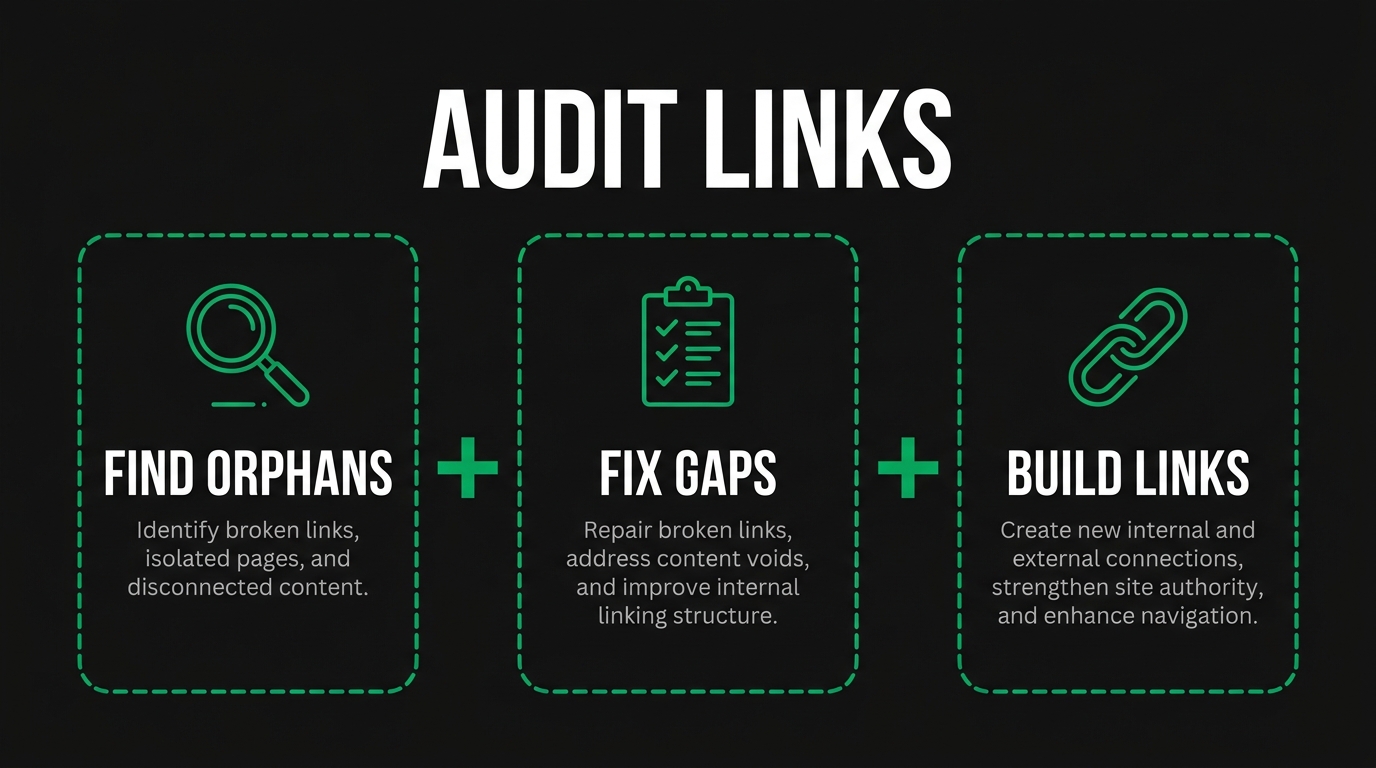
You monitor architecture health over time by tracking crawl coverage, index inclusion, internal link distribution, redirect chains, and Core Web Vitals on a recurring cadence. Use Search Console's Index Coverage and Sitemap reports, server log analysis to confirm Googlebot is crawling priority pages, and a quarterly site crawl to surface new orphaned pages, broken internal links, and unintended noindex tags. Watch the ratio of indexed to submitted URLs in each sitemap; a sustained drop signals canonical drift, soft 404s, or quality signals dragging down the catalog. Monitor average click depth, page count by template, and faceted URL exposure so faceted bloat or accidental crawl traps are caught early. Architecture health is a continuous discipline, not a one-time audit, and the next section explains how a partner can operationalize it.
How Should You Approach Site Architecture for Manufacturing Catalogs With Manufacturing SEO Agency?
You approach site architecture for manufacturing catalogs with Manufacturing SEO Agency by starting with a procurement-intent technical audit, mapping the catalog to process and material taxonomies aligned with how engineers and purchasing managers search, and instrumenting ongoing crawl and index monitoring as a dedicated manufacturing-focused seo agency for industrial B2B manufacturers.
Can a Manufacturing Technical SEO Audit Help Restructure a Large Industrial Catalog?
Yes, a manufacturing technical SEO audit can help restructure a large industrial catalog by surfacing crawl traps, orphaned SKU pages, faceted bloat, broken redirect chains, and taxonomy drift that compounds as the catalog grows. Manufacturing SEO Agency runs a manufacturing technical seo audit tailored to industrial catalogs, covering crawl coverage, internal link distribution, canonical integrity, sitemap structure, schema markup, and procurement-intent hierarchy alignment. The audit produces a prioritized restructuring plan with specific URL maps, hub-page templates, redirect rules, and faceted-navigation policies engineers can hand to their development team. Manufacturing SEO Agency focuses exclusively on B2B manufacturing, so the audit accounts for ISO, AS9100, IATF, NADCAP certification handling and the procurement workflows that drive RFQ conversion. Comparing options is easier with top manufacturing marketing firms as a reference set.
What Are the Key Takeaways About Site Architecture Best Practices for Manufacturing Catalogs?
The key takeaways about site architecture best practices for manufacturing catalogs are: keep hierarchy flat enough to surface high-intent pages within three clicks, organize the catalog by process and material as primary axes, expose certifications and tolerances as filterable facets and dedicated hubs, control faceted navigation aggressively to protect crawl budget, route internal link equity to RFQ-eligible pages through hub-and-spoke patterns, structure XML sitemaps in indexed groups under the 50,000 URL limit per file, and monitor crawl coverage and architecture health continuously. Strong architecture is the foundation that lets every other manufacturing SEO investment, from content to links to AI search visibility, compound into RFQ-driving organic traffic. Manufacturing SEO Agency builds and maintains this foundation for industrial B2B catalogs with measurable ties from rankings to closed revenue.