The best industrial SEO agencies for small business are specialist firms that rank manufacturers for the exact process, material, and certification queries procurement buyers type into search engines. We built this guide to help small manufacturers cut through generic SEO noise and pick a partner that actually understands procurement-intent search.
This guide covers what an industrial SEO agency does, how the leading agencies compare, the services they offer, realistic pricing, vetting questions, expected results, and how SEO fits alongside other growth channels.
We start by defining industrial SEO for small manufacturers, explaining how it differs from general B2B SEO, and detailing the deliverables a small business should expect.
We then review which agencies lead the market, how selection criteria separate serious manufacturing specialists from broad digital shops, and where boutique firms outperform full-service options for small accounts.
We break down the technical SEO, topical authority, link building, and technical content work the best agencies deliver for industrial websites.
We walk through typical retainer ranges, the cost factors that move pricing, and how industrial SEO ROI compares to trade shows and paid search for a small manufacturer's budget.
We outline a vetting process, the case studies and proof points that signal real manufacturing expertise, and the red flags that reliably predict a bad engagement.
We set honest expectations for rankings, lead flow, KPIs, and revenue reporting, then close by showing how SEO plugs into paid media, trade shows, outbound sales, and emerging AI-driven search channels.
What Does an Industrial SEO Agency Do for a Small Manufacturer?
An industrial SEO agency ranks a small manufacturer's website for the exact process, material, and certification queries its procurement buyers use on Google. This section covers how industrial SEO differs from general B2B SEO, why small manufacturers need a specialist partner, and what deliverables to expect.
How Does Industrial SEO Differ From General B2B SEO?
Industrial SEO differs from general B2B SEO in that it targets procurement-intent queries built from process names, material grades, tolerances, and certification numbers, not generic service terms. A design engineer searches "5-axis CNC titanium aerospace AS9100" when sourcing, not "manufacturing services." Industrial SEO maps content to that vocabulary, while general B2B SEO chases broader funnel terms. For a full primer on the discipline, see what is industrial seo.
Why Do Small Manufacturers Need a Specialized SEO Partner?
Small manufacturers need a specialized SEO partner because procurement buyers filter suppliers using certification, tolerance, and material vocabulary that generalist agencies misuse. A specialist writes "IATF 16949 stamping" correctly, scopes topical maps by process family, and understands the RFQ funnel. Generalist agencies optimize for traffic volume; specialists optimize for supplier discovery. The gap matters most on a small team, where every keyword must produce qualified inquiries, not pageview inflation. For deeper vertical context, see seo for small manufacturing companies.
What Deliverables Should a Small Business Expect From an Industrial SEO Agency?
A small business should expect four core deliverables from an industrial SEO agency: a competitive audit, a keyword architecture mapped to procurement stages, a topical content plan, and revenue-tied reporting. Manufacturing SEO Agency packages these as a manufacturing audit and competitive intelligence engagement, a procurement-intent keyword architecture, topical authority buildout, and CRM-integrated revenue-tied reporting. The audit reverse-engineers every competitor page ranking above the client. The architecture groups process, material, and certification queries into clusters. The content plan fills coverage gaps. Reporting ties rankings to RFQs, pipeline, and closed revenue. Weak agencies substitute monthly position reports for revenue accountability. Strong agencies integrate with the client's CRM and attribute organic inquiries through to booked work, closing the loop small manufacturers actually care about.
Which Industrial SEO Agencies Lead the Market for Small Businesses?
The industrial SEO agencies leading the market for small businesses are specialist firms with verifiable manufacturing-only track records, documented procurement-intent keyword frameworks, and retainer models that match small-shop cash flow. This section explains the criteria that separate top agencies, which firms rank highest, and how boutique shops compare to full-service digital agencies.
What Selection Criteria Separate Top Industrial SEO Agencies From the Rest?
Top industrial SEO agencies separate from the rest through four criteria: manufacturing vertical focus, procurement-intent keyword methodology, documented RFQ-linked case studies, and revenue-tied reporting. Selection also hinges on whether the agency writes technically correct content about process, material, and certification combinations. Buyers should compare manufacturing seo agency pricing across shortlisted firms before shortlisting finalists.
Which Agencies Rank Highest for Manufacturing-Focused SEO?
The agencies ranking highest for manufacturing-focused SEO are vertical specialists that publish manufacturing case studies, employ writers who know AS9100, ISO 9001, NADCAP, and IATF 16949, and demonstrate ranking wins on process plus material plus certification query strings. A shortlist worth vetting includes manufacturing-only SEO agencies, industrial-focused digital shops with a dedicated manufacturing practice, and boutique consultancies led by former manufacturing marketers.
How Do Boutique Firms Compare to Full-Service Digital Agencies for Industrial Accounts?
Boutique firms compare favorably to full-service digital agencies for industrial accounts because boutiques concentrate senior-level attention on fewer clients and speak the buyer's process and certification vocabulary natively. Full-service shops offer broader channel coverage but dilute manufacturing expertise across clients in retail, SaaS, and local services. A small manufacturer should weigh senior domain depth against channel breadth, then pick the partner that actually speaks procurement fluently.
This tees up the exact service mix specialist agencies deliver for small manufacturers.
What Services Do the Best Industrial SEO Agencies Offer Small Manufacturers?
The best industrial SEO agencies offer small manufacturers technical SEO, topical authority buildout, editorial link building, and technically accurate content creation. This section explains which technical services matter most, how topical authority is built, which link-building tactics work in manufacturing, and how specialists handle content for engineering audiences.
Which Technical SEO Services Matter Most for Industrial Websites?
The technical SEO services that matter most for industrial websites are schema markup, crawl health, site speed, structured product and service pages, and internal linking aligned to procurement clusters. Technical work earns trust signals Google evaluates under E-E-A-T.
How Do Top Agencies Build Topical Authority for Manufacturing Niches?
Top agencies build topical authority for manufacturing niches by mapping every process, material, certification, and application a client's buyers search for, then covering each node with dedicated pages rather than scattered blog posts. A topical map for a CNC shop might include 3-axis, 4-axis, and 5-axis machining, plus titanium, aluminum, and Inconel pages, plus AS9100, ISO 13485, and NADCAP certification pages. Complete coverage signals category authority to Google. Partial coverage under-ranks against deeper competitors. Manufacturers who invest once in full topical coverage compound rankings across every related query a procurement buyer enters.
What Link-Building Tactics Work Best in the Industrial Sector?
The link-building tactics that work best in the industrial sector are editorial placements in trade publications, technical byline contributions, manufacturing association citations, and tier-2 amplification of those anchor links. Industry trade media carries topical relevance Google rewards for manufacturing queries. Generic directory and guest-post tactics underperform. Strong agencies pitch manufacturing-trade editors with genuine technical angles, not boilerplate outreach. Manufacturing SEO Agency runs PR-grade editorial link building through major trade publications and high-traffic industry media, plus tier-2 link amplification.
How Do Agencies Handle Content Creation for Technical Manufacturing Audiences?
Agencies handle content creation for technical manufacturing audiences by staffing writers who understand process tolerances, material specifications, and certification requirements, not generalist copywriters. That gap traces directly to content that fails technical accuracy tests. Specialist agencies pair SEO structure with subject-matter reviewers, produce long-form technical articles, and treat each piece as part of a topical map that ranks across an entire process category.
Next, we translate these services into a realistic monthly budget.
How Much Should a Small Business Budget for Industrial SEO Services?
A small business should budget $3,000 to $10,000 per month for industrial SEO services, with competitive accounts reaching $15,000. This section details typical pricing models, the cost factors that move retainers up or down, and how SEO ROI compares to other manufacturing marketing channels.
What Are Typical Pricing Models for Industrial SEO Retainers?
Typical pricing models for industrial SEO retainers are fixed monthly retainers, scope-banded tiers, and hybrid retainer-plus-content packages. Industrial retainers cluster above the general average because technical content and trade-press links cost more to produce.
Which Cost Factors Drive Industrial SEO Pricing Up or Down?
The cost factors driving industrial SEO pricing up or down are site size, number of processes covered, competitive density, certification scope, and whether the engagement includes content, links, and technical SEO or just one lane. A single-process CNC shop in a niche geography costs less than a multi-facility contract manufacturer competing nationally across five processes. Scope discipline matters: paying for services the account doesn't need inflates retainers without improving rankings. The inverse also hurts: underscoping a competitive account produces rankings nobody notices. Ask any agency to map scope directly to the site's procurement-intent gap.
How Does Industrial SEO ROI Compare to Other Manufacturing Marketing Channels?
Industrial SEO ROI compares favorably to other manufacturing marketing channels because organic rankings compound, RFQ-intent queries convert at higher rates than cold outreach, and a single ranking page produces leads for years. Trade shows deliver faster face-time but higher per-lead cost. Paid search delivers speed but stops when spending stops.
SEO outperforms both on long-horizon cost per qualified RFQ for a small manufacturer with patience to let rankings compound. Pricing alone, though, won't pick the right partner.
How Should a Small Manufacturer Evaluate and Vet an Industrial SEO Agency?
A small manufacturer should evaluate and vet an industrial SEO agency by asking scope-specific vetting questions, demanding verifiable case studies, and screening for red flags. This section walks through the questions, the proof points that matter, and the warning signs to avoid.
Which Questions Should a Buyer Ask During the Agency Vetting Process?
The questions a buyer should ask during the agency vetting process are focused on manufacturing fluency, measurement discipline, and senior involvement. Ask: How many manufacturing clients do you currently serve? Who writes the technical content? Can you show ranking data for process plus material plus certification queries? How do you tie rankings to RFQs? Who works on my account day-to-day? For step-by-step frameworks, see how to choose an seo agency and how to choose an industrial seo agency.
What Case Studies and Proof Points Signal Real Manufacturing Expertise?
Case studies and proof points that signal real manufacturing expertise are RFQ-linked revenue stories, ranking wins for technical query strings, and client logos from regulated industries like aerospace, medical, and automotive. Generic traffic graphs prove nothing about procurement impact. Ask for before-and-after ranking data on queries containing process, material, and certification terms. Ask for CRM-attributed pipeline numbers. Cross-reference claims against peer collections of industrial seo agency case studies to separate real outcomes from cherry-picked screenshots. A handful of verifiable stories outweighs a deck of pretty dashboards. Part of that vetting includes a rigorous manufacturing seo competitor analysis service review of the accounts already outranking you.
Which Red Flags Should Small Manufacturers Avoid When Choosing an SEO Partner?
The red flags small manufacturers should avoid when choosing an SEO partner are guaranteed rankings, undisclosed subcontracting, thin or fake case studies, and content samples riddled with technical errors. Guarantees contradict how search ranking actually works. Outsourced writers without manufacturing backgrounds produce content that fails engineer review.
Sound vetting protects budget and timeline equally, because a bad twelve-month engagement sets rankings back further than doing nothing. With vetting discipline in place, the next question is what results to expect.
What Results Can Small Manufacturers Expect From Industrial SEO Engagements?
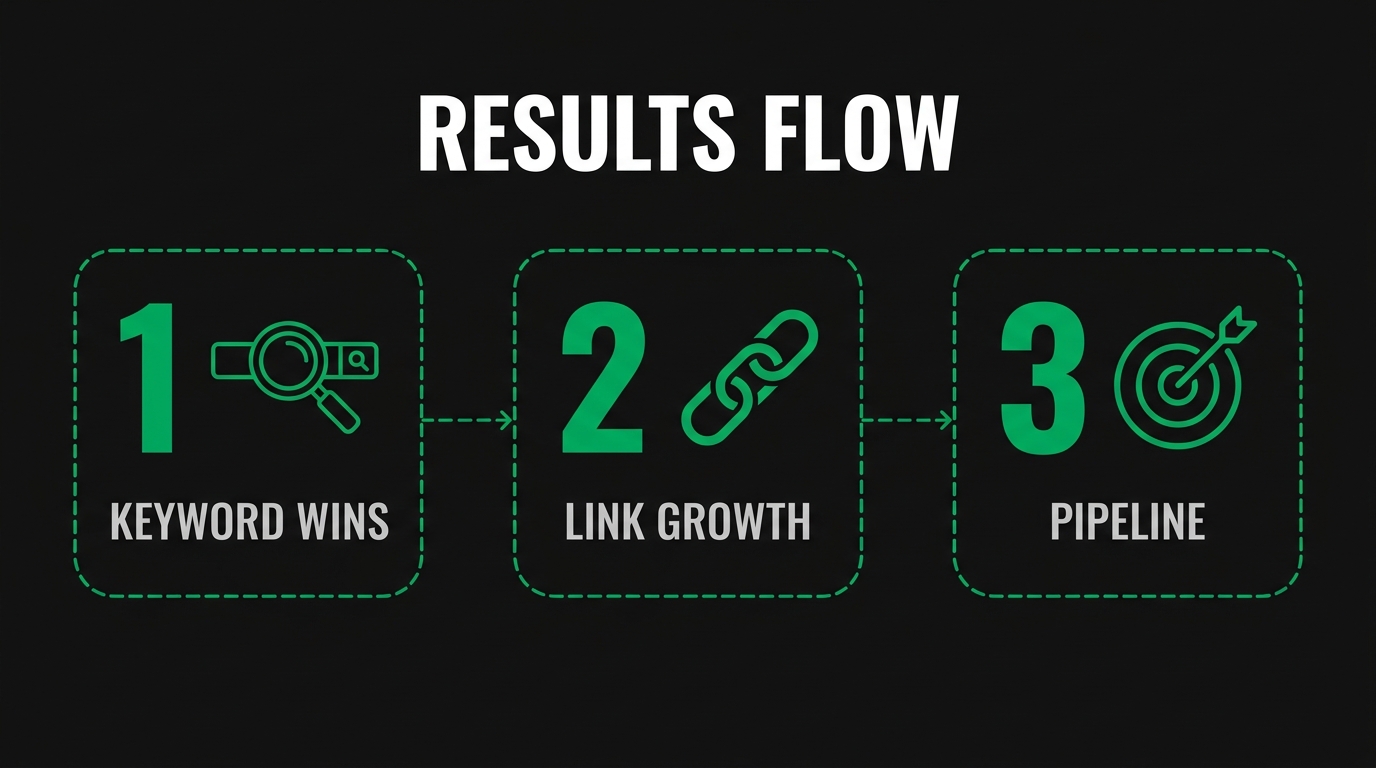
Small manufacturers can expect measurable ranking, traffic, and RFQ growth within six to twelve months of a disciplined industrial SEO engagement. This section covers realistic time-to-rank, the KPIs that prove agency performance, and how agencies tie organic rankings to pipeline value.
How Long Does It Take to See Rankings and Lead Flow From Industrial SEO?
Industrial SEO takes three to six months to produce early ranking movement and nine to eighteen months to produce steady RFQ flow for a small manufacturer. Timelines depend on site history, content inventory, and competitive density. New pages on a weak domain climb slowly; revamped pages on an established domain move faster. Procurement queries tend to convert at higher rates than generic traffic, so even modest ranking gains can produce disproportionate inquiry increases. Plan on a six-month evaluation window, not a thirty-day report, because ranking movement on technical queries rarely shows meaningful pipeline impact in the first quarter.
Which KPIs Prove an Industrial SEO Agency Is Delivering Revenue?
The KPIs that prove an industrial SEO agency is delivering revenue are RFQ volume from organic, RFQ quality by source, organic-sourced pipeline value, organic-sourced closed revenue, and rankings on process plus material plus certification query strings. Vanity metrics such as total traffic, domain authority score, and keyword count don't prove revenue. Strong agencies report on CRM-integrated numbers tied to specific queries. A disciplined manufacturing seo reporting layer ties every organic dollar back to pipeline stage and closed revenue, not pageview counts.
How Do Agencies Tie Organic Rankings to RFQs and Pipeline Value?
Agencies tie organic rankings to RFQs and pipeline value by integrating with the client's CRM, tagging organic-sourced form submissions, and attributing inbound sales conversations to landing-page and query data. Proper attribution requires form-level UTM capture, session-level source tracking, and CRM rules that preserve the first-touch organic source through to booked revenue. Without CRM integration, reporting collapses into guesswork. With it, a small manufacturer can tell exactly which ranking pages produce RFQs and which produce traffic without revenue. Revenue-tied reporting is the single clearest signal of a competent industrial SEO agency. From there, SEO must slot into the broader growth stack.
How Does Industrial SEO Fit Into a Small Manufacturer's Broader Growth Stack?
Industrial SEO fits into a small manufacturer's broader growth stack as the durable discovery layer that feeds paid search, trade shows, and outbound sales with qualified inbound demand. This section explains how SEO pairs with those channels, when to bring SEO in-house versus outsource, and which emerging channels are reshaping industrial buyer search behavior.
How Does SEO Work Alongside Paid Search, Trade Shows, and Outbound Sales?
SEO works alongside paid search, trade shows, and outbound sales by capturing procurement-intent queries organically while those channels cover the gaps SEO cannot. According to Wave Connect's trade show industry data, 72% of attendees are more likely to buy from exhibitors they meet at trade shows, and 51% of attendees request a follow-up visit from a sales representative post-event. Paid search fills speed gaps on net-new launches. Outbound covers accounts that don't search at all. SEO layers underneath each, keeping the pipeline full between events and campaigns, which matters more as B2B buyers complete most of their journey alone before engaging sales.
When Should a Small Manufacturer Bring SEO In-House Versus Outsource?
A small manufacturer should bring SEO in-house when it has consistent hiring budget for a senior technical SEO, a manufacturing-fluent writer, and a link-building lead, and should outsource when any of those roles would otherwise sit empty. In-house teams win on institutional process knowledge; agencies win on specialized tooling, senior strategists, and editorial link relationships. Most small manufacturers lack the hiring bandwidth to build an in-house team that beats a specialist retainer, so outsourcing typically delivers faster ROI. For a build-versus-buy framework, see outsource vs in-house SEO. Hybrid models also work when one in-house owner manages a specialist partner.
Which Emerging Channels Are Reshaping Industrial Buyer Search Behavior?
The emerging channels reshaping industrial buyer search behavior are AI answer engines, vertical B2B marketplaces, and LLM-powered procurement assistants. Buyers increasingly prompt AI tools with process and specification queries, then verify candidates on Google. Agencies that optimize for LLM citation signals, entity grounding, and structured data position clients to appear in AI answers as well as classical SERPs. Ignoring AI search leaves small manufacturers invisible at the top of the procurement funnel. Our take: AI visibility is additive, not replacement, work, so treat it as an extension of the same topical authority that drives Google rankings rather than a separate channel.
How Should You Approach Industrial SEO With Manufacturing SEO Agency?
You should approach industrial SEO with Manufacturing SEO Agency as a manufacturing-only partner that maps procurement-intent keywords, builds full topical authority, and ties rankings to RFQs and closed revenue. This section covers how Manufacturing SEO Agency helps small manufacturers scale procurement-intent rankings and recaps the key takeaways on choosing an industrial SEO partner.
Can Manufacturing SEO Agency Help Small Manufacturers Scale Procurement-Intent Rankings?
Manufacturing SEO Agency can help small manufacturers scale procurement-intent rankings by mapping process, material, and certification query clusters, building topical authority across the full procurement funnel, and tying organic rankings to RFQs, pipeline value, and closed revenue through CRM integration. According to the National Association of Manufacturers, in 2022 there were 239,265 firms in the manufacturing sector, with all but 4,177 firms considered to be small. Manufacturing SEO Agency serves this segment across CNC machining, injection molding, metal fabrication, additive manufacturing, aerospace, medical, automotive, and contract manufacturing. Engagements start at $5,000 per month and scale to $15,000 for multi-facility operations, matched to site size, process count, and competitive density.
What Are the Key Takeaways About Industrial SEO Agencies for Small Businesses We Covered?
The key takeaways about industrial SEO agencies for small businesses are that specialization beats generalist breadth, procurement-intent keyword architecture outperforms vanity traffic, and revenue-tied reporting is the clearest signal of a competent partner. A small manufacturer should shortlist manufacturing-only or manufacturing-focused agencies, budget realistically in the $3,000 to $15,000 monthly range, demand case studies tied to RFQs, and vet for domain fluency on process, material, and certification vocabulary. Plan on six to twelve months for meaningful pipeline impact. Pick the partner who can answer CRM-integration and technical-accuracy questions on the first call, because that partner will still be working on the account a year later.