Choosing the right SEO agency is the process of matching a search marketing partner to your business goals, buyer intent, budget, and risk tolerance so that organic investment produces measurable pipeline. We wrote this guide for owners, marketing leaders, and procurement teams who need a clear framework before signing a six-figure annual contract.
This guide covers what SEO agencies do, why the decision carries real revenue weight, when hiring one beats hiring in-house, which questions separate strong contenders from weak ones, how to validate case studies, which red flags disqualify a vendor on the spot, realistic pricing, the specialist-versus-generalist trade-off, and how to structure the final decision.
We start by defining the agency model, the deliverables you should expect, and the roles that touch your account. We then examine how a bad engagement damages rankings and pipeline, and how the right one compounds revenue across quarters. We walk through hiring triggers, budget thresholds, and the in-house comparison. We share the exact questions to ask, the proof points that matter, and the tactics that invite a Google penalty. We close with pricing models, specialist selection criteria, and a structured approach to proposal evaluation, contract negotiation, and first-90-day onboarding.
What Is an SEO Agency and What Does One Actually Do?
An SEO agency is a professional services firm that improves a website's visibility in search engines to drive qualified organic traffic, leads, and revenue. A capable agency combines technical remediation, content production, keyword architecture, and link acquisition under one coordinated plan. This section covers the services, monthly deliverables, and staffing model you should expect.
What Services Do SEO Agencies Typically Provide?
SEO agencies typically provide technical audits, keyword research, on-page optimization, content strategy, link acquisition, local and international SEO, analytics setup, and reporting. Scopes range from single-service engagements to full-stack programs that also cover conversion rate optimization and schema markup. The strongest vendors tie every activity to pipeline rather than vanity metrics. For buyers new to the discipline, a grounding in what is industrial seo clarifies the category before vendor selection begins.
What Deliverables Should You Expect Month Over Month?
The deliverables you should expect month over month are a status report, completed technical fixes, new or optimized pages, earned or placed backlinks, keyword rank updates, traffic and conversion analytics, and a next-month plan. A retainer should itemize hours, assets, and outcomes, not generic "SEO work." Baseline cadence includes weekly check-ins, a monthly executive summary, and a quarterly business review tied to pipeline. Expect raw data access, not screenshots. Manufacturing SEO Agency delivers manufacturing seo reporting that maps rankings to RFQs, pipeline value, and closed revenue through CRM integration, rather than isolated keyword positions.
What Roles Work on an SEO Engagement?
The roles that work on an SEO engagement are an account strategist or director, a technical SEO specialist, a content lead or editor, writers or subject matter experts, a link builder or digital PR manager, a data analyst, and a project manager. Smaller agencies compress these into three or four people. Ask who owns strategy, who executes, and who reports. Clear ownership shortens cycle time and sets the stage for honest measurement when you later evaluate revenue impact.
Why Does Choosing the Right SEO Agency Matter for Revenue?
Choosing the right SEO agency matters for revenue because organic search sits at the top of most B2B pipelines, and a poor partner can destroy rankings, backlink equity, and buyer trust in a single quarter. This section covers how damage happens, what a failed engagement really costs, and how long recovery takes.
How Does the Wrong Agency Damage Rankings and Pipeline?
The wrong agency damages rankings and pipeline by publishing thin content, building spammy links, breaking technical foundations during migrations, and chasing keywords buyers never search. For B2B teams weighing channels, comparing ppc vs organic search for industrial marketing clarifies which cuts hurt most when organic collapses.
What Is the Real Cost of a Failed SEO Engagement?
The real cost of a failed SEO engagement is retainer spend plus opportunity cost plus remediation spend plus pipeline shortfall. A typical six-figure annual retainer, multiplied by two years of underperformance, plus the cost to hire a second agency to clean up, often exceeds one million dollars before counting lost deals. Teams that run trade-show-heavy programs sometimes learn this the hard way when revisiting seo vs trade shows for manufacturing leads and discovering their digital channel never matured. The hidden cost is executive confidence in the channel, which takes years to rebuild.
How Long Does It Take to Recover From Bad SEO?
Recovery from bad SEO typically takes six to eighteen months, depending on penalty type, link damage, and content depth. Manual actions require fixes plus reconsideration requests. Google Search Central states that if a site has been affected by a spam-related manual action, the owner should fix the issues and request reconsideration to have the manual action removed. Algorithmic recovery is slower and less predictable. Most sites need a full content audit, a disavow workflow, and a rebuild of topical authority before rankings stabilize.
When Should You Hire an SEO Agency Instead of Building In-House?
You should hire an SEO agency instead of building in-house when speed, breadth, or specialist depth outweigh the value of full-time headcount. This section covers the signals that indicate outside help, the budget thresholds that justify a retainer, and how agencies and in-house teams compare on speed and depth.
What Signals Indicate You Need Outside Help?
The signals that indicate you need outside help are a looming site migration, a competitive gap you cannot close in-house, a plateau in organic traffic, and a lack of strategic direction. Google Search Central notes that buyers should consider hiring an SEO when considering a site redesign or planning to launch a new site, so that the site is designed search-engine-friendly from the bottom up. If internal marketing has been reactive for two quarters, and leadership cannot explain why rankings are stagnant, an external partner brings the pattern recognition and the specialist roster you are missing.
What Is the Budget Threshold for Hiring an Agency?
The budget threshold for hiring an agency usually begins around sixty thousand dollars per year, the point where retainers buy enough hours to produce compounding output. Below that, freelancers or a single in-house hire often deliver better dollar efficiency. Above that, agencies scale technical, content, and link work concurrently. Industrial buyers weighing fixed cost versus flexibility should consult a comparison of outsource seo vs in-house for industrial before committing to a twelve-month retainer. Include ramp-up, tool stacks, and attribution build in any honest comparison.
How Do Agencies and In-House Teams Compare on Speed and Depth?
Agencies and in-house teams compare differently on speed and depth. Agencies bring same-day access to technical SEOs, writers, digital PR, and analysts, plus patterns from dozens of similar engagements. In-house teams bring domain fluency, stakeholder relationships, and long-term memory. A strong program often pairs a lean in-house lead with an external agency that supplies specialist capacity.
What Questions Should You Ask Before Hiring an SEO Agency?
The questions you should ask before hiring an SEO agency fall into four buckets: track record, process, reporting, and team structure. Strong answers are specific, verifiable, and tied to revenue. This section walks through each bucket.
What Should You Ask About Their Track Record?
You should ask about their track record with direct, evidence-based prompts. Useful examples include: How many clients in my industry have you worked with in the past three years? What is your average client tenure? Can you share two or three case studies with measurable pipeline outcomes? Which engagements ended poorly, and why? Treat track record questions as due diligence, not small talk. Agencies that deflect on named references usually have thin portfolios. The industrial seo agency case studies archive shows what evidence-based proof looks like in practice.
What Should You Ask About Their Process and Methodology?
You should ask about their process and methodology to confirm repeatability and rigor. Useful prompts include: What is your discovery framework? How do you prioritize technical fixes? How do you build topical authority? What is your link acquisition method, and which tactics do you refuse to use? Request a sample project plan from a past engagement. Vague answers, "secret sauce" claims, or refusal to explain tactics in plain English are warning signs. A real methodology survives public scrutiny.
What Should You Ask About Reporting and Communication?
You should ask about reporting and communication so you know exactly what lands in your inbox and when. Ask: What reports do you send, at what cadence, and do they include raw data access? Who is my day-to-day contact? What is the escalation path? How do you tie rankings to pipeline and closed revenue?
What Should You Ask About Team Structure and Ownership?
You should ask about team structure and ownership to avoid black-box engagements. Ask: Who owns strategy on my account? Who writes the content? Is any work offshored or subcontracted? How many accounts does my strategist manage? What is your senior-to-junior ratio? Ownership ambiguity predicts missed deadlines and inconsistent output. Clear answers here set up the next conversation, where you stress-test their published results.
How Do You Evaluate an SEO Agency's Track Record and Case Studies?
You evaluate an SEO agency's track record and case studies by separating vanity metrics from pipeline outcomes, verifying the claims independently, and reading retention and review signals in context. This section covers the proof points, verification methods, and signals that matter most.
What Proof Points Separate Real Results From Vanity Metrics?
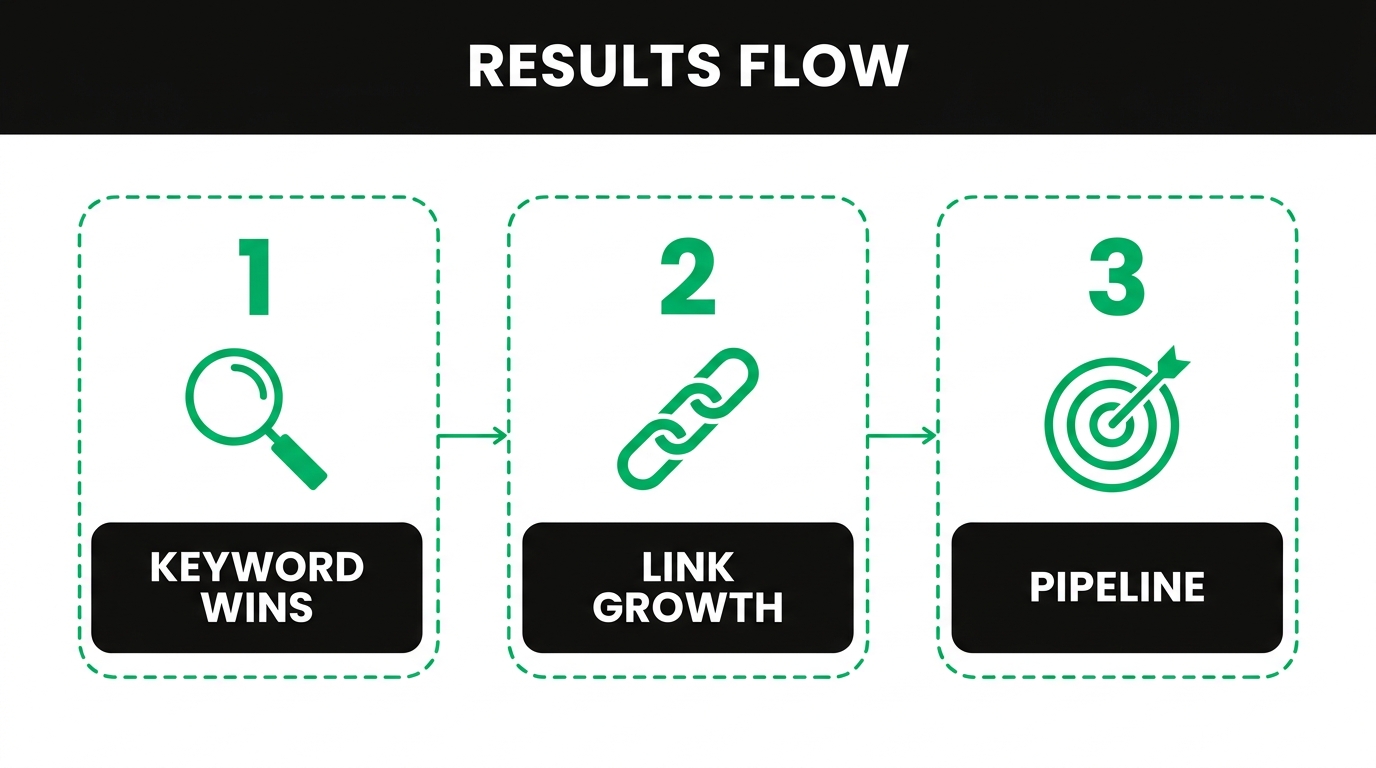
The proof points that separate real results from vanity metrics are pipeline-tied outcomes: RFQs generated, qualified leads attributed, closed revenue influenced, and customer acquisition cost change. Traffic growth alone is weak evidence. The Federal Trade Commission reinforces the standard, stating that advertising must tell the truth and not mislead consumers, and that a claim can be misleading if relevant information is left out. Ask agencies to show the metric behind the metric. If every case study leads with traffic and never with revenue, assume the rest is marketing.
How Do You Verify Case Study Claims?
You verify case study claims by asking for named client references, contacting those references directly, cross-checking traffic and link footprints in third-party tools, and requesting anonymized raw analytics exports when NDAs block names. Look for matched before-and-after screenshots with full date ranges, not cropped charts. When an agency resists verification, treat it as a disqualifier. Real results welcome scrutiny. For buyers comparing shortlists, a curated view of the best industrial seo agency for small business market shows how verified proof points should be presented.
What Client Retention and Review Signals Matter Most?
The client retention and review signals that matter most are average engagement length, renewal rate, named-client logo portfolio, and consistent public reviews across independent platforms. Short retention with frequent churn signals execution problems. The FTC's endorsement guidance is relevant here, since endorsements must reflect the honest opinions, findings, beliefs, or experience of the endorser. Scrutinize testimonials for specificity; generic praise is cheap. Tenure with recognizable clients, balanced reviews, and a transparent case-study library form the strongest signal.
What Red Flags Should Disqualify an SEO Agency Immediately?
The red flags that should disqualify an SEO agency immediately are guaranteed rankings, opaque pricing, punitive contract terms, and any tactic that violates Google's spam policies. This section breaks each category down.
Which Guarantees Should You Never Accept?
The guarantees you should never accept are guaranteed #1 rankings, guaranteed traffic numbers, guaranteed backlinks from named high-authority domains, and "priority submission" to Google. Any agency that promises otherwise is either ignorant of Google's operation or intentionally deceptive. Walk away from both. Credible partners commit to process, cadence, and effort level, not to specific SERP positions they cannot control.
What Pricing and Contract Terms Signal Trouble?
The pricing and contract terms that signal trouble are multi-year lockups without out-clauses, automatic renewals buried in fine print, prepayment demands beyond one quarter, ownership of content or links transferring to the agency, and punitive early-termination fees. Federal Trade Commission guidance makes clear that marketers have a legal obligation to ensure claims they make about products are truthful, not misleading, and substantiated by evidence. Read every clause before signing. Ask for 30-day or 60-day notice terms, shared IP ownership of produced assets, and a clear performance review gate at 90 and 180 days.
What Tactics Risk a Google Penalty?
The tactics that risk a Google penalty are paid link schemes, private blog networks, cloaking, keyword stuffing, doorway pages, and automated content farms. Google Search Essentials defines link spam as the practice of creating links to or from a site primarily for the purpose of manipulating search rankings, including buying or selling links for ranking purposes. If an agency's pitch includes "we have a network" or "we can buy placements," reject it. Penalty recovery consumes months; avoiding the tactic is free.
How Much Should You Expect to Pay for SEO Services?
You should expect to pay between two thousand and twenty thousand dollars per month for professional SEO services, depending on scope, competitive density, and technical depth. This section breaks down pricing models, cost drivers, and ROI timelines.
What Are the Common SEO Pricing Models?
The common SEO pricing models are monthly retainers, project-based fees, hourly consulting, and performance-based contracts. Retainers dominate the mid-market because they align capacity with ongoing work. Project fees fit audits, migrations, and one-time content builds. Hourly rates suit narrow consultations. Performance pricing tied to rankings is rarely healthy, since rankings depend on factors outside the agency's control. Industrial buyers can compare manufacturing seo agency pricing benchmarks across vendors before negotiating.
What Factors Influence Monthly Retainer Costs?
The factors that influence monthly retainer costs are site size, number of target markets, competitive density, content production volume, link acquisition velocity, and technical complexity. Manufacturing SEO Agency scopes engagements from five thousand to fifteen thousand dollars per month based on site size, number of manufacturing processes covered, and whether scope includes content, link building, technical SEO, or all three.
What Is the Realistic Timeline to See ROI?
The realistic timeline to see ROI from SEO is three to six months for early wins, six to twelve months for compounding traffic, and twelve to eighteen months for measurable revenue impact. Timeline depends on domain authority, content velocity, and technical health. Committing to a twelve-month engagement is usually the minimum honest horizon. Faster claims are not credible. Setting realistic expectations up front prevents the panic-driven contract terminations that ruin long-term SEO compounding.
How Do You Compare Specialist Agencies Against Generalist Agencies?
You compare specialist agencies against generalist agencies by weighing domain fluency, methodology depth, and client mix against breadth of service and cross-channel integration. This section covers what specialists offer, when generalists fit, and how to test domain fluency on a sales call.
What Does Industry Specialization Give You That Generalists Cannot?
Industry specialization gives you keyword libraries, content templates, and link-prospecting relationships that generalists cannot assemble inside one engagement. Specialists already know the process names, material grades, and certifications your buyers type into search. They avoid rookie mistakes in regulated sectors like aerospace and medical. For OEM buyers evaluating vertical focus, a grounding in what is oem seo shows how depth translates into faster results. Specialists ramp in weeks; generalists often spend quarters learning the vocabulary.
When Does a Generalist Agency Make Sense?
A generalist agency makes sense when your business crosses multiple verticals, when you need integrated paid, social, and SEO work under one roof, or when your domain is too narrow to support a dedicated specialist. Generalists bring structured processes, senior strategists, and broad cross-channel pattern recognition. Broader rosters also suit companies that want a single vendor for website, CRM, and brand work. The trade-off is slower domain ramp and diluted specialist depth.
How Do You Assess Domain Fluency in a Sales Call?
You assess domain fluency in a sales call by asking specific, terminology-loaded questions the agency cannot bluff through. Ask them to explain your process tolerances, your certifications, and your competitors' ranking footprints without a script. Request a live keyword walkthrough of one procurement query. Agencies with real domain fluency answer in your language; generalists pivot to "we learn your industry in the first 30 days." For industrial buyers building a selection rubric, a checklist on how to choose an industrial seo agency codifies these tests into a scorecard you can bring to every call.
How Do You Structure the Final Decision and Onboarding?
You structure the final decision and onboarding by grading proposals against a weighted rubric, negotiating contract protections up front, and sequencing the first ninety days for rapid value. This section covers proposal anatomy, contract negotiation, and onboarding sequencing.
What Should a Good SEO Proposal Include?
A good SEO proposal should include a diagnosis of current performance, a prioritized opportunity map, a scope-of-work with hours and deliverables, a 90- and 180-day milestone plan, a clear reporting cadence, a named team roster, and pricing with line-item transparency. Weak proposals hide hours inside "strategy" buckets. Federal Acquisition Regulation 15.101 frames the procurement standard well, defining best value continuum as a source selection process that includes cost or price and other non-cost factors. Apply that lens: cost is one input, not the input. Insist on measurable 90-day outcomes.
What Contract Terms Should You Negotiate?
The contract terms you should negotiate are notice period, out-clauses after milestone reviews, IP ownership of content and links, confidentiality, performance review gates at 90 and 180 days, and data portability at exit. Shorter notice periods, documented handoff obligations, and shared IP protect you if the engagement underperforms. U.S. General Services Administration guidance underscores the principle, noting that procurement professionals should conduct due diligence on vendors, including review of past performance, financial stability, and references, before contract award. Build those due-diligence findings directly into contract language.
How Should the First 90 Days Be Structured?
The first 90 days should be structured into three phases: discovery and audit in weeks 1 through 4, quick-win execution and content buildout in weeks 5 through 8, and measurement-and-adjustment in weeks 9 through 12. Kickoff requires access handoffs, baseline metrics capture, and stakeholder mapping. Quick wins typically include technical fixes, schema implementation, and high-intent content. Measurement at week 12 validates whether the partnership is on track. Early proof points in quarter one set the tone for the compounding timeline SEO requires.
How Should You Approach Agency Selection With Manufacturing SEO Agency?
You approach agency selection with Manufacturing SEO Agency by applying the vetting framework in this guide to an industrial-only specialist rather than a generalist shop. Manufacturing SEO Agency focuses exclusively on B2B manufacturers, which changes the diligence questions you should prioritize, the proof points you should demand, and the reporting cadence you should expect.
How Can Manufacturing SEO Agency Support Industrial Buyers Choosing an SEO Partner?
Manufacturing SEO Agency is an industrial seo agency that supports buyers choosing an SEO partner by bringing procurement-intent keyword architecture, topical authority buildout, PR-grade editorial link building, technical SEO remediation, AI search visibility engineering, and CRM-integrated revenue-tied reporting to every engagement. Manufacturing SEO Agency serves CNC machining, injection molding, metal fabrication, aerospace, medical, automotive, and other regulated industries where certifications gate buying decisions. Manufacturing SEO Agency ties organic rankings to actual RFQs and closed revenue, not vanity keyword positions. Engagements start at five thousand dollars per month and reach fifteen thousand dollars per month for multi-facility enterprise operations. For deeper vendor due diligence, Manufacturing SEO Agency's manufacturing seo competitor analysis service reverse-engineers every competitor ranking above the client.
What Are the Key Takeaways About Choosing the Right SEO Agency We Covered?
The key takeaways about choosing the right SEO agency are simple. Define what a real agency does, expect itemized deliverables, and know the roles touching your account. Treat the decision as revenue-critical, because bad engagements damage rankings and pipeline for months. Hire an agency when scale, specialization, or speed justify it. Ask hard questions about track record, process, reporting, and ownership. Verify case studies against pipeline outcomes, not traffic. Disqualify any vendor promising guaranteed rankings or using spam tactics. Budget realistically, compare specialists to generalists on domain fluency, and structure the final decision with a rubric, protective contract terms, and a disciplined ninety-day onboarding plan.