
Improving manufacturing website conversion rate means turning more procurement-intent visitors into RFQs by aligning capability content, form design, page experience, and measurement with how engineers and purchasing managers actually buy. We approach it as a disciplined system that connects diagnosis, optimization, experimentation, and revenue-tied reporting.
This guide covers what manufacturing conversion rate is and why it matters, how to diagnose conversion bottlenecks, capability and service page optimization, RFQ form design, page speed and Core Web Vitals, conversion-focused content and messaging, A/B testing for industrial traffic, personalization for different buyer types, measurement and reporting, common mistakes that erode conversions, and how to execute improvements alongside Manufacturing SEO Agency.
The definition section grounds conversion in industrial reality, where the macro conversion is usually a qualified RFQ tied to a specific process, material, and certification.
Diagnosis, capability page optimization, and form design form the operational core because most manufacturing sites lose conversions to friction inside these three surfaces.
Page speed, Core Web Vitals, content and messaging, and A/B testing compound those gains by removing technical friction and validating which changes actually move RFQ rate.
Personalization and measurement close the loop by matching the right experience to each buyer type and tying every form fill back to pipeline and closed revenue.
Common mistakes and the bridge to Manufacturing SEO Agency cover the failure patterns to avoid and how a manufacturing-only program executes the system end to end.
What Is Manufacturing Website Conversion Rate and Why Does It Matter?
Manufacturing website conversion rate is the percentage of site visitors who complete a defined business action, most often submitting an RFQ. The sub-sections below define the metric for industrial B2B sites, list what counts as a conversion, compare industrial benchmarks, and explain why conversion lift outpaces traffic growth.
How Is Manufacturing Website Conversion Rate Defined for Industrial B2B Sites?
Manufacturing website conversion rate is defined for industrial B2B sites as the share of unique sessions that complete a tracked goal, calculated as conversions divided by sessions multiplied by 100. The most common macro conversion is a qualified RFQ form submission tied to a specific process, material, certification, or tolerance. Micro-conversions also count: spec-sheet downloads, capability video plays, calculator use, and engineer-targeted email signups.
What Counts as a Conversion on a Manufacturing Website?
What counts as a conversion on a manufacturing website depends on buyer stage, but typically includes a stack of macro and micro events. There are six conversion types most industrial sites should track: RFQ submissions, contact form submissions, capability spec-sheet downloads, certification PDF downloads, capability video completions, and qualified phone calls tied to a tracked number. Treat the RFQ as the macro conversion that drives revenue forecasting. Treat the rest as leading indicators that show where buyers self-educate before requesting a quote. Foundational context on how do manufacturers get leads online maps each event to a buyer stage.
How Do Manufacturing Conversion Rates Compare to Other B2B Benchmarks?
Manufacturing conversion rates compare to other B2B benchmarks at a lower median because the buying group is larger and the sales cycle is longer.
Industrial sites that hit 1.5% to 3% conversion on capability pages typically outperform peers. Comparing yourself only to ecommerce or SaaS benchmarks distorts the picture and pushes teams to chase the wrong metric.
Why Does a Higher Conversion Rate Drive More Manufacturing Pipeline Than More Traffic?
A higher conversion rate drives more manufacturing pipeline than more traffic because each procurement-intent session is comparatively scarce and expensive to acquire.
Doubling RFQ rate on the same traffic doubles pipeline without doubling SEO spend. That math is why conversion is the leverage point for most industrial programs and why speed gains and conversion gains should be tracked as one system.
How Do You Diagnose Conversion Bottlenecks on a Manufacturing Website?
You diagnose conversion bottlenecks on a manufacturing website by combining a structured audit, behavior analytics, journey mapping, and a checklist of common industrial conversion killers. The sub-sections below walk through each diagnostic layer in sequence.
How Do You Audit a Manufacturing Site for Conversion Friction?
You audit a manufacturing site for conversion friction by inventorying every capability, service, location, and product page, then scoring each for clarity of offer, RFQ accessibility, spec depth, page speed, and mobile usability. Start with a crawl, export the URL list, and tag each page with its primary procurement intent and conversion goal. Walk every capability page in mobile and desktop view as if you were a procurement engineer. Time the path from organic landing to RFQ submission and count clicks.
Which Analytics and Heatmap Tools Should Manufacturers Use to Spot Drop-Off?
The analytics and heatmap tools manufacturers should use to spot drop-off are GA4 for funnel and event tracking, Microsoft Clarity or Hotjar for session replay and heatmaps, Search Console for query and landing-page truth, and a CRM-connected dashboard for downstream pipeline.
Pair quantitative funnel data with qualitative replays. The best seo tools for b2b manufacturing shortlist covers complementary discovery tools.
How Do You Map the Procurement Buyer Journey to Specific Pages?
You map the procurement buyer journey to specific pages by aligning each Gartner buying job to one or more pages on your site, then assigning a primary CTA per page that matches the buyer's next decision.
Build a spreadsheet with columns for buying job, query intent, target URL, primary CTA, and downstream conversion event. Pages without a clear job assignment usually under-convert because nobody knows what action the buyer should take next.
What Common Conversion Killers Appear on Industrial Catalogs and Capability Pages?
The common conversion killers that appear on industrial catalogs and capability pages are buried CTAs, missing tolerances and certifications, generic stock imagery, slow load times on spec tables, contact forms with too many fields, and broken file uploads on RFQ pages. There are also subtler killers: vague capability headlines, no proof of compliance, and inconsistent units between pages. Score each capability page against this list during the audit. A page that fails three or more checks is a high-priority remediation target. Fixing the worst-performing 20% of pages typically lifts site-wide RFQ rate faster than a homepage redesign.
How Do You Optimize Capability and Service Pages for RFQ Conversions?
You optimize capability and service pages for RFQ conversions by combining specification depth, an engineer-friendly above-the-fold layout, certification and tolerance proof, and a stack of trust signals that reduce buyer risk. The sub-sections below detail each lever in order of conversion impact.
What Specification Detail Should a Manufacturing Capability Page Include?
The specification detail a manufacturing capability page should include covers process parameters, materials, tolerances, certifications, lead time, and example applications. There are seven detail blocks every capability page needs: process description with machine inventory, accepted materials with grades, achievable tolerances with numeric values, certifications with scope and issue dates, typical lead time, customer verticals served, and representative part photos. Procurement engineers reject pages that read like brochures. They scan for verifiable specifications they can quote in their internal RFQ. Fuller specification depth also supports broader visibility; pair it with how to improve industrial website ranking tactics for compounding gains.
How Should You Structure a Capability Page Above the Fold for Engineers?
You should structure a capability page above the fold for engineers by leading with a process-and-material headline, listing three to five proof bullets, and placing a visible RFQ CTA within the initial viewport. The headline should answer "what do you make and what can you make it from" in eight to twelve words. The proof bullets should cover certifications, tolerances, lead time, and an example part photo.
How Do You Use Certifications, Tolerances, and Materials as Conversion Proof?
You use certifications, tolerances, and materials as conversion proof by displaying them as structured facts on the page, not buried in PDFs or footers. List each certification with its standard, scope, and issue date. Display achievable tolerances with numeric values and units (for example, plus or minus 0.0005 inches). List materials by grade and condition (for example, Inconel 718 solution annealed). Include a downloadable certificate of conformance template so buyers see proof before they request a quote. Procurement teams shortlist suppliers on these three attributes more than on price or marketing copy, so making them scannable is the single highest-leverage capability-page change.
What Trust Signals Increase RFQ Submission on Manufacturing Sites?
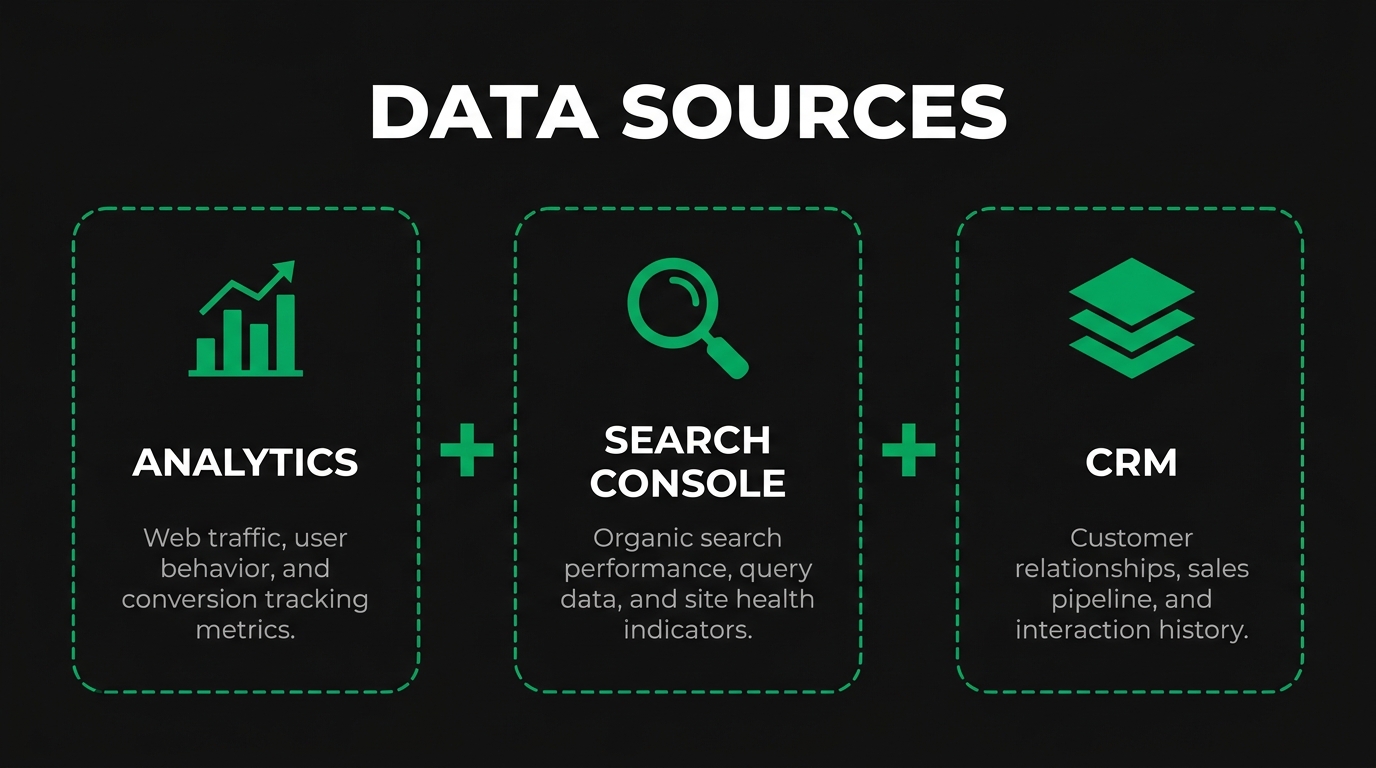
The trust signals that increase RFQ submission on manufacturing sites are visible certifications, named customer logos, photos of real shop-floor equipment, named engineering leadership, third-party audit links, customer quotes with role and vertical, and clear NAP details for each facility.
There are five must-have signals: an on-page certifications block, three to five named customer logos, a real shop-floor hero photo, a named engineering or quality lead, and a NAP block tied to LocalBusiness schema. Robust trust signals turn a cold capability page into a credible shortlist candidate.
How Do You Design Manufacturing RFQ Forms That Actually Convert?
You design manufacturing RFQ forms that actually convert by collecting only the fields needed to qualify and quote, supporting CAD and drawing uploads, and choosing the form pattern (multi-step versus single-page) that fits buyer effort and quote complexity. The sub-sections below cover field selection, length thresholds, attachments, and pattern choice.
What Form Fields Should a Manufacturing RFQ Form Include?
The form fields a manufacturing RFQ form should include are name, work email, company, phone, process or capability needed, material, target tolerance, target lead time, expected annual volume, and optional file upload.
Manufacturing RFQs should follow the same discipline. Eight to ten fields is the sweet spot. Strip anything that does not directly affect quote feasibility. Move long-tail discovery questions (industry, role, project stage) to a follow-up email rather than blocking the form submit.
How Many Fields Are Too Many for an Industrial Quote Request?
Too many fields for an industrial quote request usually starts above twelve fields, where completion rate drops sharply on mobile. There are three thresholds to plan against: under eight fields is friction-light and best for first-time visitors, eight to twelve is acceptable when each field gates a real quote dimension, and over twelve is risky unless the buyer is already deep in evaluation.
How Do File Uploads, CAD, and Drawing Attachments Affect Form Completion?
File uploads, CAD, and drawing attachments affect form completion in two ways: they raise upfront effort but signal a higher-quality lead when present. Make uploads optional, accept the most common formats (STEP, IGES, STL, DWG, DXF, PDF), and cap individual file size around 50 MB with a clear progress indicator. Reassure buyers about NDA handling with a one-line confidentiality note next to the upload field. Strategic teams often pair upload-enabled forms with improving lead quality in manufacturing practices to score and route attached-drawing leads first. Drawings shorten the back-and-forth required to issue a quote, so faster RFQ replies compound the conversion lift.
How Should You Handle Multi-Step Quote Forms Versus Single-Page Forms?
You should handle multi-step quote forms versus single-page forms by matching pattern to perceived effort and quote complexity. Multi-step works when the form has more than ten fields, conditional logic, or different paths for one-off prototypes versus production runs. Single-page works when the form has eight or fewer fields and the buyer is on a focused capability page.
Show a progress bar on multi-step forms so buyers know how close they are to finishing.
How Do You Improve Page Speed and Core Web Vitals to Lift Conversions?
You improve page speed and Core Web Vitals to lift conversions by tightening LCP on capability heroes, reducing INP on interactive elements, eliminating layout shift on spec tables, and tuning mobile performance for engineer and buyer traffic. The sub-sections below detail the levers in priority order.
How Does Page Load Time Affect Manufacturing Lead Conversion?
Page load time affects manufacturing lead conversion by directly altering the probability that a buyer waits long enough to scan capability detail and reach the RFQ form.
Industrial buyers see similar abandonment patterns. Each extra second on a capability page measurably reduces the share of sessions that reach the form. Speed is conversion infrastructure, not a vanity metric.
What Core Web Vitals Most Influence Industrial RFQ Completion?
The Core Web Vitals that most influence industrial RFQ completion are LCP for first-paint trust, INP for form responsiveness, and CLS for spec-table stability.
On industrial pages, INP usually slips on heavy form components, third-party chat widgets, or analytics tags. Audit each capability page with PageSpeed Insights, prioritize fixes that reduce INP under 200 ms and LCP under 2.5 s, and re-test on real mobile devices, not just desktop emulators.
How Do You Optimize Heavy Catalogs, CAD Previews, and Spec Tables for Speed?
You optimize heavy catalogs, CAD previews, and spec tables for speed by lazy-loading off-screen content, serving images in WebP or AVIF, using a CDN, and rendering large spec tables progressively rather than all at once. Compress hero photography aggressively. Replace inline CAD with a lightweight viewer that loads on demand rather than on page load. Server-render spec tables so search engines see the data and users get a fast first paint.
How Should Mobile Performance Be Tuned for Engineer and Buyer Traffic?
Mobile performance should be tuned for engineer and buyer traffic by treating mobile as the dominant device for first contact and for shop-floor lookups.
Use a responsive layout, defer non-critical JavaScript, inline critical CSS, and test the RFQ form on real mid-tier Android devices. Mobile RFQ completion is usually the lowest-converting funnel segment on industrial sites, so improving it generally produces the largest absolute conversion lift.
How Do You Use Content and Messaging to Convert Industrial Buyers?
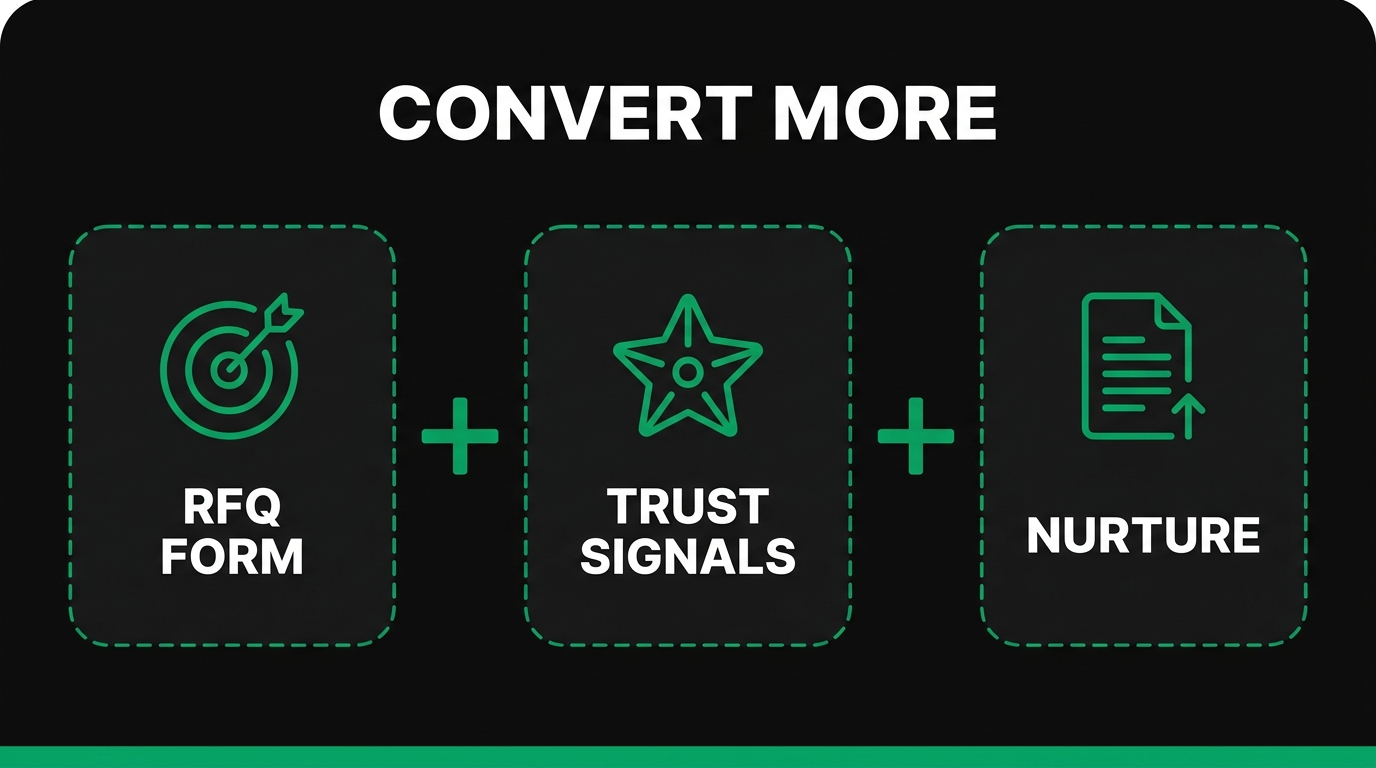
You use content and messaging to convert industrial buyers by writing headlines that name the process and material, matching copy to procurement stage intent, deploying case studies as social proof, and using technical assets (whitepapers, datasheets, calculators) as conversion tools. The sub-sections below break down each lever.
What Headline and Value Proposition Patterns Work for Manufacturing Pages?
The headline and value proposition patterns that work for manufacturing pages name the process, material, and a differentiating credential in eight to twelve words.
Use patterns like "Process X for Material Y, Certified to Z." Add a sub-headline naming a tolerance, lead time, or vertical served. Skip empty modifiers like "premium," "world-class," or "innovative." Engineers reward concrete capability claims with longer page time and higher RFQ rate.
How Do You Match Page Copy to Procurement Stage Intent?
You match page copy to procurement stage intent by aligning each page to one Gartner buying job and writing copy that resolves that job, not the next one. Awareness pages explain the process or problem. Consideration pages compare options and list capabilities. Decision pages display certifications, lead time, and the RFQ form prominently.
Pair each page with a primary CTA that matches stage intent. Many teams formalize this with lead generation strategies for b2b manufacturing playbooks that map content type to funnel stage.
How Do Case Studies and Application Stories Move Buyers to Quote?
Case studies and application stories move buyers to quote by giving procurement teams a relevant precedent they can show their internal stakeholders. Each case study should name the customer (with permission) or the vertical, specify the process and material, list the tolerance achieved, mention any relevant certification, and quantify the outcome.
Case studies are the single most effective long-form format for industrial CRO because they pre-answer the validation questions a buying group raises internally.
How Should Technical Whitepapers, Datasheets, and Calculators Be Used as Conversion Assets?
Technical whitepapers, datasheets, and calculators should be used as conversion assets by gating them behind a short form (three to four fields) and routing the resulting leads into nurturing, not directly into sales. Whitepapers work for awareness and consideration. Datasheets work for shortlisting. Calculators (cost, weight, lead time) work for active selection because they create a small commitment that qualifies the buyer. Place these assets on capability pages near the spec block, not behind a separate "Resources" tab. Each asset should have a unique tracked URL so attribution to the originating procurement page survives downstream pipeline analysis.
How Do You Run A/B Testing and Conversion Experiments on a Manufacturing Site?
You run A/B testing and conversion experiments on a manufacturing site by prioritizing high-traffic, high-intent pages, calculating realistic sample sizes for limited industrial traffic, focusing tests on elements with the largest expected effect, and documenting every winning experiment for repeatable rollout. The sub-sections below detail each step.
What Should You A/B Test First on a Low-Traffic Industrial Site?
What you should A/B test first on a low-traffic industrial site is the highest-traffic capability page's hero section, primary CTA, and form length, because those elements move conversion the most per unit of test traffic. There are five elements that usually deserve the first wave of tests: the hero headline, the above-the-fold CTA copy, the number of form fields, the trust-signal block, and the spec-table format.
The same prioritization logic applies to other small-site programs documented in seo for small manufacturing companies.
How Do You Calculate Statistical Significance With Limited Manufacturing Traffic?
You calculate statistical significance with limited manufacturing traffic by using a sequential testing framework rather than waiting for a fixed-sample-size cliff.
Plan tests around minimum detectable effect. For industrial sites with under 5,000 monthly sessions on a page, target an MDE of 15% or larger. Smaller effects exist but require months of traffic to confirm and are usually not worth the lost test slots.
Which Page Elements Move the Needle Most in Industrial CRO?
The page elements that move the needle most in industrial CRO are the hero headline, the primary CTA placement, the form field count, and the trust-signal block above the fold. There are four levers that consistently drive double-digit conversion lift in industrial tests: a process-and-material-led headline replacing a brand-led one, an in-hero RFQ CTA replacing a "Contact Us" link, removing two to three non-essential form fields, and adding three to five named customer logos near the form. Test each lever in isolation. Combination tests confound attribution and slow learning. Stack the winners into the next page template once each is validated independently.
How Do You Document and Roll Out Winning Conversion Experiments?
You document and roll out winning conversion experiments by maintaining an experiment log with hypothesis, change, baseline, variant, sample size, lift, statistical confidence, and rollout decision. Apply each winner to the page template, then propagate to similar capability pages in priority order. Run a follow-up validation test on the second page to confirm the lift replicates across different traffic mixes. There are four log fields that matter most for replication: the exact change made, the page type tested, the lift observed, and the rollout date. Disciplined experiment documentation turns one-off wins into a compounding conversion program rather than scattered anecdotes.
How Do You Personalize the Manufacturing Website Experience for Different Buyers?
You personalize the manufacturing website experience for different buyers by segmenting traffic by industry, process, and role, serving dynamic content to returning visitors, layering account-based marketing tactics on top of organic, and tailoring the experience for distributors, resellers, and OEM audiences. The sub-sections below explain each personalization layer.
How Do You Segment Manufacturing Traffic by Industry, Process, and Role?
You segment manufacturing traffic by industry, process, and role by combining first-party signals (URL path, referring page, form input) with enrichment data (firmographics, IP-based industry detection).
Build segments around your top three customer verticals, your top three processes, and the buyer roles that submit RFQs (engineer, purchasing, plant manager). Tag each session with its segment in GA4. Route capability-page variants and CTAs based on segment to lift conversion rate without rewriting every page.
What Dynamic Content Should an Industrial Site Show to Returning Buyers?
The dynamic content an industrial site should show to returning buyers includes recently viewed capability pages, customer logos most relevant to their inferred vertical, a contextual CTA tied to their last action, and any open quote in progress.
Personalization that genuinely helps the returning buyer also signals quality to ranking systems. Avoid surfacing dynamic content that feels surveillance-driven; show practical context that shortens the path to a quote rather than reminding the buyer they were tracked.
How Do Account-Based Marketing Tactics Improve Manufacturing Conversion?
Account-based marketing tactics improve manufacturing conversion by aligning website experience, sales outreach, and ad targeting around a defined list of high-value accounts. Use IP-based or reverse-DNS detection to identify visitors from named target accounts, then surface tailored capability examples, case studies from similar verticals, and a direct line to a named account engineer.
Pair ABM with strong organic visibility so target accounts can find the site naturally before sales reaches out.
How Should You Handle Distributor, Reseller, and OEM Audiences on the Same Site?
You should handle distributor, reseller, and OEM audiences on the same site by giving each audience a clearly labeled entry point, a distinct CTA, and content depth tuned to their decision stage. There are three handling patterns: a top-nav segment switcher with three labeled paths, dedicated landing pages per audience with parallel capability information, and dynamic CTAs that change based on referring source. Avoid burying audience splits inside a single contact form; that mixes lead types and corrupts attribution. Many sellers separate these audiences cleanly with the model documented in contract manufacturing vs custom manufacturing seo. Clean audience routing lifts conversion for each segment independently.
How Do You Measure and Report Manufacturing Website Conversion Rate?
You measure and report manufacturing website conversion rate by tracking a focused KPI stack, tying form submissions to pipeline and closed revenue, choosing tools that fit industrial use cases, and reviewing conversion targets on a fixed cadence. The sub-sections below walk through each requirement.
Which KPIs Should Manufacturers Track Beyond Raw Conversion Rate?
The KPIs manufacturers should track beyond raw conversion rate are RFQ-to-MQL rate, MQL-to-SQL rate, SQL-to-opportunity rate, opportunity-to-closed-won rate, average quote value, and time-to-quote. There are six metrics that matter most: RFQ submissions per page type, RFQ-to-opportunity conversion, average opportunity value sourced from organic, time from form submit to first sales touch, win rate on organic-sourced opportunities, and revenue closed per ranked keyword.
Teams often benchmark this against how to measure website conversion rate for the underlying formula and KPI definitions.
How Do You Tie Form Submissions to Pipeline and Closed Revenue?
You tie form submissions to pipeline and closed revenue by passing organic session attribution through your CRM, tagging each RFQ with landing page and referring keyword, and reporting opportunity and closed-won revenue by source. Connect Google Search Console, GA4, and your CRM (HubSpot, Salesforce, or a manufacturing ERP) with consistent UTM and source fields.
Build a dashboard that traces ranking to impressions to clicks to RFQs to pipeline to closed revenue.
What Tools Best Fit Manufacturing Conversion Rate Reporting?
The tools that best fit manufacturing conversion rate reporting are GA4 for behavior and conversion tracking, Search Console for query and landing-page truth, Microsoft Clarity or Hotjar for session replay, a CRM-connected BI layer for pipeline reporting, and a server-side tag manager for clean event capture. Use Looker Studio or a lightweight warehouse to blend Search Console, GA4, and CRM into a single industrial conversion dashboard. Prioritize the handful of capability pages that drive RFQs over hundreds of secondary pages. Dashboards should answer one operational question: which capability pages produced pipeline this month, and which fell.
How Often Should Manufacturers Review and Recalibrate Conversion Targets?
Manufacturers should review and recalibrate conversion targets monthly for tactical adjustments, quarterly for full funnel review, and annually for strategic resets aligned with sales planning. There are four triggers that force an off-cycle review: a Google core algorithm update affecting top capability pages, a CRM platform change, a redesign or migration, and any sustained shift in lead quality reported by sales.
Maintain a conversion log with dated baselines, change events, and observed lift.
What Mistakes Most Often Hurt Manufacturing Website Conversion Rates?
The mistakes that most often hurt manufacturing website conversion rates are generic contact forms, vague capability copy, broken navigation and architecture, and slow response times paired with weak confirmation pages. The sub-sections below explain each failure pattern and how to fix it.
Why Do Generic Contact Forms Underperform on Industrial Sites?
Generic contact forms underperform on industrial sites because they pool unqualified inquiries with serious procurement requests, slow sales response, and fail to gather the specs needed to price a quote. A "How can we help?" textarea wastes the buyer's effort and yours. Replace it with an RFQ-specific form on capability pages that asks for process, material, tolerance, target quantity, and lead time. Keep a generic contact form for non-procurement inquiries (careers, partnerships, press) on a dedicated page. Splitting these two paths typically lifts qualified-lead rate by a meaningful margin because each form gathers exactly what its audience expects to provide.
How Does Vague Capability Copy Lose Engineer Trust and Quote Requests?
Vague capability copy loses engineer trust and quote requests by signaling that the supplier cannot speak the buyer's technical language. A page that says "We provide world-class machining solutions" without listing achievable tolerances, accepted materials, or certifications fails the procurement scan.
Replace marketing platitudes with verifiable specifications: machine inventory with travel and accuracy, certification scope with issue dates, tolerances with numeric values, and applications by customer vertical. The same discipline applies to small operators documented in seo for small manufacturing companies.
What Navigation and Architecture Mistakes Block RFQ Submission?
The navigation and architecture mistakes that block RFQ submission are deeply nested capability menus, missing breadcrumbs, sticky headers that hide the CTA on mobile, and "Quote" links that resolve to a generic contact page.
There are four architecture rules to enforce: every capability page must be reachable in three clicks from the homepage, every capability page must have a visible RFQ CTA above the fold, every capability page must link to its sibling capabilities, and every facility page must link to the relevant capabilities.
How Do Slow Response Times and Weak Confirmation Pages Erode Conversion?
Slow response times and weak confirmation pages erode conversion by breaking the buyer's momentum at the moment of highest intent. A submitted RFQ that gets a generic "Thanks, we'll be in touch" page and no email for forty-eight hours signals that the supplier is not ready to quote.
Replace the default confirmation with a page that names the engineer who will reply, sets a response-time expectation (four business hours is a common target), links to relevant case studies, and offers a calendar booking link.
How Should You Approach Manufacturing Website Conversion Improvements with Manufacturing SEO Agency?
You should approach manufacturing website conversion improvements with Manufacturing SEO Agency by pairing procurement-intent SEO with manufacturing seo reporting and analytics so every conversion gain ties to RFQ volume and closed revenue. The sub-sections cover practice and key takeaways.
Can Manufacturing SEO Agency's Revenue-Tied Reporting Improve Your Manufacturing Website Conversion Rate?
Yes, Manufacturing SEO Agency's revenue-tied reporting can improve your manufacturing website conversion rate by connecting every form submission to a tracked CRM record so the team can identify which capability pages, processes, and queries actually produce pipeline. Manufacturing SEO Agency serves U.S.-based B2B manufacturers in CNC machining, injection molding, metal fabrication, additive, aerospace, automotive, medical, and other regulated verticals. Manufacturing SEO Agency combines audits, procurement-intent keyword architecture, topical authority buildout, technical remediation, PR-grade editorial links, AI search visibility, and revenue-tied reporting into one program.
What Are the Key Takeaways About Improving Manufacturing Website Conversion Rate We Covered?
The key takeaways about improving manufacturing website conversion rate we covered are listed below:
- Define conversion as a qualified RFQ tied to a specific process, material, certification, and tolerance, not as raw form fills.
- Diagnose bottlenecks with a structured audit, GA4 plus session replay, journey mapping per Gartner buying job, and a checklist of common industrial conversion killers.
- Optimize capability pages with deep specification detail, an engineer-friendly above-the-fold layout, and visible certification, tolerance, and material proof.
- Design RFQ forms that collect only what is needed to quote (eight to ten fields), accept CAD and drawing uploads, and choose multi-step versus single-page based on field count.
- Treat page speed and Core Web Vitals as conversion infrastructure: tighten LCP, reduce INP under 200 ms, eliminate layout shift, and tune mobile performance for engineer traffic.
- Match content to procurement stage intent and use case studies, datasheets, and calculators as conversion assets rather than passive resources.
- Run disciplined A/B tests on hero headlines, CTAs, form length, and trust signals using sequential testing and a 95% significance level.
- Personalize by industry, process, and role; serve dynamic content to returning buyers; and route distributor, reseller, and OEM audiences cleanly.
- Measure beyond raw conversion rate by tying form submissions to pipeline and closed revenue with GA4 attribution and CRM integration.
- Avoid generic contact forms, vague capability copy, broken navigation, and slow follow-up that erode conversion at the moment of highest buyer intent.